Most beginner guides give you ten steps and a pat on the back. Then you open a brokerage app, stare at 8,000 tickers, and close it again.
So let’s do this differently. This guide uses one idea: split your money into a boring Core and a small Curiosity bucket. The Core does the heavy lifting. The Curiosity bucket scratches the “I want to pick a stock” itch without wrecking your future.
By the end, you’ll know where to open an account, what to buy first, how much you actually need, and how to spot risk before it finds you.
How to Invest in Stocks in 2026
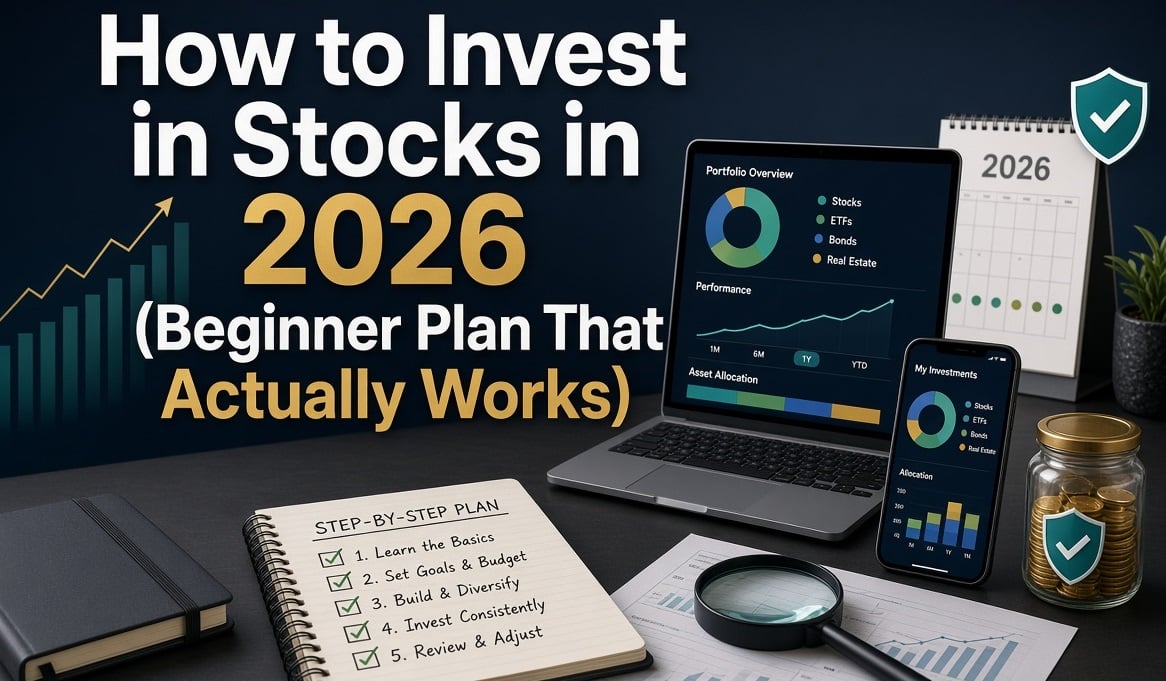
- Decide what the money is for and when you’ll need it.
- Open a brokerage account (or an IRA if it’s retirement money).
- Fund it with whatever you can comfortably spare.
- Buy a broad, low-cost index fund first. That’s your Core.
- Automate a fixed monthly amount.
- Only then, give a small slice to individual stocks. That’s your Curiosity bucket.
That’s the whole game. The rest of this article is the “how” behind each line.
Why 2026 Is a Weird (and Useful) Time to Start
Commission fees are mostly gone, fractional shares are common, and you can start from a phone. That’s the good news.
The less comfortable news: headlines are loud. In recent weeks we’ve seen the Nasdaq hit records while Treasury yields climbed above 5%, AI stocks pulling back, and oil moving back above $100. If you’re new, that mix can feel like a reason to wait.
It usually isn’t. A steady plan is built to survive noisy markets. Our own 7 market indicators to watch heading into 2027 is a good companion read once you’re set up, but you don’t need to understand every indicator to begin.
Step 1: Get Clear on Your “Why” and Your Timeline
Before any ticker, answer two questions:
- When will I need this money? Under about 3 to 5 years, stocks are a risky home for it. Over 10 years, stocks have a long runway to recover from bad stretches.
- Do I have a cushion? Keep a few months of expenses in cash first, and think twice about investing while carrying high-interest debt. A 20%+ credit card rate can cancel out a lot of stock market gains.
If you want a broader foundation before narrowing to stocks, start with our beginner’s guide to how to start investing. And if you’re staring at a lump sum, questions to ask before investing new money in 2027 will save you from a few expensive mistakes.
Step 2: Where to Buy Stocks: Picking an Account
This is the “where to buy stocks” question people search for constantly, and the answer is simpler than it looks.
Taxable brokerage account. Flexible. Withdraw any time, pay taxes on gains and dividends.
IRA (Traditional or Roth). Retirement-focused with tax advantages. For 2026 the IRS limit is $7,500, or $8,600 if you’re 50 or older.
Workplace 401(k). If your employer matches, grab the match first. It’s free money. The 2026 employee limit is $24,500, with an $8,000 catch-up for ages 50+.
(Heads-up: some older guides still list the 2025 limits of $23,500 and $7,000. Double-check any number you see against the IRS.)
For the broker itself, look for no account minimum, low or zero commissions, fractional shares, and a clean mobile app. Our best brokerage for beginners breakdown compares the options. If you’re choosing between two big names, we’ve done head-to-heads: Robinhood vs Fidelity and Robinhood vs Schwab.
Can You Invest in Stocks Without a Broker?
Sort of. You can buy shares directly through some company programs, but options are limited and clunky. For most people, an online brokerage is cheaper and easier. We walk through the alternatives in how to buy stocks online without a broker, including the trade-offs.
Step 3: How Much Money Do You Need to Buy Stocks?
Less than you think. Many brokers have no minimum to open an account, and fractional shares let you buy a slice of a stock for a few dollars instead of the full price.
Is $100 Enough to Invest in Stocks?
Yes, to start. A $100 deposit can buy a slice of an index fund or several fractional shares. What $100 won’t do is change your life. Its real value is building the habit and learning how the platform works while stakes are low.
Is Buying $10 of Stock Worth It?
Financially, $10 won’t move the needle. Practically, it can be worth it as a practice run: place the order, see how fees and settlement work, and watch how a small position behaves. Just don’t let $10 become your entire plan. Move to a regular schedule as soon as you’re comfortable.
How Much Do You Need to Invest to Make $1,000 a Month?
Here’s the honest math. $1,000 a month is $12,000 a year. If your portfolio produced a 4% yearly income, you’d need roughly $300,000. At 3%, closer to $400,000. These are rough illustrations, not promises, and returns vary every year.
The more useful flip side: investing $300 a month at an assumed 7% average annual return for 20 years could grow to roughly $156,000. That assumption isn’t guaranteed, but it shows why time and consistency matter more than a big starting amount. If income is your goal, our guides on passive income streams and the covered call strategy show what each path really involves.
Step 4: Build Your Core (What to Buy First)
This is the answer to “which stock should I buy first?” and “what type of stock is best for beginners?”
For most beginners, the first purchase isn’t a single stock. It’s a broad index fund or ETF, such as an S&P 500 or total US market fund. One purchase gives you a slice of hundreds or thousands of companies, so one bad company can’t sink you.
What to look for:
- Low expense ratio. Broad index funds from major providers often charge well under 0.10% a year. Fees compound against you, just like returns compound for you. See how platform fees eat into your income and yield.
- Wide diversification. Hundreds of holdings beats a handful.
- Plain-English strategy. If you can’t explain it to a friend in one sentence, skip it for now.
Then automate it. A fixed amount on a fixed date, no matter what the market did this week. This is dollar-cost averaging, and its biggest benefit is behavioral: you stop trying to time things.
Step 5: Add Your Curiosity Bucket (How Do I Pick Stocks?)
Once your Core is running, you can set aside a small slice for individual stocks. A common rule of thumb is around 5% to 10% of your investable money, though that’s a preference, not a law.
Why a bucket? Because picking stocks is fun, and fun with a boundary is healthy. If a pick goes to zero, your plan survives.
A Simple Way to Pick Stocks
Before buying any single stock, answer four questions:
- What does this company actually sell, and who pays for it?
- Is it growing revenue, and is it profitable (or on a believable path to it)?
- How much debt does it carry?
- What would make me sell? Write the answer before you buy.
Learn to read the price action too. Our guide on how to read stock charts covers support, resistance, and volume without the jargon.
Which Stocks Are the Best to Buy Right Now? Which 3 Stocks Should I Buy Today?
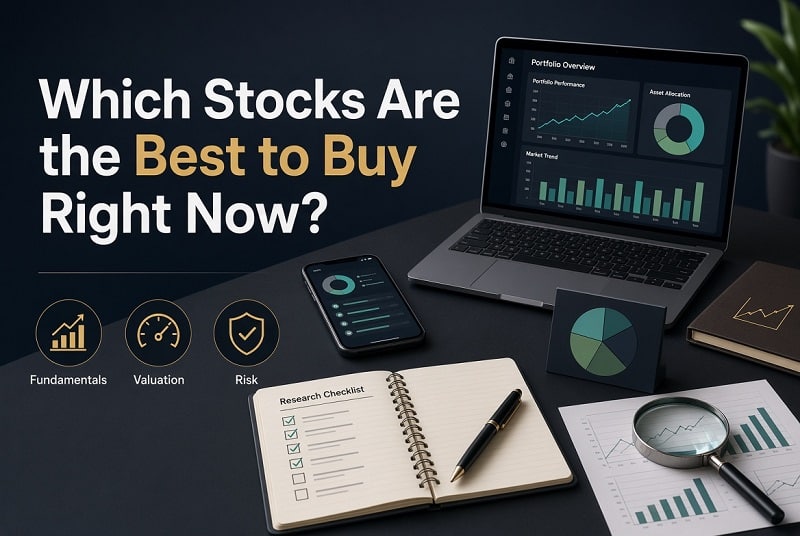
We’re not going to hand you a “top 3 today” list, and you should be wary of anyone who does without knowing your goals, timeline, and risk tolerance. A stock that’s right for a 25-year-old saving for retirement can be wrong for someone buying a house in two years.
What we can do is point you to research that shows the reasoning, so you can judge for yourself:
- Curious about tech and AI? Read AI semiconductor stocks and top cybersecurity stocks.
- Want a single-company deep dive? See our Amazon stock prediction and OpenAI stock in 2026 explainers.
- Interested in cyclical themes? Compare the best electric vehicle stocks or industrial automation stocks.
Treat these as homework, not instructions.
What Are the 5 Best Stocks to Own?
There’s no universal five. Instead of five names, aim for five qualities: businesses you understand, steady or growing cash flow, manageable debt, some spread across industries, and a price you aren’t overpaying for. A broad index fund gives you most of those automatically, which is why it anchors the Core.
Using AI Picks and Newsletters with a Small Portfolio
Stock-picking services can be useful idea generators, but they’re not a substitute for your own plan. If you try one, keep it inside your Curiosity bucket and read how to buy into AI stock picks safely with a small portfolio first. Our roundup of the best investment newsletters shows how to compare them without getting swept up by hype.
How Risky Is Stock Trading, Really?
Two different things get lumped together here:
- Long-term investing in diversified funds is volatile (prices bounce around) but historically has rewarded patience.
- Short-term trading of individual stocks is much riskier. Most beginners who trade frequently end up worse off than if they’d just held an index fund, once you factor in emotions, taxes, and timing mistakes.
Risk comes in a few flavors: market risk (everything drops), company risk (one business fails), and behavior risk (you panic-sell at the bottom). Of the three, behavior risk is the one you can control best, which is exactly why automation and a written plan matter.
Is Now a Good Time to Invest?
Nobody can reliably call the top or bottom, including professionals. A better question is: “Is my money going to sit here for 5, 10, or 20 years?” If yes, starting sooner usually beats waiting for a perfect moment.
If a big lump sum makes you nervous, spread it out over several months. You give up a little theoretical upside in exchange for sleeping better, and that’s a perfectly reasonable trade. Our piece on where you’d put $5,000 heading into 2027 walks through that decision.
Investing in Stocks at 13 or 14
Younger teens can’t open a brokerage account on their own, but they can still start with a parent or guardian. The usual routes are a custodial account (UTMA/UGMA) or, if the teen has earned income, a custodial Roth IRA. The adult manages it until the child reaches the age of majority. It’s a great way to learn: pick a company they know (a game maker, a sneaker brand) and watch it together.
How to Make Money Investing in Stocks (Realistically)
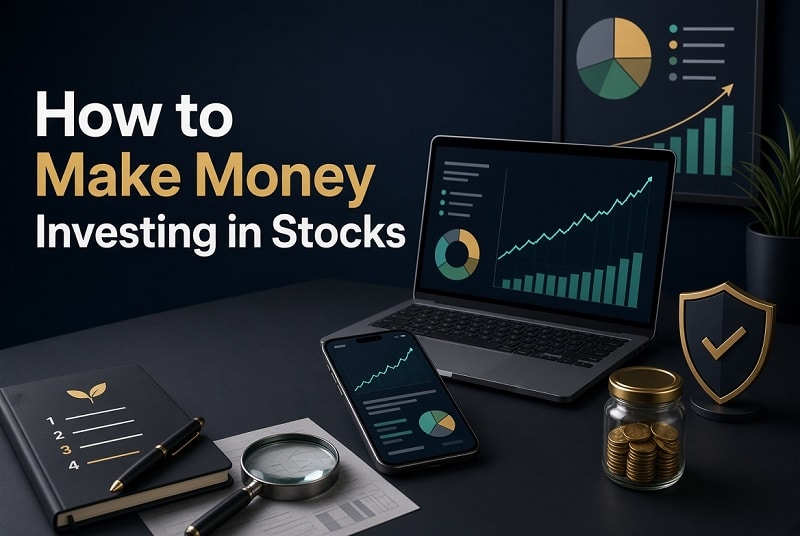
Stocks can reward you in two ways: price growth and dividends. Neither is fast. The pattern that works for most people is boring on purpose:
- Invest regularly.
- Keep costs low.
- Reinvest dividends while you’re building.
- Don’t sell in a panic.
- Rebalance once or twice a year.
As your portfolio grows, taxes start to matter. Learn how tax-loss harvesting works, and use our year-end checklist and 7 investing moves before the end of 2026 to tidy things up before January. It’s also worth skimming year-end investing mistakes that follow you into 2027.
Common Beginner Mistakes
- Chasing hot tips. If you heard it on social media, the move has probably already happened.
- Putting everything in one stock. Diversification isn’t optional.
- Investing money you’ll need soon. Rent and emergency money don’t belong here.
- Checking your balance daily. Volatility feels worse when you stare at it.
- Ignoring fees and taxes. Small percentages compound too.
Your First-Week Checklist
- Write down your goal and time horizon.
- Pick an account type (taxable, IRA, or both).
- Open it with a low-fee broker.
- Deposit an amount you won’t miss.
- Buy one broad index fund.
- Set an automatic monthly contribution.
- Decide your Curiosity bucket size, and stick to it.
FAQs
Is $100 enough to invest in stocks?
Yes. Many brokers have no account minimum and offer fractional shares, so $100 can buy a slice of an index fund or a few stocks. It won’t build wealth by itself, but it starts the habit and teaches you the platform with low stakes.
How much money do I need to buy stocks?
There’s no fixed minimum at most online brokers. You can begin with whatever you can comfortably spare, as long as it’s money you won’t need for bills or emergencies in the near term. Consistent monthly deposits matter more than the starting amount.
What type of stock is best for beginners?
Beginners usually do best starting with broad index funds or ETFs rather than single stocks, because they spread risk across many companies. If you buy individual stocks, stick to businesses you understand and keep them to a small share of your portfolio.
Is now a good time to invest?
No one can time the market reliably. If your money has a long horizon, starting now and investing steadily usually beats waiting. If a lump sum worries you, spread it across several months.
How risky is stock trading?
Short-term trading of individual stocks is high risk, and losses are common. Long-term investing in diversified funds is still volatile but has historically rewarded patience. You can lower risk by diversifying, avoiding borrowed money, and only investing funds you won’t need soon.
Conclusion
You don’t need to be an expert, and you don’t need a big pile of cash. You need an account, a broad fund, an automatic schedule, and a small, clearly-fenced bucket for your curiosity. Start there, stay consistent, and keep learning as you go.
Disclosure: This article is for educational purposes only and isn’t personalized financial, tax, or legal advice. Investing involves risk, including possible loss of principal. Consider speaking with a licensed financial professional about your situation. Contribution limits cited are 2026 IRS figures; verify current rules at IRS.gov.