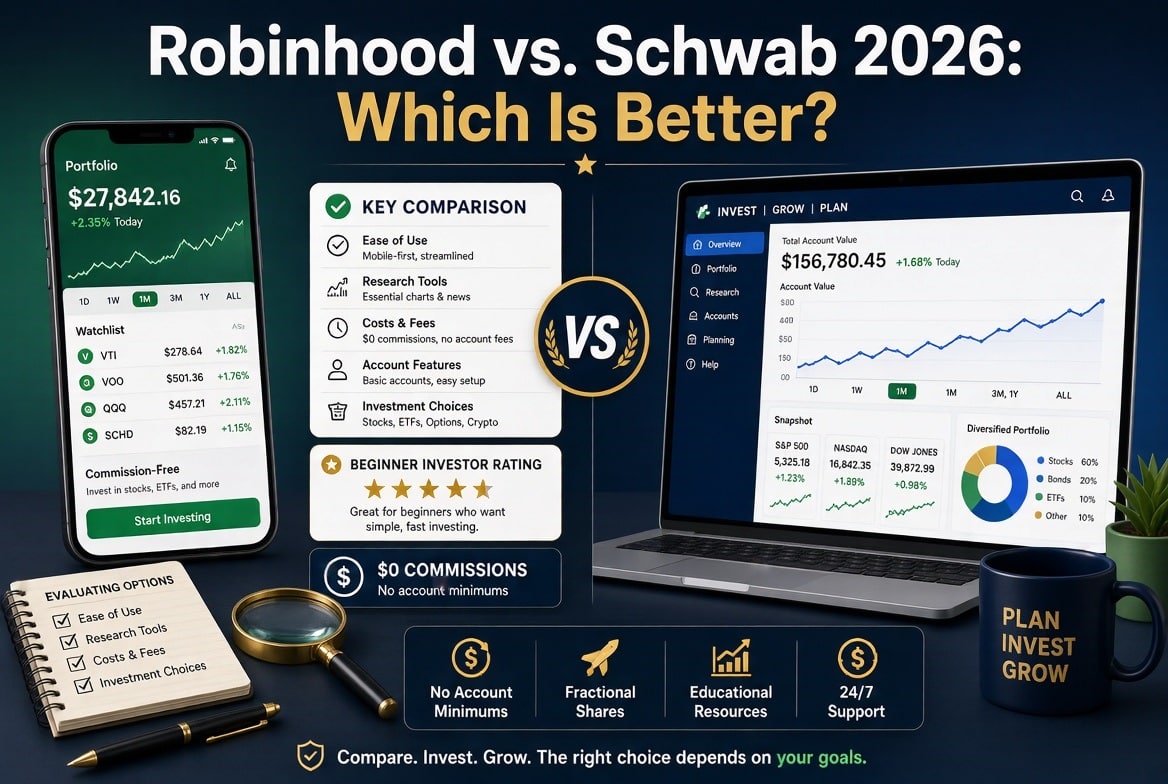
When deciding between Robinhood vs. Charles Schwab (or weighing Charles Schwab vs. Robinhood), you are fundamentally comparing two completely different investing philosophies. On one hand, Robinhood represents the mobile-first, high-yield fintech era designed for rapid execution, cash sweeps, and modern portfolio incentives. On the other, Charles Schwab stands as a traditional full-service powerhouse with vast research depth, institutional banking, and comprehensive asset management.
Whether you are evaluating is charles schwab good for long-term wealth building or looking at Robinhood to see where modern apps fall short, choosing the right platform requires looking past surface-level marketing. While both platforms offer commission-free stock and ETF trades, their core differences in idle cash yields, options pricing structures, retirement account matches, and trading desktop software reveal distinct advantages depending on your strategy.
Top Brokerage Comparison Matrix: Schwab vs. Robinhood at a Glance
To quickly compare Robinhood vs. Schwab across core operational parameters, here is a breakdown of how both brokers stack up:
| Feature / Metric | Robinhood (Gold Tier Focus) | Charles Schwab |
| Stock & ETF Commissions | $0 | $0 |
| Options Trading Fees | $0 per contract ($0.35/contract on Gold) | $0.65 per contract |
| Uninvested Cash Yield (APY) | ~3.35% – 4.5% (with Gold) | ~0.45% (Schwab Bank Sweep) |
| IRA Contribution Match | 1% standard / 3% with gold | 0% |
| Trading Desktop Software | Web App / Robinhood Legend | Thinkorswim Platform |
| Fractional Shares & DRIP | $1 minimum (all stocks/ETFs) | $5 minimum (Stock Slices: S&P 500 only) |
| Research & Customer Care | Morningstar (Gold), 24/7 Chat/Call-Back | Morningstar, CFRA, Argus, 24/7 Phone & Branch |
| Account Variety | Individual, Roth/Trad IRA, Crypto | Full-service (529s, Custodial, Trusts, Checking) |
For investors looking for low-cost platforms to kickstart their wealth journey, reviewing the best brokerage for beginners reveals how both these brokers eliminate standard barriers to entry while taking vastly different paths to monetization.
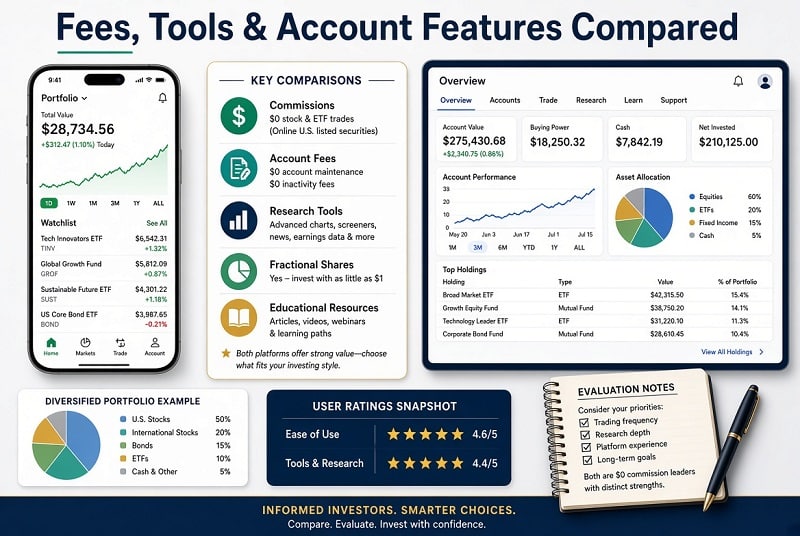
Charles Schwab Account Types vs. Robinhood Features
When comparing schwab account types with Robinhood’s financial product lineup, account diversity remains a primary point of divergence.
1. Charles Schwab Account Variety (Full-Service Depth)
Charles Schwab functions as a complete financial institution. Beyond standard individual brokerage accounts, Schwab provides:
- Retirement Accounts: Traditional, Roth, Rollover, SEP, and SIMPLE IRAs.
- Education Savings: Robinhood 529 plans do not exist in traditional formats, but Schwab offers fully managed 529 College Savings Plans and Coverdell ESAs.
- Custodial & Trust Accounts: UGMA/UTMA accounts for minors and complete trust management.
- Banking Integration: Schwab Bank high-yield checking accounts featuring unlimited ATM fee rebates worldwide.
2. Robinhood Account Structure & Modern Add-Ons
Robinhood focuses heavily on individual retail investors and crypto enthusiasts. Its account ecosystem includes:
- Individual taxable brokerage accounts.
- Retirement IRAs (traditional & Roth) featuring direct contribution matching.
- Standalone crypto wallets for direct digital asset trading.
While Robinhood lacks broad account diversity like 529 plans or trust accounts, its targeted approach caters directly to active retail investors and wealth accumulators.
Yield & Cash Sweeps: Robinhood Gold vs Schwab Cash Borrowing
One of the largest operational gaps between these platforms revolves around how uninvested cash and leverage are handled.
The Uninvested Cash APY Gap
A major criticism often highlighted in Robinhood vs. Charles Schwab Reddit threads is Schwab’s default cash sweep rate. Schwab automatically sweeps uninvested investor cash into its banking affiliate at relatively low rates (around 0.45% APY). Investors must manually move idle cash into money market funds to capture prevailing market interest rates.
Conversely, Robinhood Gold pays a competitive high-yield cash sweep rate (~3.35% to 4.5% APY depending on broader rate environments) directly on uninvested settled cash without requiring manual sweeps into money market assets.
Margin Rates and Cash Borrowing Terms
For investors evaluating cash borrowing Schwab programs versus Robinhood Gold margin rates, leverage structures differ significantly:
Robinhood Gold Margin: First $1,000 included in $5/mo fee -> Competitive tiered rate thereafter
Schwab Margin: Base rate + tiered markup depending on account balance
Robinhood provides lower baseline margin rates for smaller account balances, making modest cash borrowing simpler for retail accounts. Schwab’s margin schedules become more competitive primarily at institutional balance thresholds. Understanding how leverage fits into your larger picture is essential; establishing solid long-term investment strategies help ensure that borrowed capital or high cash yields align with your overall risk tolerance.
Trading Experience: Robinhood vs. Thinkorswim Platform Analysis
To answer whether Schwab vs. Robinhood for day trading makes sense, we must look at their respective trading platforms and analytical tools.
+——————————————————————-+
| TRADING ENGINE DYNAMICS |
+——————————————————————-+
| ROBINHOOD LEGEND | SCHWAB THINKORSWIM |
| – Fast execution | – Advanced charting & indicators |
| – Clean, simplified UI | – Complex multi-leg order routing |
| – Essential Level-2 data | – Level-2, news, & backtesting |
+——————————————————————-+
1. Charles Schwab Stock Research & Thinkorswim Power
Analyzing Charles Schwab stock analytical tools requires looking at Thinkorswim, the flagship platform acquired from TD Ameritrade. When traders compare Robinhood vs. Thinkorswim, Schwab wins on technical depth. Thinkorswim delivers custom scripting, deep technical indicators, option strategy backtesting, and live news feeds, making it the preferred desk for professional day traders and complex options strategists.
2. Robinhood Mobile UX & Instant Execution
Robinhood pioneered zero-commission mobile trading, and its interface remains streamlined. For mobile-first users tracking stock schw or individual equities, Robinhood provides instant deposits, simple chart overlays, and fast order routing without complex clutter.
Options & DRIP: Calculating Total Costs & Passive Income Reinvestment
For active income investors, pricing structures and dividend reinvestment mechanics directly impact portfolio compounding.
1. Options Pricing Contrast
Schwab charges $0.65 per contract on options trades ($0 commission + contract fee). If you trade 50 contracts per week, you pay $32.50 per week ($1,690 annually) in contract fees. Robinhood charges $0 per contract ($0.35 per contract on Robinhood Gold), preserving capital for high-volume traders.
For strategy setups and evaluating options workflows, reviewing how traders approach options trading strategies can help contextualize whether contract fees impact your net returns.
Automated compounding relies on flexible fractional share rules:
- Robinhood: Allows automatic DRIP on virtually all stocks and ETFs down to $1 fractional purchases.
- Schwab Stock Slices: Restricts fractional share purchases to S&P 500 companies with a $5 minimum per order.
How to Transfer Robinhood to Schwab (Step-by-Step Migration)
If you decide to consolidate your accounts, executing a transfer from Robinhood to Schwab process via ACATS (Automated Customer Account Transfer Service) is straightforward.
- Prepare Account Details: Open an identical account type at Schwab (e.g., Robinhood Individual to Schwab Individual). Obtain your 10-digit Robinhood account number from your app profile settings.
- Initiate Transfer at Schwab: Log into Schwab, navigate to Move Money > Transfer Account, and select Robinhood as the transferring institution.
- Select Transfer Type: Choose a Full Transfer (transfers all eligible stocks, ETFs, and uninvested cash) or a Partial Transfer (transfers selected shares while leaving crypto or remaining assets).
- Submit and Monitor: Submit the request. ACATS transfers typically take 3 to 7 business days to settle completely.
- Fee Reimbursement: Robinhood charges a $100 ACATS transfer-out fee. However, Schwab often reimburses this transfer fee if your transferred portfolio balance exceeds $2,000—simply contact Schwab customer support after the transfer completes.
Brokerage Alternatives: Robinhood vs Fidelity vs Schwab
When looking at wider retail brokerage comparisons, traders frequently evaluate three-way platform dynamics like Vanguard vs. Fidelity vs. Schwab vs. Robinhood.
+———————————————————————————-+
| BROKERAGE LANDSCAPE |
+———————————————————————————-+
| BROKER | BEST FOR | CORE STRENGTH |
| Robinhood | Mobile Traders, Cash APY, IRA Match | High Yield & Low Fees |
| Schwab | Full-Service Banking & Thinkorswim | Platform Power |
| Fidelity | Fractional ETFs, Core Cash Yield, No-Fee | All-Round Versatility |
| E*TRADE | Mobile Options & Futures | Power E*TRADE UX |
| Public.com | Fractional Bonds & Alternative Assets | Diversified Income |
+———————————————————————————-+
Key Comparisons:
- Robinhood vs. Fidelity vs. Schwab: Fidelity offers zero-expense ratio index funds and automatic high-yield money market cash sweeps by default, bridging the gap between Robinhood’s cash yields and Schwab’s institutional research.
- ETRADE vs. Charles Schwab: ETRADE (Morgan Stanley) competes directly with Schwab on active web trading via Power ETRADE, though Schwab’s Thinkorswim remains favored for technical charting.
- Public vs. Robinhood: Public.com focuses heavily on yield-bearing treasuries, corporate bonds, and alternative assets, whereas Robinhood focuses on crypto, margin, and options volume.
For broader portfolio structuring tips, aligning your broker choice with an overarching checklist like these essential year-end investing moves ensures your account setups support long-term tax efficiency and goal tracking.
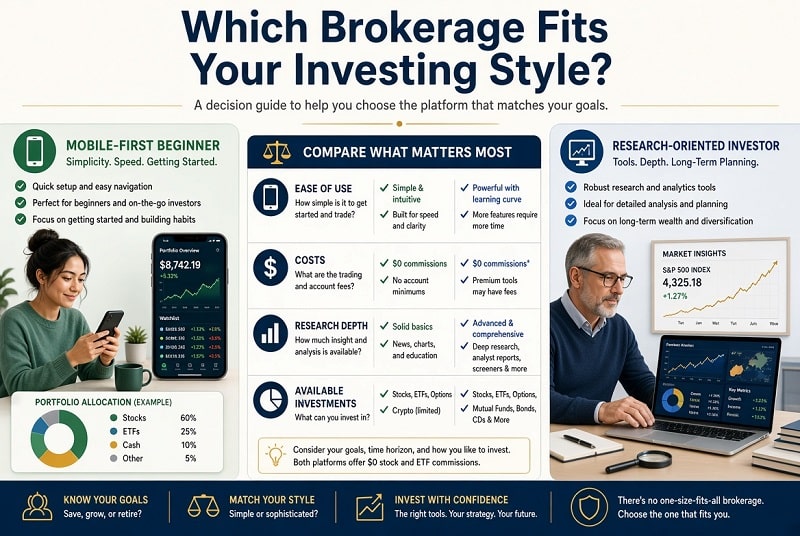
Frequently Asked Questions
Is Charles Schwab better than Robinhood for beginners?
It depends on learning style. Robinhood offers a simpler interface that eliminates clutter for new investors. Schwab offers superior educational content, market research reports (Morningstar/CFRA), and 24/7 phone support, making it better for beginners who want to build deep market knowledge.
Schwab vs Fidelity for retirement: Which is better?
Both are industry leaders for retirement accounts. Fidelity stands out by offering cash sweep accounts that automatically yield market rates without manual transfers, alongside zero-expense-ratio index funds. Schwab offers excellent IRA services, though idle cash must be manually moved into money market funds to capture top yield.
Can I transfer my Robinhood account to Schwab without selling stocks?
Yes. An ACATS transfer moves your actual share holdings directly from Robinhood to Schwab without liquidating your positions, avoiding capital gains tax events. However, cryptocurrencies and fractional share fractions cannot pass through ACATS and will be liquidated to cash prior to transfer.
Does Robinhood charge contract fees for options trading like Schwab?
No. Robinhood charges $0 per contract for standard options trades ($0.35 per contract for Gold members), whereas Schwab charges $0.65 per options contract.
Conclusion
When choosing between Robinhood vs. Charles Schwab, your selection depends on how you generate returns and manage daily cash flow:
- Choose Robinhood if you want competitive APY on uninvested settled cash, zero options contract fees, a 3% IRA contribution match via Robinhood Gold, and a streamlined mobile interface.
- Choose Charles Schwab if you require a full-service financial partner with custodial accounts, 529 plans, checking integration, advanced charting via Thinkorswim, and 24/7 customer support.
Aligning your choice with your trading frequency, account variety requirements, and cash yield preferences will ensure your trading platform actively supports your long-term wealth-building goals.