A once-in-a-generation financial threat is already underway in America. Twelve-term former Congressman and sound-money advocate Dr. Ron Paul has spent five decades warning about the dangers of government overreach, Federal Reserve policy, and the slow destruction of the dollar. Market veteran Dan Ferris, known for calling the 2008 crash months in advance and the 2021 Nasdaq top to the day, has joined him in sounding a sharper alarm. Together they describe a crisis that could prove worse than 2000, 2008, or 2020. They call it a crack-up boom—the final stage of a currency that is being abandoned while asset prices still look strong on paper.
At the center of their practical advice sits a new research package from Dan Ferris and Stansberry Research. The core piece is a digital book titled Capitalism in Crisis: America’s New Survival Blueprint for the Crack-Up Boom, which carries a foreword by Dr. Ron Paul. Alongside the book comes the Capitalism in Crisis Portfolio—seven specific stock ideas Ferris believes can help investors survive the coming chaos and potentially come out wealthier. This article examines the warning, the reasoning behind it, the structure of the research, and the exact tools offered to readers who want to act before the means of protection become more difficult or more expensive.
The Warning from Ron Paul and Dan Ferris
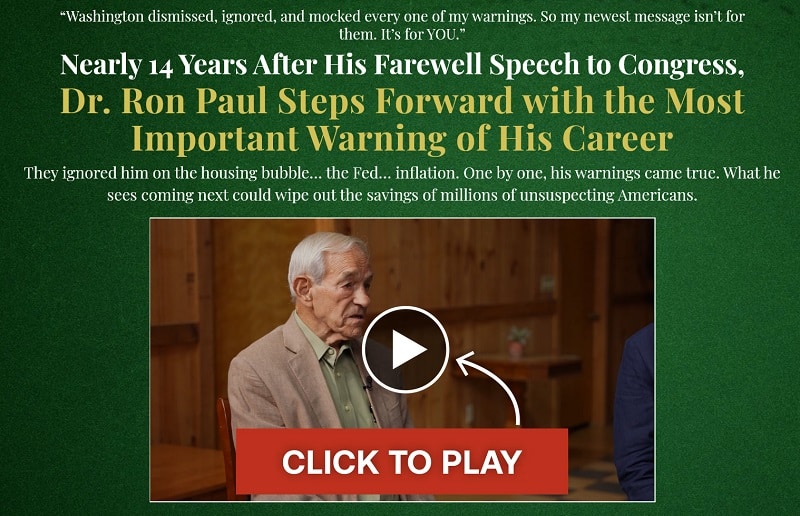
Ron Paul has spent more than half a century criticizing the Federal Reserve, deficit spending, and the merger of government power with corporate interests. He served 22 years in Congress. He has written and spoken about sound money for decades. At age 91 he is not running for office and has no political career left to protect. His message is directed at ordinary Americans rather than at the political class that has ignored him for fifty years.
Dan Ferris brings a different but complementary record. He is a 25-year market analyst whose public calls attracted coverage in Barron’s and Bloomberg. He warned about the 2008 financial crisis early enough that some of his readers positioned themselves ahead of the Lehman Brothers collapse. He guided subscribers away from stocks before major declines in 2011, 2015, and 2018. He identified the top of the Nasdaq in 2021 on the exact day. His work has drawn attention from multimillionaires and fund managers who follow independent research.
Together they argue that the current environment is more dangerous than previous bubbles because the government itself has become a large shareholder in dozens of private companies. Since early 2025 the federal government has taken ownership stakes worth nearly $30 billion across roughly 30 companies. These deals take various forms—direct stock purchases, tariff-linked arrangements, revenue-sharing agreements with chipmakers, and more. High-profile examples include an $8.9 billion investment for a 10 percent stake in Intel, a $400 million Pentagon position that made the government the largest shareholder in rare-earth company MP Materials, and a “golden share” arrangement with U.S. Steel that effectively gave the White House authority over key business decisions.
Paul and Ferris call this system corporatism. Companies still trade on the stock market, still have boards and auditors, and still look like ordinary businesses. Yet the government has injected so much capital and secured so much influence that the line between public and private has blurred. When the government becomes a major shareholder it gains tools no ordinary investor possesses. It can steer contracts toward the companies it owns. It can impose tariffs on their competitors. It can relax regulations. It can extend special loans. And when those measures prove insufficient, it can lean on the Federal Reserve to expand the money supply and keep the process going.
This arrangement is different from classic socialism, which nationalizes companies outright. It is also different from free-market capitalism, in which private owners take both the gains and the losses. Corporatism leaves the appearance of private ownership while concentrating real control in the hands of politicians and bureaucrats. Paul has long argued that this hybrid is more dangerous than open socialism because it disguises the source of the problems. When the system fails, the public tends to blame capitalism itself rather than the political favoritism that distorted the market.
Why the Middle Class Faces the Greatest Risk
The practical consequences fall hardest on ordinary savers and retirees. Grocery costs that once ran $64 in 2020 now routinely exceed $158 for the same basket. Gas prices have forced some families to skip meals so they can afford to drive to work. Nearly half of Americans in one LendingTree survey planned to use buy-now-pay-later loans, some for basic necessities, even though interest rates on those loans can reach 36 percent. Wages as a share of gross domestic income recently hit their lowest level since tracking began in 1929. A record 106 million adults sit outside the labor force—nearly 40 percent of the adult population.
Meanwhile the stock market trades at valuations that, relative to GDP, stand nearly twice as high as the peak of the dot-com bubble. Sixty percent of American households own stocks, the highest ownership rate in history. That means a major decline would touch far more families than previous crashes. Ferris has publicly discussed scenarios in which the S&P 500 could fall 60 percent or more. Some research he has reviewed even explores the theoretical possibility of a market decline toward zero under extreme conditions. The tech-heavy Nasdaq would likely suffer deeper losses.
Retirement accounts hold nearly $30 trillion. That pool of registered, regulated, liquid capital is the largest single source of private wealth in the country. History shows that cash-strapped governments facing collapsing currencies have reached for similar pools before. Argentina nationalized private pensions in 2008. Hungary did so in 2010. Poland took roughly half of its private pension assets in 2014. Paul notes that America already has precedent for emergency measures affecting private assets. In 1933 an executive order required citizens to turn in gold. Trading has been halted during past emergencies. He does not claim any of these outcomes is certain, but he argues that the pressure on the system makes them more plausible than many investors assume.
The quiet version of the same pressure is financial repression—interest rates held below the rate of inflation so that savers silently subsidize government debt. New rules about where money can be held, how it can be moved, and which assets are permitted can appear gradually. Paul emphasizes that the middle class usually absorbs the damage first because their wealth is concentrated in dollars, salaries, pensions, and 401(k)s—the very instruments a currency crisis erodes.
The Crack-Up Boom Explained
Paul draws on the work of Austrian economist Ludwig von Mises, who described the final stage of a currency collapse as a “crack-up boom.” In this phase the public begins to flee the currency. They may not articulate the process clearly, but they convert cash into anything tangible—stocks, houses, gold, farmland, or pantry goods. Asset prices rise sharply. The market posts record highs. Politicians point to the rising numbers as proof of economic strength. Yet the rising prices do not reflect new wealth. They reflect the abandonment of the currency.
Paul and Ferris point to current conditions as early evidence of the same process. Gold trades above $4,000 an ounce. The average home is valued near half a million dollars. Equity indexes sit at all-time highs. At the same time real purchasing power for ordinary families has fallen. The dollar has lost roughly 30 percent of its purchasing power since the early COVID period alone. Power bills in some states have risen 50 percent in a few years. When gold became legal for Americans to own again in 1975 it traded near $35. Today’s price does not mean gold became more valuable by a factor of one hundred; it means the dollar lost more than 95 percent of its value against gold over that span. The median family income would need to reach roughly $381,000 today simply to match the purchasing power that existed when the dollar was stronger.
Venezuela offers a modern illustration. While its currency collapsed, its stock market ranked among the best-performing in the world on paper, rising thousands of percent. Citizens did not grow richer. The market simply stopped measuring real value and began measuring the death of the currency. America is not Venezuela. It possesses the world’s largest economy and the reserve currency. Those advantages buy time. They do not repeal the underlying principles. Every bailout, every rate cut, and every monetary injection that props up the current structure adds fuel to the final boom.
Paul stresses that the end does not arrive on a fixed date. Anyone who claims to know the exact week or month is guessing. The process can accelerate suddenly or stretch longer than expected. The only reliable approach is to prepare while the tools of protection remain legal, available, and relatively inexpensive.
How Corporatism Differs from Previous Bailouts
Paul opposed the Chrysler bailout, the Export-Import Bank, TARP, the rescues of GM and AIG, the structure of Obamacare, and the CHIPS Act subsidies. None of those earlier interventions produced the rapid socialist gains some feared. What has changed, he argues, is the openness and the scale. The government is no longer waiting for a crash to intervene. It is taking equity stakes while valuations remain elevated and while the AI investment boom still depends on cheap capital and circular financing.
In the early phase of the AI expansion, major technology companies funded data-center and chip investments from free cash flow. That phase has ended. Companies now issue 30-year bonds, use off-balance-sheet leverage, and engage in vendor loops in which firms effectively lend one another the money to buy one another’s products. Direct government capital has become another source of funding. The companies accept the capital because it supports stock prices. The government supplies it because it wants to avoid or delay a visible crash. Neither side treats the arrangement as temporary or exceptional.
When private shareholders lose money, they absorb the loss. That is how markets clear excesses. When the government is a major shareholder, the political incentive is to protect the investment. Losses can be papered over with more spending, more regulatory favoritism, or more monetary expansion. Each rescue deepens the underlying distortion and makes the eventual adjustment larger.
Ferris notes that the market is already the most expensive it has ever been by several historical measures. At some point valuations will fall. When they do, the government may sit on substantial paper losses or feel compelled to inject still more capital. Either path increases political pressure for greater control. Socialist candidates and activists already point to rising prices, inequality, and concentrated wealth as evidence that free markets have failed. Paul and Ferris reply that the system on display is not a free market. It is corporatism. The socialists correctly identify real problems and then prescribe more of the same political control that produced those problems.
Dan Ferris and the Independent Research Model
Dan Ferris works at Stansberry Research, an independent publisher that has operated for more than 25 years. The firm employs more than 250 people, including financial analysts, corporate attorneys, accountants, technology specialists, former hedge-fund managers, and a medical doctor. Its research has been covered in Barron’s, USA Today, Bloomberg, MarketWatch, Fox Business, and Forbes. More than 100,000 paid readers in nearly every country subscribe to various Stansberry publications.
The firm accepts no advertising. It does not manage client money. It is not affiliated with any political party. Those structural choices remove the most common conflicts of interest that affect banks, brokerages, and many other financial firms. Ferris’s own track record includes the 2008 Lehman warning, the 2021 Nasdaq top, and multiple successful exits from stocks before major declines. The average gain across the Ferris Report portfolio since inception stands at 24.6 percent, though past results do not guarantee future performance and all investments carry risk.
The current research package is built around the specific risks Paul and Ferris describe. The centerpiece is the digital book Capitalism in Crisis. It is not sold on Amazon or through ordinary retail channels. The only way to obtain it is through the current membership offer for The Ferris Report. The book walks readers through four practical steps.
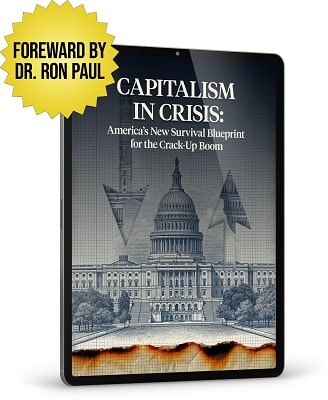
Step one focuses on moving savings out of the most vulnerable positions. It reviews the historical pattern of pension seizures in Argentina, Hungary, and Poland, the proposals that surface in Washington whenever deficits spike, and the principle that should guide every decision while options remain open. It also presents government data showing that quiet debasement of purchasing power is already measurable.
Step two covers the assets most likely to survive a crack-up boom. It examines the single category of asset that protected families in Weimar Germany while the most diligent paper savers were wiped out. It introduces a simple “Crack-Up Boom Signal” chart that measures equity performance in real terms rather than nominal dollars. It outlines a silver strategy that rose more than 38 times during the 1970s currency stresses. It also provides practical guidance on buying gold—how to avoid dealer markups, where to store it, and one common form of gold ownership that Ferris advises against.
Step three addresses the corporatist bubble directly. It lists the approximately 30 companies that currently sit inside the federal government’s equity portfolio and explains why owning the same stocks as the government may prove especially dangerous when the cycle turns. It also reviews widely held stocks whose earnings depend heavily on government favor, cheap debt, and circular AI financing—names that may not yet appear on the official list but that carry similar risks.
Step four covers household preparation beyond pure portfolio moves. It discusses practical steps that helped one neighborhood stay intact after Hurricane Katrina, the single most useful document system for keeping financial life accessible during disruption, and other measures that reduce vulnerability when systems strain.
The Capitalism in Crisis Portfolio
The limited-time bonus that accompanies the book is the Capitalism in Crisis Portfolio itself. Ferris provides full write-ups on seven stock ideas he considers suitable for the environment he and Paul describe. The portfolio is not a collection of high-flying growth names. It is built around durability, cash flow, and low correlation to the broader equity market.
One idea is described as one of the lowest-risk investments available today, with almost no price volatility. Another is a security whose returns have historically been largely uncorrelated to stocks and bonds and that produced positive results in 2022, a year when most markets declined. A third offers a way to own mineral rights and collect royalty cash flow. The remaining ideas follow the same logic: businesses or structures that can continue to generate value even if equity indexes fall sharply or if the purchasing power of the dollar continues to erode.
Readers receive the full analysis, the reasoning behind each selection, and the specific instructions Ferris provides for position sizing and monitoring. The portfolio is designed to be held alongside the broader protective steps outlined in the book rather than as a standalone trading system. Ferris emphasizes that the goal is survival first and potential appreciation second. In an environment where nominal asset prices can rise while real purchasing power falls, the distinction between paper gains and real gains becomes critical.
Supporting Special Reports
Three additional research reports come with the membership.
The first is The Silver Trade. Silver has a long history of sharp moves during currency stress. In the 1970s it rose more than 38 times. Investors can own physical bullion, mining shares, or royalty companies. The report focuses on a structure that Ferris believes can produce multi-year percentage gains far larger than simple bullion ownership while still providing a monetary-metal hedge.
The second report is The Asset That Soars Higher Against a Falling Dollar. It presents a straightforward method for protecting purchasing power while positioning for potential triple-digit gains if the dollar continues to weaken. The approach is designed to be simple enough for non-professionals to implement without complex derivatives or leverage.
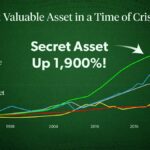
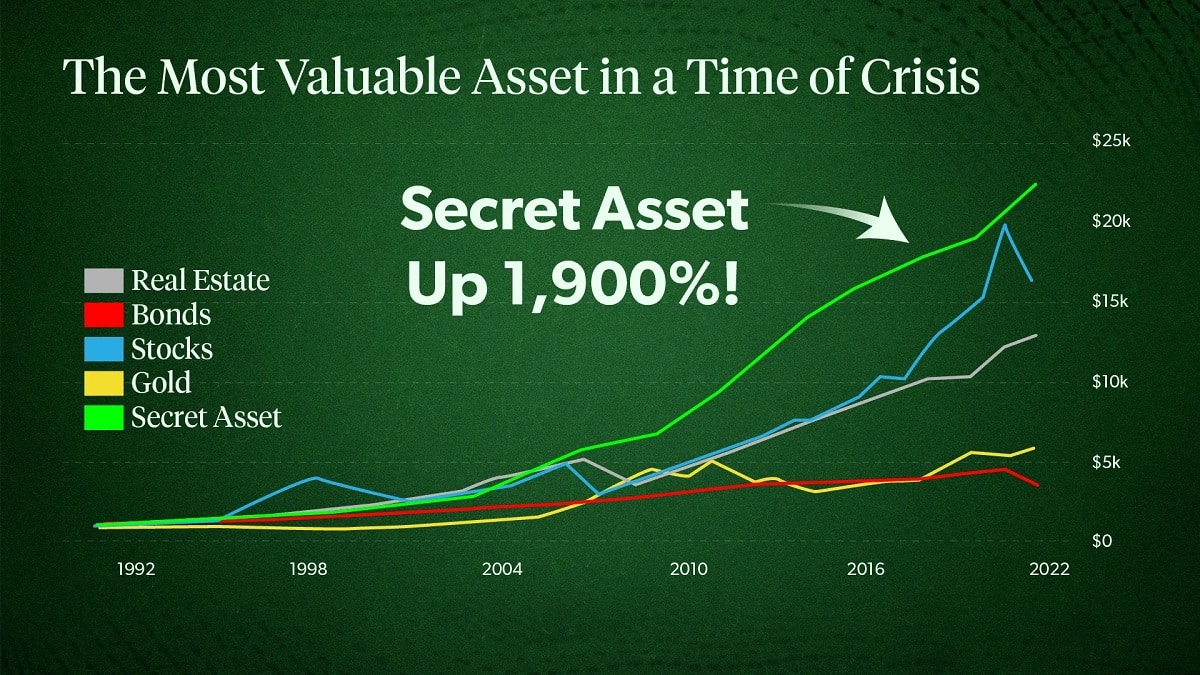
The third report is The Most Valuable Asset in a Time of Crisis. It examines an asset class that has historically delivered strong long-term returns with relatively low volatility and without a single down year across multiple decades. During World War II and other periods of severe disruption, this category helped some families preserve and even grow real wealth while others lost everything through inflation or seizure. The report explains the historical record and the practical ways Americans can own the asset today.
Together the book, the seven-stock portfolio, and the three special reports form a complete starting package. Monthly issues of The Ferris Report then keep the research current. Each month Ferris delivers new analysis, updated recommendations, and commentary on the evolving risks. Special alerts go out when he believes a position should be adjusted or when a new threat appears. Members also receive the complete archive of prior issues and reports, the daily Stansberry Digest market summary, and the weekly Stansberry Investor Hour podcast that has featured guests such as Jim Rogers, Glenn Beck, and Ron Paul himself.
Membership Terms and the Risk-Free Trial
The regular annual price of The Ferris Report is $499. Under the current promotional terms the full year is available for $129—a 74 percent discount. The offer includes the digital book, the Capitalism in Crisis Portfolio, the three special reports, the complete archive, daily and weekly market commentary, and ongoing monthly research and alerts.
A one-year membership to TradeStops Basic is also included at no extra cost. TradeStops is a portfolio-tracking tool that syncs with brokerage accounts, calculates position sizes according to individual risk tolerance, and uses a Volatility Quotient metric to set data-driven exit levels. The tool is intended to remove emotion from the decision to sell when markets become volatile.
The entire package carries a 30-day, 100 percent money-back guarantee. Members can review the book, the portfolio write-ups, the special reports, the archive, and the first issues of the monthly service. If the material does not meet expectations, a full refund is available by contacting the Maryland-based member services team. Members keep the digital book and the other materials even if they cancel within the trial window.
Paul and Ferris both stress that the window for preparation is open now. The tools remain legal and relatively inexpensive. Once a full-scale crisis arrives, capital controls, higher premiums on physical assets, or new regulations can make the same steps harder or more costly. The research does not claim to eliminate risk. It aims to give readers a clear map of the threats and a concrete set of actions that have protected wealth in earlier episodes of currency stress and political overreach.

Why Independent Research Matters in This Environment
Most financial firms have business models that depend on assets under management, trading commissions, or product sales. Those incentives can discourage blunt warnings about systemic risks. An independent publisher that sells research rather than products or advisory services faces fewer of those pressures. Ferris’s public record of calling major tops and bottoms without regard to consensus opinion is part of the reason Paul agreed to write the foreword and to appear in the joint presentation.
The research does not require readers to abandon all equities or to adopt an extreme survivalist stance. It asks them to examine concentration risk, currency risk, and political risk with the same seriousness they already apply to ordinary market risk. The seven ideas in the Capitalism in Crisis Portfolio are presented as one practical expression of that examination. The supporting reports on silver, dollar-hedging assets, and crisis-resilient holdings supply additional layers. The monthly service then keeps the map updated as conditions change.
Putting the Pieces into Practice
Readers who decide to act receive immediate access to the digital book and the full portfolio write-ups. The first task is to understand the four steps in Capitalism in Crisis and to measure personal exposure against them. The second is to review the seven specific ideas and decide which, if any, fit individual circumstances, risk tolerance, and existing holdings. The third is to implement the practical suggestions on physical metals, document organization, and household readiness. The fourth is to follow the ongoing monthly research so that positions and strategies can be adjusted as new information appears.
Paul’s closing message is direct. Corporatism has taken root in Washington. When the arrangement eventually fails, large numbers of Americans will look to the same government for rescue and will be disappointed as the dollar continues to lose purchasing power. Most will be unprepared. The research package is offered as a way for individuals and families to reduce that vulnerability while options remain open. The 30-day guarantee removes the usual financial risk of trying the material. The discounted price and the included bonuses lower the cost of starting.
The market will decide the precise timing and severity of the next major adjustment. History suggests that currency stress, political overreach, and inflated asset prices eventually correct. The families and investors who emerge in better condition are usually those who recognized the risks early and took concrete steps while the steps were still straightforward. The Capitalism in Crisis Portfolio and the surrounding research are presented as one structured way to take those steps.
For readers who want the full details of the seven stocks, the complete reasoning in the book, and the ongoing monthly guidance, the current membership offer provides the access. The research is available immediately upon enrollment. The risk-free trial period allows a full month of evaluation before any permanent decision is required. In an environment where the largest risks are systemic rather than company-specific, independent analysis that focuses on those systemic risks can serve as a useful counterweight to the official narrative of permanent prosperity.
Ready to try The Ferris Report? Click Here – Best price + discount