
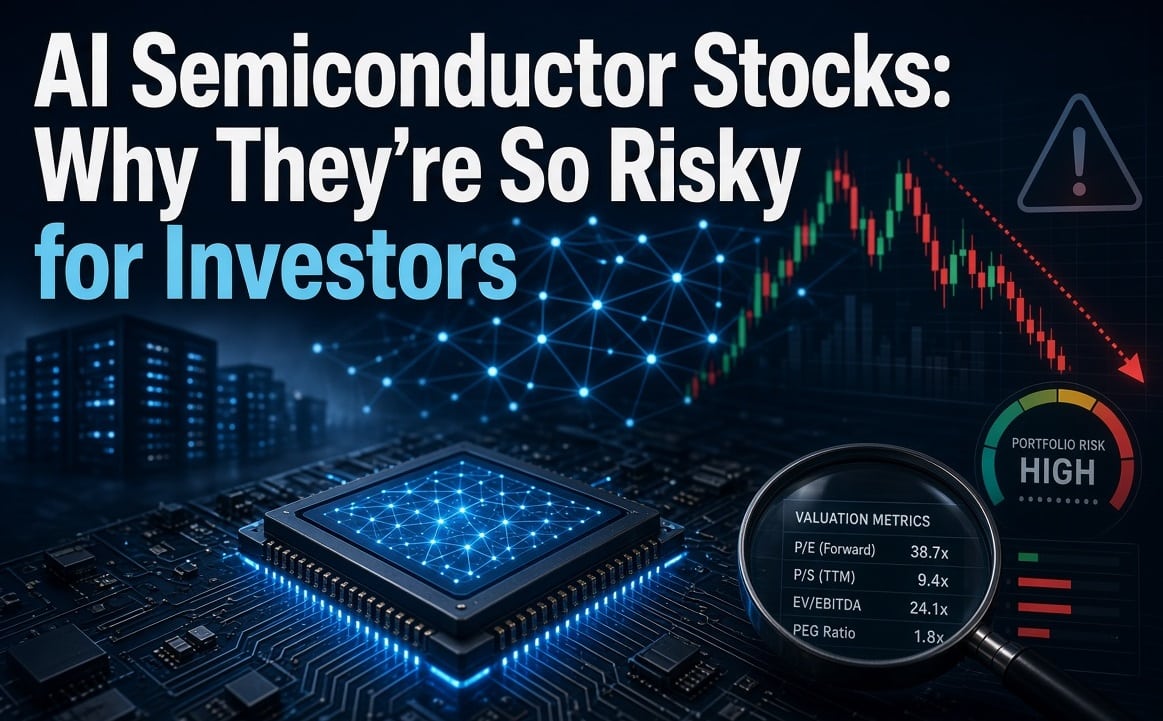
AI semiconductor stocks sit at the center of the market’s biggest growth story, and that excitement can make them unusually dangerous investments. Demand for chips powering data centers, cloud computing and advanced models is real, but share prices often assume years of flawless execution.
For investors, the key risk is that this remains a fiercely cyclical industry. Rich valuations, rapid product shifts, concentrated customers and rising competition can turn even strong earnings into disappointing returns when expectations outrun reality.
Key takeaways
- AI chip demand is powerful, but high valuations leave little room for slower growth or execution setbacks.
- Semiconductors are cyclical: delayed data-centre spending, inventory builds and oversupply can rapidly pressure profits.
- Heavy reliance on a few cloud customers can turn spending pauses into abrupt demand shocks.
- Competition, custom chips and supply constraints can quickly reshape margins, market share and company prospects.
- Export controls, Taiwan exposure and shifting subsidy policies create industry-wide geopolitical risks.
- Prioritise diversification, cash flow, balance-sheet strength and reasonable valuations; ETFs can reduce single-stock risk.
AI semiconductor stocks: why they’re so risky for investors
AI semiconductor stocks have become one of the market’s most exciting stories, but excitement and dependable investment returns are not the same thing. Chips are essential to artificial intelligence: data centres need huge amounts of computing power, and companies such as Nvidia, AMD, Broadcom and memory-chip producers are competing to supply it. That demand can produce exceptional growth. It can also lead investors to pay prices that assume near-perfect execution for years ahead.
For an investor focused on steady income, the central risk is valuation. Many AI-linked stocks already reflect very optimistic expectations for sales, margins and market share. If revenue growth merely slows rather than collapses, a richly valued stock can still fall sharply. Semiconductor shares are also cyclical by nature. Customers can delay data-centre spending, inventories can build unexpectedly, and a small change in demand can have an outsized effect on profits.
- High valuations can leave little room for disappointment.
- Data-centre spending can slow and inventories can rise unexpectedly.
- Competition, export restrictions and manufacturing disruption can quickly affect profits.
The AI supply chain adds further uncertainty. Competition is fierce, chip design cycles are short, and the biggest buyers have considerable negotiating power. Export restrictions, manufacturing disruption in Asia and the capital intensity of advanced chip production can all move the market quickly. In other words, the question behind “AI semiconductor stocks: why they’re so risky for investors” is not whether artificial intelligence matters, it plainly does, but whether today’s share prices leave enough room for setbacks. Growth stocks can have a place in a diversified portfolio, but concentration in a fashionable theme can turn a sensible investment into a speculative one.
Key risks to weigh
- High valuations can leave little room for disappointment, even when companies continue growing.
- Semiconductor demand is cyclical; delayed data-centre spending can quickly pressure revenue and profits.
- Intense competition may reduce margins, market share or pricing power as rivals release newer chips.
- Large cloud customers have significant bargaining power and can cut orders or negotiate lower prices.
- Export controls and Asian manufacturing disruption can affect supply chains, sales and investor confidence.
- Advanced chip development requires huge capital spending, increasing execution risk and financial pressure.
- Diversification helps limit the damage if a popular AI theme suffers a sharp market reversal.
Why the AI chip opportunity attracts so much capital
I see the appeal of semiconductor stocks in a straightforward way: artificial intelligence has turned computing capacity into essential infrastructure. Every major AI model needs enormous volumes of processing power to train, refine and serve users, and that demand runs through advanced chips, memory, networking equipment and the facilities that house them. Data centers are consequently becoming one of the most important destinations for corporate capital spending.
Investors are responding not simply to a compelling technology story, but to a visible spending cycle. Large cloud platforms and other companies are committing billions to expand AI capacity, while chip designers, foundries, equipment makers and suppliers compete to meet demand. A leading semiconductor business can benefit from powerful operating leverage when production is constrained and customers need its technology. That prospect helps explain the exceptional valuations attached to parts of the semiconductor industry.
Still, the opportunity is broader, and more complicated, than owning whichever company has the most prominent AI chip. The ecosystem includes businesses that design processors, manufacture them, supply specialist tools, provide high-bandwidth memory and build the power and cooling systems data centers require. Each has different competitive advantages, financial profiles and sensitivity to the cycle.
Capital flows where investors expect durable growth, and AI has created a credible case for years of elevated investment. But semiconductor demand has always been cyclical. For income-minded investors, the key is separating businesses with resilient cash generation and disciplined capital allocation from those priced for a flawless year after year of expansion.

The Key Segments of the AI Infrastructure Ecosystem
AI Semiconductor Ecosystem: Where Demand and Investment Flow
| Ecosystem segment | Role in AI infrastructure | Potential investor consideration |
|---|---|---|
| Chip design | Designs processors used to train, refine and serve AI models. | Can benefit from strong demand and operating leverage when production is constrained and customers need its technology. |
| Manufacturing and foundries | Manufactures advanced chips required for AI computing capacity. | Competitive position and exposure to the semiconductor cycle may differ from those of chip designers. |
| Specialist equipment | Supplies the tools used in semiconductor production. | Demand is linked to investment in expanding AI chip capacity. |
| High-bandwidth memory | Provides memory needed alongside advanced AI chips. | May have a distinct financial profile and sensitivity to the investment cycle. |
| Networking equipment | Supports the movement of data within AI computing infrastructure. | Benefits from data-center expansion, but its competitive advantages can differ from those of chip businesses. |
| Power and cooling systems | Helps data centers operate the facilities that house AI computing capacity. | Demand is tied to corporate capital spending on data-center construction and expansion. |
Customer concentration can turn AI spending into a demand shock
AI’s build-out is being financed by a surprisingly narrow group of companies. That concentration matters: a pause in data centers spending by one or two buyers can remove a million dollars, or far more, from the market’s expected investment pipeline, quickly pressuring stocks tied to the cycle rather than merely softening sentiment for a quarter.
Competition and supply constraints can reshape the winners
The AI supply chain is not a single trade, and investors should resist treating every semiconductor company as an interchangeable beneficiary. Market leaders may command the richest valuations, but their success invites competition from established rivals, custom-chip programs and a growing field of smaller semiconductor specialists addressing narrower bottlenecks.
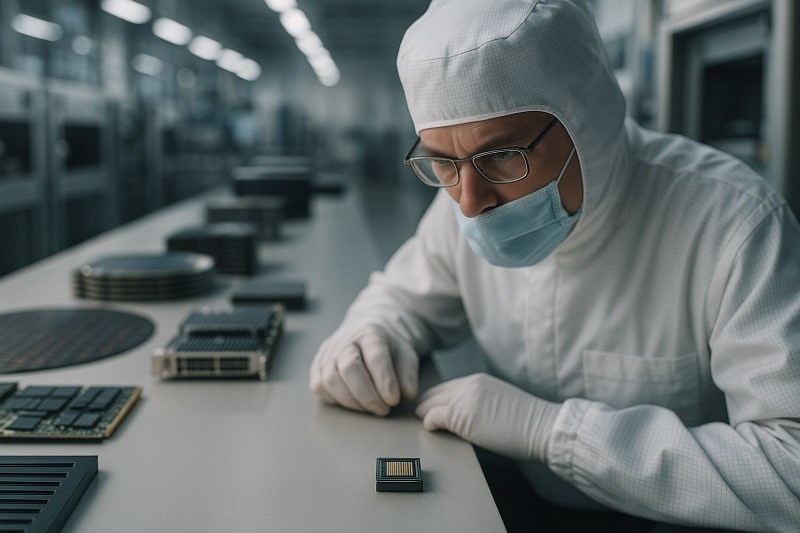
For a small-cap semiconductor business, the opportunity can be substantial when its technology solves a specific problem in power management, networking, memory or advanced packaging. Yet growth is rarely linear. A design win may take years to translate into meaningful revenue, while a lost customer, manufacturing delay or pricing concession can have an immediate effect on results.
Supply constraints add another complication. Limited foundry capacity, packaging availability and access to high-bandwidth memory can protect margins for some firms, but they can also cap shipments for others. In my view, the better candidates are those with credible production access, a defensible product roadmap and customers willing to pay for performance, not simply a share price lifted by enthusiasm around AI.
Small-Cap Semiconductor Checklist
- Identify whether the company solves a defined bottleneck in power, networking, memory, or advanced packaging.
- Check that design wins have realistic timelines, since qualification can precede meaningful revenue by years.
- Assess customer concentration; one lost account or pricing concession can materially affect results.
- Verify access to foundry capacity, advanced packaging, and high-bandwidth memory before projecting shipment growth.
- Compare the product roadmap against established rivals, custom-chip initiatives, and specialist competitors.
- Favor customers paying for measurable performance advantages rather than demand driven solely by AI enthusiasm.
- Distinguish durable margins supported by scarce supply from temporary gains that may fade as capacity expands.
Policy and geopolitical exposure reach beyond any one chipmaker
Investors should resist treating policy risk as a company-specific issue. The semiconductor industry is now inseparable from industrial strategy, national security and the contest for technological leadership between the US, China, Europe and several Asian manufacturing hubs. That reality affects the entire market: designers, foundries, equipment suppliers, materials groups and the companies that buy advanced chips for data centres, cars and consumer devices.
Export controls can limit access to customers or production tools with little warning. Subsidy programmes can improve the economics of new factories, but they often come with conditions on investment, sourcing and expansion in certain countries. A diplomatic flare-up around Taiwan would be especially consequential because so much leading-edge capacity remains concentrated there. Even firms with diversified revenues can face delayed deliveries, higher costs or weaker demand when customers reassess their own supply chains.
For income-focused investors, the practical lesson is to look beyond the day’s news and the movement in financial futures. A strong earnings report may still be followed by a sharp repricing if policymakers tighten restrictions or if trade relations deteriorate. Diversification across regions and business models matters more than guessing which headline will move the next session.
The long-term case for chips remains compelling, but valuation discipline is essential. The market tends to reward companies that combine technological relevance with resilient balance sheets, broad customer relationships and the flexibility to operate through a more fragmented global economy.

Red flags investors should check before buying
Semiconductor shares can reward patience, but this is not a corner of the market where a compelling story is enough. Before making a semiconductor investment, investors should look past the headline growth rate and ask what is driving it: durable demand, a temporary inventory rebuild, or a surge in one fashionable application. A company whose sales depend heavily on one customer, one end market or one advanced manufacturing partner can be more exposed than its valuation suggests. That concentration risk deserves particular attention when the stock price already assumes years of flawless execution.
Margins and capital spending are another useful reality check. Chip businesses may require enormous, recurring investment in fabrication capacity, equipment and research, while pricing can weaken quickly when supply catches up with demand. Watch for management teams that emphasise adjusted measures while cash flow, inventory levels or debt move in the wrong direction. Export restrictions, geopolitical tensions around Taiwan and changing subsidy policies can also alter the outlook far faster than a quarterly earnings model implies.
For the individual investor, valuation discipline matters as much as technology leadership. Buying stocks after a sharp rally can turn a sound business into a poor entry point. Compare the company with its direct peers, not only with a broad market index, and be wary of trading on rumours around product launches or artificial-intelligence demand. An ETF or specialist fund can reduce single-company risk, although investors should still inspect its largest holdings, fees and overlap with shares they already own. Diversification does not remove red flags; it makes them easier to manage.
Semiconductor investment red flags
- Question whether growth reflects durable demand, a short-lived inventory rebuild, or enthusiasm for a fashionable application.
- Check reliance on a single customer, end market, or manufacturing partner; concentration can magnify setbacks.
- Compare capital spending, research costs, inventory, debt, and cash flow against management’s adjusted earnings claims.
- Assess margin resilience when supply expands, as chip pricing can weaken rapidly during industry downturns.
- Factor in export controls, Taiwan-related geopolitical risk, and changing subsidy policies before relying on forecasts.
- Compare valuation with direct semiconductor peers, especially after a sharp rally that may assume flawless execution.
- For ETFs, review major holdings, fees, and overlap with existing shares; diversification reduces, but does not erase, risk.
Frequently asked questions
Why are AI semiconductor stocks considered risky?
AI chip shares can be risky because many are priced for sustained rapid growth, strong margins and continued data-centre spending. Even a modest slowdown in sales, a customer spending pause or increased competition can cause a sharp share-price decline.
What are the main risks facing AI chip companies?
Key risks include high valuations, cyclical demand, customer concentration, supply constraints, short product cycles and intense competition. Export controls, Taiwan-related geopolitical tensions and disruption at manufacturing partners can also affect revenue, costs and deliveries.
Can semiconductor stocks fall even if AI demand continues to grow?
Yes. A stock can fall while its business continues growing if investors had expected faster growth or higher profits. Share prices reflect future expectations, so results that are good but below ambitious forecasts may still lead to a repricing.
Why does customer concentration matter for AI semiconductor investors?
A relatively small group of cloud and technology companies funds much of the AI infrastructure build-out. If one major customer cuts, delays or redirects spending, suppliers with heavy exposure may experience an abrupt decline in orders and earnings expectations.
Are Nvidia, AMD and Broadcom exposed to the same risks?
They share exposure to AI spending, competition and market valuation, but their risks differ by product mix, customer base, manufacturing relationships and pricing power. Investors should assess each company’s revenue concentration, margins, supply access and competitive position separately.
Is an AI semiconductor ETF safer than buying individual chip stocks?
An ETF can reduce the impact of one company disappointing, but it does not remove sector-wide risks such as a semiconductor downturn or lower AI capital spending. Check the fund’s largest holdings, fees, geographic exposure and overlap with shares already owned.
What should investors check before buying AI semiconductor stocks?
Review valuation against direct peers, revenue and customer concentration, inventory trends, free cash flow, debt, capital-spending needs and exposure to export restrictions. A strong technology story is more attractive when supported by resilient finances and realistic expectations.