
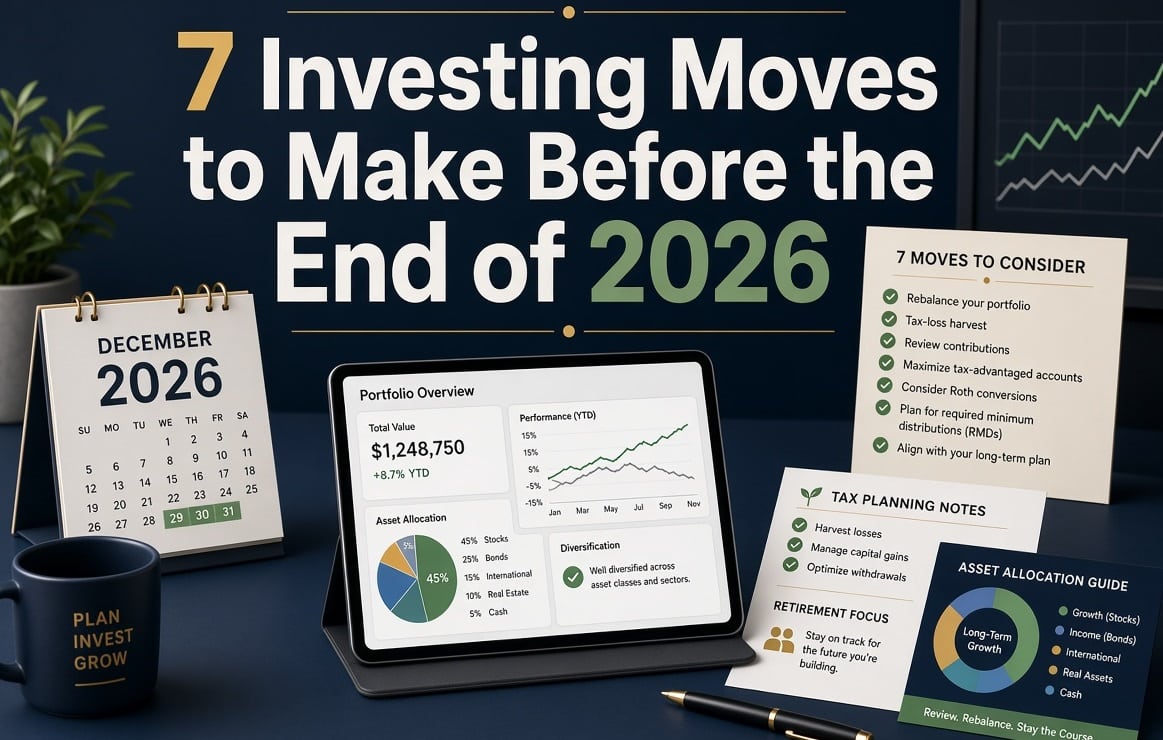
The most useful investing decisions before year-end are rarely dramatic. They are the measured adjustments that bring your portfolio back into alignment with your goals, time horizon and risk tolerance. As 2026 moves quickly, a focused year-end planning review can reveal concentration concerns, overlooked tax opportunities and cash that could be working harder for you.
These 7 investing moves to make before the end of 2026 offer a practical order of operations: begin with the plan, then examine allocation, diversification and account strategy. You do not need to overhaul everything at once; you need a clear, confident view of what merits attention before December 31.
Key takeaways
- Capture the full employer retirement match before year-end; it is often the highest immediate return available.
- Build a goals-based plan and maintain cash reserves before making portfolio changes or taking additional market risk.
- Review all accounts together for allocation drift, duplicated holdings, concentration risk, fees and idle cash.
- Use tax-loss harvesting and capital-gains planning carefully; tax benefits should support, not override, your investment strategy.
- Confirm retirement contributions, catch-up eligibility and account investment choices before deadlines pass.
- Update beneficiaries, account records, security settings and estate documents to protect retirement assets and heirs.
How to prioritize the 7 investing moves to make before the end of 2026
Effective year-end planning does not begin with a scramble to buy something new. It begins with sequence and purpose. Before making changes, assess the decisions most likely to strengthen your financial position now: tax deadlines, high-cost debt, overlooked employer benefits, concentrated holdings and an investment mix that no longer reflects your goals, risk tolerance or long term priorities. The 7 investing moves to make before the end of 2026 will vary by household, but the order should generally favor time-sensitive opportunities and avoidable costs over market predictions. Start by taking stock of your money, clarifying your financial plan and using the review to create a goals-based plan for the year ahead.
First, capture any employer retirement-plan match and consider whether you can increase contributions before the final payroll cycles of 2026. For many savers, this is the most compelling immediate return available. Review each retirement account, including a traditional ira or roth ira, and confirm that your contribution strategy still fits your tax year income and retirement timeline. Next, make sure you hold sufficient cash reserves and have a practical plan for expensive variable-rate debt; investing more aggressively while carrying costly balances can erode long term wealth. It may also be an opportune time to audit recurring bills, revisit insurance coverage and redirect unnecessary spending toward retirement or other priorities.
From there, examine taxable accounts for capital gains and losses. Tax-loss harvesting, when appropriate, may help offset realized gains, while charitable gifts of appreciated stocks, etfs or other investments can be more tax-efficient than cash donations for those already planning to give. Then turn to portfolio construction. Rebalance when allocations have materially drifted from their intended targets, not because of a headline or a recent market surge. A disciplined review should identify redundant funds, outsized single-stock exposure, underused investment options and fees that quietly diminish returns. Whether you invest through fidelity or another platform, the essential question is whether each holding still serves a clear investment strategy.
Finally, make the decisions that support the next several years: refresh automatic contributions for 2027, update beneficiaries and determine whether estate documents still reflect your family, assets and wishes. Investors nearing retirement may also need to coordinate withdrawals, required distributions and Medicare-related income thresholds. For local investors, municipal-bond income, state tax treatment or a residency change may influence the broader planning picture. These are not one-size-fits-all moves. The priority is to address deadlines first, make deliberate changes second and leave room for careful guidance on complex tax, estate and investment decisions. Qualified financial advisors can connect the details, but a focused year-end checklist ensures the conversation begins with the decisions that matter most.
Year-End Investing Priorities
- Maximize employer retirement-plan matching contributions before final 2026 payroll deadlines.
- Strengthen emergency savings and address high-interest or variable-rate debt before increasing investment risk.
- Review taxable accounts for tax-loss harvesting opportunities and planned charitable gifts of appreciated securities.
- Rebalance only when portfolio allocations have materially drifted from your long-term targets.
- Reduce unnecessary fund overlap, concentrated stock positions and investment fees that can erode returns.
- Consider state tax treatment, municipal-bond income and residency changes as part of broader planning.
- Refresh 2027 automatic contributions, beneficiaries, estate documents and retirement withdrawal plans.
Create a goals-based financial plan before changing investments
Before moving money, selling a holding or reacting to the latest market headline, create a goals-based plan that gives each decision a clear purpose. A thoughtful financial plan starts with the life you want your money to support: the timing of retirement, the income you may need from your portfolio, family commitments, property plans, education costs, charitable giving and the capacity to absorb the unexpected. Investments are the tools, not the destination.
That distinction becomes especially important when markets feel unsettled. A short-term decline can make a carefully considered investment strategy appear inadequate, while a run of strong returns can tempt investors to assume more risk than their circumstances warrant. Neither response necessarily advances a long term objective. A plan offers an anchor, helping you judge change by whether it strengthens the likelihood of meeting your goals rather than whether it provides immediate reassurance.
Begin with a precise view of household finances. Identify dependable income, essential and discretionary spending, debts, accessible cash reserves and the dates when significant withdrawals may be required. Someone drawing income in retirement will have different priorities from someone still building capital through regular investing. Both may hold similar assets, yet the appropriate mix, withdrawal approach and level of liquidity may differ substantially.
Risk tolerance belongs at the centre of this work, though it should be assessed in practical as well as emotional terms. It is not merely a measure of your comfort when markets move. It also reflects how much loss your plan can withstand, how soon you need the money, and whether you could reduce spending or defer a goal if returns fall short. A portfolio that appears sensible on paper may still be unsuitable if a downturn would compel you to sell investments at the wrong time.
With those foundations established, you can set an investment strategy that connects assets to specific goals and time frames. Protect near-term spending needs from unnecessary market risk; allow longer-horizon money the opportunity to grow; and revisit the plan when circumstances change, not whenever the news cycle shifts. The result is a more disciplined framework for investing, one that treats money as a means to fund a considered life, including a confident and sustainable retirement.
Goals-Based Planning Checklist
- Define the life goals your money should support, including retirement timing, family commitments, property plans and charitable giving.
- Map household finances: dependable income, essential spending, debts, cash reserves and expected dates for major withdrawals.
- Separate near-term spending money from long-term investments to reduce the chance of selling assets during a market decline.
- Assess risk capacity alongside risk comfort: consider potential losses, time horizons and whether spending or goals could change.
- Match investments to specific goals and time frames, recognising that retirement income needs differ from wealth-building priorities.
- Use your plan to evaluate portfolio changes, rather than reacting to headlines, short-term declines or periods of strong returns.
- Review the plan after meaningful life or financial changes, not simply because markets or news cycles become unsettled.
Check allocation drift, stocks and concentration risk
Markets rarely move in neat, balanced lines. A sustained rally in one corner of the market can quietly redraw a portfolio, leaving you with more risk than you intended when your investment plan was set. This is allocation drift: the gradual change in asset weights as holdings deliver different returns.
A portfolio originally built around a 60/40 split between growth and defensive assets, for instance, may become markedly more growth-heavy after several strong years for shares. That does not automatically signal poor performance, but it can leave you carrying a level of volatility that no longer suits your timeframe, income needs or appetite for loss.
Begin with a full review of every holding across your accounts, including super, brokerage portfolios, managed funds and cash. Assess the combined picture, rather than judging each account in isolation. It is common to find the same Australian bank, global technology company or broad market fund appearing in several places, creating more overlap than expected. Then measure your current mix against your intended allocation.
Consider the proportion held in Australian and international stocks, listed property, fixed income and cash, and whether those weights still reflect your goals. ETFs can make diversification easier, but a large number of securities does not guarantee a genuinely diversified portfolio. Several Australian-share ETFs may still leave you heavily exposed to financials and resources, while multiple global funds can concentrate investment in the largest US companies.
Review the underlying indexes, regional exposure and top holdings before assuming your investment options are meaningfully distinct. Concentration risk deserves equally direct scrutiny. A large parcel of employer shares, a sharply appreciated individual stock or a substantial position in one sector can have an outsized effect on your financial position. The stakes are higher when employment income, property exposure and investments are all linked to the same local economic cycle. Rebalancing need not mean reacting to every market move. Many investors choose a review date once or twice a year, or rebalance when an asset class moves beyond a pre-agreed range. This disciplined approach may involve trimming assets that have grown beyond their target and adding to areas that have lagged, keeping decisions anchored to strategy rather than headlines. Before making changes, account for brokerage, capital gains tax and any implications for superannuation accounts. The aim is not to predict the market; it is to confirm that the portfolio you own remains the portfolio you chose.
Portfolio allocation and concentration risk review checklist
| What to review | What to compare or check | Why it matters |
|---|---|---|
| Total allocation | Compare the current mix of growth and defensive assets with the intended allocation, including Australian and international stocks, listed property, fixed income and cash. | Different investment returns can shift portfolio weights over time and change the level of volatility. |
| All accounts combined | Review holdings across super, brokerage portfolios, managed funds and cash holdings as one combined portfolio. | Assessing accounts separately can hide the portfolio’s overall risk and exposures. |
| Account overlap | Identify repeated holdings, such as the same Australian bank, global technology company or broad market fund appearing in multiple accounts. | Repeated holdings can create more exposure to a company or market area than expected. |
| ETF and fund holdings | Review underlying indexes, regional exposure and top holdings rather than relying on the number of securities held. | Several Australian-share ETFs may remain concentrated in financials and resources, while global funds may concentrate in the largest US companies. |
| Single-stock and sector exposure | Check for large employer share parcels, highly appreciated individual stocks or substantial holdings in one sector. | A concentrated holding can have an outsized effect on the financial position. |
| Connected economic exposures | Consider whether employment income, property exposure and investments are tied to the same local economic cycle. | Multiple exposures to the same cycle can increase concentration risk. |
| Rebalancing triggers | Use a scheduled review once or twice a year, or review when an asset class moves outside a pre-agreed range. | This keeps decisions anchored to the investment strategy rather than market headlines. |
| Costs and account implications | Consider brokerage, capital gains tax and superannuation implications before making changes. | Portfolio adjustments can have costs and tax or account consequences. |

Consider tax-loss harvesting and capital gains with care
Tax decisions can materially influence an investment return, but they should reinforce, not commandeer, your broader financial plan. Tax-loss harvesting involves selling an investment in taxable accounts for less than its purchase price, then using the realised loss to offset capital gains. In certain cases, excess losses can also reduce a limited amount of other income, with any remaining balance potentially carried forward under the rules where you file.
The opportunity tends to be most useful in a volatile market, when a diversified portfolio holds both appreciated positions and temporary losers. Harvesting a loss may reduce the tax bill on gains realised elsewhere in the same tax year, while reinvesting the proceeds helps keep your investment strategy intact. The replacement investment, however, deserves close attention. Selling purely for a tax benefit and repurchasing the same or a substantially similar holding too soon may invoke wash-sale or anti-avoidance rules, disallowing the intended loss.
Capital gains merit the same deliberate approach. Before selling an appreciated asset, whether stocks, etfs, or another holding, consider the holding period, whether the sale could shift your tax bracket, and how the gain fits within your total income for the year. A sizeable sale can reach beyond the immediate tax due, affecting deductions, credits, benefits, or investment surcharges according to your location and circumstances. Spreading planned sales across tax years can sometimes create a more manageable outcome, though delaying a sound portfolio decision simply to defer tax is not always prudent.
Account location matters, too. Taxable accounts can offer flexibility for tax-loss harvesting and managing gains, while a retirement account, traditional ira, or roth ira follows different rules. These accounts may be better suited to investment options expected to produce substantial interest, dividends, or turnover. Keep precise records of purchase dates, cost basis, reinvested distributions, contribution and contributions, and sales; accurate documentation is essential when calculating gains and losses.
Because tax treatment is personal and rules change, review significant transactions with qualified advisors before acting. As part of year-end planning for 2026, audit recurring bills, review insurance, assess risk tolerance, and create a goals-based plan that reflects retirement, wealth, liquidity, and long term priorities, not just tax savings. Whether you use fidelity or another provider, the point of 7 investing moves to make before the end of 2026 is to make thoughtful moves with your money: disciplined planning can improve tax efficiency without compromising diversification or your financial goals.

Review Roth IRA, traditional IRA and retirement account contributions
Before the calendar turns, take a clear-eyed look at every retirement account, not only the one tied to your paycheck. A Roth IRA, traditional IRA and workplace plan can each serve a distinct purpose in a thoughtful 2026 savings strategy. The right mix, however, depends on income, tax filing status, cash flow and the tax bracket you expect to occupy later. Begin with the practical question: Have you made the contribution you intended to make this year? IRA contributions for a tax year generally remain available until that year’s federal tax-filing deadline, while many employer-plan contributions must be made through payroll before year-end. Confirm applicable 2026 limits directly with your plan administrator or tax adviser, particularly if you are age 50 or older and eligible for catch-up contributions.
- Confirm whether you have made the contribution you intended for the year.
- Check deadlines for IRA and workplace-plan contributions.
- Verify that contributions were coded for the correct tax year.
- Review catch-up contribution eligibility with your plan administrator or tax adviser.
A Roth IRA is funded with after-tax dollars, which means qualified withdrawals in retirement are generally tax-free. That feature can be especially appealing for younger savers, people experiencing a temporarily lower income, or households seeking greater tax diversification. A traditional IRA may offer a current-year deduction, although eligibility can be limited when you or a spouse participates in a workplace retirement plan and household income rises. The deduction is only one element of the decision: a deductible contribution lowers taxable income today, but distributions are generally taxable in retirement.
Consider whether you are using the right accounts in the right order. Many local households first contribute enough to a 401(k), 403(b) or similar retirement account to capture the full employer match, then evaluate an IRA for its broader investment menu or Roth flexibility. If income prevents a direct Roth contribution, do not assume the opportunity has disappeared; a backdoor Roth strategy may be appropriate, though existing pre-tax IRA balances can create pro-rata tax consequences. Discuss this approach with a qualified tax professional before moving money.
Finally, review the details that can easily slip through the cracks: whether contributions were coded for the correct tax year, whether an automatic monthly contribution needs adjustment, and whether cash sitting in an IRA has actually been invested. Retirement contributions are most effective when they are intentional, properly reported and aligned with the rest of your accounts, not treated as a last-minute deposit after every other financial decision has been made.
Retirement contribution review checklist
- Confirm intended 2026 contributions across workplace plans, Roth IRAs and traditional IRAs.
- Capture the full employer match before directing additional savings elsewhere.
- Verify contribution deadlines; payroll-plan deposits often require action before year-end.
- Check 2026 limits and catch-up eligibility with your plan administrator or tax adviser.
- Compare Roth and traditional IRA benefits based on current income and expected retirement taxes.
- Review income limits, deduction rules and workplace-plan participation before choosing an IRA.
- Ensure deposits are coded correctly, invested rather than held in cash, and aligned with automatic contributions.
Audit Fidelity and other investment accounts for fees and overlap
A disciplined portfolio review extends well beyond the account you use most often. Gather every Fidelity account, along with former workplace plans, IRAs, taxable brokerage accounts, HSAs, and holdings at other firms. The objective is to view your household’s investments as one coordinated portfolio, not a stack of disconnected statements. That wider lens can expose duplicated funds, idle cash, and costs that are easy to overlook when each account is reviewed in isolation.
- Compare costs: expense ratios, advisory charges, managed-account fees, transaction fees, and plan-level expenses.
- Identify overlap: holdings that may own many of the same underlying companies despite having different fund names.
- Review account roles: tax treatment, employer matches, investment options, and potential capital gains consequences before selling.
Begin with fees. Fidelity offers a broad selection of low-cost mutual funds and commission-free ETFs, but the details of each holding still deserve scrutiny. Review every fund’s expense ratio, then identify advisory charges, managed-account fees, fund transaction fees, and plan-level expenses within a 401(k) or 403(b). A fee that appears modest in a single year can become a material drag over decades, especially in accounts with substantial balances. Cost is not the only measure of quality, but you should understand precisely what you are paying for, and what service or investment access you receive in return.
Then examine overlap. It is easy to hold a total U.S. stock index fund in one account, an S&P 500 ETF in another, and several large-cap growth funds elsewhere. Different names can mask exposure to many of the same underlying companies. The result may be a portfolio that looks diversified by fund count while remaining heavily concentrated in one segment of the market. Fidelity’s research tools can help compare holdings, though a straightforward asset-allocation worksheet can also clarify your true exposure across U.S. stocks, international stocks, bonds, cash, and alternatives.
Consider the role of each account before making changes. Taxable accounts may be well suited to broad, tax-efficient ETFs, while retirement accounts can accommodate investment options that produce more taxable income. Employer plans may include a match or exceptionally strong institutional funds that merit keeping. In a taxable account, selling simply to streamline can trigger capital gains, so weigh the benefit of simplicity against the potential tax cost.
The goal is not to own the fewest possible funds. It is to make every holding intentional: a clear purpose, an acceptable cost, and a sensible place within your overall investment plan. Once the full picture is in view, consolidating accounts or redirecting future contributions may reduce complexity without creating unnecessary trading.
Portfolio audit checklist
- Gather statements for Fidelity, workplace plans, IRAs, HSAs, taxable accounts, and accounts at other firms.
- List every holding, balance, expense ratio, advisory fee, transaction charge, and employer-plan expense.
- Map combined exposure to U.S. stocks, international stocks, bonds, cash, and alternatives across the household.
- Compare fund holdings to identify duplicate large-cap, index, sector, or growth-stock exposure.
- Assign each account a purpose, considering employer matches, institutional options, liquidity needs, and tax treatment.
- Consider tax consequences before selling taxable holdings; redirecting new contributions may simplify without triggering gains.
- Keep holdings only when their cost, role, and account location support the overall investment plan.
Match cash reserves to spending, insurance and near-term needs
Cash is not the unproductive corner of a well-built financial life. It is the foundation that lets every other decision unfold on its own timetable. Before committing money to the market, be clear about what must stay readily available: routine household spending, known large bills, deductibles, family support, tax payments and purchases likely within the next few years.
A practical reserve begins with the reality of monthly outgoings, not an arbitrary rule of thumb. Households with stable salaries, modest debt and strong workplace benefits may be comfortable holding less than those with variable income, a business to run, older property to maintain or likely care, education or renovation costs ahead. Factor in the gaps insurance may leave. A policy can protect against a major loss, yet an excess, waiting period, exclusion or delayed claim can still create an immediate demand for cash.
Keep this money in places suited to its purpose: easy-access savings for urgent needs, with short-term deposits or other low-volatility holdings for expenses with a defined date. The priority is availability and capital stability, not the highest possible return. If a payment is due soon, it should not rely on selling an investment after a poor market month.
That distinction matters most when markets are unsettled. Selling shares or funds to pay for a boiler replacement, a period between contracts or an uninsured expense can turn a temporary decline into a permanent loss. A separate cash buffer gives a long term portfolio time to recover and keeps investment decisions focused on opportunity rather than immediate necessity.
Review the reserve as part of regular planning, especially after a move, career change, new child, mortgage refinance or change in insurance cover. The right figure is not fixed forever. It should rise or fall with the commitments it is designed to protect, leaving the balance of your money free to pursue the returns and time horizon that suit your wider goals.

Protect retirement accounts, records and beneficiary details
Retirement planning is not only about building a balance; it is about ensuring your money can be located, accessed and transferred according to your wishes. Begin with a secure, up-to-date inventory of every retirement account: employer plans from prior jobs, IRAs, pension information, annuities and accounts held with a spouse or former employer. Record the institution, account type, approximate value, advisor or plan administrator contact details, and the location of original statements or online credentials. Store the working list in an encrypted digital vault or locked home file, and let a trusted person know how to find it without casually sharing passwords.
Beneficiary designations merit the same care as a will. These forms typically determine who receives many retirement accounts, even when an estate plan says otherwise. Review them after a marriage, divorce, death in the family, new child or grandchild, or another meaningful change in your financial life. Name contingent beneficiaries, too, so there is a clear path if the primary beneficiary cannot inherit. When a trust, minor child or person with special needs is involved, consult qualified legal and financial advisors before submitting a form; even a well-meaning designation can create avoidable tax, probate or eligibility complications.
Thoughtful records also ease the burden during an already difficult time. Keep recent statements, tax forms, pension election letters, required distribution records, insurance documents and a concise note identifying your key professionals. Confirm that mailing addresses, email addresses and phone numbers remain accurate with every provider. Enable account alerts and multifactor authentication, and treat unexpected calls asking you to “verify” account information with caution. Retirement scams often depend on urgency, familiarity and pressure to move funds quickly.
Finally, audit recurring bills and automatic withdrawals at least once a year. Confirm that advisory fees, subscriptions, insurance premiums and charitable gifts still reflect your intentions, and flag payments connected to closed accounts or outdated cards. This review is a practical complement to broader retirement planning: it sharpens your view of monthly cash flow, helps prevent fraud from slipping unnoticed, and leaves an orderly financial record for the next person who may need to step in.
Frequently asked questions
What investing moves should I prioritize before the end of 2026?
Start with time-sensitive actions: capture the full employer retirement-plan match, review payroll contributions, maintain adequate cash reserves and address high-interest debt. Next, review taxable gains and losses, portfolio drift, fees, fund overlap, beneficiaries and automatic contributions for 2027.
Should I rebalance my portfolio before year-end?
Rebalance if your holdings have moved materially away from your target allocation or no longer fit your goals, time horizon and risk capacity. Avoid making changes solely because markets recently rose or fell. Consider trading costs, capital gains taxes and account-specific rules first.
How does tax-loss harvesting work?
Tax-loss harvesting involves realizing losses in a taxable investment account to offset realized capital gains, subject to the rules that apply to your tax situation. Do not let a tax benefit override diversification or long-term goals, and take care not to trigger wash-sale or similar anti-avoidance rules.
Should I contribute to a Roth IRA, traditional IRA or 401(k) first?
Many investors first contribute enough to a workplace plan, such as a 401(k), to receive the full employer match. The choice between a Roth IRA and traditional IRA then depends on eligibility, current and expected future tax rates, cash flow and the value of tax diversification. Confirm 2026 limits before contributing.
How much cash should I keep instead of investing?
Keep enough accessible cash for essential spending, known near-term costs, insurance deductibles, taxes and income disruptions. The appropriate amount depends on job stability, debt, household obligations and upcoming expenses. Money needed within the next few years generally should not depend on stock-market performance.
How can I find overlap and fees in Fidelity or other investment accounts?
Review all brokerage, IRA, workplace retirement, HSA and taxable accounts together. Compare fund expense ratios, advisory and plan fees, top holdings and asset-class exposure. Multiple funds can own the same large companies, so fund names alone do not show true diversification.
Why should I review retirement account beneficiaries annually?
Beneficiary forms commonly direct who receives retirement accounts and may override instructions in a will. Review primary and contingent beneficiaries after marriage, divorce, births, deaths or major estate-plan changes. Update account records, enable multifactor authentication and keep a secure inventory of accounts and documents.