Nobody wakes up one morning and decides, out of nowhere, to subscribe to an investment newsletter. It usually happens after something specific — a bad trade, a stock that doubled right after you sold it, or just the slow realization that you’ve been making portfolio decisions based on whatever showed up in your feed that morning. Eventually the question gets hard to ignore: is there a better way to figure out what to buy and when?
That’s really the whole reason investment newsletters exist. A good one won’t hand you a crystal ball. What it can give you is a repeatable process, a second set of eyes on the market, and — in the better cases — a track record you can actually check before handing over your card number. This guide covers what these services actually do, how to tell the credible ones apart from the noise, and which newsletters keep showing up when independent researchers look at long-term, real performance.
What Is an Investment Newsletter, Exactly?
At its core, an investment newsletter is a paid (sometimes free) subscription, delivered by email these days, that gives you stock picks and market commentary on some kind of regular schedule. Weekly. Monthly. Occasionally daily. Some are run by one well-known analyst who’s been doing this for thirty years. Others come out of larger research teams at bigger financial publishers.
It’s a broad category, honestly. A stock market newsletter might chase growth stocks and momentum trades exclusively. A dividend investing newsletter cares more about income and steady compounding. A real estate investment newsletter skips individual equities entirely and focuses on REITs and property markets instead. There’s no single template here, which is exactly why grabbing whatever newsletter ad shows up first on your phone probably isn’t the smartest move.
If you’re still deciding whether newsletters or hands-on stock picking is the right starting point for you at all, our guide on how to start investing with your first $1,000 walks through the basics before you commit to any paid research service.
How to Actually Evaluate One Before You Pay
Every financial newsletter out there claims to have some kind of edge. Very few can actually back that up with numbers you can check yourself. Before you subscribe to anything, run it through a short mental checklist.
Track record, verified by someone other than the newsletter. This is probably the single biggest thing that separates legitimate services from the rest. Anyone can slap a chart on their homepage claiming incredible returns — that’s easy. What’s hard to fake is independent, third-party tracking. Hulbert Ratings, started by longtime financial analyst Mark Hulbert back in 1980, has been doing exactly that for decades. It builds hypothetical portfolios based on a newsletter’s actual published advice, then tracks the real, audited results instead of trusting whatever the newsletter says about itself. The Hulbert Investment Newsletter Honor Roll singles out the small handful of newsletters that have posted above-average, risk-adjusted returns across nearly two decades, through both bull and bear markets. It’s usually a short list — two or three publications in a given year — which tells you something about how rare that kind of consistency actually is.
Transparency matters too. A newsletter worth your money should explain why it’s recommending something, not just issue a bare buy signal. If the reasoning gets replaced by urgency — “act now before this window closes” — that’s usually a cue to slow down, not speed up.
Then there’s price, which varies enormously in this industry. Some services are free. Others run several hundred dollars a year. A higher price tag doesn’t automatically mean better research, and free doesn’t automatically mean worse — it usually just means more ads and fewer portfolio tools.
And fit matters more than people expect going in. A newsletter built for active options traders is a bad match for someone who wants a slow, buy-and-hold retirement account, no matter how good either one is at what it actually does. It’s also worth checking your own numbers before you lean too heavily on anyone else’s picks — this rundown of five metrics to check before investing in any stock is a decent gut-check to run alongside whatever a newsletter recommends.
Best Investment Newsletters for Beginners
If you’re new to this, the goal isn’t finding the newsletter with the flashiest returns. It’s finding one that explains its reasoning clearly enough that you actually learn something along the way, instead of just clicking “buy” on faith.
The Motley Fool Stock Advisor is probably the name you’ve already run into. It holds recommendations for three to five years instead of trading in and out constantly, which naturally nudges you toward a longer-term mindset rather than chasing whatever moved yesterday. Each pick comes with the actual business case behind it, which is genuinely useful if you’re still building your own instincts.
Zacks Investment Research is another reasonable starting point, mostly because its rating system is built around something transparent and rules-based — earnings estimate revisions — instead of one analyst’s gut call. That transparency makes it easier to understand why a stock got the rating it did, rather than just trusting the label.
For something slower and more education-heavy, Investor’s Business Daily pairs its CAN SLIM approach with a lot of investor education content, so it functions almost as much as a learning tool as a stock-picking service. If you’re still setting up the account this newsletter’s picks will live in, our beginner brokerage comparison is worth reading first — and pairing a solid education-focused newsletter with one of the stock trading courses built for new traders tends to shorten the learning curve quite a bit.
Best Investment Newsletters for Retirement
Retirement money generally wants two things: capital preservation and steady income, not home runs. The better newsletters in this space are built around exactly that.
The Oxford Income Letter, published by Marc Lichtenfeld under the Oxford Club umbrella, is focused specifically on dividend-paying and income-generating positions rather than growth names, with model portfolios built around different risk levels. If you want a closer look at how Lichtenfeld’s research holds up, our Marc Lichtenfeld review breaks down what subscribers actually get.
Investor Advisory Service, published by ICLUBcentral, deserves a mention here mostly because of how well-documented its record is — it’s landed on the Hulbert Honor Roll for over fifteen years running, with independently tracked returns showing something like an 11 to 12% annualized return from late 2007 through 2025. That span includes the 2008 crash and the 2020 crash. Multi-decade, audited consistency like that is genuinely rare, and it’s the kind of data point retirement-focused investors should actually be looking for instead of taking a sales page’s word for it.
Value Line Investment Survey is worth a mention too — it’s been publishing standardized stock rankings since the 1930s, and its timeliness and safety ratings are built with exactly the risk-conscious mindset retirement planning calls for. And if income investing broadly (not just newsletters) is the goal, our breakdown of passive income streams covers a wider set of options beyond just stock picks.
Best Free Investment Newsletters
Not every useful newsletter has a price tag attached. Several of the best free investment newsletters work fine as a daily or weekly briefing on their own, no paid tier required.
Seeking Alpha’s free email newsletter rounds up market-moving news and contributor analysis without needing a Premium subscription — a reasonable way to sample the platform’s research style before you decide whether to pay for anything.
Kiplinger publishes a handful of free newsletters that cover personal finance and market commentary more broadly, useful if you want context around the news rather than a straight list of tickers to buy.
Most free stock market newsletters worth your inbox tend to come from bigger financial publishers who use the free tier to build an audience for their paid products. That’s not really a bad trade for the reader, as long as you go in knowing that’s the business model behind it.
Best Mutual Fund Investment Newsletters
Mutual fund investors have a smaller, more specialized set of options here compared to the broader stock-picking newsletter world, but a couple of names come up again and again.
Morningstar is the standard reference point for fund research — its star ratings and analyst reports cover thousands of mutual funds and ETFs. It’s less a traditional newsletter and more of a full research platform, but its email updates function the same way for fund-focused investors who just want the highlights.
No-Load Fund Investor, one of the longer-running newsletters in this particular corner of the industry, sticks to no-load fund selection and asset allocation strategy — a natural fit if you want fund-level diversification without a broker taking a cut.
What People Actually Say About Investment Newsletters on Reddit
Search “best investment newsletters Reddit” and the same theme keeps showing up across investing subreddits: a fair amount of skepticism toward anything promising guaranteed returns, mixed with real recommendations for the more transparent, research-heavy services already mentioned above. The advice tends to boil down to a few repeated points — check for independent performance verification before you pay anything, be wary of newsletters leaning hard on urgency and countdown timers in their marketing, and treat any single newsletter as one input into your decision, not a replacement for doing your own homework.
List of Investment Newsletters Worth Knowing
Here’s a consolidated list of investment newsletters covered in this guide, grouped by what they’re actually built for:
| Newsletter | Best For | Focus |
| Motley Fool Stock Advisor | Beginners | Long-term growth stocks |
| Zacks Investment Research | Beginners | Rules-based stock ratings |
| Investor’s Business Daily | Beginners / education | CAN SLIM growth methodology |
| Oxford Income Letter (Marc Lichtenfeld) | Retirement / income | Dividend and income stocks |
| Investor Advisory Service | Retirement | Long-term value stocks |
| Value Line Investment Survey | Retirement / risk-conscious | Standardized stock rankings |
| Seeking Alpha (free tier) | Free research | News + contributor analysis |
| Kiplinger | Free commentary | Personal finance & markets |
| Morningstar | Mutual fund investors | Fund ratings & analysis |
| No-Load Fund Investor | Mutual fund investors | No-load fund selection |
| Chaikin Analytics | Technical / quant investors | Power Gauge stock ratings |
| Weiss Ratings | Risk-focused investors | Independent financial ratings |
Curious how a couple of these actually compare in practice? Our Weiss Ratings Plus review and Louis Navellier review both go deeper into two of the more quant-driven names in this table.
Investment Newsletter Ratings: Who Actually Verifies Performance?
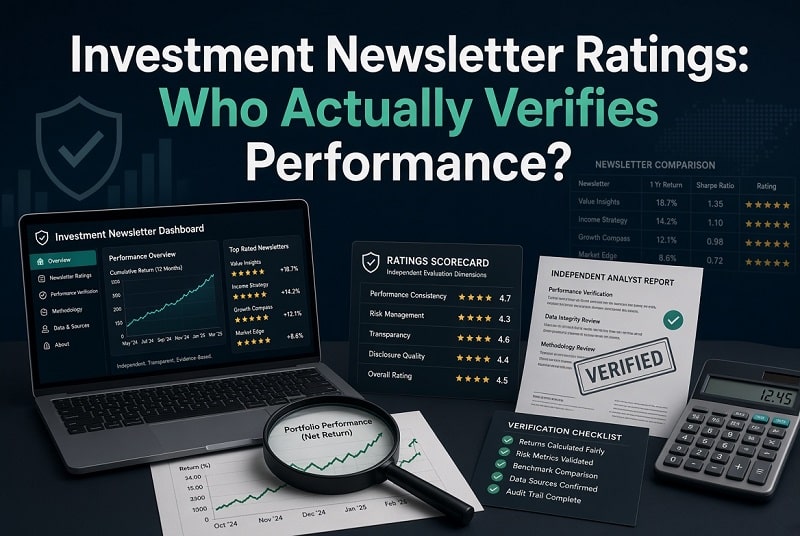
This is the part most marketing pages conveniently skip over. Investment newsletter ratings from an independent source matter a lot more than anything printed on a newsletter’s own sales page, for the obvious reason that a newsletter grading its own homework has every incentive to make the numbers look good.
Hulbert Ratings is still the most established independent rating body in this space. It tracks newsletters through hypothetical portfolios built strictly from their published recommendations, and it uses pseudonymous subscriptions specifically so no newsletter gets advance warning that it’s being watched. When a service can point to a Hulbert Honor Roll appearance — especially several years running — that’s a meaningfully stronger signal than a testimonial or a chart on the newsletter’s own homepage.
If you’d rather lean on algorithm-driven research instead of a single analyst’s picks, our guide to AI-powered stock picking services covers how that category is rated and priced differently from traditional newsletters.
Conclusion
The investment newsletter world has no shortage of confident claims and not nearly enough independent verification to back most of them up. The services actually worth paying for tend to share a few traits: a track record checked by someone other than the newsletter itself, clear reasoning behind each recommendation, and pricing that’s honest about what you’re getting for it. Start with your own goal — growth, income, retirement, just learning the ropes — narrow the list down to whatever’s actually built for that goal, and check the performance history before your card gets charged.