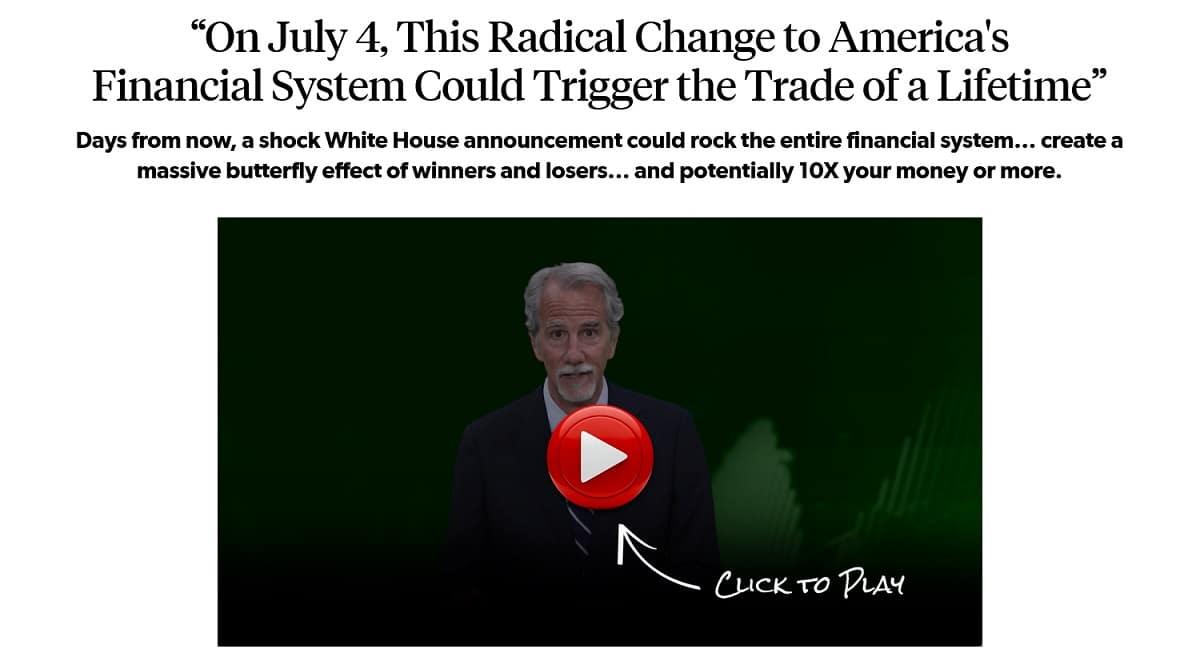
In the high-stakes world of finance, few names command attention like Dan Ferris. As a currency expert, stock picker, and longtime voice at Stansberry Research, Ferris has built a reputation for spotting seismic shifts before they hit the mainstream. His latest warning—or opportunity, depending on how you view it—centers on “Project Hamilton,” a purported radical overhaul of America’s financial system potentially launching as early as July 4, 2026.
The pitch? Treasury Secretary Scott Bessent, in coordination with monetary economist Dr. Judy Shelton, could announce gold-backed “Treasury Trust Bonds.” This move, tied to America’s 250th anniversary, might force a revaluation of U.S. gold reserves, spark massive demand for precious metals, and create asymmetric investment opportunities in gold royalty stocks and silver plays. Ferris claims this could dwarf historic trades by Paul Tudor Jones, George Soros, and Michael Burry.
But is it legit? Or is this another hyperbolic sales letter designed to sell newsletter subscriptions? Below, we’ll dissect the claims, examine the evidence, profile the key players, review historical precedents, evaluate the recommended investment thesis, address risks and skepticism, and explore the Extreme Value service offer. By the end, you’ll have a clear-eyed view of whether to engage—or sit on the sidelines.
Who Is Dan Ferris and Why Should You Listen?
Dan Ferris isn’t a household name like Warren Buffett, but within value investing and resource circles, he’s respected. He’s known for early warnings on the 2008 financial crisis, including flagging Lehman Brothers’ vulnerabilities. He also highlighted inflation risks in 2022 and called Bitcoin’s top before its plunge, alongside successful long calls on Apple and earlier Bitcoin entries.
Ferris positions himself as a currency expert who speaks with luminaries like Rick Rule, Jim Rickards, and Ron Paul. His track record at Stansberry Research includes triple-digit winners, with Extreme Value subscribers reportedly seeing gains like 597% on Constellation Brands or 410% on Prestige Consumer Healthcare.
In his emergency broadcast, Ferris ties Project Hamilton to a “butterfly effect” that could 10X money or more. The core narrative: Insiders are positioned; Main Street risks being left behind.
Understanding Project Hamilton: The Big Idea
Project Hamilton isn’t an official government program name but a label Ferris and his team use for Dr. Judy Shelton’s proposal for “Treasury Trust Bonds.” These would be U.S. Treasury-issued securities offering redemption at maturity in either dollars or a pre-specified amount of gold, at the holder’s choice.
Key Mechanics:
- Zero-coupon structure: Issued at a discount, no periodic interest payments. This could lower borrowing costs for the Treasury.
- Gold convertibility: Ties the dollar partially back to gold, absent since Nixon’s 1971 shock ending the Bretton Woods system.
- Timeline: Potential announcement on July 4, 2026—America’s 250th anniversary—with 50-year maturities suggested, aligning with the 300th in 2076.
- Backing: Leverages U.S. gold reserves (over 8,100 metric tons, ~261 million ounces), currently valued on books at $42.22/oz versus market prices around $3,300–$4,500+/oz (as of recent context).
Why Now? Ferris highlights bond market stress: Moody’s downgrade, foreign dumping by China and Japan, rising yields, and central banks favoring gold over Treasurys. Scott Bessent, as “the United States’ leading bond salesman,” faces a “fiscal doomsday machine” per Stanley Druckenmiller.
Proponents argue this restores dollar credibility, attracts institutional buyers (pensions, sovereign funds restricted from direct gold), saves on interest (U.S. pays ~$1T/year), and monetizes gold reserves without new printing.
Potential Revaluation Impact: Experts like Jim Rickards or Luke Gromen have speculated on gold repricing to $10,000–$27,000/oz range in extreme scenarios. A revaluation from $42 to market levels could add trillions to Treasury balance sheets on paper. Historical precedents include FDR’s 1933–34 revaluation from $20.67 to $35/oz.
Is this plausible? Shelton’s ideas have traction in policy discussions, with op-eds in WSJ and interviews noting political momentum. Trump administration figures like Bessent (with gold bug history) add credibility. However, full implementation faces hurdles: Congressional approval, Fed dynamics, inflation risks, and legal complexities. It’s not guaranteed by July 4—more an aspirational target.
The Key Players: Bessent, Shelton, and Hamilton’s Legacy
Scott Bessent: Former Soros CIO, architect of major currency trades (pound, yen). Now Treasury Secretary, controlling vast resources. Ferris calls him the “Mount Rushmore Trader.” Bessent’s public comments emphasize bond market stability and has acknowledged gold interests. His transition from hedge funds signals commitment.
Dr. Judy Shelton: Economist who predicted Soviet collapse, Fed nominee (2019–2020, blocked), author of “Good as Gold.” Her whitepapers advocate sound money. The January 26 meeting with Bessent is cited as pivotal. Shelton’s vision links to Alexander Hamilton’s financial foundations.
Alexander Hamilton Tie-In: Project name evokes the first Treasury Secretary’s push for stable U.S. credit. Ferris frames it as completing Hamilton’s vision 250 years later.
These aren’t fringe figures. Shelton’s proposals appear in mainstream outlets; Bessent’s role is real.
The Bond Market Crisis Narrative: Fact or Fearmongering?
Ferris details real pressures:
- Credit rating downgrades.
- Foreign divestment (China ~$4B/month, Japan record sales).
- Surging long-term yields.
- Central banks holding more gold than Treasurys.
- Quotes from Dalio, Druckenmiller, Jones, Dimon, Kiyosaki signaling concern.
These echo legitimate debates on U.S. debt sustainability ($35T+ national debt). However, the U.S. bond market remains the deepest, most liquid globally. “No one showed up” anecdotes often exaggerate auction dynamics—demand exists, albeit at higher yields.
Gold’s rise as reserve asset is factual amid de-dollarization talks. Project Hamilton could address this by offering a hybrid instrument—dollar liquidity with gold optionality.
Historical Parallels: Nixon Shock, FDR, Carter Bonds
- 1971 Nixon Shock: Ended dollar-gold convertibility, leading to gold bull market and mining/royalty gains (e.g., some stocks up thousands of percent).
- 1933–34: Gold confiscation + revaluation boosted prices.
- Carter Bonds: Foreign-currency denominated to attract buyers.
- TARP Warrants: Crisis-era instruments yielding big for early players.
Ferris argues royalty companies amplified gold’s moves (e.g., Franco-Nevada up massively). Past bull markets (1976–80 silver +977%; 2001–11 +1100%) show leverage.
Caveat: Past performance ≠ future. Geopolitics, rates, and tech (AI silver demand) differ today.
The Investment Thesis: Gold Royalties as “The Move After the Move”
Ferris’ top pick isn’t bullion, ETFs, or miners—it’s a gold royalty company. Royalties provide streaming revenue (percentage of production at fixed costs), offering leverage with lower operational risk.
Why Royalties Excel:
- Revenue rises with gold price; costs fixed.
- No exploration/drilling risk.
- Proven outperformance: One example from $4.65 to 373% gains on 30% gold rise; long-term multiples of gold’s return.
Insider buying cited: Billionaire bond expert (Paul Singer-like?), Dalio, Cohen, Murray Stahl, Renaissance Technologies. Ferris’ No. 1 is their largest holding per 13F.
Silver Angle: Industrial demand (AI, EVs, solar) + deficits create scarcity. Silver often outperforms gold in bull phases. Ferris’ silver stock pick targets this “catapult.
Nuclear Bonus: “America First” uranium renaissance via policy, supply shortages. Small market = explosive potential (Doug Casey quote). Two stocks recommended.
These align with resource cycles. Royalty/silver/uranium plays offer convexity.
Is It Legit? Addressing Skepticism
Pros/Evidence:
- Shelton’s proposal documented in WSJ, interviews, books.
- Bessent’s background and role fit.
- Macro tailwinds: Debt, geopolitics, gold buying by CBs.
- Ferris’ verifiable track record elements.
- Asymmetric setup: Limited downside if thesis partial; upside if revaluation hits.
Cons/Risks:
- Speculative Timing: July 4 announcement not confirmed. Policy shifts slowly.
- Execution Risk: Legal, market, political opposition.
- Opportunity Cost/Volatility: Precious metals cyclical; drawdowns common.S
- Revaluation Scale: Extreme $20k+ targets are bullish scenarios, not base case.
Legitimacy score: Core ideas have substance; specific stock pick and exact July 4 trigger are promotional extrapolations. Not a scam, but high-risk speculation. Suitable for those with high risk tolerance allocating small portfolio portions.
Deep Dive: Extreme Value Service and the Full Offer
Extreme Value is Ferris’ flagship newsletter: Monthly briefings, model portfolio, updates. Focus on undervalued, cash-flowing stocks, occasionally resources.

Special Offer (Limited-Time):
- 60% off 1-year Extreme Value ($999 vs $2,500).
- Free: No. 1 Project Hamilton Gold Stock report.
- Bonus: Silver Mania report + Nuclear Renaissance report.
- Mystery Gift ($2,999 value).
- Library access, updates.
- 30-day satisfaction (Stansberry Credit).
Total value pitched: $5,499+. Backed by guarantee, but read terms—no cash refunds.
Risks, Disclosures, and Responsible Investing
All investments carry risk. Past gains (20 doubles, etc.) don’t guarantee future. Precious metals volatile; government policy unpredictable. Diversify, use only risk capital. Ferris discloses track record averages ~62% since inception.
Why This Could Be Historic?
Project Hamilton taps real tensions: Fiat trust erosion, reserve currency challenges, asset scarcity. If executed, it could stabilize borrowing, boost gold/silver, reward royalty holders. Gold’s millennia role as money, combined with modern industrial needs, supports long-term bull case.
Conversely, if delayed or diluted, gains moderate. Broader economy (rates, growth, innovation) dominates.
Ferris’ call echoes his contrarian history. Whether “the trade of a lifetime” depends on unfolding events. Positioned readers (insiders per claims) may benefit; preparation beats reaction.
Conclusion: Act or Observe?
Dan Ferris’ Project Hamilton thesis blends verifiable policy discussion with high-conviction stock picks. The gold royalty angle offers logical leverage; silver and uranium add diversification. Legit foundation? Yes. Guaranteed moonshot? No—speculative.
For those intrigued, the Extreme Value offer provides low-commitment entry with reports and portfolio. Click to review order form if aligned with goals. Research independently, size positions conservatively.
The clock ticks toward July 4, 2026. History favors the prepared. Whether Project Hamilton delivers the biggest trade ever remains to be seen—but ignoring macro shifts rarely pays.
FAQ: Dan Ferris Project Hamilton – Your Questions Answered
What exactly is Project Hamilton and why is it tied to July 4, 2026?
Project Hamilton refers to Dr. Judy Shelton’s proposal for “Treasury Trust Bonds” — new U.S. Treasury-issued securities that can be redeemed at maturity in either U.S. dollars or a fixed amount of gold. Treasury Secretary Scott Bessent is reportedly considering this radical gold-backed bond structure, which could be announced on July 4, 2026, to coincide with America’s 250th anniversary. The goal is to restore confidence in the dollar, lower borrowing costs for the government, and monetize America’s gold reserves (currently undervalued at $42.22/oz on Treasury books). Dan Ferris believes this could trigger a major revaluation of gold and create one of the biggest investment opportunities in decades.
Is Dan Ferris’ Project Hamilton prediction legitimate or just marketing hype?
The core idea has real substance. Dr. Judy Shelton has advocated gold-linked Treasury instruments for years in whitepapers, books, and media appearances. Scott Bessent’s background as a currency trader and his public emphasis on fixing the U.S. bond market add credibility. Mainstream outlets like the Wall Street Journal, Forbes, and Bloomberg have discussed similar concepts. However, the exact timing of a July 4 announcement and the scale of any gold revaluation (potentially to $20,000+/oz in bullish scenarios) remain speculative. Ferris’ analysis builds on documented policy discussions, but readers should treat it as high-conviction speculation rather than a guaranteed event. Always do your own research.
What is Dan Ferris’ #1 recommended stock for Project Hamilton, and why a gold royalty company?
Ferris’ top pick is a junior-to-mid-tier gold royalty company (detailed in the free “No. 1 Project Hamilton Gold Stock” report). Royalty firms don’t mine gold themselves — they own the right to a percentage of production at fixed low costs. This structure provides powerful leverage: when gold prices rise due to revaluation or increased demand, revenue climbs sharply while costs stay flat, often delivering multiples of gold’s return. Ferris highlights strong institutional buying (including from billionaires and top hedge funds) and historical outperformance during past gold bull markets. It’s positioned as “the move after the move” — profiting from surging institutional demand without the risks of operating mines.
What are the main risks of investing based on this Project Hamilton thesis?
Precious metals and resource stocks are highly volatile. There is no guarantee the July 4 announcement will occur, or that gold will be revalued at the levels some experts project. Policy changes can face delays, political opposition, or modifications. Gold and silver prices can experience sharp drawdowns, and even strong royalty companies aren’t immune to market corrections. Past performance (e.g., triple-digit winners in previous cycles) does not guarantee future results. Ferris emphasizes only risking money you can afford to lose and “dipping your toe” rather than going all-in. Diversification and professional advice are essential.
What exactly do I get with the Extreme Value special offer and is it worth it?
For $999 (60% off the regular $2,500 price), you receive a full year of Dan Ferris’ Extreme Value service plus: the free “No. 1 Project Hamilton Gold Stock” report, the “How to Play the Coming Silver Mania” bonus report, the “America First Nuclear Renaissance” uranium report, a $2,999-value Mystery Gift, access to Ferris’ full model portfolio, monthly briefings, special updates, and the entire library of past issues/videos. You’re covered by Stansberry Research’s 30-day satisfaction guarantee (Stansberry Credit, not cash refund). Many members value the ongoing guidance through volatile markets, especially if Project Hamilton unfolds as described. The offer is time-sensitive and expires soon.