Quick Verdict
For a long-term investor with $5,000 available heading into 2027, a sensible starting point would be a diversified portfolio built mainly around low-cost broad-market index funds or ETFs, with some high-quality bonds or Treasury securities and, depending on the investor’s situation, a small cash reserve.
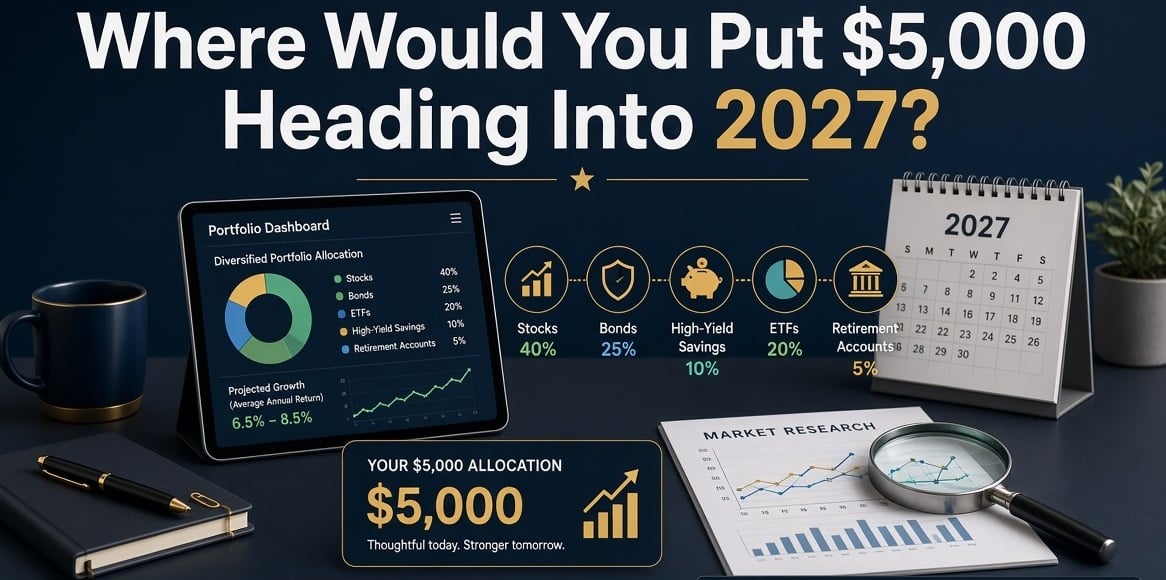
A simple moderate example would be roughly 60% in a broad U.S. stock index, 20% in an international stock index, 15% in high-quality bonds or Treasuries, and 5% in cash or a cash equivalent. On $5,000, that would mean approximately $3,000 in U.S. equities, $1,000 in international equities, $750 in bonds, and $250 in cash.
That is not a prediction that stocks will rise in 2027. It is a way to spread risk while keeping most of the money invested for long-term growth.
The current environment also gives investors more choices than they had when interest rates were near zero. As of September 16, 2026, the Federal Reserve’s target range for the federal funds rate is 3.75% to 4.00%. Treasury yields on September 22, 2026 were about 4.16% for three-month Treasuries, 4.26% for six-month Treasuries, 4.43% for one-year Treasuries, 4.71% for two-year Treasuries and 4.96% for 10-year Treasuries. At the same time, inflation remains above the Federal Reserve’s 2% objective, with August 2026 consumer prices up 3.4% over the previous year.
That combination matters. Stocks still provide the main long-term growth engine, but short-term government securities and high-quality bonds can also produce meaningful income while reducing the need to put every dollar into equities.
The other important question is not just what to buy. It is where to put the money. For money intended for retirement, a Roth IRA, traditional IRA, or workplace retirement plan can be more tax-efficient than a regular taxable brokerage account, depending on income, eligibility and circumstances. For money that may be needed in the next few years, keeping more of it in cash, Treasury bills or another low-volatility vehicle can make more sense.
The key is to avoid treating $5,000 as a lottery ticket. A diversified $5,000 portfolio can be useful even without finding the next explosive stock.
Key Takeaways
- A broad-market index fund or ETF can serve as the core of a $5,000 portfolio because it spreads the investment across many companies rather than making the outcome depend on one stock.
- A moderate allocation could place about 80% in stocks, 15% in high-quality bonds or Treasuries and 5% in cash, with the stock portion divided between U.S. and international markets.
- Investing the full amount immediately gives the money more time in the market. Vanguard research found that lump-sum investing historically outperformed cost averaging roughly two-thirds of the time, although gradual investing can make sense for investors who are particularly uncomfortable with near-term losses.
- The current interest-rate environment makes Treasury bills, Treasury notes and high-quality bond funds more useful portfolio tools than they were when yields were extremely low. Treasury bills have maturities of one year or less, while Treasury notes mature in more than one year but not more than 10 years.
- For retirement money, tax treatment can matter as much as the investment itself. The 2026 IRA contribution limit is $7,500, or $8,600 for people age 50 or older, subject to the usual compensation and eligibility rules.
- Heading into 2027, investors may want to watch several themes without building an entire portfolio around them: AI-related capital spending, elevated U.S. equity valuations, international diversification, interest rates, inflation and the growing role of fixed income.
How Would You Invest $5,000 for 2027?

The question sounds simple, but it contains several different decisions.
Someone asking where to invest $5,000 for 2027 could be asking about retirement money, money for a home, a child’s future, a future business, an emergency reserve or simply extra savings that has been sitting in a bank account.
Those goals should not be invested in the same way.
A person who will not need the money for 20 years can generally tolerate much more short-term market movement than someone who expects to spend the money in 18 months. The Securities and Exchange Commission’s investor education material makes the same basic point: asset allocation should reflect an investor’s time horizon and ability and willingness to tolerate risk.
That is why there is no single universally correct answer to the question, “Where should I put $5,000 heading into 2027?”
There is, however, a useful framework.
For most long-term investors, the first decision should be whether the $5,000 should be invested at all. If there is expensive credit-card debt, no emergency savings and a strong chance that the money will be needed soon, investing the entire amount in stocks may not be appropriate.
Once those issues are handled, the next question is how much risk the money can reasonably take.
That leads to the basic choices: stocks, bonds, cash and cash equivalents.
Stocks are generally used for long-term growth.
Bonds and Treasuries can provide income and can reduce the amount of a portfolio exposed to stock-market fluctuations.
Cash is useful for flexibility and short-term needs, but holding too much cash for too long can reduce the potential for long-term growth.
The final piece is diversification. Instead of trying to identify one perfect investment for 2027, an investor can own a mix of assets that respond differently to economic conditions.
Investor.gov describes diversification as spreading money among different investments so that losses in one area may be offset by gains or stability in another.
That does not eliminate losses. It simply avoids making one investment responsible for the entire result.
What Is Different About Heading Into 2027?
The investment backdrop in September 2026 is very different from the near-zero interest-rate environment that defined much of the 2010s.
The Federal Reserve raised the federal funds target range by 25 basis points on September 16, 2026, to 3.75%–4.00%. The Fed said economic activity was expanding at a solid pace, productivity growth was strong and capital investment was robust, while also noting that inflation remained elevated.
That means investors are no longer forced to choose between “almost no yield” in cash and “take stock-market risk” for potentially higher returns.
Short-term Treasury securities currently offer meaningful yields. On September 22, 2026, the Treasury’s published par yield curve showed approximately 4.16% for three-month maturities, 4.26% for six months, 4.43% for one year, 4.71% for two years and 4.96% for 10 years.
Those numbers can change every trading day, so they should be treated as a snapshot rather than a promise of what an investor will receive in the future.
Inflation is another important consideration.
The August 2026 CPI report showed consumer prices rising 0.4% for the month and 3.4% over the prior 12 months. Core CPI, excluding food and energy, increased 2.4% over the year.
The employment market is also still functioning at a relatively solid level. August payroll employment increased by 162,000 and the unemployment rate was 4.1%, according to the Bureau of Labor Statistics.
Economic growth, however, slowed during the second quarter. Real GDP increased at a 1.5% annual rate in the second quarter of 2026, compared with 2.1% in the first quarter.
This is why a 2027 portfolio should not be built around one simple prediction such as “rates are falling” or “stocks are going up.
There are several moving pieces.
Interest rates can affect borrowing costs and company valuations.
Inflation can affect consumer purchasing power and the Federal Reserve’s decisions.
Economic growth can affect corporate earnings.
Geopolitical developments can affect energy prices, trade and investor sentiment.
And technology investment, particularly AI-related spending, is increasingly important to corporate capital expenditure.
Fidelity’s 2026 midyear analysis noted that strong AI spending and corporate earnings were supporting stocks, but also highlighted the possibility that higher energy prices and inflation could pressure interest rates and equities.
That backdrop argues for diversification rather than a single-market bet.
If You Had $5,000 Available to Invest Heading Into 2027, Where Would You Put It and Why?
For a hypothetical moderate long-term investor, one reasonable starting allocation is:
| Investment | Percentage | Dollar Amount |
|---|---|---|
| Broad U.S. stock index fund or ETF | 60% | $3,000 |
| International stock index fund or ETF | 20% | $1,000 |
| High-quality bonds or Treasury fund/securities | 15% | $750 |
| Cash or cash equivalent | 5% | $250 |
| Total | 100% | $5,000 |
The important idea is not the exact percentages.
It is the structure.
The majority of the money is invested in productive assets for long-term growth. The portfolio is not dependent exclusively on U.S. stocks. A smaller bond allocation provides another source of income and diversification. A small cash position provides flexibility.
Why make broad U.S. stocks the largest piece?
Broad U.S. stock index funds offer exposure to hundreds or thousands of companies, depending on the index and fund.
Rather than trying to select one company that will outperform in 2027, the investor owns a piece of many businesses across different sectors.
That does not mean the portfolio cannot fall.
A broad stock index can still decline sharply during a bear market or recession. But concentration risk is lower than it would be if the investor placed the entire $5,000 into one company or one narrow industry.
The SEC notes that index funds generally use a passive strategy designed to achieve approximately the return of the index they track before fees. Index investing can also involve relatively low costs, although investors still need to examine each fund’s actual expenses.
For a $5,000 account, simplicity can be a major advantage.
An investor does not necessarily need 10 different ETFs.
One broad U.S. stock fund can provide the domestic equity core.
One international fund can add non-U.S. exposure.
One bond fund or a Treasury ladder can provide fixed income.
That can be enough for a complete portfolio.
Why include international stocks?
U.S. companies have been exceptionally important to global stock-market returns, but a portfolio does not need to assume that the United States will outperform every other market forever.
International diversification provides exposure to other economies, currencies, industries and valuation levels.
Fidelity’s June 2026 international outlook noted that non-U.S. shares had continued gaining and generally remained valued at a discount to U.S. stocks, while also pointing to AI opportunities outside the major U.S. technology companies. Fidelity highlighted areas such as hardware, power infrastructure, materials, industrials and financial companies as examples of businesses that can benefit from broader AI-related investment.
This is important because the economic effects of artificial intelligence are not limited to companies that sell AI software.
A data center needs electricity.
It needs networking equipment.
It needs semiconductor manufacturing.
It needs cooling systems.
It needs construction.
It needs real estate.
It needs communications infrastructure.
It needs materials and industrial equipment.
Some of those businesses are outside the group of well-known U.S. technology companies.
International diversification is therefore not necessarily a bet against U.S. technology. It is a way of avoiding an unnecessarily narrow portfolio.
Why hold bonds heading into 2027?
The answer is partly about current yields.
The Treasury curve in September 2026 provides investors with the opportunity to earn interest from government securities without taking the same stock-market risk associated with equities.
A three-month Treasury yield around 4.16% and a two-year Treasury yield around 4.71% are meaningful compared with the low-yield environment many investors became accustomed to.
The trade-off is that fixed-income investments have their own risks.
Bond funds can lose value when interest rates rise. Longer-duration bond funds generally have greater sensitivity to interest-rate movements than shorter-duration funds. The SEC also points out that bond funds face credit risk, interest-rate risk and other risks.
This is one reason a small investor may prefer high-quality short- or intermediate-term bonds instead of reaching for high-yield bonds simply because the yield looks larger.
Higher yield usually comes with higher risk somewhere in the structure.
Why keep $250 in cash?
The cash allocation is optional.
An investor with a fully funded emergency reserve might not need a separate $250 cash position inside the investment portfolio.
An investor who wants some flexibility could keep it in a high-yield savings account, money market fund or similar vehicle.
The purpose is not to predict a market crash.
The purpose is to have a small amount available without having to sell an investment.
The distinction between a bank deposit and an investment product also matters. FDIC insurance covers eligible deposits at insured banks, such as savings accounts, certificates of deposit and certain money market deposit accounts. Stocks, bonds and mutual funds are not FDIC-insured deposits. The standard FDIC insurance limit is $250,000 per depositor, per insured bank, per ownership category.
A Simpler $5,000 Portfolio Could Be Even Easier
Not every investor needs four separate holdings.
A person who values simplicity could use a single diversified target-date fund or a broadly diversified asset-allocation fund.
Target-date funds generally hold combinations of stock and bond funds and adjust their allocation over time as the target date approaches.
Another approach is a two-fund portfolio:
80% broad stock index funds and 20% high-quality bonds.
That would mean:
$4,000 stocks
$1,000 bonds
A more aggressive investor might use something closer to:
90% stocks
10% bonds or cash
And a conservative investor might use something closer to:
40% stocks
40% bonds
20% cash or short-term Treasuries
These are examples, not universal formulas.
The SEC specifically warns that there is no single asset allocation model that is appropriate for every financial goal.
Should You Invest the $5,000 All at Once or Gradually?
This is one of the most difficult psychological decisions.
Suppose you invest all $5,000 today and the market falls 15% during the next three months.
The account would temporarily be worth about $4,250 before considering dividends, interest or any other changes.
That can feel terrible even when the original plan is long term.
Now consider the opposite.
Suppose you keep the $5,000 in cash and invest $500 each month for 10 months.
The market rises strongly during that period.
You may end up wishing you had invested everything at the beginning.
Both situations are possible.
The important difference is that the two strategies are taking different risks.
The case for investing the $5,000 immediately
When the money is already available and the investor has a long-term horizon, investing immediately gives the portfolio more time to participate in market returns.
Vanguard research comparing lump-sum investing with cost averaging found that lump-sum investing historically outperformed cost averaging approximately two-thirds of the time. Vanguard explained that the reason is straightforward: when assets are expected to earn a risk premium over cash, leaving money uninvested creates an opportunity cost.
This does not mean a lump-sum investment will always outperform.
It simply means there is a cost to waiting.
If stocks rise during the period in which you are holding cash, the cash does not participate in that increase.
FINRA makes the same basic point: dollar-cost averaging can reduce the emotional risk of investing a lump sum at the wrong time, but holding money in cash longer can mean missing gains.
The case for gradual investing
Dollar-cost averaging means investing equal amounts at regular intervals rather than putting the entire amount into the market at once.
Investor.gov describes dollar-cost averaging as investing equal portions at regular intervals regardless of market movements. When prices fall, the same dollar amount buys more shares. When prices rise, it buys fewer shares.
For a $5,000 investment, a six-month schedule could be:
| Month | Amount Invested |
|---|---|
| Month 1 | $833 |
| Month 2 | $833 |
| Month 3 | $833 |
| Month 4 | $833 |
| Month 5 | $833 |
| Month 6 | $835 |
| Total | $5,000 |
Another option is $1,000 per month for five months.
The exact schedule is less important than actually following it.
What matters more than the mathematical difference?
Behavior.
If an investor puts $5,000 into the market immediately, sees the market fall 15%, panics and sells, then the theoretical advantage of lump-sum investing becomes irrelevant.
A disciplined six-month strategy may produce a different return, but it may keep the investor committed to the plan.
FINRA notes that dollar-cost averaging can reduce the emotional pressure associated with trying to select the “right” time to invest.
That is an important consideration for people who know they would struggle to stay invested after a large short-term decline.
A middle-ground approach
An investor does not have to choose between exactly $5,000 today and exactly six equal monthly purchases.
One practical compromise would be to invest a larger amount immediately and reserve the rest for scheduled purchases.
For example:
$3,000 invested immediately
$500 per month for four months
That gets 60% of the money working immediately while creating a predetermined schedule for the remaining 40%.
The danger is changing the plan based on headlines.
A gradual strategy should not become:
“I will invest the rest when the market looks better.”
That is market timing.
A better rule is:
I will invest the next $500 on the first trading day of each month regardless of what the headlines say.
That turns a market prediction into a process.
What Specific Investments Would You Consider?

For a $5,000 portfolio, there are four broad categories worth understanding: index funds, ETFs, bonds and individual stocks.
Each has a different role.
Index funds
An index fund is designed to track a market index.
Examples include funds that track:
- a broad U.S. stock index,
- a large-company U.S. index,
- a total U.S. stock market index,
- an international stock index,
- a bond index.
The main attraction is diversification and simplicity.
Investor.gov notes that index funds are generally passively managed and that passive management may reduce costs, although fees vary and investors should examine the actual cost of a fund.
For a $5,000 account, low costs matter because every fee is coming out of a relatively small investment base.
A fund charging 0.05% and one charging 1.00% may not look dramatically different on a brokerage screen.
But fees compound over time.
The SEC explains that even small differences in fund expenses can have a meaningful impact on long-term returns.
ETFs
An exchange-traded fund can hold a diversified portfolio of stocks, bonds or other securities and trades on an exchange.
ETFs can be useful for a $5,000 portfolio because one fund can provide exposure to a large number of securities.
However, “ETF” does not automatically mean diversified.
There are ETFs focused entirely on one industry, one country, one commodity, one theme or even a leveraged trading strategy.
A semiconductor ETF and a total-market ETF are both ETFs, but they behave very differently.
The label is less important than what the fund actually owns.
The SEC recommends checking the fund’s investment objective, assets, adviser and fees before investing.
Bonds and Treasury securities
Bonds can play several roles.
They can provide income.
They can diversify a stock portfolio.
They can provide stability relative to stocks.
And with interest rates at substantially higher levels than the ultra-low-rate era, high-quality fixed income can now make a more meaningful contribution to portfolio income.
Treasury bills have maturities of one year or less. Treasury notes mature in more than one year but not more than 10 years. Treasury bonds have maturities longer than 10 years.
An investor using $5,000 could simply purchase short-term Treasury bills with a portion of the portfolio.
Another option is a Treasury ETF or a diversified bond ETF.
The difference is important.
When you buy an individual Treasury security and hold it to maturity, you know the maturity date and coupon or discount structure.
A bond fund does not mature in the same way.
Its share price continues to fluctuate as the bonds inside the fund change in value.
That can make a bond fund convenient, but it also means that an investor should understand duration and interest-rate risk.
Individual stocks
There is nothing inherently wrong with owning individual stocks.
The problem is making them the foundation of a $5,000 portfolio without understanding the concentration risk.
Suppose an investor puts:
$4,000 into one company
$1,000 into another
That portfolio has only two major sources of equity risk.
One earnings surprise could have a large effect on the entire account.
By contrast, a broad index fund spreads the money across many businesses.
For an aggressive investor who specifically enjoys researching individual companies, allocating a small “satellite” portion to individual stocks can be reasonable.
For example, an aggressive portfolio might use 80% or 90% broad funds and 10% or 20% for individual ideas.
That keeps stock picking from determining the entire outcome.
How Would the $5,000 Allocation Change for Conservative, Moderate and Aggressive Investors?
Risk tolerance changes the answer more than predictions about 2027.
Conservative investor
A conservative investor’s priority is usually capital preservation and lower volatility rather than maximum growth.
An example allocation might be:
| Asset | Percentage | Amount |
|---|---|---|
| Broad U.S. stock index | 30% | $1,500 |
| International stock index | 10% | $500 |
| High-quality bonds/Treasuries | 40% | $2,000 |
| T-bills/cash equivalents | 20% | $1,000 |
| Total | 100% | $5,000 |
This portfolio still has stock exposure, but half of the money is outside stocks.
That can make a major difference during a bear market.
The trade-off is that it may produce less long-term growth if stocks substantially outperform bonds and cash.
A conservative investor should not select a high stock allocation simply because stocks have recently performed well.
Moderate investor
A moderate investor typically wants meaningful growth while accepting some volatility.
A possible allocation is:
| Asset | Percentage | Amount |
|---|---|---|
| Broad U.S. stock index | 60% | $3,000 |
| International stock index | 20% | $1,000 |
| Bonds/Treasuries | 15% | $750 |
| Cash | 5% | $250 |
| Total | 100% | $5,000 |
This keeps 80% in equities but gives the portfolio a 20% stabilizing component.
This is the model allocation used earlier in the article.
It is not “the” moderate portfolio. It is simply one example of how a diversified approach can work.
Aggressive investor
An aggressive investor with a long time horizon may be comfortable with larger stock-market losses in pursuit of higher expected long-term returns.
An example could be:
| Asset | Percentage | Amount |
|---|---|---|
| Broad U.S. stock index | 65% | $3,250 |
| International stock index | 20% | $1,000 |
| Small-cap/value or other diversified equity exposure | 10% | $500 |
| Individual stocks or thematic exposure | 5% | $250 |
| Total | 100% | $5,000 |
Notice what is still missing.
There is no 50% allocation to the hottest stock.
There is no leveraged ETF.
There is no attempt to turn $5,000 into $50,000 in a year.
Aggressive does not have to mean reckless.
A highly aggressive portfolio can still be diversified.
That distinction is especially important when an investor is influenced by stories about artificial intelligence, quantum computing, cryptocurrencies or other fast-moving themes.
The Biggest Mistake Is Confusing Risk Tolerance With Risk Capacity
There are two separate ideas.
Risk tolerance is how comfortable you are with fluctuations and losses.
Risk capacity is how much loss you can actually afford.
Someone may say they are comfortable with a 30% market decline.
But if they need the $5,000 for a house down payment next summer, they may not have the financial capacity to accept that decline.
The SEC emphasizes that time horizon is one of the key considerations in determining an appropriate asset allocation.
A portfolio for retirement in 2045 can look very different from a portfolio for tuition due in 2028.
Would Current Interest Rates and Market Conditions Affect the Decision?
Yes, but not in the way many investors think.
Current market conditions should influence the mix of assets and assumptions about risk, not cause an investor to abandon a long-term plan every time the market moves.
As of September 2026, the federal funds target range is 3.75% to 4.00%. The 10-year Treasury yield was about 4.96% on September 22.
That changes the opportunity cost of holding cash and the attractiveness of bonds.
Higher rates make cash more useful
When short-term rates are close to zero, holding a significant amount of cash can be expensive because the investor gives up much of the potential return available from productive assets.
When Treasury yields are around 4%, the cost of holding a short-term reserve is lower.
That does not mean cash is the best long-term investment.
It means cash now has a more meaningful return than it did during the ultra-low-rate period.
Higher rates can also make bonds more attractive
Bond prices and yields generally move in opposite directions.
When rates rise, existing bond prices generally fall.
When rates decline, existing bonds can rise in price.
That is one reason an investor thinking about bonds should consider duration.
A short-term Treasury fund generally has less interest-rate sensitivity than a long-term bond fund.
The SEC notes that longer-maturity bond funds are generally more sensitive to interest-rate changes than shorter-maturity funds.
Rates also matter for stocks
Stock valuations are affected by interest rates because investors compare potential equity returns with the returns available elsewhere.
Higher rates can also increase borrowing costs for businesses.
Lower rates can make financing cheaper and can change how investors value future corporate profits.
That does not create a simple “rates down = stocks up” rule.
Economic growth, inflation, earnings, credit conditions and market valuations all matter.
What Should Investors Watch in 2027?
An investor does not need to forecast the economy correctly.
But several trends deserve attention.
AI spending
Artificial intelligence is one of the largest investment themes in global markets.
Fidelity’s 2026 research pointed to strong AI-related capital spending as an important driver of corporate earnings and broader market performance. It also estimated that major U.S. technology companies were expected to spend more than $700 billion during 2026 on data centers and related infrastructure.
The important question for a diversified investor is not simply:
“Which AI stock will explode?”
A better question is:
“Which parts of the economy are receiving investment because of AI?”
The answer reaches beyond software.
It includes semiconductors, electricity generation, power transmission, data-center construction, cooling equipment, industrial automation, networking, materials and infrastructure.
It also creates a valuation question.
When a theme becomes extremely popular, investors may pay high prices for companies expected to benefit.
Vanguard’s July 2026 capital-markets outlook said U.S. equity valuations had become more stretched after a strong rally and reduced its 10-year projected return range for U.S. equities to 4.2%–6.2%, while saying value stocks had the most attractive expected-return profile within U.S. equities in its model. Those figures are forecasts, not guarantees, and should not be interpreted as a prediction of the 2027 market return.
International diversification
The second trend worth watching is the widening opportunity set outside the United States.
International markets can perform differently from U.S. markets because they have different currencies, industries, valuations, interest rates and economic cycles.
Fidelity has specifically highlighted overseas AI opportunities and other industries benefiting from strategic investment in infrastructure, defense, materials and industrial capacity.
A global approach can therefore reduce the risk of having the entire stock allocation tied to one country’s valuation and economic outlook.
Fixed income
Bonds are another trend worth watching because the starting yield matters.
Fidelity’s third-quarter 2026 outlook said bond yields suggested fixed-income valuations were close to long-term averages and could provide solid income as part of a diversified portfolio.
For years, investors seeking income often felt pushed toward stocks with high dividend yields or risky credit.
Higher Treasury yields give investors another option.
That does not mean bonds will outperform stocks.
It means bonds can once again play a meaningful role in a portfolio without requiring investors to accept extremely low yields.
Inflation
Inflation remains one of the biggest variables heading into 2027.
August 2026 CPI was up 3.4% over the previous year, while core CPI was up 2.4%.
If inflation remains higher for longer, interest rates could also remain higher than investors expect.
That could affect both stock valuations and bond prices.
It may also affect household budgets, wage growth and corporate margins.
That is why investors should avoid building a portfolio around one Federal Reserve forecast.
How Much of the $5,000 Should Stay in Cash?
There is no required cash percentage.
A reasonable answer depends on whether the investor already has an emergency fund.
If a person has six months of living expenses sitting safely in a separate account, there may be little reason to maintain a large cash position inside a long-term $5,000 investment portfolio.
If that $5,000 is also the person’s emergency fund, then investing it in stocks may be inappropriate.
A useful distinction is between investment cash and emergency savings.
Emergency savings exists because life is unpredictable.
Investment cash exists primarily for liquidity, planned purchases or a deliberate asset allocation.
Those are different jobs.
Three possible cash approaches
A long-term aggressive investor might keep:
0%–5%
A moderate investor might keep:
5%–10%
A conservative investor might keep:
10%–20% or more
Again, these are illustrations.
The more important rule is that money needed within the next year or two should generally not be treated like long-term stock-market capital.
For short-term reserves, investors often use insured bank deposits, money market funds or short-term Treasury securities.
Remember that a bank savings account and a money market mutual fund are not the same thing.
FDIC insurance applies to eligible bank deposits, not to mutual funds or stocks and bonds.
Which Account Is Better: IRA, Roth IRA, Taxable Brokerage or Something Else?

The account can be as important as the investment.
There is no universal winner because the best account depends on the purpose of the money and the investor’s tax situation.
But for someone investing $5,000 specifically for retirement, tax-advantaged accounts deserve serious consideration.
Roth IRA
A Roth IRA is particularly attractive for many long-term investors because contributions are made with after-tax dollars, while qualified distributions can be tax-free.
The IRS states that Roth IRA contributions are not deductible, but qualified distributions are generally tax-free. A Roth IRA also does not require distributions for the original owner during the owner’s lifetime under the general rules.
The 2026 IRA contribution limit is $7,500 for people under age 50 and $8,600 for those age 50 or older, subject to the compensation and other rules.
That means a $5,000 contribution would fit within the 2026 annual IRA limit for an eligible investor.
Income limits can affect direct Roth IRA eligibility.
For 2026, the Roth IRA contribution phase-out range is $153,000 to $168,000 for single taxpayers and heads of household, and $242,000 to $252,000 for married taxpayers filing jointly.
Those figures are for 2026. Investors making a 2027 contribution should check the IRS’s current 2027 limits and eligibility rules when they are published.
Traditional IRA
A traditional IRA may offer a current tax deduction depending on income, filing status and whether the investor or spouse participates in a workplace retirement plan.
The IRS explains that traditional IRA contributions may be fully or partially deductible, and amounts inside the account are generally not taxed until distribution.
The question is therefore partly about taxes today versus taxes later.
An investor in a high current tax bracket may value a potential deduction.
Another investor may prefer a Roth because of the potential for tax-free qualified withdrawals later.
401(k)
A workplace 401(k) can be even more important if the employer offers matching contributions.
For 2026, the employee elective deferral limit for most traditional 401(k) plans is $24,500.
A person receiving an employer match should consider that benefit before treating the $5,000 as a separate brokerage investment.
For example, suppose someone contributes enough to a workplace plan to receive a full employer match.
The first priority may be ensuring that the match is captured.
The precise rules depend on the employer plan.
Taxable brokerage account
A taxable brokerage account is more flexible.
There is no retirement-age restriction simply because the account is a brokerage account.
The trade-off is that dividends, interest and realized capital gains can create current tax consequences.
For money that may be needed before retirement, that flexibility can be valuable.
For money intended specifically for retirement and eligible for tax-advantaged treatment, an IRA or employer retirement plan can be more tax-efficient in many circumstances.
The Account and the Investment Should Be Considered Together
An investor sometimes asks:
“Should I buy an ETF or a mutual fund?”
The more useful question can be:
“What am I investing for, and which account will hold it?”
A broad equity fund in a Roth IRA has a different tax context from the same investment in a taxable brokerage account.
A bond fund can have different tax implications in different accounts.
A Treasury security can have different tax characteristics from a corporate bond.
The IRS rules can become complicated, particularly when an investor has multiple retirement accounts, nondeductible IRA contributions or Roth conversions.
For complex situations, professional tax advice may be worthwhile.
Which Investment Trends Should Investors Watch Heading Into 2027?
The strongest trend may not be a single sector.
It may be the interaction between technology spending, energy needs, capital investment, interest rates and valuation.
AI infrastructure
The first major trend is the build-out of AI infrastructure.
AI requires enormous amounts of computing power.
That creates demand for chips, networking, data centers and electricity.
It can also create demand for cooling systems, construction and grid investment.
This matters to a $5,000 investor because it is easy to hear about one popular AI company and miss the broader economic chain.
An index fund may already own many companies benefiting from this trend.
That makes diversification particularly useful.
An investor does not necessarily need to identify the single biggest AI winner.
Power demand
AI data centers require electricity.
That means an investor interested in the economic effects of AI should also pay attention to energy and power infrastructure.
This is not an argument that energy stocks must outperform in 2027.
It is simply a reminder that technology trends can create second-order effects.
International technology
Fidelity’s 2026 international outlook specifically argued that AI opportunities could extend beyond the United States and beyond the biggest technology companies.
That supports the case for considering international funds rather than assuming every technology winner must be a U.S. mega-cap.
Value stocks
Vanguard’s July 2026 outlook said U.S. equity valuations had become more stretched and identified value stocks as having the most attractive expected-return profile within U.S. equities in its model.
That does not mean every investor should switch to value stocks.
It does suggest that valuation deserves attention when building a portfolio for the next decade.
A diversified investor can address that without trying to predict the exact month when growth stocks will fall or value stocks will rise.
Bonds returning to the conversation
The fixed-income market should also remain important heading into 2027 because yields are meaningfully higher than during the zero-rate era.
Investors may find that they can earn reasonable income from high-quality fixed income without reaching deeply into speculative credit.
That can make the stock-bond balance more relevant again.
What Should You Avoid Doing With a $5,000 Lump Sum Right Now?
The most useful answer may be a list of behaviors rather than a list of forbidden investments.
Avoid putting everything into one stock
A $5,000 portfolio can be badly damaged by one company-specific mistake.
Even a company with excellent products can disappoint investors because of valuation, competition, regulation, debt, management decisions or changing economic conditions.
A single stock can therefore be a poor substitute for diversification.
Avoid treating a market forecast as certainty
No one knows the exact level of the S&P 500 in December 2027.
No one knows exactly where interest rates will be.
No one knows whether inflation will return to the Federal Reserve’s 2% target quickly or remain elevated.
That uncertainty is a reason to diversify.
It is not a reason to do nothing.
Avoid chasing whatever just went up
Investors often notice a stock after it has already risen dramatically.
The problem is that the price reflects expectations.
A great company can still be a poor investment if an investor pays too much for it.
Fidelity’s 2026 outlook acknowledged strong AI-driven earnings and capital spending while also warning that elevated valuations for AI-linked stocks leave markets vulnerable to volatility.
That is a good reason to separate a company’s business prospects from the price being paid for those prospects.
Avoid leverage you do not understand
Leveraged and inverse ETFs can produce very different results from what a new investor might expect.
Options can multiply both gains and losses.
Margin can cause an investor to lose more than the original capital.
Those tools can have legitimate uses, but they are not necessary for a basic $5,000 portfolio.
Avoid investing emergency savings
This is one of the most important points.
If the $5,000 may be needed for an emergency, it may not belong in stocks at all.
Stock prices can fall precisely when people need money most.
Avoid paying high fees for a simple portfolio
A $5,000 account does not need a complicated collection of high-cost investments.
The SEC explains that fund expenses reduce investment returns and that investors should examine the actual costs associated with funds and ETFs.
Avoid trying to predict every market correction
Corrections are normal.
Trying to avoid every decline requires being right twice: once when selling and again when buying back.
That is much harder than it sounds.
A written asset allocation can reduce the temptation to turn investing into a series of market forecasts.
What About Buying Cryptocurrency With the $5,000?
Cryptocurrency is another area investors may consider when deciding how to invest $5,000 heading into 2027.
The important distinction is between making a diversified investment and making a highly speculative allocation.
If cryptocurrency is part of the plan, it should generally be treated as a speculative satellite position rather than assuming it will behave like a broad stock index.
An investor who puts 5% of a $5,000 portfolio into a speculative asset has exposed $250 to that risk.
An investor who puts 80% into it has exposed $4,000.
The difference is enormous.
A portfolio does not become conservative simply because the investor owns several different cryptocurrencies.
True diversification means diversification across assets and risks, not simply owning several securities within the same speculative category.
Is There Anything Else to Recommend When Investing an Extra $5,000?
The biggest recommendation is to think about the $5,000 as the beginning of a process rather than a one-time bet.
Suppose a person starts with $5,000 and then adds $250 every month.
That monthly contribution can become more important than choosing between two similar index funds.
At a 6% hypothetical annual return, a $5,000 starting balance followed by $250 monthly contributions could grow substantially over a long period.
The point of the example is not to predict a 6% return.
Actual returns will vary.
The point is that ongoing contributions can matter more than obsessing over the precise entry point for one $5,000 investment.
FINRA emphasizes regular investing and notes that even relatively small investments can compound over time.
Have a written allocation
Write down the intended allocation.
For example:
60% U.S. stocks
20% international stocks
15% bonds
5% cash
Then decide how often to rebalance.
Perhaps once or twice a year.
The goal is not to constantly trade.
It is to prevent the portfolio from drifting far away from the level of risk originally chosen.
The SEC describes rebalancing as bringing a portfolio back toward its target allocation after different investments have moved at different rates.
Reinvest dividends
For long-term investments, reinvesting dividends can help compound returns.
The effect becomes more noticeable over long periods.
Increase contributions when income rises
A $5,000 investment is useful.
A $5,000 investment followed by regular contributions can be much more powerful.
Someone receiving a raise may choose to increase monthly retirement contributions.
Someone paying off a car loan may redirect part of that former payment toward investments.
The habit can matter more than the initial amount.
Should the $5,000 Be Invested in Dividend Stocks?
Dividend stocks may be attractive to investors seeking income, but dividend yield should not be confused with safety.
A company paying a 7% dividend is not automatically safer than a company paying 2%.
A high yield can sometimes reflect a falling share price or concerns about the sustainability of the dividend.
For a small portfolio, it may be more practical to use a diversified dividend ETF rather than selecting a handful of individual dividend stocks.
A diversified dividend fund can provide exposure to a larger collection of companies.
However, investors should remember that dividend payments are not guaranteed.
Companies can reduce or eliminate dividends.
Stock prices can also fall even while dividends continue.
For investors whose primary goal is long-term total return, a broad-market fund may be a simpler core holding than trying to maximize dividend yield.
What About Small-Cap Stocks?
Small-cap stocks can add another source of diversification.
They represent smaller companies and can behave differently from large-cap companies.
They also tend to carry higher volatility.
For an aggressive investor, a modest allocation to a diversified small-cap or small-cap-value fund could be considered.
For a conservative investor, it may not be necessary.
Again, the purpose is not to predict which market segment will win in 2027.
It is to construct a portfolio that does not depend entirely on one segment winning.
How Much of the $5,000 Should Go Into Individual Stocks?
For a beginner, potentially none.
A broad-market fund can already provide enough equity exposure.
For an experienced investor who wants to research companies directly, 5%–10% of the portfolio could be used for individual-stock ideas without making them the main driver of the portfolio.
For $5,000, that means:
5% = $250
10% = $500
That is a much different risk profile from putting $4,500 into two speculative companies.
The purpose of a satellite allocation is to allow room for active investing without replacing diversification.
Should You Wait for a Stock-Market Correction Before Investing?
Waiting for a correction sounds logical because it creates the possibility of buying at lower prices.
The problem is identifying the correction in advance.
Maybe stocks fall 10%.
Then you wait for 15%.
Stocks recover before reaching 15%.
You wait again.
The market rises another 20%.
The investor eventually buys at a higher price than the original entry point.
This is one of the central problems with market timing.
FINRA points out that attempts to time the market can backfire and that dollar-cost averaging may help investors avoid making emotionally driven decisions.
The alternative is not pretending the market cannot fall.
It is acknowledging that markets can fall and building a portfolio capable of surviving that possibility.
What If the Market Crashes Right After Investing the $5,000?
That possibility should be accepted before making the investment.
An investor who cannot tolerate seeing $5,000 temporarily become $4,000 should probably not put the entire amount into stocks.
But an investor with a 15- or 20-year horizon may have time to recover from a downturn.
This is the difference between price risk and permanent loss.
A market decline does not automatically create a permanent loss if the investor remains invested in diversified assets and eventually participates in the recovery.
However, there is an important qualification.
There is never a guarantee that a particular investment will recover.
Individual companies can fail.
Some industries decline permanently.
That is another reason broad diversification matters.
Could Treasury Bills Be the Best Place for the $5,000?
For a person with a short time horizon, they could be.
For example, suppose the investor knows the $5,000 will be used to pay for a major expense in six months.
Putting that money into a stock index fund creates the possibility that the account will be worth less when the bill arrives.
A Treasury bill with a maturity aligned to the spending date may be much more appropriate.
Treasury bills are short-term securities with original maturities that include four, six, eight, 13, 17, 26 and 52 weeks, along with cash-management bills of varying maturity.
For an emergency fund, a high-yield savings account or another suitable cash-equivalent option may be more practical because the money can be accessed without needing to sell an investment.
The key is matching the maturity and liquidity of the asset to the need for the money.
What If the Investor Is Five Years From Retirement?
That changes the answer considerably.
A person five years from retirement may have less ability to wait through a prolonged stock-market decline.
They may need more bonds and cash than a 30-year-old investor with several decades until retirement.
They may also want to separate the portfolio into different time horizons.
For example:
Money needed in the next one to three years: cash and short-term fixed income.
Money needed several years later: bonds and a moderate stock allocation.
Money not needed for many years: more equity exposure.
The SEC’s asset-allocation guidance makes the basic point that investors with longer horizons can generally tolerate more volatile investments because they have more time to recover from market declines.
This is why the phrase “best investment for 2027” can be misleading.
The right investment depends on when the money will be spent, not simply the calendar year.
A $5,000 Portfolio for Three Different Time Horizons
Consider three hypothetical investors.
Investor A: Money needed in 12 months
This investor may have no business taking substantial stock-market risk.
A possible structure could be:
60% short-term Treasury bills
30% high-yield savings or money-market-type cash vehicle
10% stocks
The exact allocation would depend on the purpose and ability to tolerate losses.
Investor B: Money needed in 7–10 years
This investor can generally accept more volatility.
A possible structure might be:
60% stocks
30% bonds
10% cash
Investor C: Retirement money for 20+ years
This investor can potentially hold significantly more stocks.
A possible structure might be:
80%–90% diversified equities
10%–20% bonds
The examples show why there cannot be one universal answer to where to put $5,000 heading into 2027.
What Does a Financial-Advisor-Style Answer Look Like?
If the question is framed as, “You have $5,000. Where would you put it?”, a careful advisor-style response should start with questions.
How old are you?
When will you need the money?
Do you have emergency savings?
Do you have high-interest debt?
Do you receive an employer 401(k) match?
Have you already contributed to an IRA?
What is your tax bracket?
How would you respond if the account dropped 20%?
Are you investing for retirement or another goal?
These questions may completely change the recommendation.
For example, a young investor with a fully funded emergency fund may have a very different appropriate allocation from a pre-retiree who expects to use the $5,000 for living expenses.
The SEC’s guidance is clear that asset allocation is personal and depends heavily on time horizon and risk tolerance.
A Practical Decision Tree for $5,000
The decision can be simplified.
Step one: Do you need the money soon?
If yes, prioritize cash and short-term fixed income.
If no, continue.
Step two: Do you have emergency savings?
If no, consider whether the $5,000 should serve that purpose.
If yes, continue.
Step three: Do you have high-interest debt?
If yes, compare the guaranteed benefit of reducing that debt against the uncertain return from investing.
If no, continue.
Step four: Is the money for retirement?
If yes, consider available tax-advantaged accounts.
If no, a taxable brokerage account may provide useful flexibility.
Step five: How much loss can you tolerate?
That determines the balance between stocks, bonds and cash.
Step six: Keep the portfolio simple
A handful of diversified, low-cost investments can be enough.
Why Simplicity Matters With $5,000
There is a tendency to believe that a small portfolio needs more investments because $5,000 does not provide enough diversification.
Usually the opposite is true.
With $5,000, simplicity can help reduce costs, overlap and confusion.
A portfolio containing:
- five technology ETFs,
- three semiconductor funds,
- four AI funds,
- two dividend funds,
- individual stocks,
- cryptocurrency,
- several bond funds,
may look diversified.
It may actually be highly concentrated.
Several funds may own the same companies.
For example, an investor could own a broad S&P 500 index fund and then add technology and AI ETFs without realizing that the same large technology companies are already major holdings in the broad index.
Diversification should therefore be measured by the underlying exposure, not by the number of ticker symbols.
Why Low Fees Matter Even More With Long-Term Investing
An investor may think:
“It is only 0.50%.”
But costs compound in the other direction from investment returns.
The SEC explains that fund expenses directly reduce returns and that even relatively small fee differences can become significant over long periods.
This is one reason broad, low-cost index funds are often considered as the core of a simple portfolio.
The objective is not to find a fund with the lowest possible fee regardless of what it owns.
The objective is to make sure the fee is reasonable for the exposure provided.
A low-cost fund tracking a sensible diversified index can be very different from a low-cost fund tracking a highly speculative sector.
How AI Could Affect a $5,000 Portfolio in 2027
AI is likely to remain one of the most visible investment themes heading into 2027.
But investors should distinguish between:
AI adoption
and
AI stock performance.
Those are not the same thing.
A technology can become more important to the economy while some investors still lose money in individual companies.
That happens when expectations become too high or valuations move ahead of fundamentals.
Fidelity’s 2026 research noted both the strength of AI-related spending and the possibility of market volatility if energy prices, inflation or other conditions become less favorable.
A diversified investor can participate in AI growth without needing to predict which company will dominate the next decade.
Broad stock funds already own many major technology companies.
International funds can add exposure to companies outside the United States.
Industrial and infrastructure funds may provide another way to gain exposure to the economic effects of AI investment.
That is different from putting the entire $5,000 into an AI-themed ETF simply because the theme is popular.
How Interest Rates Could Affect a $5,000 Portfolio in 2027
There are several possible interest-rate scenarios.
Scenario one: Rates remain relatively high
In that environment, cash and short-term Treasury yields may remain attractive.
Bonds can continue to provide income.
Higher borrowing costs can be more challenging for some businesses.
Scenario two: Rates decline
Short-term cash yields would likely fall as Treasury bills and money-market yields adjust.
Existing longer-term bonds could benefit if market yields fall, although the exact result depends on maturity, duration and other factors.
Lower interest rates can also affect equity valuations.
Scenario three: Inflation stays elevated
The Federal Reserve may have less room to lower rates quickly.
Stocks and long-duration bonds could remain sensitive to inflation data.
Treasury Inflation-Protected Securities, or TIPS, could be relevant for some investors because their principal value is linked to inflation under the Treasury’s rules.
None of these scenarios needs to be forecast perfectly.
A diversified portfolio can be designed to operate under more than one environment.
Should a $5,000 Investor Buy Gold Heading Into 2027?
Gold can serve as a diversifier for some investors, particularly those concerned about inflation, currency risk or financial stress.
But gold does not produce corporate earnings or bond interest.
It also does not need to be an all-or-nothing decision.
A moderate allocation could be a small percentage of a broader portfolio rather than a major holding.
The key question is the role gold is supposed to play.
If the investor cannot explain that role, the asset may simply be another market prediction.
What Is the Best ETF for $5,000?
There is no single best ETF for every investor.
A better way to search is by exposure.
For a U.S. stock core, an investor might examine a broad-market or total-market index ETF.
For international exposure, an investor might consider a broad international or total-world index ETF.
For bonds, an investor might look at a high-quality Treasury or broad investment-grade bond ETF.
The decision should then be based on the fund’s holdings, fees, tracking method, tax characteristics, liquidity and role in the portfolio.
The SEC recommends checking the investment objective and expenses rather than choosing an ETF simply because it appears frequently in financial media.
What Is the Best Investment for $5,000 in 2027?
The phrase “best investment” is often used to search for a single ticker.
A more useful answer is that the best investment depends on the investor’s goal.
For long-term retirement money, diversified stock index funds may form the core.
For money needed soon, Treasury bills or cash equivalents may be more appropriate.
For a moderate portfolio, bonds can provide balance.
For someone seeking higher potential returns and willing to accept larger losses, a larger equity allocation may be reasonable.
The same $5,000 can therefore belong in completely different investments for different people.
A Model $5,000 Allocation for a Typical Moderate Long-Term Investor
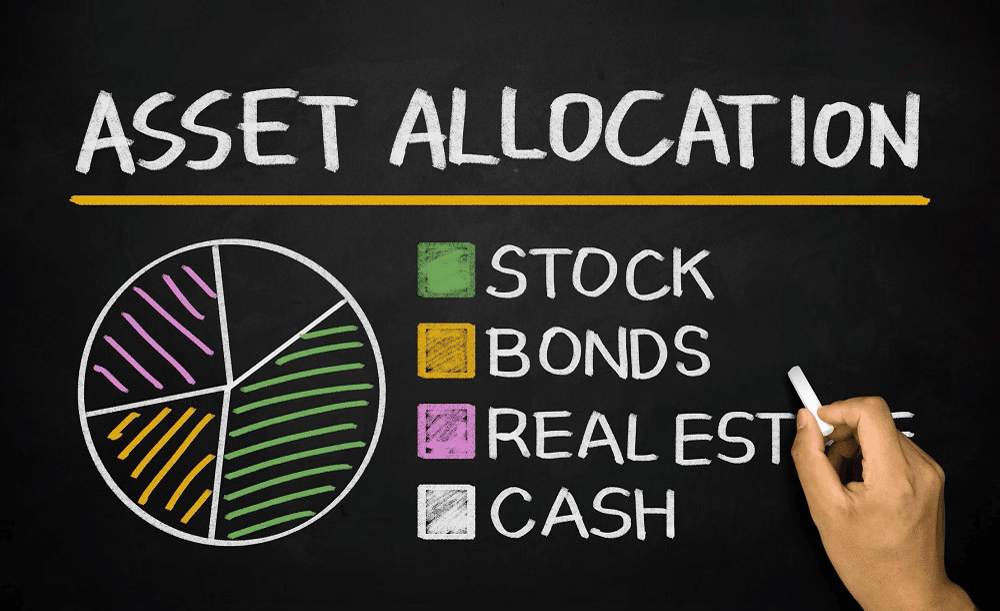
Putting all of the discussion together, consider this hypothetical model:
$3,000 — Broad U.S. stock index
The objective is broad exposure to the U.S. stock market without depending on a small number of individual companies.
$1,000 — Broad international stock index
This provides exposure to developed and emerging markets outside the United States.
$750 — High-quality Treasury or bond exposure
This provides income and portfolio diversification while reducing the percentage exposed to stock-market volatility.
$250 — Cash or cash equivalent
This provides flexibility and a small liquidity reserve.
The portfolio is still stock-heavy.
That is deliberate.
A long-term investor generally needs some exposure to growth assets to build wealth over decades.
But the portfolio is not 100% dependent on stock prices continuing to rise.
A Model $5,000 Conservative Allocation
For a more conservative investor:
$1,500 — U.S. stock index
$500 — International stock index
$2,000 — High-quality bonds
$1,000 — T-bills or cash equivalents
This portfolio sacrifices some expected growth potential in exchange for lower stock-market exposure.
It could make more sense for a shorter time horizon or lower risk capacity.
A Model $5,000 Aggressive Allocation
For an aggressive long-term investor:
$3,250 — Broad U.S. stock index
$1,000 — International stock index
$500 — Small-cap or value equity fund
$250 — Individual stocks or another high-risk satellite allocation
This portfolio is designed to remain heavily diversified even though it accepts substantial equity risk.
An aggressive investor can still avoid leverage and excessive concentration.
Should You Put All $5,000 Into the S&P 500?
That is a defensible simple strategy for someone seeking broad exposure to large U.S. companies, but it is not the same as a globally diversified portfolio.
The S&P 500 contains many companies and spans multiple sectors.
But it is still a U.S. large-cap index.
A global portfolio adds companies outside the United States.
A portfolio including bonds adds another asset class.
Whether those additions are worthwhile depends on the investor.
One important issue is concentration.
The strongest U.S. companies can become a very large part of major indexes after years of outperformance.
Vanguard’s July 2026 outlook said U.S. equity valuations had become more stretched after a strong rally.
That does not mean investors should abandon U.S. stocks.
It does mean investors should understand what they own.
What If $5,000 Is All the Investor Has Saved?
Then the investment decision should begin outside the brokerage account.
Before investing, consider whether there is adequate emergency savings.
Unexpected expenses can include:
medical bills,
car repairs,
home repairs,
temporary unemployment,
insurance deductibles,
family emergencies.
If an investor has no emergency reserve and invests all available cash in stocks, a surprise expense may force a sale during a market decline.
That can turn a temporary market decline into a permanent realized loss.
A financial plan should therefore separate short-term safety from long-term growth.
Should Someone Use Dollar-Cost Averaging Every Month?
There is an important distinction between investing new money as it becomes available and receiving $5,000 today and deliberately waiting.
When a person receives a paycheck and invests part of every paycheck, that is normal ongoing investing.
When a person already has $5,000 available and chooses to keep it in cash for six months before investing, the situation is different.
Vanguard’s research on lump-sum versus cost averaging specifically examined this difference and concluded that investing the lump sum immediately historically had the higher probability of outperforming gradual cost averaging, while recognizing that cost averaging can reduce downside exposure during the investment period.
That is why the choice should depend partly on behavior.
A Good Rule for Investing the $5,000 Gradually
Set the schedule before the first purchase.
For example:
$2,500 immediately
$500 on the first trading day of each of the next five months
Then follow it regardless of whether markets rise or fall.
Do not increase the amount because a particular stock becomes exciting.
Do not stop because the market declines.
Do not delay because a commentator predicts a recession.
A schedule works because it creates rules in advance.
What Would Be Specifically Avoided?
A disciplined investor could reasonably avoid:
Putting 100% of the money into one company.
Buying an investment solely because it has recently risen sharply.
Using margin for a $5,000 account without a very specific understanding of the risks.
Buying leveraged ETFs as a substitute for long-term diversification.
Trying to trade around every Federal Reserve announcement.
Holding a high-cost fund when a similar lower-cost alternative is available.
Ignoring taxes when choosing between retirement and taxable accounts.
Investing emergency savings in volatile assets.
Waiting indefinitely for the perfect correction.
The common element is that none of these decisions improves the probability of long-term success simply by being more complicated.
The Role of Rebalancing
Suppose the investor begins with:
60% U.S. stocks
20% international stocks
15% bonds
5% cash
After several years, U.S. stocks perform extremely well.
The portfolio might become:
72% U.S. stocks
16% international stocks
9% bonds
3% cash
The investor now has a very different risk profile from the original plan.
Rebalancing can bring the portfolio closer to its intended allocation.
This is not the same as trying to sell at the top.
The objective is to maintain the chosen level of risk.
The SEC describes rebalancing as restoring the portfolio to its intended asset mix after market movements change the original percentages.
What Should Someone Check Before Buying Any ETF?
Before placing an order, check:
What index or strategy does it follow?
What does it actually own?
How concentrated are the holdings?
What is the expense ratio and total cost?
How liquid is the fund?
Does it use leverage or derivatives?
How does it fit with the other investments already owned?
Is it appropriate for the account being used?
The SEC provides investor guidance emphasizing the importance of understanding an ETF’s objective, assets and fees.
These questions can prevent an investor from buying three different ETFs that all own the same companies.
What Should Investors Do Between Now and 2027?
There is no need to predict every economic event.
A more productive approach is to decide:
How much should remain in cash?
How much should be invested in stocks?
How much should be in bonds?
Which account should hold the investment?
Will the money be invested immediately or gradually?
What will trigger a rebalance?
What will the investor do if the market drops 20%?
Those decisions matter because they are made before emotions become involved.
The Bottom Line on Where to Put $5,000 Heading Into 2027
For a long-term investor, the answer does not have to be a search for the next big stock.
A diversified portfolio can be enough.
A reasonable moderate framework is approximately:
60% broad U.S. equities
20% international equities
15% high-quality bonds or Treasuries
5% cash
For $5,000, that translates to:
$3,000 U.S. stocks
$1,000 international stocks
$750 bonds or Treasuries
$250 cash
The percentages can move significantly depending on risk tolerance and time horizon.
A conservative investor might hold much more in bonds and cash.
An aggressive investor might hold 85%–95% equities.
Someone who needs the money within a year might hold most or all of it in cash or short-term government securities rather than the stock market.
The current rate environment gives investors a meaningful alternative to keeping everything in equities. The federal funds target range is 3.75%–4.00%, and Treasury yields in September 2026 are above 4% across much of the short and intermediate curve.
At the same time, inflation remains above the Federal Reserve’s 2% goal, and U.S. equity valuations have been described as elevated by major investment firms.
Those conditions argue for attention to valuation, diversification and fixed income rather than an all-or-nothing market call.
For the timing question, the historical evidence generally favors putting a lump sum to work rather than leaving it in cash for an extended period, but a short predetermined dollar-cost-averaging schedule can be reasonable for an investor who is particularly uncomfortable with immediate market risk. Vanguard’s research found lump-sum investing outperformed cost averaging about two-thirds of the time historically, while Investor.gov and FINRA note that dollar-cost averaging can reduce the effects of poor short-term timing but can also sacrifice some upside when markets rise.
The account decision is equally important.
For retirement money, a Roth IRA or traditional IRA may provide tax advantages that a taxable account does not. For 2026, the combined IRA contribution limit is $7,500, or $8,600 for investors age 50 or older, subject to eligibility and compensation rules.
Ultimately, the most important decision is not whether $5,000 belongs in one specific ETF.
It is whether the investor has a sensible plan for the money.
A diversified portfolio, a suitable account, reasonable costs, a clear time horizon and the discipline to keep investing can matter much more than correctly guessing what the market will do in 2027.
Frequently Asked Questions About Investing $5,000 Heading Into 2027
What is the best way to invest $5,000 heading into 2027?
For a long-term investor, one reasonable approach is to use a diversified portfolio centered on low-cost broad stock index funds, with some international stocks and high-quality bonds or Treasuries. The exact allocation should depend on the investor’s time horizon and risk tolerance.
Should I invest $5,000 all at once?
For money already available and intended for long-term investment, investing immediately gives the money more time in the market. Vanguard research has found that lump-sum investing historically outperformed dollar-cost averaging roughly two-thirds of the time.
Is dollar-cost averaging better than investing a lump sum?
Not necessarily. Dollar-cost averaging can reduce the risk of investing the entire amount immediately before a market decline, but part of the money remains in cash and may miss market gains. Investor.gov and FINRA both describe this trade-off.
How much of $5,000 should be invested in stocks?
A long-term aggressive investor might hold 80%–95% in equities, while a conservative investor might hold closer to 30%–50%. There is no universal percentage because the appropriate allocation depends on time horizon, risk tolerance and financial circumstances.
Should I buy individual stocks with $5,000?
Individual stocks can be used as a small satellite allocation by experienced investors, but they do not need to be part of a $5,000 portfolio. Broad index funds offer diversification without requiring the investor to select individual winners.
Should I invest $5,000 in an S&P 500 index fund?
An S&P 500 index fund can provide broad exposure to large U.S. companies and may be a reasonable core holding for a long-term investor. It does not, however, provide the same diversification as a global portfolio that also includes international stocks and other asset classes.
Are bonds worth considering heading into 2027?
Yes. The current interest-rate environment makes high-quality bonds and Treasury securities more relevant than they were during the period of extremely low yields. The Treasury curve in September 2026 showed yields above 4% across several short and intermediate maturities.
How much cash should I keep from the $5,000?
There is no universal amount. Investors with a separate emergency fund may need little or no cash inside the portfolio. Someone without emergency savings may need to keep much more available rather than investing the entire $5,000.
Should I put the $5,000 in a Roth IRA?
For eligible investors using the money for retirement, a Roth IRA can be attractive because contributions are made after tax while qualified withdrawals can be tax-free. Income and other eligibility rules apply.
What is the 2026 IRA contribution limit?
For 2026, the combined contribution limit for traditional and Roth IRAs is $7,500, or $8,600 for people age 50 or older, subject to taxable compensation and other applicable rules.
Should I use a taxable brokerage account instead?
A taxable brokerage account may be preferable when flexibility and access to the money are important. It does not have the same retirement-account tax structure, but it also does not impose the same retirement-account restrictions.
Should I wait for a market correction?
Waiting can work if the market falls, but there is no reliable way to know when a correction will occur. A predetermined investment schedule can reduce the temptation to make repeated market-timing decisions.
What should I avoid doing with $5,000?
Avoid putting the entire amount into one speculative stock, using leverage without understanding the risks, chasing investments simply because they have recently risen, paying unnecessary fees and investing money that should remain available for emergencies.
Is AI still an important investment trend for 2027?
AI is likely to remain an important economic and market theme because of ongoing spending on computing, data centers and infrastructure. Fidelity’s 2026 research also noted that the opportunities can extend beyond major U.S. technology companies into areas such as power, hardware, materials and industrial businesses.
Does the current Fed rate affect how I should invest?
It can affect the balance between stocks, bonds and cash because higher short-term rates increase the return available from cash and short-term government securities. The Fed’s target range was 3.75%–4.00% as of September 16, 2026.
What if I am a conservative investor?
A conservative investor may want a larger allocation to short-term Treasuries, high-quality bonds and cash, with a smaller stock allocation.
What if I am an aggressive investor?
An aggressive investor with a long time horizon may choose a high equity allocation, potentially 80%–95%, while still maintaining diversification through U.S. and international funds and avoiding excessive concentration in individual companies.
What is the simplest way to invest $5,000?
One diversified target-date fund or asset-allocation fund can be a simple solution. Another straightforward approach is a broad U.S. stock fund combined with an international fund and a bond fund. Target-date funds generally hold combinations of stocks and bonds and adjust their allocation over time.
Is there a guaranteed return on any investment for 2027?
No. Stocks, bonds and funds involve investment risk. Treasury securities held to maturity have defined payment terms, but marketable securities can still fluctuate in market value before maturity. Bank deposits may have FDIC insurance when held at an eligible insured institution, subject to coverage rules.

Final Perspective
A $5,000 investment may not seem large compared with a six- or seven-figure portfolio, but it is large enough to establish a real investment plan.
The strongest plan does not need to depend on identifying the next “10x” stock.
It can start with four simple questions:
How long can the money stay invested?
How much loss can I realistically tolerate?
Which account gives the money the most useful tax treatment?
What diversified allocation can I stick with through both good and bad markets?
Heading into 2027, those questions are particularly relevant because investors are dealing with a combination of still-elevated inflation, meaningful interest rates, strong technology investment, high U.S. equity valuations and renewed opportunities in fixed income and international markets.
The answer to “Where would you put $5,000 heading into 2027?” therefore does not have to be one stock, one ETF or one market prediction.
For a long-term moderate investor, a diversified mix such as 60% U.S. stocks, 20% international stocks, 15% bonds and 5% cash provides one practical framework.
For a conservative investor, more can go toward bonds and cash.
For an aggressive investor with a long time horizon, more can go toward equities.
And for someone who needs the money soon, the answer may be substantially more conservative.
The $5,000 itself is only the starting point.
The larger advantage comes from putting the money into an appropriate account, investing it in a diversified portfolio, keeping costs under control, continuing to add money and avoiding decisions based on short-term market excitement.
That is a strategy that can still make sense even when the answer to what the market will do in 2027 is unknown.
Sources for Current Figures
Federal Reserve, September 16, 2026 FOMC statement.
U.S. Treasury, Daily Treasury Par Yield Curve Rates, September 22, 2026.
U.S. Bureau of Labor Statistics, August 2026 CPI.
U.S. Bureau of Labor Statistics, August 2026 Employment Situation.
U.S. Bureau of Economic Analysis, Q2 2026 GDP.
Internal Revenue Service, 2026 IRA contribution limits and retirement-plan rules.