Quick Verdict
AI stocks are pulling back, but the recent weakness does not by itself mean the artificial intelligence investment story is over.
The bigger issue is that investors are becoming more selective. After years of enormous gains across chipmakers, cloud companies, data-center suppliers and AI software companies, the market is asking a harder question: Are the earnings and cash flows from artificial intelligence growing quickly enough to justify the money being spent on the technology and the valuations attached to AI-related stocks?
That question is becoming particularly important for semiconductor companies. The Philadelphia Semiconductor Index has fallen sharply during the third quarter, while investors have also become more sensitive to high Treasury yields and the cost of financing the enormous infrastructure buildout required for AI. Reuters reported that Micron’s upcoming earnings are being watched as an important test of whether AI infrastructure spending remains on track.
At the same time, there are reasons not to assume that the AI trade is simply finished. J.P. Morgan analysts said the recent pullback has improved positioning and lowered valuations in parts of the AI complex, while arguing that capital spending is likely to remain strong.
For investors, the important question now is not simply whether AI stocks are going up or down.
It is what happens next.
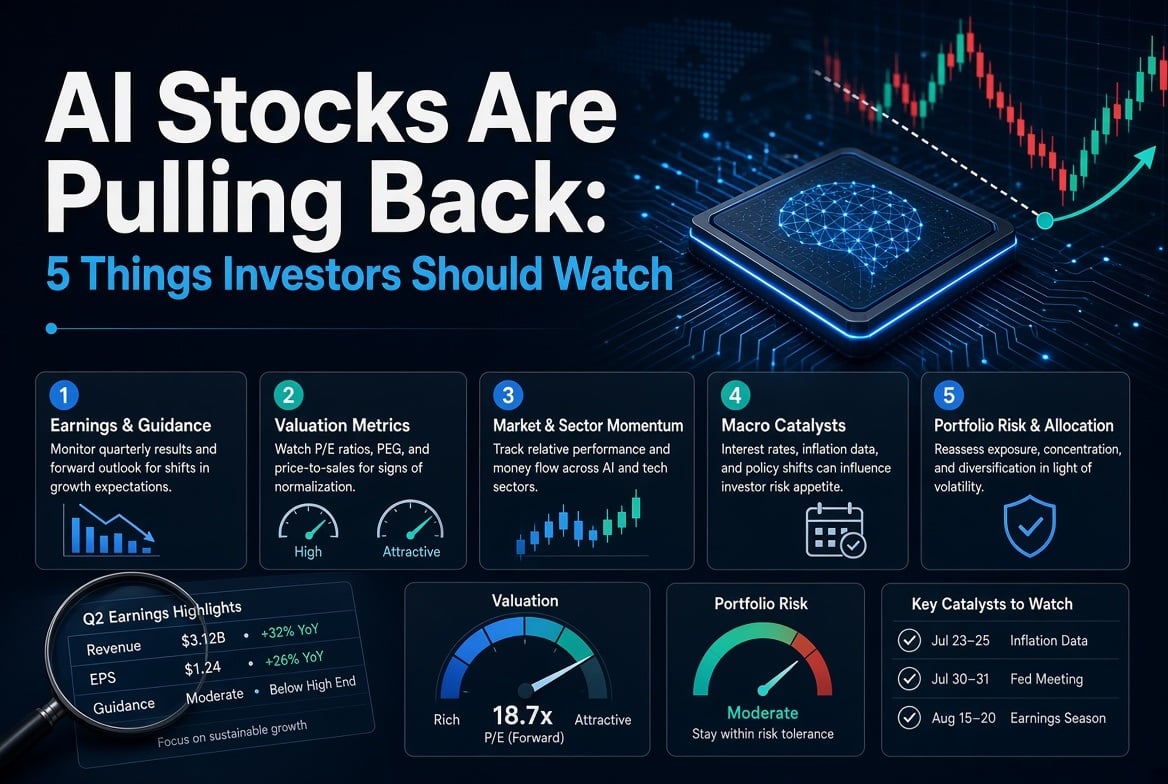
Here are five things worth watching.
Key Takeaways
- The AI-stock pullback is exposing a growing gap between companies with strong underlying revenue growth and companies that depend heavily on future AI spending.
- AI infrastructure spending remains enormous, but investors increasingly want evidence that those investments will generate attractive returns.
- Semiconductor stocks deserve particular attention because they sit at the center of the AI infrastructure cycle.
- Higher Treasury yields can put pressure on expensive growth stocks by increasing the discount rate investors apply to future earnings.
- Nvidia remains a critical stock to watch, but the broader AI opportunity extends into memory, networking, cloud computing, software and data-center infrastructure.
- A pullback can create opportunities, but investors still need to distinguish between a temporary valuation reset and a deterioration in business fundamentals.
Why Are AI Stocks Pulling Back?
The artificial intelligence trade has been one of the most important forces in the stock market over the past several years.
Companies supplying the hardware needed to train and run AI models have benefited enormously. So have cloud providers, data-center operators, networking companies and software businesses that have successfully incorporated AI into their products.
But large gains eventually create a different problem.
Expectations become extremely high.
When investors already expect years of rapid growth, simply reporting strong earnings may not be enough to push a stock higher. A company may need to beat expectations by a wide margin and provide guidance suggesting that growth will continue.
That is one reason the recent weakness in AI stocks deserves attention.
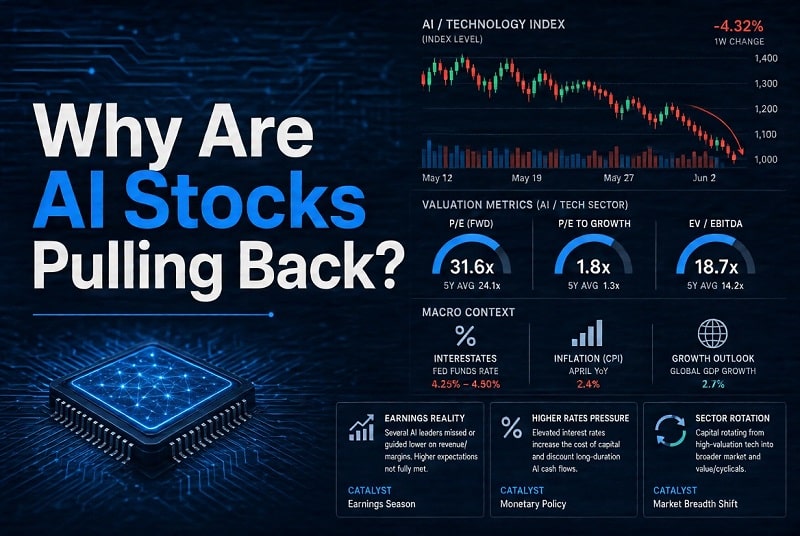
Reuters reported on September 28 that the recent pullback had made valuations more attractive across much of the AI complex, while investors were also reassessing positioning.
Meanwhile, the broader market is dealing with another headwind: elevated bond yields.
The 10-year Treasury yield approached 5.23% on September 28, according to the Associated Press, its highest level since 2007. The combination of higher yields and uncertainty around inflation has put additional pressure on technology stocks.
That creates an important distinction.
The AI-stock pullback is not necessarily being caused by one problem inside the AI industry.
It is happening at the intersection of high valuations, enormous capital spending, changing interest-rate expectations and increasingly demanding investors.
That makes the next few months particularly important.
Watch How Much Big Tech Keeps Spending on AI
The first thing investors should watch is simple:
How much money are technology companies still willing to spend on AI infrastructure?
Building AI systems requires an enormous amount of computing power.
That means companies need advanced processors, high-bandwidth memory, networking equipment, data centers, electricity and cooling infrastructure. The spending involved is far larger than simply buying a few new servers.
For companies such as Nvidia and its suppliers, this spending has been the foundation of the AI investment boom.
The problem is that investors eventually want to know what all that spending produces.
If technology companies continue increasing capital expenditures at extremely high rates, that would provide evidence that demand for AI infrastructure remains strong.
If spending begins to slow materially, investors could start questioning whether the current level of semiconductor and data-center valuations is sustainable.
This is why earnings reports from companies connected to the AI infrastructure chain matter so much.
Micron is one example.
Reuters identified Micron’s September earnings report as an important test for the AI trade because the company supplies memory used alongside AI processors. Its stock had fallen during the quarter even as AI-related demand remained significant.
The market will therefore be watching not just the company’s latest numbers but also what management says about future demand.
That distinction is critical.
Past AI spending tells investors what companies have already committed to. Future spending tells them where management believes the AI market is going.
Watch Whether AI Revenue Is Catching Up With AI Spending
This may be the most important issue of all.
The AI industry is spending enormous sums on infrastructure. But eventually, that infrastructure has to generate revenue and profits.
Investors should therefore pay attention to the relationship between AI spending and AI monetization.
Imagine a cloud company spending tens of billions of dollars building AI data centers.
That may be positive for Nvidia, memory suppliers and networking companies because those businesses sell the equipment.
But the cloud company itself ultimately needs customers to pay for the computing capacity.
If AI demand continues growing rapidly, that investment could generate attractive returns.
If demand grows more slowly than expected, the financial picture becomes more complicated.
This is why investors should look beyond headlines about AI adoption.
A company announcing a new AI product is interesting.
A company showing that customers are paying substantial amounts for that product is more important.
The same principle applies to software.
Many businesses can add an AI assistant, chatbot or automated feature. But investors should ask whether those products are producing incremental revenue, improving margins or reducing costs.
The market has already seen that an AI label alone is not enough.
During the third quarter, investors increasingly shifted attention toward companies that could demonstrate tangible revenue and profit growth, while some infrastructure names faced pressure from valuation, margin and supply concerns.
That could become one of the defining themes of the next phase of the AI market.
The first phase was about building AI capacity.
The next phase may be increasingly about earning a return on that capacity.
Watch AI Stock Valuations
The third issue is valuation.
This sounds obvious, but it is particularly important after several years of spectacular performance.
A great company can still be an expensive stock.
And an expensive stock can fall even when the underlying business continues performing well.
Why?
Because stock prices reflect expectations about the future.
Suppose investors expect an AI company to grow earnings by 40% annually. If the company reports 35% growth, that may still represent excellent business performance.
But if investors were expecting 45%, the stock could fall.
This is why investors should not judge an AI stock simply by asking whether its earnings are growing.
They also need to ask:
How much growth is already reflected in the stock price?
This is particularly important across the semiconductor industry.
AI chip companies have enjoyed extraordinary demand, but their stocks can also be highly sensitive to expectations. A small change in projected growth, margins or capital spending can produce a large change in valuation.
The recent pullback has already changed some of those calculations.
J.P. Morgan said on September 28 that valuations had fallen significantly across much of the AI complex and that investor positioning had become cleaner following the pullback.
That does not mean every AI stock is suddenly cheap.
It means investors need to reassess companies individually.
A profitable semiconductor leader with rising cash flow is not the same investment proposition as a speculative company whose valuation depends on several years of rapid future growth.
That distinction becomes even more important when the market becomes less willing to pay extremely high multiples for expected future earnings.
Watch Interest Rates and Treasury Yields
AI investors sometimes focus so heavily on technology that they overlook one of the biggest forces affecting growth stocks:
interest rates.
When Treasury yields rise, the relative attractiveness of stocks can change.
This matters particularly for companies whose most significant earnings are expected several years in the future.
The higher the discount rate applied to those future cash flows, the less those future earnings are worth today.
That can put pressure on high-growth technology stocks.
And the current environment makes the issue especially relevant.
On September 28, the 10-year Treasury yield climbed to roughly 5.23%, its highest level since 2007, according to the Associated Press.
At the same time, higher energy prices have added to inflation concerns.
That combination is uncomfortable for expensive growth stocks.
If oil prices remain elevated and inflation proves persistent, investors may have to contend with higher interest rates for longer.
That could make it harder for highly valued AI stocks to maintain the kinds of multiples they enjoyed when borrowing costs were lower.
On the other hand, if inflation pressures ease and Treasury yields stabilize or decline, growth stocks could receive some relief.
This is why investors watching AI stocks should also watch the bond market.
The next major move in AI stocks may not come from an AI announcement.
It could come from a change in expectations about interest rates.
Watch Competition Beyond Nvidia
Nvidia remains one of the most important companies in the AI ecosystem.
But investors should avoid thinking about the AI industry as though there is only one company that matters.
The ecosystem is much larger.
There are companies making processors, memory, networking equipment and data-center components.
There are cloud providers renting AI computing power.
There are software companies building AI applications.
There are model developers competing to create increasingly capable systems.
And there are technology companies developing their own custom AI chips.
That last category deserves particular attention.
Google’s custom Tensor Processing Units, or TPUs, have become an increasingly important part of the competitive conversation around AI computing. Investors are also watching how companies such as Amazon and Microsoft develop their own AI infrastructure and accelerators.
That does not automatically mean Nvidia’s position is being displaced.
Rather, it means the AI infrastructure market is evolving.
Competition can have several effects.
It can increase innovation.
It can reduce costs.
It can shift profit margins.
And it can determine which companies capture the economics of the next stage of AI growth.
Nvidia itself remains highly influential. On September 28, the company announced a $150 billion increase in its stock buyback authorization, highlighting management’s confidence in its financial position even as the broader technology sector experienced volatility. Nvidia shares subsequently rose in premarket trading on September 29.
But investors should not confuse Nvidia’s strength with proof that every AI-related stock will perform similarly.
The next stage of the AI market could produce much greater differentiation between winners and losers.
What Does the AI Pullback Mean for Investors?
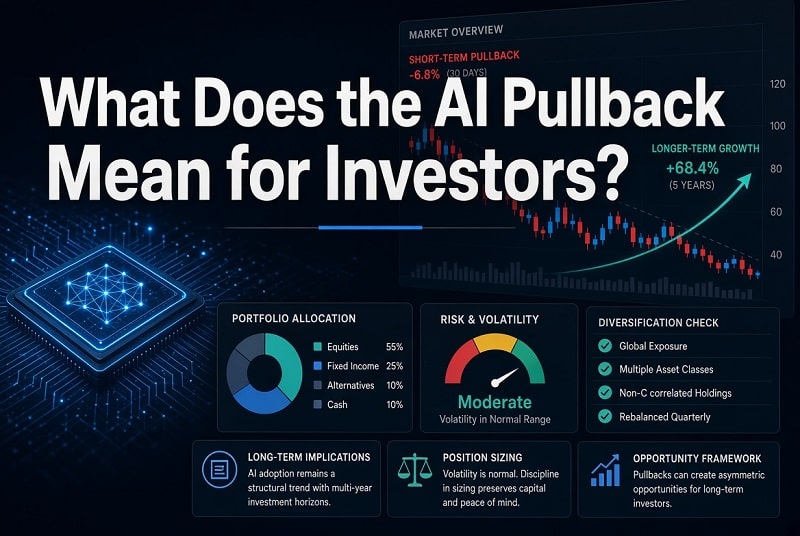
The biggest mistake investors can make during a market pullback is treating every stock in a theme as though it has the same risk.
They don’t.
Some AI companies already generate enormous revenue and profits.
Others are still investing heavily in infrastructure.
Some have relatively predictable recurring revenue.
Others depend on future demand.
Some have reasonable valuations relative to their growth.
Others require extremely strong growth to justify their current prices.
That means the AI pullback may actually increase the importance of stock selection.
Investors should examine balance sheets, free cash flow, operating margins, capital expenditures and customer demand rather than simply asking whether a company is considered an AI stock.
It is also worth remembering that a falling share price does not automatically make a stock cheap.
A stock that falls 25% after rising 200% can still be expensive.
Likewise, a stock that falls 10% because investors temporarily became more cautious may still have strong long-term fundamentals.
The numbers behind the business matter more than the percentage decline in the stock.
AI Infrastructure vs. AI Software
Another useful distinction is between AI infrastructure and AI applications.
Infrastructure companies are benefiting from the enormous investment required to build AI systems.
That includes semiconductor companies, memory manufacturers, networking businesses and data-center suppliers.
Software companies are focused on monetizing AI through applications and services.
Both categories can benefit from the growth of artificial intelligence, but their investment cycles can look very different.
Infrastructure spending can be extremely large and arrive quickly.
Software monetization may take longer.
That means investors should watch for evidence that the two sides of the market are connecting.
If infrastructure spending keeps rising while AI applications generate stronger revenue, that would provide an important signal that the ecosystem is maturing.
If infrastructure spending accelerates while monetization disappoints, questions about returns on capital could become more prominent.
What Could Send AI Stocks Higher Again?
A pullback can reverse if the market receives evidence that the underlying AI growth story remains intact.
Several developments could matter.
First, strong earnings from semiconductor companies could reassure investors that demand remains healthy.
Second, continued increases in AI-related capital expenditures from major technology companies could signal that businesses remain committed to expanding computing capacity.
Third, evidence that AI products are producing meaningful revenue could strengthen the case for software companies.
Fourth, falling Treasury yields could reduce pressure on high-growth valuations.
And finally, continued improvements in AI models and applications could expand the addressable market.
The market does not necessarily need another wave of hype.
It needs evidence.
If companies can demonstrate that the enormous amounts of money being spent on AI are producing real economic returns, investors may become more comfortable assigning high valuations to the sector.
What Could Make the Pullback Worse?
The opposite scenario is also worth considering.
The AI pullback could become more serious if several negative developments occur at the same time.
For example, major technology companies could reduce capital spending plans while semiconductor companies report weaker demand.
AI software adoption could also fail to translate into meaningful revenue.
At the same time, persistently high inflation could keep Treasury yields elevated.
That would create a difficult combination for AI stocks.
Investors would be dealing with slower expected growth and a higher discount rate at the same time.
Another risk would be an acceleration in competition that reduces margins.
If multiple companies develop comparable AI hardware or software products, pricing power could weaken.
The AI industry does not need to collapse for stocks to fall.
Sometimes all that is required is for future expectations to become slightly less optimistic.
The Bottom Line
AI stocks are pulling back, but the most important question is not whether the artificial intelligence story is dead.
There is little evidence to support such a simple conclusion.
AI investment remains enormous, semiconductor demand remains strategically important, and major technology companies continue committing substantial resources to the technology. J.P. Morgan recently argued that the pullback had improved valuations and positioning across parts of the AI complex.
But that does not mean investors should automatically buy every stock that has fallen.
The market is entering a more demanding phase.
Investors want to see whether AI spending can produce revenue, whether revenue can produce profits, and whether profits can grow quickly enough to justify current valuations.
That is why the five signals discussed here matter.
Watch AI spending. Watch AI revenue. Watch valuations. Watch Treasury yields. And watch competition.
The next phase of the AI market could be less about buying anything associated with artificial intelligence and more about identifying the companies that can turn the enormous AI investment boom into durable earnings and cash flow.
For investors, that may ultimately be a healthier environment.
A market that rewards actual business performance rather than simply the AI label can make it easier to separate the companies building the future from the stocks that merely benefit from the excitement surrounding it.
Frequently Asked Questions
Are AI stocks still a good investment after the pullback?
The answer depends on the individual company, valuation and investment time horizon. A decline in an AI stock does not automatically make it attractive, just as a rising stock is not automatically overvalued. Investors should examine earnings growth, cash flow, balance-sheet strength and the assumptions already reflected in the share price.
Why are AI semiconductor stocks falling?
AI semiconductor stocks have faced several pressures, including concerns about valuations, the pace of future AI infrastructure spending and higher bond yields. Reuters reported that the Philadelphia Semiconductor Index had fallen significantly during the third quarter as investors questioned how long heavy AI capital spending could continue at its previous pace.
Is the AI boom over?
A stock-market pullback does not establish that the underlying AI industry is ending. Major technology companies continue investing heavily in AI infrastructure, while companies across chips, cloud computing and software continue developing AI products. The more important question is whether future growth and profitability can justify current expectations.
What should investors watch in Nvidia?
Investors can watch Nvidia’s revenue growth, margins, data-center demand, product launches, customer spending and competitive developments. The company’s large buyback authorization announced in September 2026 is also notable, but a buyback by itself does not determine whether the stock is attractively valued.
Why do higher interest rates hurt AI stocks?
Higher interest rates can put pressure on growth-stock valuations because investors generally place a lower present value on earnings expected further in the future when discount rates rise. High Treasury yields can therefore create an additional headwind for expensive technology stocks.
Should investors buy AI stocks during a pullback?
A pullback can change a stock’s valuation, but it does not automatically make the stock attractive. Investors should consider why the stock declined, whether earnings expectations have changed and whether the company’s long-term fundamentals remain intact.
What is the biggest risk for AI investors now?
One major risk is that AI investment and expectations could grow faster than the revenue and profits generated by the technology. If investors begin to believe that companies are spending too much money for too little economic return, valuations could come under additional pressure.
What could restart the AI stock rally?
Evidence of strong AI demand, continued capital spending, better-than-expected earnings, successful AI monetization and lower interest rates could all support renewed investor interest. Conversely, weaker spending or disappointing AI revenue could keep pressure on the sector.
Are all AI stocks affected by the pullback equally?
No. AI is a broad investment theme that includes semiconductor manufacturers, memory companies, networking businesses, cloud providers, software companies and data-center operators. Their financial models, valuations and exposure to AI spending can be very different.
What is the most important thing investors should remember?
The AI label is not enough.
Investors should focus on the economics behind the technology: How much is being spent, who is paying for it, who is generating revenue, who is producing profits and how much of that future growth is already reflected in the stock price.
Those questions may become increasingly important as the AI market moves from its early infrastructure-building phase toward a period in which investors demand clearer evidence of financial returns.