Most people assume investing means downloading an app, linking a bank account, and tapping a green button. That’s one way to do it. It isn’t the only way, and if you plan to hold a company for ten or twenty years, it may not even be the best one.
You can skip the brokerage entirely. Plenty of large US companies sell shares straight to the public through a transfer agent, the firm that keeps their shareholder records. Computershare, EQ/AST, and Broadridge handle most of this work. If you’ve ever wondered how to buy stocks online without a broker, or whether you can buy stocks without a broker at all, this guide is for you. I’ll walk through the process, show you what it costs, and be upfront about where it gets annoying. Think of it as how to buy stock by myself, minus the trading app.
One caution before we start: this is education, not personal advice. Plan fees and minimums change, so check each company’s own page before you enroll.
Can You Buy Stocks Without a Broker? (Direct Stock Purchase vs. Brokerage)
You can. But “without a broker” doesn’t mean buying on some hidden market. It means buying from the company, through the agent it hired. That’s the whole trick behind how to buy stocks online without a broker.
The Legal Reality: Transfer Agents vs. Stockbrokers
Open a normal brokerage account and your shares sit in “street name.” The broker, or its clearing firm, is the owner of record. You hold a claim recorded in their system.
A transfer-agent plan works differently. Your name goes on the company’s own shareholder register, as a book-entry position with no paper certificate. Computershare, Equiniti (which runs AST), and Broadridge manage those registers for thousands of issuers. They process your purchases, pay your dividends, and move your shares when you ask.
What they don’t do is act like a broker. There’s no live trading screen, no stock screener, and no menu of ten thousand tickers. You get one company per plan, and that’s it. If you already know which company you want, that’s fine. If you want to browse, it’s frustrating.
Why Investors Choose to Buy Stocks Directly From Companies
Some people just like the quiet. With no alerts, no meme-stock chatter, and no one-tap trades, it’s hard to make an emotional decision at 11 p.m. Direct plans are boring on purpose, and for long-term holders, boring tends to work.
There’s also the ownership angle. You’re a registered shareholder, not a name in a broker’s database. And there’s the automation: set up a monthly ACH debit once, and the plan keeps buying whether the market is up, down, or in the news. Fractional shares mean the full amount of every deposit goes to work.
If you’d rather compare mainstream apps first, our guide to the best brokerage for beginners lays out the alternatives.
How to Buy Stocks Directly Without a Broker (The 2-Method Blueprint)
There are two tools here, and they fit together nicely.
Method 1: Direct Stock Purchase Plans (DSPPs)
A DSPP lets you make your first purchase, and every purchase after it, through the transfer agent. A few plans want you to already own a share. Many don’t, so you can start with just a deposit.
You enroll online, make an initial deposit, and usually set up a recurring ACH debit from your checking account. The agent collects money from many investors and buys shares on set dates. Your account is credited with whole and fractional shares, often to several decimal places.
The side benefit is dollar-cost averaging, and you don’t have to think about it. The same dollar amount buys more shares when prices are low and fewer when they’re high. Over the years, that smooths out your average cost without you trying to guess the market.
Method 2: Dividend Reinvestment Plans (DRIPs)
A DRIP takes the cash dividend a company pays and uses it to buy more of that same company’s stock. Inside a transfer-agent account, that happens automatically. Those extra shares then pay their own dividends, which buy still more shares. It’s slow at first and surprisingly powerful after a decade or two.
Some plans let you reinvest only part of the dividend and take the rest as cash. Read the plan document, because a few charge a small fee on reinvestment. If income investing is your goal, our piece on passive income streams puts DRIPs in a wider context.
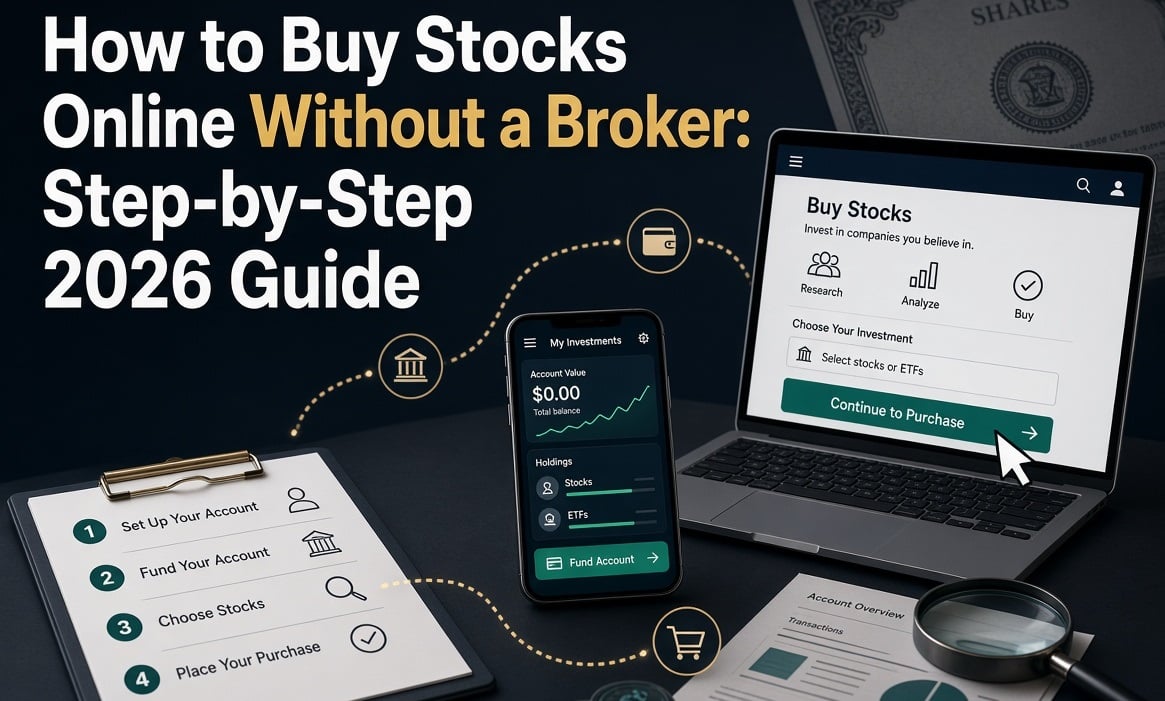
Here’s the process in plain order. It’s the same whether the agent is Computershare, AST, or Broadridge, give or take some screens.
Step 1: Find the Company’s Investor Relations (IR) Page
Search the company’s name plus “investor relations.” Look for a tab called Shareholder Services, Stock Information, or Direct Stock Purchase Plan. If the company runs a plan, it’s listed there.
The IR page links to the agent’s enrollment portal. Follow that link rather than Googling the agent’s name. Fake lookalike sites do exist, and you’ll be typing in your Social Security number.
Step 3: Verify U.S. Tax ID (SSN/TIN) and Identity Verification
Expect to enter your legal name, address, birth date, and SSN or taxpayer ID. The IRS requires it, and the agent has to confirm who you are, much like a bank would.
Step 4: Fund the Account via ACH Electronic Bank Transfer
Link a checking or savings account and make your first deposit. Check the minimums: plans often set one amount for the first deposit and a smaller one for automatic monthly debits. Also check the fee per purchase. A $5 fee on a $50 deposit eats 10% before the market even moves.
This is the part that trips up new investors: nothing happens right away. Your order waits for the plan’s next investment date, often weekly. You pay the average price the agent got on that batch, plus any per-share fee. Once it settles, your whole and fractional shares appear in your account.
Top U.S. Companies Offering Direct Stock Purchase Plans
The figures below are sample terms, and they do change. Treat the table as a starting point and confirm everything on the plan’s official page.
| Company | Ticker | Transfer Agent | Initial Minimum | Recurring Auto-Debit Minimum | Typical Setup / Purchase Fee |
| The Home Depot | HD | Computershare | $50 | $50 / month | Small setup fee plus per-share charge |
| IBM | IBM | Computershare | $250 | $50 / month | Flat transaction fee, roughly 1-5 |
| RPM International | RPM | EQ/AST | $200 | $25 / month | $0 commission |
| Eastman Chemical | EMN | EQ/AST | $250 | Varies by plan | Flat fee plus per-share fee |
| Procter & Gamble | PG | Computershare | $250 | $50 / month | Low administrative fee |
A quick way to read it: the initial minimum is your entry ticket, the recurring minimum is your monthly floor, and the fee column tells you how much of a small deposit disappears. If you plan to invest $25 or $50 at a time, a plan with no commission is worth a lot more than one with a flat charge.
The Fine Print: Drawbacks & Hidden Costs of Brokerless Buying
I’d be doing you a disservice if I only listed the upsides. Anyone figuring out how to buy stocks online without a broker in the USA should read this section twice.
Delayed Order Execution (Batching vs. Real-Time Market Orders)
At a zero-commission broker, you tap buy and a fill comes back in seconds. In a DSPP, your money joins a queue. You can’t set a limit price or a stop. If the stock jumps between your order and the batch date, you pay the higher average price.
For a buy-and-hold investor, that hardly matters over twenty years. For anyone who wants to react to news, it’s a deal-breaker. A DSPP is the wrong tool for trading.
Transfer Agent Fee Schedules (Buying vs. Selling)
Buying is usually cheap. Selling is where the costs show up.
- Enrollment: some plans charge a one-time setup fee, often $5 to $15.
- Purchases: a flat fee, a per-share fee, or both.
- Selling: commonly $15 to $25 as a transaction fee, plus a per-share commission.
- Extras: look for charges on reinvested dividends or account closure.
That selling fee is the reason many people move their shares to a broker before they sell. Small percentages add up fast, which is the point of our article on how platform fees eat into your income investing yield.
IRS Tax Reporting Realities (Form 1099-DIV & Form 1099-B)
Owning shares directly doesn’t change your tax bill. Dividends are reported on IRS Form 1099-DIV, and that includes dividends you reinvested in a DRIP. You never touched the cash, but the IRS still counts it as income that year.
When you sell, expect Form 1099-B. Your cost basis is what you paid, including reinvested dividends, so keep every statement. Dozens of small purchases make basis tracking messy if you don’t save records as you go. If you sell at a loss, tax-loss harvesting may apply, and a tax professional can tell you how it fits your situation.
Direct Purchase Plans (DSPP) vs. Zero-Commission Online Brokers
Here’s how the two stack up.
| Feature | DSPP / Transfer Agent | Online Brokerage (e.g., Robinhood, Schwab) |
| Share Registration | Direct registration, your name on company books | Street name, broker’s name |
| Execution Speed | Batch process, typically days | Real-time, seconds |
| Order Types | Batch-style purchases only | Market, limit, stop, and more |
| Selling Cost | High; 15-25 plus per-share fees is common | Usually $0 commission on stocks |
| Choice of Stocks | One company per plan | Thousands of stocks, ETFs, and funds |
| Fractional Shares | Built in | Offered at many brokers |
| Diversification | Hard, each company needs its own account | Easy, one account holds everything |
| Best For | Ultra-long-term buy and hold | Active trading and flexible portfolios |
My honest take: if you want to own one or two specific companies for decades, a DSPP is a clean, low-effort way to do it. If you want a diversified portfolio or cheap exits, a brokerage wins easily. Plenty of investors use both. For brokerage head-to-heads, see Robinhood vs. Fidelity and Robinhood vs. Schwab.
Knowing how to buy stocks online without a broker is only half the story. Plan your exit before you put in the first dollar.
You can sell through the agent’s website, by phone, or by mail. Sales often run in batches too, so you won’t know the exact price in advance. Fees usually include a flat transaction charge and a per-share commission. After the sale settles, the agent sends proceeds by check or electronic deposit, and you’ll get a Form 1099-B the following tax season.
In a small position, those fees can take a real bite. Check the schedule before you click sell.
The common workaround is to move the shares to a brokerage and sell there for free. A transfer between accounts isn’t a sale, so it generally doesn’t trigger tax by itself.
Here’s how it usually goes. Open a brokerage account, then ask the broker how to start an incoming transfer. Some use an ACATS transfer. Others use the Direct Registration System (DRS) when shares sit in book-entry form with an agent. Your broker will tell you which one applies. Give them your agent account number and the exact name on the account, then wait for it to finish.
Check afterward that everything arrived. Fractional shares sometimes don’t transfer, and some agents cash them out instead. Ask both firms before you start, and confirm the cost basis carried over correctly.
Conclusion
Direct plans are a quiet, low-effort way to own real shares in your own name. The trade-offs are slow batch orders, one company per account, and fees that jump when you sell. For someone who plans to hold for decades, that bargain is often fine. For someone who wants speed or variety, a broker is the better home.
If you want to try it, here’s the short version:
- Pick one company you’d be happy to hold for ten years.
- Find its plan and transfer agent on the investor relations page.
- Read the fee schedule, especially the selling fees.
- Decide between a DSPP and a zero-commission broker.
- Start small with an automatic monthly ACH debit, and save your statements for tax time.
That’s how to buy stocks online without a broker: go to the company’s agent, accept a slower pace, and plan your exit before you enter. And before the year ends, you might also look at our list of 7 investing moves to make before the end of 2026 and think about where you’d put $5,000 heading into 2027.
Frequently Asked Questions
Can I buy stock directly without a broker?
Yes. Companies that run Direct Stock Purchase Plans sell shares through transfer agents such as Computershare and EQ/AST. Not every public company has a plan, so check the investor relations page of the one you want.
How can I buy stocks online without a broker for beginners?
Choose a dividend-paying company you understand and find its transfer agent on the IR site. Enroll, verify your identity, link your bank, and set up an automatic ACH debit. Many beginners start at $25 to $50 a month. Look at fees first, because flat charges hit small deposits hardest.
How do I buy stock by myself with little money?
Look for plans with low minimums and low or zero purchase fees. Fractional shares let a small deposit buy a slice of an expensive stock. If a plan’s fees are too heavy for your budget, a commission-free broker may suit small amounts better. Our piece on AI stock picks with a small portfolio covers small-account thinking too.
Is investing $25 to $500 a month in stocks worth it?
For most long-term investors, yes. Steady monthly deposits average out your purchase price, and reinvested dividends add compounding on top. What matters most is sticking with it and keeping fees low. Stocks can fall, and nothing is guaranteed.
How much money do I need to invest to make $1,000 to $3,000 a month?
It’s a simple division: yearly income goal divided by dividend yield.
- $1,000 a month is $12,000 a year. At a 4% yield, $12,000 ÷ 0.04 = $300,000.
- $3,000 a month is $36,000 a year. At a 4% yield, $36,000 ÷ 0.04 = $900,000.
Yield changes everything. At 3%, you’d need about $400,000 for the first goal and $1.2 million for the second. At 5%, roughly $240,000 and $720,000. All of that is before tax, and companies can cut dividends, so a very high yield isn’t automatically a good sign. If you’re building toward a bigger number, our guide on how to invest $50K for passive income is a useful next read.
How can I turn $100 into $1,000 in a month?
Realistically, you can’t, at least not without taking a gamble that usually ends badly. Direct stock buying is built for the opposite: slow, steady growth over many years. Be wary of anyone promising overnight multiples.