

Picking cybersecurity stocks to buy today is a very different exercise than it was even a couple of years back. The explosion of autonomous AI tools, sprawling app integrations, and increasingly targeted identity scams has pushed corporate IT teams to rethink their entire defense playbook. Plain firewalls and off-the-shelf antivirus software just don’t cut it against today’s cloud-native attacks.
Big tech names like Microsoft and Amazon still dominate large enterprise contracts, but investors who want direct, concentrated exposure to rising security budgets tend to gravitate toward focused security software vendors instead. Below, we break down some of the best cybersecurity stocks to buy in 2026, looking at metrics that actually matter here—Annual Recurring Revenue (ARR), Net Retention Rate (NRR), and how well each company is consolidating its platform.
Why Pure-Play Cyber Stocks Keep Beating the Big Conglomerates
Most stock screeners bucket big tech companies under one broad “software” label, which hides a lot. Focused security vendors actually carry some real structural advantages over these generalist platforms:
Sharper R&D Focus
Pure-play security companies pour their capital straight into threat research, ML models, and rapid breach response, instead of spreading it across unrelated business lines.
Platform Consolidation
CISOs are actively trimming the number of point tools they manage. A single platform that covers firewalls, endpoint protection, and cloud monitoring under one contract is an easier sell than five separate vendors.
Predictable, Recurring Revenue
Subscription-based SaaS pricing gives these companies steady multi-year cash flow, which matters a lot when the broader economy hits a rough patch.
Best Cybersecurity Stocks at a Glance
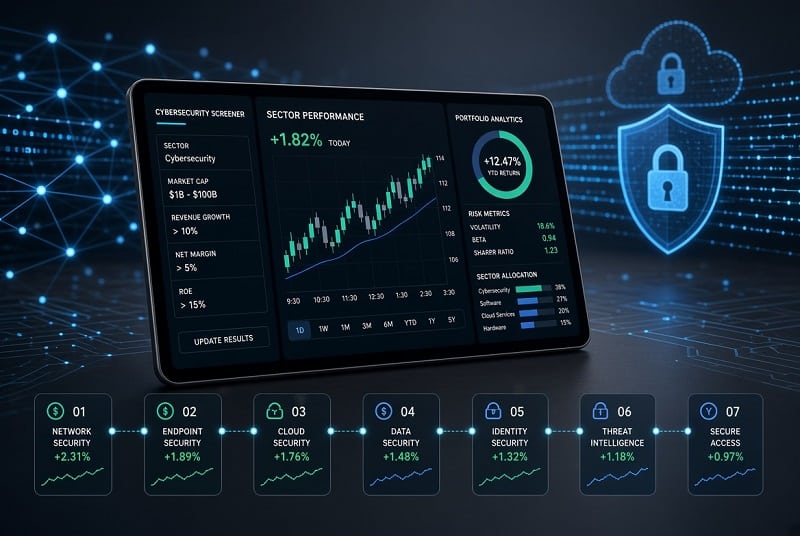
Here’s a quick snapshot of how the top pure-play security vendors compare on strategy and growth metrics:
| Company | Ticker | Primary Focus | Platform Strategy | Key Growth Metric |
| CrowdStrike | CRWD | Endpoint & Cloud Security | Falcon Platform | Strong ARR Growth & Module Adoption |
| Palo Alto Networks | PANW | Network & Cloud Firewalls | Strata, Prisma, Cortex | Total Contract Value (TCV) Expansion |
| Zscaler | ZS | Zero Trust & Secure Edge | Zero Trust Exchange | Net Retention Rate (NRR) > 115% |
| SentinelOne | S | Autonomous AI Endpoint | Singularity Platform | Fast Revenue & Margin Expansion |
| Fortinet | FTNT | Network Firewalls & SASE | FortiOS Hardware/Software | High Free Cash Flow Margins |
| CyberArk | CYBR | Identity Access Management | Identity Security Platform | Enterprise Privileged Access Demand |
| Cloudflare | NET | Edge Security & Web Defense | Global Anycast Network | Enterprise Account Tier Additions |
A well-balanced growth strategy usually pairs aggressive software innovators with steadier cash-flow compounders. For a broader look at how high-growth tech names fit into a diversified portfolio, check out our detailed breakdown of the best long-term investments.
1. CrowdStrike Holdings (NASDAQ: CRWD)
CrowdStrike shows up on pretty much every serious cybersecurity company’s stock list, and for good reason—its cloud-native Falcon engine has become something of an industry benchmark. A single lightweight agent feeds data into a central cloud AI that sifts through trillions of security events every day, catching breaches before they can spread.
What Sets It Apart
Cross-selling. Once a company is on Falcon, adding modules like identity defense or vulnerability management is an easy upsell.
AI Angle
Charlotte AI acts almost like a generative analyst on the team—security staff can ask it plain-language questions about threat logs instead of digging through raw data themselves, which speeds up response time considerably.
2. Palo Alto Networks (NASDAQ: PANW)
Palo Alto has bet big on full platform consolidation, and it’s paying off. Bundling network firewalls (Strata), cloud posture management (Prisma Cloud), and automated security operations (Cortex) into one system gives enterprise clients a genuine reason to finally retire their old point solutions.
What Sets It Apart
Deep, long-standing relationships across Fortune 500 leadership.
Cash Flow
Consistently strong free cash flow margins make it a solid choice for more conservative institutional investors who still want growth exposure.
3. Zscaler (NASDAQ: ZS)
As enterprise apps keep migrating to multi-cloud environments, traditional corporate VPNs are becoming more of a liability than a safeguard. Zscaler runs a large-scale cloud security platform built on Zero Trust principles, connecting users straight to the apps they need without ever exposing the wider corporate network.
What Sets It Apart
It’s essentially the market leader in Secure Access Service Edge (SASE), replacing a lot of legacy routing hardware.
Growth Driver
Its Net Retention Rate stays consistently high, which tells you existing customers keep adding more cloud modules year after year rather than just renewing at the same spend.
4. SentinelOne (NYSE: S)
If you’re after more upside within ai cybersecurity stocks, SentinelOne is worth a look. Its Singularity platform runs machine learning directly on the endpoint itself, which lets it detect, isolate, and even roll back ransomware attacks in milliseconds.
What Sets It Apart
Fully automated threat response—it keeps working even when a device is offline, which a lot of competitors still can’t claim.
Financial Trend
Margins have been steadily improving as the company scales across both mid-market and enterprise accounts.
5. Fortinet (NASDAQ: FTNT)
Fortinet takes a different route by designing its own custom ASIC security chips that sit right inside its hardware firewalls. That proprietary silicon means faster processing with lower power draw, giving Fortinet an edge in both physical appliances and hybrid-cloud SASE deployments.
What Sets It Apart
An unusually strong price-to-performance ratio, combining hardware firewalls with a growing base of recurring software revenue.
Capital Allocation
Strong cash generation has supported steady share buyback programs over time.
For anyone looking to sharpen how they evaluate growing tech companies more broadly, our guide on AI stock-picking tools breaks down how quantitative tools track software performance metrics.
6. CyberArk Software (NASDAQ: CYBR)
Identity security has become one of the fastest-growing areas of spend, largely because attackers increasingly go straight after high-level admin credentials rather than trying to break through perimeter defenses. CyberArk focuses on Identity Security and Privileged Access Management (PAM), protecting both human and machine credentials across servers, cloud workloads, and DevOps pipelines.
What Sets It Apart
A dominant position in enterprise PAM that’s hard for competitors to dislodge.
Sticky Revenue
High switching and implementation costs make customers far less likely to churn once they’re set up.
7. Cloudflare (NYSE: NET)
Cloudflare operates a massive global network spanning hundreds of cities. What started out as DDoS protection and content delivery has grown into a full developer platform, complete with serverless computing and Zero Trust access tools.
What Sets It Apart
Its sheer visibility into global web traffic lets it catch zero-day threats earlier than most.
Upside Potential
Plenty of room left as smaller developer accounts graduate into enterprise-tier plans.
ETFs vs. Individual Stocks: How Should You Allocate Capital?
If picking individual tickers feels like too much volatility for your taste, ETFs offer a simpler way to get exposure across the whole cybersecurity sector at once.
| ETF Ticker | Benchmark Focus | Top Holdings Exposure |
| CIBR | First Trust NASDAQ Cybersecurity ETF | Balanced mix of hardware, software, and infrastructure |
| HACK | ETFMG Prime Cyber Security ETF | Tilted toward pure-play software SaaS names |
| BUG | Global X Cybersecurity ETF | Pure-play SaaS growth focus |
When you’re setting up your investment accounts, it’s worth picking a platform with low trading costs and automated fractional buying—small details, but they add up. Our detailed review of the best brokerages for beginners compares execution quality and account features if you want to dig deeper.

Three Financial Metrics to Check Before You Buy
Before putting money into any security software stock, it’s worth checking these three things first:
ARR Growth
Confirms new recurring subscription revenue is actually expanding, not just one-time setup fees padding the numbers.
Net Retention Rate
Anything above 115% signals existing clients are genuinely expanding their contracts over time, not just sticking around.
EV-to-Sales vs. Growth Rate
Comparing enterprise value against sales growth helps you avoid overpaying for a platform whose growth is actually slowing down.
If you’re mapping out a broader portfolio mix, it’s worth thinking about how software positions like these sit alongside other growth themes. Our analysis of the best EV stocks to buy is a useful comparison point for how clean-energy cycles stack up against enterprise security spending.
Conclusion
As corporate workloads push further into multi-cloud setups and automated workflows, demand for specialized threat defense platforms shows no sign of slowing. Companies like CrowdStrike, Palo Alto Networks, and Zscaler sit right at the center of what’s becoming essential enterprise spending, not optional spending.
Sticking with pure-play leaders that show strong ARR growth, sticky customer retention, and expanding multi-module platforms is still one of the clearer ways for investors to capture long-term growth in this sector.
FAQs
What Makes a Stock a “Pure-Play” Cybersecurity Company?
It means the company earns nearly all of its revenue directly from security software, hardware, or threat intelligence—not from broad IT services or cloud hosting on the side.
Are Cybersecurity Stocks Recession-Resistant?
Security budgets are widely seen as one of the more defensive corners of corporate IT spending. A single breach or ransomware incident can cost millions, so companies rarely cut security contracts even when times get tough.
How Is AI Reshaping Cybersecurity Investing?
It’s a two-way street. Attackers now use generative AI to automate phishing and credential-based attacks, while vendors use real-time AI models to spot unusual network behavior and shut threats down before they spread.
Which Cybersecurity Stock Has the Strongest Growth Potential for 2026?
There’s no single answer here since each company leans on a different growth lever. SentinelOne and Zscaler tend to attract investors chasing faster top-line growth given their smaller revenue base and expanding module adoption, while CrowdStrike and Palo Alto Networks appeal more to those who want an established platform leader with proven cross-selling momentum. The better approach is usually to weigh growth rate against valuation and retention metrics for each name rather than picking one “winner” outright—or to spread that risk across a sector ETF instead.