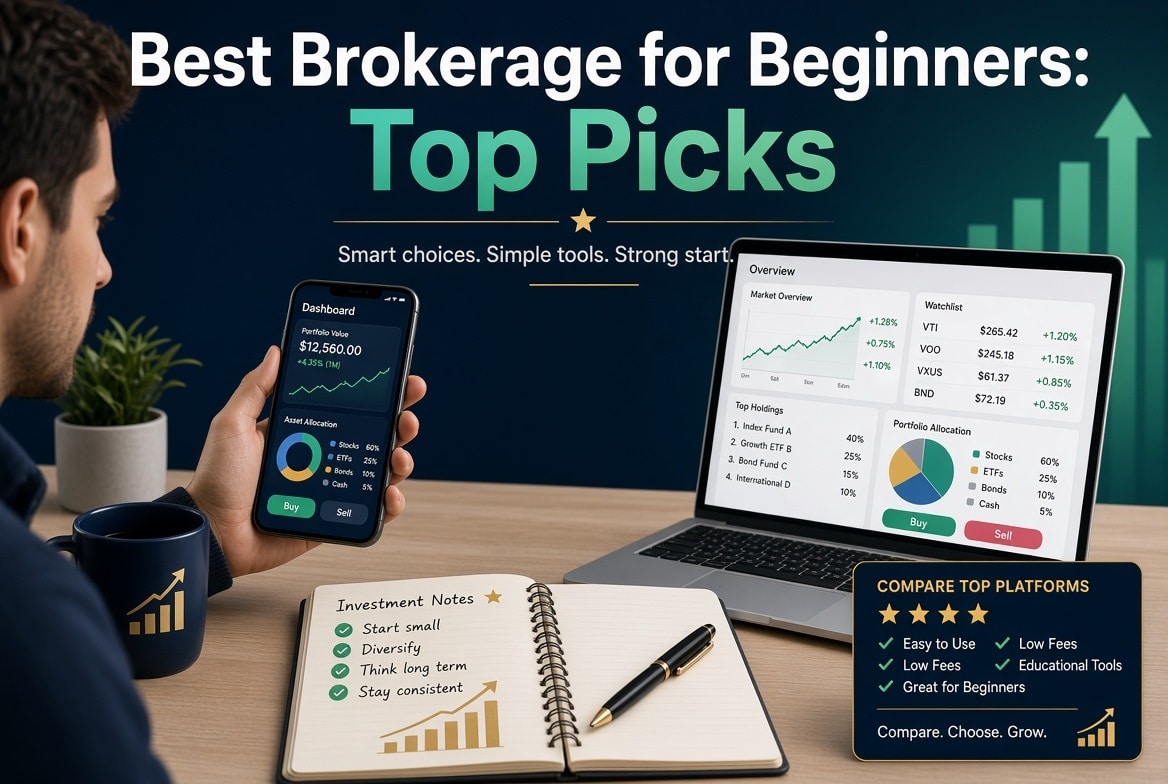
You don’t need to know anything about the stock market to open a brokerage account. You just need a broker that won’t punish you for being new — no per-trade fees eating into a $50 deposit, no $2,000 minimum sitting between you and your first trade, and an app that doesn’t require a finance degree to navigate.
So which one actually fits that description in 2026? A short list keeps coming up across every review, comparison chart, and Reddit thread on the topic: Fidelity, Charles Schwab, Robinhood, Vanguard, and a couple of newer names like Webull. They’re not interchangeable, though. Fidelity leans toward “grow with you for 30 years.” Schwab lets you practice with fake money first. Robinhood is built for people who want to open the app, buy a stock, and move on with their day. Vanguard barely has a personality at all — which is kind of the point if you’re a buy-and-hold investor.
This guide walks through what separates them, which one probably fits you, and how to actually open an account without overthinking it. If the long game for you is passive income streams rather than day-trading, the broker you pick now matters more than it feels like it does at $50 in the account.
What Actually Makes a Broker Beginner-Friendly
Every comparison site scores this stuff a little differently, but a few things separate a genuinely beginner-friendly broker from one that just markets itself that way.
Zero commissions on stock and ETF trades are table stakes now — almost every broker on this list offers it, so it barely counts as a selling point anymore. What still varies a lot: account minimums. Some platforms let you start with $0. Others (M1 Finance, T. Rowe Price) still want $100 to $2,500 before you can open the account at all, which is a real barrier if you’re starting with a summer job’s worth of savings.
Fractional shares matter more than people expect going in. A single share of some well-known stocks runs several hundred dollars — without fractional investing, you’d need to save up just to own a sliver of one company. Most beginner-focused brokers now let you buy $5 or $10 worth instead of a whole share.
Dividend reinvestment is the quiet feature nobody markets well but that compounds hardest over time. If you’re aiming at passive income streams rather than short-term trades, an account that automatically reinvests dividends back into more shares (instead of letting cash sit there) does a lot of the heavy lifting for you.
And then there’s the stuff that’s harder to put a number on — how usable the app actually is, whether the educational content is real or an afterthought, whether you can practice with a paper trading account before risking real money. Schwab and Interactive Brokers are really the only two on this list that offer genuine paper trading, for what it’s worth.
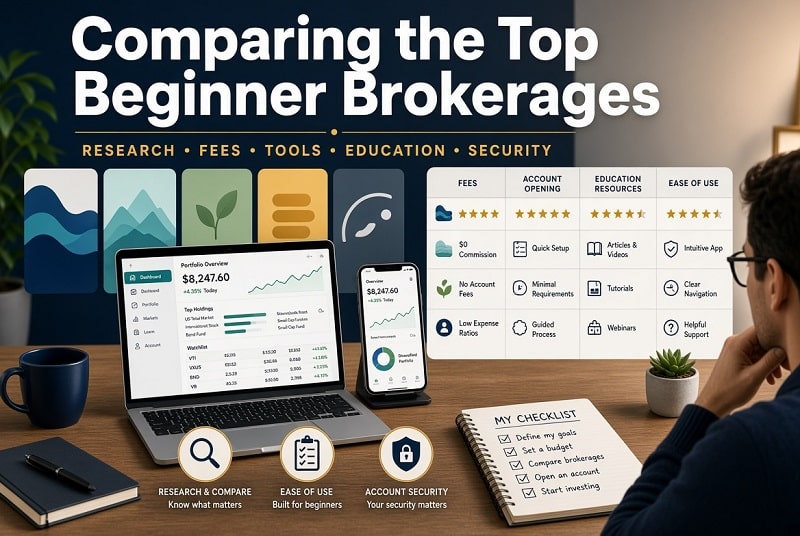
Comparing the Top Beginner Brokerages
| Brokerage | Best For | Account Minimum | Fractional Shares | What Stands Out |
| Fidelity | Overall pick | $0 | Yes, from $1 | Free index funds with zero expense ratio |
| Charles Schwab | Practicing before you commit real money | $0 | Yes, from $1 | Paper trading on thinkorswim |
| Robinhood | Simplicity | $0 | Yes, from $1 | 1–3% match on IRA contributions |
| Vanguard | Buy-and-hold, hands-off investing | $0 (ETFs) / ~$3,000 (many mutual funds) | ETFs only | Rock-bottom expense ratios |
| E*TRADE | Wanting to actually learn as you go | $0 | Limited, ETFs/mutual funds via auto-invest | Free index funds + daily market webcasts |
| SoFi Active Investing | Getting advisor access without paying for it | $0 | Yes, from $5 | One free 1-on-1 advisor meeting |
| M1 Finance | Set-it-and-forget-it portfolios | $100 | Yes, from $1 | “Pie” investing with auto-rebalancing |
| Webull | Wanting a community around your trades | $0 | Yes | In-app investing community + paper trading |
| Interactive Brokers (IBKR Lite) | Going deep on education | $0 | Yes, 10,000+ tickers | IBKR Campus courses and webinars |
The Brokers, One by One
Fidelity — the one most people should probably start with
Fidelity shows up at or near the top of nearly every list like this one, and it’s earned it. There’s no paper trading option, which is a real gap, but the educational library more than makes up for it — genuinely one of the deepest in the industry, not the thin “Investing 101” page some competitors slap together.
The thing worth knowing about: Fidelity’s ZERO fund family. Four index funds, no expense ratio, no minimum. That’s not “low fee” marketing language — it’s actually free, which is rarer than it sounds even among brokers that call themselves low-cost. You also get fractional shares down to $1, crypto trading if you want it, and access to over 10,000 outside mutual funds on top of Fidelity’s own.
Where it falls short: the mobile app gets dinged consistently in user reviews as clunky compared to Robinhood or Webull, and if you ever need a broker-assisted trade (calling in instead of trading online), the fee for that is higher than most competitors charge.
Charles Schwab — the one that lets you practice first
Schwab’s real edge for beginners is something almost nobody else offers: a legitimate paper trading platform through thinkorswim, so you can test out buying and selling with fake money before your real cash is on the line. If the idea of placing your first actual trade makes you nervous, that alone might settle it.
New accounts also get Schwab’s “Starter Kit” — a small bonus split automatically into fractional shares across five big S&P 500 names, which doubles as a low-stakes way to see what owning a diversified handful of stocks actually looks like day to day. The Learn center mixes articles with real trading demos, not just static explainer pages, and Schwab’s phone support has a reputation for actually resolving issues fast, 24/7.
The catch: no high-yield cash management account, and if you want one-on-one wealth advising rather than the robo-advisor tier, you’ll need $500,000 in assets — a number that has nothing to do with beginners.
Robinhood — the one that gets you started in five minutes
Robinhood basically rebuilt what people expect a brokerage app to look like, and a decade later it’s still the app other brokers get measured against for simplicity. You open it, you buy a fractional share for $1, you’re investing. That’s really the whole pitch.
The IRA match is legitimately strong here — 1% on every user’s contributions, bumped to 3% if you pay for the $5/month Gold tier. What you’re trading off: research tools are thinner than Fidelity’s or Schwab’s, there are no mutual funds at all, and without Gold, your uninvested cash just sits there earning nothing.
Vanguard — the one built for people who’d rather not look at it often
Vanguard isn’t trying to be exciting, and the platform itself shows it — pretty bare-bones, not much in the way of research tools. But if your plan is “buy index funds and check back in a decade,” Vanguard’s expense ratios are about as low as they get. VTSAX, one of its flagship funds, runs around 0.04% — a fraction of what many actively managed funds charge.
One thing that trips people up: a lot of Vanguard’s mutual funds carry minimums around $3,000, which is steep if you’re starting small. The workaround most beginners use is buying Vanguard’s ETFs instead — no minimum, and commission-free.
E*TRADE — the one that teaches while you trade
E*TRADE leans hard into education in a way most competitors don’t bother with — webinars, articles, daily market webcasts, and Bloomberg TV streamed right inside the trading platform itself. If the platform feels a little more intimidating than Robinhood on first login (and it does), the built-in hand-holding is meant to close that gap.
It’s also one of only two major brokers, alongside Fidelity, offering fully free index funds — no expense ratio, no minimum. Fractional shares are more limited though: really only available on ETFs and mutual funds through an automatic-investing program, not on individual stocks the way Fidelity and Schwab allow.
SoFi Active Investing — the one with a free advisor built in
SoFi’s biggest advantage for a beginner has nothing to do with the trading interface — it’s that every member gets one free meeting with an actual financial advisor, something most brokers charge for. If you want a real person to sanity-check your first portfolio, that’s worth more than it looks like on paper.
The app itself is simpler than most, which cuts both ways: easier to learn, but there’s less to dig into once you outgrow the basics. Fractional shares start at $5, on a more limited selection of stocks and ETFs than some competitors.
M1 Finance — the one for people who don’t want to touch it
M1 doesn’t top the overall rankings the way Fidelity and Schwab do, but its “Pie” feature is genuinely useful — you build your portfolio as a custom allocation, and M1’s Dynamic Rebalancing keeps it in line automatically as money moves in and out. It’s basically a free version of something robo-advisors usually charge for.
This fits well if you’re aiming for something like our best long-term investments to maximize your returns approach — set it up once, let it run. The downsides: restricted trading windows instead of trading whenever markets are open, no options trading, and a $100 minimum, higher than most brokers on this list.
Webull — the one with a community attached
Webull built something most competitors haven’t bothered with: an actual in-app community where you can ask questions and see what other investors are watching, paired with a genuine paper trading tool. It’s one of the more social ways to learn without real money on the line at first.
No account minimum, no commissions on stocks or ETFs, and a decent rate on uninvested cash if you opt into the high-yield account. The gap: no mutual funds, and as a newer, recently public company (2025), it doesn’t have the multi-decade track record Fidelity or Schwab can point to.
Interactive Brokers (IBKR Lite) — the one for people who actually want to learn the mechanics
IBKR Lite can feel like a lot on day one — there’s a genuinely overwhelming amount of data and functionality packed into it for someone who’s never traded before. But if you’re willing to put in the time, IBKR Campus goes deeper than almost anything else on this list: full courses, webinars, podcasts, in-house analysis.
Fractional shares cover more than 10,000 U.S. stocks and ETFs starting at $1, commission-free on the basics. What’s missing: no built-in robo-advisor and no in-house advisors, so if you want someone else managing things rather than DIY research, look elsewhere.
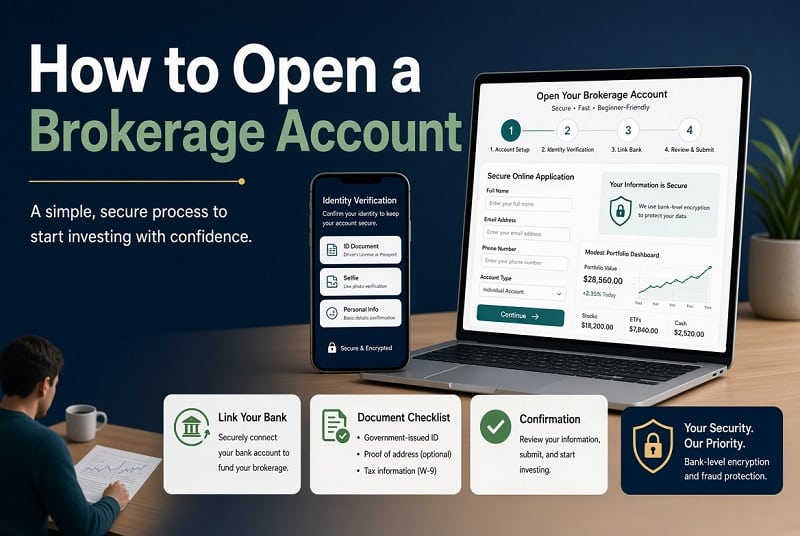
How to Open a Brokerage Account
It’s less complicated than it sounds — closer to opening a bank account than most people expect.
First, decide whether you want a taxable account or a tax-advantaged one. A regular brokerage account has no contribution limits and you can pull money out whenever, but you’ll owe capital gains tax on any profit. A Roth or traditional IRA gives you tax advantages for retirement money specifically, with contribution limits and generally some restrictions on early withdrawals.
Next comes identity verification — Social Security number, a government ID, basic income info. Every regulated U.S. broker requires this (it’s called KYC, know-your-customer), so it’s not something specific to one platform being sketchy.
Then you link a bank account and fund it, usually via ACH transfer, which takes one to three business days to clear. If you’re moving money from an existing account at a different firm, ask about an ACAT transfer instead — it moves your actual investments over without selling them first, which also means no surprise tax bill from the move.
And then you just… place the trade. Start small if that feels better. Fractional shares mean $25 gets you a real slice of a real company, not nothing.
If you’re still figuring out where that first deposit should actually go once the account’s open, our best investments for beginners breakdown picks up right where this one leaves off.
Conclusion
There’s no single right answer here — just a best fit for what you’re trying to do. Want one account you can realistically keep for 30 years without switching? Fidelity’s the safe default. Want to practice before any real money is on the line? Schwab’s paper trading covers that in a way almost nobody else does. Want the simplest possible app and don’t care much about research tools? Robinhood still wins that one. Building toward something automated and dividend-focused? M1 or Vanguard fit better.
The account itself is really just the starting point, though — what you consistently put into it matters a lot more than which logo is on the app. Once it’s open, the real question becomes where that money goes next. If the goal is durable passive income streams rather than chasing short-term moves, pairing a low-cost beginner brokerage with a steady, dividend-reinvesting approach tends to beat trying to time the market — and it’s a lot easier to actually stick with.
FAQ’s
What’s the best brokerage for someone starting with almost no money?
Fidelity, Robinhood, and Webull are the strongest fits here — all three have $0 minimums and fractional shares starting around $1. You genuinely don’t need hundreds of dollars just to open the account and place your first order.
Which broker has the lowest fees for a beginner?
Most of the brokers on this list — Fidelity, Schwab, Robinhood, Vanguard, E*TRADE, Webull, IBKR Lite — charge $0 on U.S. stock and ETF trades. Where fees actually show up is options contracts, some mutual fund transactions, and broker-assisted trades, so “commission-free” isn’t quite the same as “no fees anywhere.”
Is it actually safe to keep money in a brokerage account?
With a regulated U.S. broker, yes. SIPC insurance covers up to $500,000 in cash and securities (with a $250,000 cap on cash specifically) if the brokerage itself collapses. That’s not the same as protection against your investments losing value — SIPC covers broker failure, not market risk. Every broker mentioned here is SIPC-insured and regulated by the SEC and FINRA.
How much money do you actually need to start investing?
Technically $1, between fractional shares and $0 minimums at places like Fidelity and Robinhood. What matters more than the exact number is whether you can leave it invested for years without needing it back. If you’ve got a bit more to work with, 7 best investments for $1,000 walks through where that could realistically go.
Can you lose money through a brokerage account?
Yes — stocks, ETFs, and mutual funds all carry risk, and SIPC insurance doesn’t cover investment losses, only broker failure. The U.S. stock market has historically averaged something like 10% annual returns before inflation over long stretches, but that number smooths over a lot of short-term ups and downs. Before putting real money in, it’s worth a look at 5 metrics investors should check before investing in stocks.
Robo-advisor or picking your own investments — which one’s actually better for a beginner?
Depends on how involved you want to be. A self-directed account (Fidelity, Schwab, Robinhood) means every pick is yours. A robo-advisor like Betterment builds and rebalances a diversified portfolio for you automatically, usually for something like 0.25% a year. A few brokers, Schwab and SoFi included, offer both under one account, so it’s not necessarily either-or.