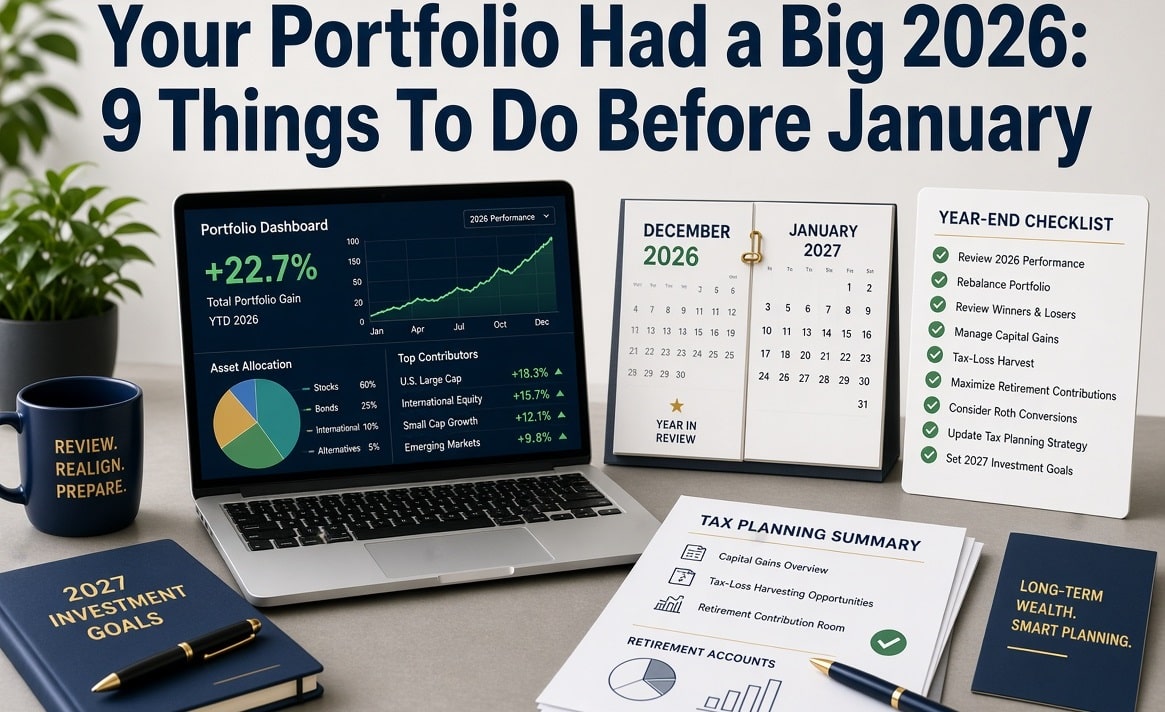
A strong market year feels great—until January arrives and you realize the portfolio that delivered those gains no longer looks like the one you designed. Equity markets that climb hard shift weightings, inflate single-stock or sector concentrations, push effective risk higher than planned, and create tax decisions that cannot be deferred forever. Year-end is the natural checkpoint. The calendar forces attention to contribution deadlines, required minimum distributions for some account types, tax-lot decisions, and the simple arithmetic of whether today’s allocation still matches tomorrow’s goals.
This article walks through nine concrete actions (plus one overarching priority) every investor should consider before the books close on 2026. The guidance is practical rather than theoretical: how gains produce drift, when to rebalance, how to think about realizing gains versus letting them run, what concentration risk looks like in individual holdings, the mechanics of capital-gains taxes and tax-loss harvesting, year-end opportunities inside tax-advantaged accounts, the interaction between portfolio growth and personal risk capacity, the behavioral traps that follow strong years, and the single highest-leverage check if time is limited. The framing assumes a U.S. investor subject to federal capital-gains rules, ordinary-income treatment on certain accounts, and the usual suite of retirement and health-savings vehicles. Nothing here constitutes personalized advice; every portfolio and tax situation differs. The goal is a clear decision framework you can apply with your own numbers and, where appropriate, with a tax professional or advisor.
The First Things to Review After a Strong 2026
Begin with three high-level questions before diving into individual positions or tax worksheets. First, what is the current asset allocation versus the strategic targets that were set when the portfolio was last formally designed or reviewed? A multi-asset portfolio that started the year at 60 percent equities / 40 percent fixed income and intermediate cash can easily finish at 68–72 percent equities after a strong equity year, even without new contributions. That shift is not automatically wrong, but it is information. Second, has the absolute dollar size of the portfolio changed the investor’s effective risk capacity? A $1.2 million portfolio that grew to $1.55 million may still be the same percentage allocation, yet the dollar amount at risk is larger. For someone five to seven years from retirement or a major liquidity need, that absolute exposure matters. Third, are there any known cash-flow events in 2027—home purchase, education funding, business transition, required minimum distributions—that now look more or less manageable because of the gains?
These three reviews can be completed in a single sitting with a current statement, a spreadsheet of target weights, and a short list of known future cash needs. They surface the issues that later sections address in detail: whether rebalancing is required, whether concentration has become dangerous, whether tax-aware harvesting or gain realization is worth considering, and whether cash or lower-volatility holdings should be increased simply because the portfolio is larger. Skipping this triage step is the most common reason investors either over-trade or under-adjust after a good year. The market has already done the hard work of generating returns; the remaining work is to decide what those returns imply for the next leg of the plan.
Document the findings. Write down the current equity weight, the target weight, the largest single position as a percentage of total liquid net worth, the estimated unrealized gains by account type (taxable versus tax-deferred), and any 2027 cash needs that exceed routine spending. That one-page snapshot becomes the reference for every subsequent decision. It also prevents the common error of reacting to the most recent month’s performance rather than to the full-year shift in risk.
How Strong Gains Cause Allocation Drift and When to Rebalance
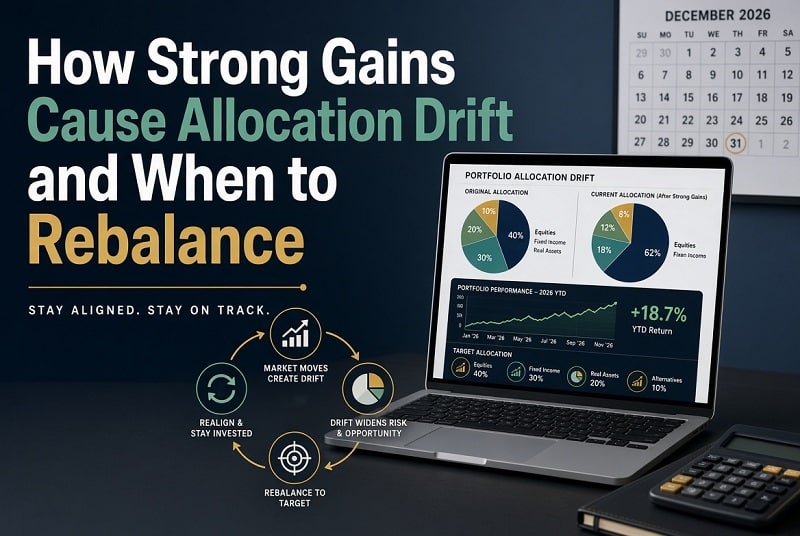
Asset-class drift is mechanical. Equities have higher expected volatility and, in most historical periods, higher expected returns than intermediate bonds or cash. When equities outperform, their weight in a mixed portfolio rises automatically. The larger the outperformance and the longer it persists, the greater the drift. A portfolio that begins at a 60/40 equity-to-fixed-income mix and experiences a 20 percent equity total return while fixed income returns 4 percent will finish the year roughly 63–64 percent equities if no rebalancing occurs and no new cash is added. Compound that effect over two or three strong years and the equity weight can climb into the high 60s or low 70s without any conscious decision by the investor.
Sector and style drift compounds the problem. Within equities, technology, growth, or large-capitalization stocks may have led the market. A total-market or S&P 500 fund will automatically increase its weight in those leaders. An investor who also holds individual technology names or concentrated growth funds can easily find that a single sector represents 30–40 percent of the equity sleeve and 20–25 percent of the total portfolio. That concentration is invisible if the investor only monitors the broad equity-versus-bond percentage.
Determining whether it is time to rebalance requires three comparisons. First, compare current weights to the strategic targets that were established for the investor’s risk tolerance, time horizon, and spending needs. Most institutional and many individual frameworks use tolerance bands—commonly ±5 percentage points around the target equity weight. A portfolio that has moved from 60 percent to 67 percent equities has breached a typical band and warrants action. Second, examine absolute risk. Even if the percentage equity weight is still inside the band, a large increase in portfolio value may have pushed the dollar amount of equity exposure beyond the investor’s comfort zone or beyond the amount that can reasonably be liquidated if markets reverse. Third, consider tax location. Rebalancing inside a 401(k) or IRA has no immediate tax consequence. Rebalancing inside a taxable brokerage account does. The existence of large unrealized gains does not eliminate the need to rebalance; it simply changes the optimal method—favoring new contributions, dividend reinvestment redirection, or selective sales of lots with higher cost basis.
Practical rebalancing approaches after a strong year include: (1) directing all new contributions and dividends into the underweight asset classes until targets are restored; (2) selling a portion of the overweight equities inside tax-advantaged accounts where gains are not currently taxed; (3) using tax-loss harvesting elsewhere in the taxable portfolio to offset any gains that must be realized; and (4) raising cash or short-duration fixed income if the investor’s time horizon has shortened. The goal is not to return precisely to the original percentages on December 31. The goal is to restore risk to a level consistent with the plan before the next market cycle begins.
Investors who rebalance only when markets fall are systematically selling low. Those who never rebalance after strong years are systematically increasing risk when valuations are higher and expected future returns are lower. Year-end after a big gain year is the moment to interrupt that pattern deliberately.
Taking Gains Versus Letting Winners Run
Selling simply because a position has risen is usually a mistake. Markets can remain elevated or continue rising for extended periods; truncating a successful investment solely because it is “up a lot” introduces opportunity cost and, in taxable accounts, an unnecessary tax bill. The relevant question is never “Has this gone up?” but “Does this position still belong in the portfolio at its current weight given my objectives, risk tolerance, and the rest of my holdings?”
There are legitimate reasons to realize gains after a strong year. The first is rebalancing: if a single stock or sector has grown far beyond its intended allocation, reducing it restores diversification even if the reduction crystallizes tax. The second is portfolio construction: an investor who has decided to move from an aggressive growth allocation toward a more balanced or income-oriented allocation as retirement approaches may need to sell appreciated equities to fund the transition. The third is concentration risk: a position that represents more than 10–15 percent of liquid net worth (or a lower threshold for more risk-averse investors) creates single-name risk that is difficult to justify on any long-term basis. The fourth is tax-rate management: if an investor expects to be in a higher capital-gains bracket in future years, or if legislative changes are anticipated, realizing gains at today’s rates can be rational.
Conversely, the most common error is to sell winners and keep losers purely on the basis of recent performance. That behavior is the opposite of disciplined rebalancing. Another frequent mistake is to treat every realized gain as “found money” that can be spent rather than as capital that should remain invested according to the plan. Gains are not income in the economic sense; they are the market’s recognition of higher expected future cash flows or lower risk premiums. Spending them reduces the capital base that must continue to compound.
A practical decision rule: if the position still fits the strategic allocation, has acceptable fundamental characteristics, and does not create undue concentration, leave it alone. If any of those three conditions fail, reduce it—preferably inside a tax-advantaged account or by selling higher-cost-basis lots first—and redeploy the proceeds according to the target allocation. The tax cost is real, but the risk of an unbalanced portfolio is also real. After a strong year the probability that the next meaningful move will be a correction or a multi-year period of lower returns is higher, not lower. Protecting the plan matters more than protecting any single year’s tax bill.
Reviewing Outsized Stocks, Funds, and Sectors
Concentration is the silent risk that strong markets create. An individual stock that began the year as a 4 percent position can finish as an 8–10 percent position after a large price move, especially if the rest of the portfolio lagged. A sector ETF that was intended as a satellite holding can become a core driver of returns and risk. A single actively managed fund that performed well can dominate the equity sleeve.
When reviewing these outsized positions, examine four dimensions. First, absolute size: what percentage of total investable assets does the position represent? Thresholds vary, but many advisors flag any single security above 5–7 percent and any sector above 15–20 percent of the equity allocation for closer scrutiny. Second, correlation and diversification: does the position move with or against the rest of the portfolio? A technology-heavy holding may be highly correlated with other growth exposures already present, reducing the diversification benefit. Third, fundamental durability: has the business or the fund’s process changed, or is the recent performance simply the continuation of a favorable environment that may not persist? Fourth, tax and liquidity characteristics: is the position held in a taxable account with a low cost basis, or inside a retirement account where realization is frictionless?
Practical responses include partial sales to bring the weight back inside a predetermined band, the use of options strategies (for sophisticated investors) to hedge without immediate sale, or the deliberate decision to hold and accept the concentration because the investor’s overall risk capacity and conviction remain high. The last option should be rare and documented. Most investors who “decide to hold” after a big run are simply avoiding the psychological discomfort of realizing a gain or the tax cost. That discomfort is real; it is not a sound investment reason.
Fund-level concentration deserves the same treatment. An investor who holds three large-cap growth funds plus a technology sector fund plus individual technology stocks may believe they are diversified across “managers” while in reality owning highly overlapping exposures. Year-end is the moment to calculate the true underlying factor and sector exposures rather than relying on the fund names.
Capital Gains Taxes Before Year-End Sales
Capital-gains tax is the friction that makes rebalancing in taxable accounts more expensive than in retirement accounts. Long-term capital gains (assets held more than one year) are taxed at preferential rates—0 percent, 15 percent, or 20 percent for most investors, plus the 3.8 percent net investment income tax for higher-income taxpayers. Short-term gains are taxed as ordinary income. The holding-period clock and the cost-basis method therefore matter.
Before selling appreciated securities in a taxable account, investors should estimate the tax cost under current law and under any plausible changes that might take effect in 2027 or later. They should also identify specific lots. Most brokerage platforms allow selection of highest-cost-basis lots first, which minimizes the gain realized on any given sale. Tax-lot accounting is not optional for serious investors; it is a primary tool for managing the tax drag of rebalancing.
Two additional considerations apply at year-end. First, the wash-sale rule does not apply to gains—only to losses—so an investor can sell a winner and immediately repurchase a similar (or even identical) security if the goal is simply to reset cost basis or to fund a different allocation. Second, the timing of the sale within the tax year affects the payment of estimated taxes and the possible underpayment penalties. Realizing a large gain in December may require an estimated-tax payment by January 15 of the following year for some taxpayers.
None of these mechanics should freeze an investor into inaction. A portfolio that has drifted far from target because of unrealized gains is still a higher-risk portfolio. Paying tax to restore the risk profile is often the correct economic decision, especially if the alternative is carrying elevated equity exposure into a period when expected returns are lower. The tax is a cost of the rebalancing transaction, not a reason to abandon the strategic allocation.
Investors in the 0 percent long-term capital-gains bracket have a particularly valuable opportunity: they can realize gains up to the top of that bracket with no federal tax cost, thereby resetting basis for future years. Those near the top of the 15 percent bracket should calculate carefully whether additional gains will push them into the 20 percent rate or trigger the net investment income tax. Bracket management is a year-end discipline that strong markets make more relevant.
Tax-Loss Harvesting After a Strong Year
Even in a strong overall market, individual securities, sectors, or asset classes can produce losses. International equities, certain value styles, real-estate investment trusts, or individual stocks that lagged the broad averages may sit at unrealized losses. Tax-loss harvesting remains useful: realized losses can offset realized gains dollar-for-dollar, and up to $3,000 of net losses can offset ordinary income each year, with excess losses carried forward indefinitely.
The process is straightforward. Identify positions with unrealized losses that no longer fit the strategic allocation or that can be replaced with a similar but not “substantially identical” security. Sell the losing position, capture the loss, and reinvest the proceeds in a replacement that maintains market exposure. The wash-sale rule prohibits claiming the loss if a substantially identical security is purchased within 30 days before or after the sale. Careful selection of replacements—different but correlated ETFs, or a brief period in cash or a dissimilar asset—avoids the rule.
After a strong year the absolute size of available losses may be smaller, yet the value of those losses is higher because the investor is more likely to have realized gains from rebalancing or from other sales. Losses harvested in a high-gain year produce immediate tax savings. Losses left unrealized produce no current benefit and may be less useful in a future year if the investor has fewer gains to offset.
Tax-loss harvesting is not free. Transaction costs, bid-ask spreads, and the risk of temporary market exposure differences all exist. For most taxable investors with meaningful unrealized losses, the tax benefit still dominates. The key is to treat harvesting as a routine year-end process rather than an opportunistic trade that only occurs in down markets. Strong years create the gains that make the losses valuable; the two sides of the ledger should be managed together.
Year-End Opportunities in 401(k)s, IRAs, HSAs and Other Tax-Advantaged Accounts
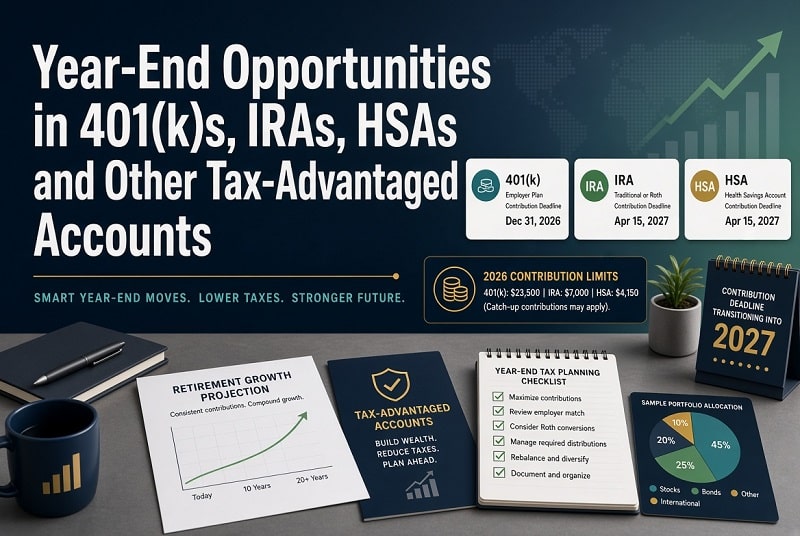
Tax-advantaged accounts offer several hard deadlines and strategic opportunities that do not exist in taxable brokerage accounts. Contribution limits for 401(k), 403(b), and similar plans are set by calendar year; unused capacity disappears on December 31. Catch-up contributions for participants age 50 and older increase the available room. Investors who received large bonuses or experienced high earned income in 2026 should verify whether they have fully funded the elective deferral limit and any available after-tax or Roth options inside the plan.
IRA contribution deadlines are more flexible—typically mid-April of the following year—but the decision to contribute and the choice between traditional and Roth still benefit from year-end clarity about current-year income and expected future tax rates. Roth conversions are a powerful year-end tool after a strong market: converting traditional IRA assets to Roth while equity prices are elevated means the conversion tax is paid on a larger balance, but future growth occurs tax-free. Conversely, if an investor expects a lower-income year in 2027, waiting may be preferable. The calculation requires estimating the tax cost of the conversion against the value of tax-free compounding and the investor’s expected tax rate in retirement.
Health savings accounts (HSAs) combine a current-year deduction, tax-free growth, and tax-free withdrawals for qualified medical expenses. The contribution deadline is also mid-April of the following year, yet funding the HSA before year-end locks in the deduction against current-year income and begins the compounding clock earlier. Investors who are eligible and have high-deductible health coverage should treat the HSA contribution as a priority comparable to the 401(k) deferral.
Required minimum distributions (RMDs) for those who have reached the applicable age must be completed by December 31. Missing the deadline produces a steep penalty. Investors who are subject to RMDs and who also have charitable intentions can use qualified charitable distributions to satisfy part or all of the RMD without recognizing the income. That strategy is available only from IRAs and only for direct transfers to qualified charities.
Finally, asset location—the deliberate placement of tax-inefficient assets inside tax-advantaged accounts and tax-efficient assets in taxable accounts—can be reviewed and adjusted at year-end with minimal friction. High-turnover funds, taxable bond funds, and REITs generally belong in retirement accounts; broad equity index funds and municipal bonds can reside in taxable accounts. A strong year that has swollen equity balances inside taxable accounts may create an opportunity to sell those equities (paying the capital-gains tax) and repurchase them inside a tax-advantaged account using available contribution room or by shifting other assets. The net effect is a permanent improvement in the tax efficiency of the overall portfolio.
Risk Tolerance, Cash Allocation, and Approaching Goals
Portfolio growth changes the mathematics of risk even if the percentage allocation stays constant. An investor who needed $40,000 of annual withdrawals from a $1 million portfolio was withdrawing 4 percent. The same $40,000 from a $1.4 million portfolio is only 2.9 percent. That lower withdrawal rate increases the sustainability of the plan and may allow a higher equity allocation than previously felt comfortable. Conversely, an investor five years from retirement who watched the portfolio grow from $1.8 million to $2.4 million now has a larger absolute amount at risk. A 20 percent market decline would erase $480,000 instead of $360,000. Psychological risk tolerance does not always scale linearly with portfolio size.
Year-end after a strong market is therefore the right moment to revisit both risk capacity (the objective ability to absorb losses without changing the plan) and risk tolerance (the emotional willingness to do so). Capacity is determined by time horizon, other income sources, flexibility of spending, and the presence of non-portfolio assets. Tolerance is determined by past behavior during drawdowns and by honest self-assessment. If capacity has increased because of the higher portfolio value and shorter effective withdrawal rate, a modest increase in equity exposure may be justified. If tolerance has not kept pace—if the investor feels more anxious about the larger dollar amounts—then reducing equity exposure or increasing cash and short-duration reserves is the appropriate response.
Cash allocation deserves explicit attention. Many investors enter a strong year with a minimal cash buffer and finish the year with even less because equities have crowded out the cash weight. Rebuilding a cash reserve equal to six to twenty-four months of expected portfolio withdrawals (depending on employment stability and other income) provides dry powder for future rebalancing and reduces the need to sell equities in a subsequent decline. For investors approaching retirement, a larger cash or short-bond bucket that covers the first two to five years of spending is a common and sensible adjustment after a strong equity run.
The decision is not binary. Partial de-risking—moving from 70 percent equities to 60 percent, or from 60 percent to 55 percent—can restore comfort without abandoning the long-term return potential that equities provide. The key is to make the change deliberately, with reference to the written plan, rather than in reaction to a single year’s performance or to media narratives about “locking in gains.”
Common Mistakes After a Particularly Good Year
Behavioral errors cluster after strong markets. The first is return chasing: investors notice which sectors, styles, or individual stocks performed best and increase exposure to them precisely when valuations are higher and expected future returns are lower. The second is overconfidence: a portfolio that rose 18 percent feels like evidence of skill rather than of a favorable market environment. That feeling leads to higher risk taking, concentrated bets, and reduced diversification. The third is neglect of rebalancing: the portfolio “feels fine” because balances are higher, so the drift is left unaddressed until the next decline forces attention. The fourth is lifestyle inflation financed by paper gains: spending rises to match the new perceived wealth, reducing the savings rate and the capital available to compound. The fifth is tax blindness: investors either refuse to sell anything with a gain, allowing concentration to build, or sell indiscriminately without regard to holding periods, lot selection, or the availability of losses to offset.
A subtler mistake is the failure to update the financial plan itself. Goals, time horizons, and risk capacity change. A plan written when the portfolio was half its current size may no longer be optimal. Year-end is the natural time to refresh the plan’s assumptions—expected returns, inflation, longevity, spending—and to test whether the current allocation still supports the updated goals with adequate probability.
Avoiding these mistakes requires process, not willpower. A written investment policy statement that specifies target allocations, rebalancing bands, and the conditions under which concentrations will be reduced removes the need to make emotionally charged decisions in real time. A calendar-based review—every December, regardless of market performance—ensures that the review happens when it is most useful. Working with an advisor or a disciplined co-pilot who is not emotionally invested in the recent winners provides an external check on overconfidence.
The Single Highest-Leverage Check Before January 2027
If an investor can perform only one portfolio action before the new year, it should be a full comparison of the current asset allocation—including major sector and single-security concentrations—against the strategic targets that were established for the investor’s goals, time horizon, and risk tolerance. Everything else flows from that comparison.
If the allocation is still inside the predetermined tolerance bands and no single position has become dangerously large, the investor can stop there with reasonable confidence that the portfolio remains aligned with the plan. If the allocation has drifted materially, the investor then knows that rebalancing, tax-aware sales, or adjustments to cash and risk are required, and can prioritize those actions according to tax location and cost. The allocation check is fast, objective, and decisive. It surfaces the problems that strong markets create and prevents both complacency and unnecessary trading.
That single check also forces a conversation with reality. Markets do not care about calendar years. The portfolio that enters 2027 will face whatever returns the next twelve months deliver. Entering with an allocation that still matches the plan is the highest-probability way to ensure that those returns, whatever they are, serve the investor’s long-term objectives rather than the accidental path of the previous year’s winners.
Strong years are gifts. They expand the capital base, improve the sustainability of spending plans, and create optionality. They also create drift, concentration, tax complexity, and behavioral temptation. The investors who treat the gift as a prompt for disciplined review rather than as a signal to relax or to chase the next winner are the ones who convert a good year into lasting progress. The calendar is about to turn. Use the remaining weeks of 2026 to make certain the portfolio that produced the gains is still the portfolio that can protect and grow them.