

Quick Verdict
Oil is back above the $100-a-barrel mark, and that matters for more than energy stocks.
On September 28, Brent crude futures rose above $108 a barrel as uncertainty surrounding Middle East supply and the Strait of Hormuz pushed oil prices higher. At the same time, U.S. Treasury yields moved above 5.2%, adding another layer of pressure to stocks and other risk assets.
Higher oil prices can help energy producers and some companies tied directly to the oil industry. But they can also increase transportation costs, put pressure on consumers, raise inflation expectations and make it harder for central banks to cut interest rates.
For investors, the important question is not simply whether oil is going higher or lower.
It is how a sustained change in energy prices moves through the economy and eventually shows up in corporate earnings, interest rates and stock valuations.
Key Takeaways
- Brent crude has moved back above $100 a barrel, with prices recently trading above $107 as supply concerns remain elevated.
- Higher oil prices can benefit oil producers and some energy companies because their potential revenue and cash flow can increase when crude prices rise.
- Airlines, transportation companies and other fuel-intensive businesses can face higher operating costs.
- Expensive energy can feed into inflation, which can influence Treasury yields and expectations for Federal Reserve policy.
- Higher yields can put particular pressure on growth stocks because higher discount rates reduce the present value investors assign to future earnings.
- Consumers can also feel the impact through gasoline, heating and transportation costs, potentially affecting spending elsewhere.
- Dividend and income investors may want to pay closer attention to how higher energy prices affect cash flows across energy producers, pipeline businesses and royalty companies.
Why Oil Above $100 Matters to Stock Investors
For much of the past few years, investors have become accustomed to thinking about oil as just another commodity.
It rises. It falls. Energy stocks follow. Consumers notice gasoline prices at the pump.
But oil can have a much broader influence on financial markets.
When crude prices rise sharply, the effects can spread through the economy in several directions at once.
An oil producer may benefit because it can sell its output at higher prices.
An airline may face the opposite situation because jet fuel represents a significant operating expense.
A manufacturer may have to absorb higher transportation and energy costs.
Consumers may have less money available for discretionary purchases after paying more for gasoline and other energy-related expenses.
Then there is the inflation question.
If higher energy prices persist, investors may start worrying that inflation will remain elevated. That can affect expectations for interest rates and Treasury yields. And when bond yields rise, stock valuations can come under pressure, particularly among companies whose valuations depend heavily on earnings expected years into the future.
That is the bigger story behind today’s oil market.
On Monday, September 28, Brent crude climbed sharply as uncertainty surrounding U.S.-Iran negotiations and the reopening of the Strait of Hormuz raised concerns about global energy supplies. Reuters reported Brent futures around $108.50 a barrel, with oil prices roughly 20% higher for the month.
The move is occurring alongside unusually high Treasury yields. The 10-year Treasury yield was around 5.2% on Monday, while Reuters reported that investors were increasingly concerned about the possibility of higher-for-longer interest rates as energy prices rise.
That creates an important investing question:
What happens to stocks if oil stays above $100 for an extended period?
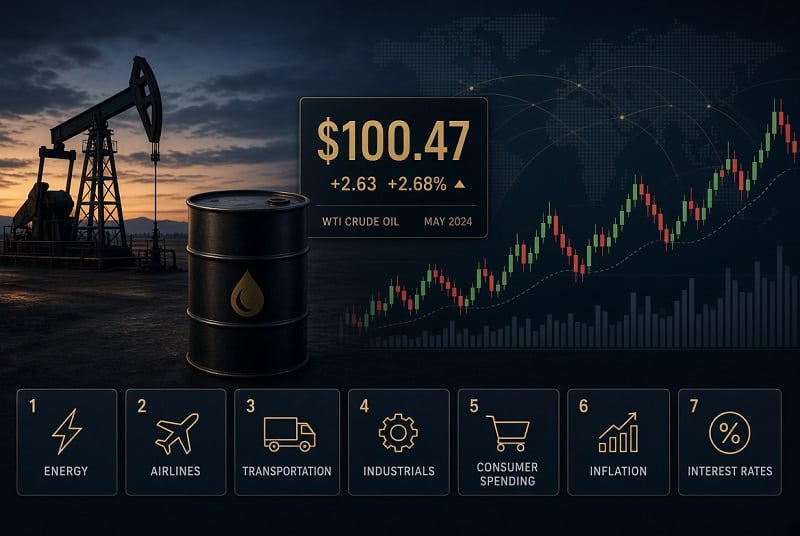
Here are seven ways higher energy prices could affect the stock market.
Energy Stocks Could Benefit From Higher Oil Prices
The most obvious beneficiaries of higher crude prices are companies that produce and sell oil and natural gas.
When crude prices rise, producers can potentially generate more revenue from every barrel they sell.
That does not mean every energy stock automatically becomes a winner.
Production costs, debt levels, hedging strategies, capital expenditures and the amount of oil a company actually produces all matter.
Still, the relationship is relatively straightforward.
If a producer can sell oil at a higher price without a corresponding increase in production costs, its operating margins can improve.
That can translate into stronger cash flow.
For investors, this is one reason energy stocks often behave differently from technology or consumer stocks during periods of rising oil prices.
The energy sector can also provide a degree of diversification because its earnings drivers are different from those of many other industries.
But there is an important distinction between higher oil prices and attractive energy investments.
Oil prices can move quickly in both directions.
A company that looks extremely profitable at $110 oil may face a very different environment if crude falls back toward $70.
Investors therefore need to look beyond the headline price of crude and consider the financial strength and cost structure of individual companies.
Airlines and Transportation Companies Could Feel the Pressure
What helps an oil producer can hurt an airline.
Fuel is one of the major expenses for airlines, trucking companies and other transportation businesses.
When energy prices rise, these companies can face higher operating costs.
That does not necessarily mean their stocks must fall. Companies can sometimes raise ticket prices, add fuel surcharges or otherwise pass some costs on to customers.
But passing higher costs to consumers is not always easy.
If consumers become more price-sensitive, demand can weaken.
That creates a difficult equation for transportation companies:
Higher fuel costs + limited pricing power = potential pressure on profit margins.
We have already seen this relationship reflected in the market.
A September 28 market report noted that airline shares declined as oil prices rose, with United Airlines and American Airlines both moving lower during the session.
The same principle applies beyond airlines.
Trucking companies, delivery businesses, shipping companies and other firms that depend heavily on fuel can also face higher expenses when crude prices rise.
This is one reason investors should not look at an oil rally only through the lens of energy stocks.
There are potential second-order effects throughout the economy.
Higher Oil Prices Can Put Pressure on Inflation
This may be the most important connection for the broader stock market.
Oil is an input into a huge number of economic activities.
It affects transportation, manufacturing, logistics and consumer energy costs.
When crude prices rise substantially, businesses may eventually pass some of those higher costs to customers.
Consumers can also feel the impact directly at gasoline pumps.
That creates the possibility of renewed inflation pressure.
Reuters recently described the combination of rising energy prices and higher global borrowing costs as creating a potentially difficult environment of higher inflation and slower growth.
This matters because inflation is one of the variables investors watch when trying to understand where interest rates could go next.
If energy prices remain elevated, investors may become less confident that inflation will continue moving toward central-bank targets.
That can change expectations about monetary policy.
And that leads to the next connection.
Higher Oil Prices Could Keep Interest Rates Higher for Longer
The Federal Reserve does not set interest rates based on the price of oil alone.
But persistent energy inflation can complicate the central bank’s job.
Imagine an economy where growth is slowing but oil prices are rising.
That creates an uncomfortable combination.
The economy may need lower borrowing costs to support activity, but higher energy prices could make inflation more persistent.
This is one reason investors are watching the relationship between crude prices, inflation data and Treasury yields so closely.
The current environment is particularly notable because the 10-year Treasury yield has moved above 5%.
Reuters reported on September 28 that the rise in oil prices was accompanied by higher Treasury yields as investors priced in the possibility that interest rates could remain elevated for longer.
That matters for virtually every asset class.
Mortgage rates can rise.
Corporate borrowing can become more expensive.
Consumers may face higher financing costs.
And stock valuations can change.
This is why an oil-price story can quickly become an interest-rate story.
Growth and Technology Stocks Could Face Valuation Pressure
Technology stocks are not directly tied to the price of crude oil in the same way energy producers are.
But they can still be affected.
The connection often comes through interest rates and valuation.
Many high-growth companies derive a significant portion of their perceived value from earnings investors expect far into the future.
When interest rates rise, those future earnings are discounted at a higher rate.
That can put pressure on valuation multiples.
This is particularly relevant in a market where investors have already assigned high valuations to companies associated with artificial intelligence, semiconductors and other growth themes.
Recent market action has illustrated the connection.
On September 28, rising oil prices and Treasury yields were cited as sources of pressure on technology shares, while Chinese technology stocks also came under pressure as investors weighed higher oil prices and global capital costs.
This does not mean higher oil prices automatically make technology stocks unattractive.
It means investors need to consider the second-order effects.
An investor buying a high-growth company is effectively making assumptions about future earnings, future cash flow and the discount rate applied to those cash flows.
A prolonged period of higher inflation and interest rates can change that equation.
Consumers Could Have Less Money to Spend on Everything Else
The oil market can eventually reach individual household budgets.
Think about a household that drives two cars.
If gasoline becomes significantly more expensive, part of that household’s monthly budget has to go toward fuel.
That money has to come from somewhere.
Perhaps the family eats at restaurants less often.
Maybe it delays buying a new television.
It could postpone a vacation.
Or it might simply reduce the amount it saves each month.
This is sometimes described as the consumer spending effect of higher energy prices.
It can become particularly important when oil prices remain elevated rather than simply experiencing a brief spike.
A short-term move in crude may have a limited effect on household behavior.
A prolonged period of expensive gasoline and energy costs can be different.
For investors, that makes consumer-facing companies worth watching.
Companies selling discretionary products may have less pricing power than businesses selling essential goods.
A higher energy bill can therefore create a chain reaction:
Higher oil → higher fuel costs → less disposable income → changes in consumer spending → potential pressure on certain corporate revenues.
Of course, the actual impact depends on wages, employment, savings, household balance sheets and the broader economy.
But the mechanism is worth understanding.
Dividend and Income Investors May Need to Look at Energy Differently
This is where the current oil environment becomes particularly interesting for income-focused investors.
Higher oil prices can potentially increase the cash flow available to some energy businesses.
But investors looking for income do not necessarily have to choose between a traditional oil producer and a broad stock-market index.
There are several types of energy-related businesses, including producers, pipeline companies, infrastructure businesses and royalty interests.
Their economics can be quite different.
For example, a company involved in transporting oil and natural gas may generate revenue through infrastructure and contracts rather than simply relying on the spot price of crude.
Royalty businesses can have a different model again.
Instead of taking on the full cost of operating wells, a royalty interest can provide exposure to production revenue without requiring the royalty owner to operate the underlying wells.
This is one reason the current oil-price environment may be relevant to investors whose primary objective is income rather than simply capital appreciation.
An Income-Focused Approach to the Energy Market
If your goal is to generate investment income, it can be useful to look beyond the question:
“Which oil stock will go up the most?”
A different question is:
“Which types of energy-related investments can potentially generate cash flow during a period of elevated energy prices?”
That distinction matters.
Oil producers, pipeline partnerships and royalty interests have different risk profiles.
A higher oil price does not guarantee that any particular investment will deliver a higher return or maintain its distribution.
Investors still need to consider debt, payout sustainability, production levels, commodity exposure, management decisions and valuation.
But income investors may find the energy sector particularly interesting when crude prices are elevated.
Could Higher Oil Prices Create an Opportunity for Income Investors?
This is where an existing resource from Steady Income Investments fits naturally into the conversation.
The Oxford Income Letter, led by Marc Lichtenfeld, focuses on dividend and income-generating investments. Your existing review describes its model portfolios and income-focused research, including opportunities involving energy-related investments.
One of the current themes highlighted in the review is an oil and gas royalty opportunity connected to the Permian Basin, along with a pipeline partnership and other income-oriented investments.
For readers who are specifically interested in the income side of the energy story, that provides a natural next step.
Rather than trying to predict the next move in crude oil, the focus is on understanding how certain energy-related businesses can potentially generate income.
What Is the Oxford Income Letter?
The Oxford Income Letter is an investment newsletter associated with Marc Lichtenfeld, The Oxford Club’s Chief Income Strategist.
According to Steady Income’s review, the service focuses on dividend and income-generating investments and includes model portfolios designed around different income objectives.
The service also includes research reports covering specific income opportunities.
One of the opportunities highlighted in the current review is an oil-and-gas royalty investment tied to production in the Permian Basin. The review also discusses an oil-and-gas pipeline partnership and a gold royalty opportunity.
For investors who are researching the relationship between today’s oil market and income investing, this is relevant because it illustrates an important point:
There are multiple ways to gain exposure to the economics of the energy industry.
You do not necessarily have to approach the sector only by buying an exploration-and-production company.
That said, royalty investments, pipeline businesses, dividend stocks and energy producers all carry their own risks. Investors should read the underlying offering materials and understand what they are buying before committing capital.
Read the full Oxford Income Letter review to see how Marc Lichtenfeld’s income strategy works and what the service currently offers.
What Investors Should Watch Next
The oil story is unlikely to exist in isolation.
Several other market developments could determine how important today’s crude-price move becomes for stocks.
Watch Inflation Data
Investors will be watching inflation readings closely.
If higher energy costs begin appearing more clearly in inflation data, markets may reassess the path of interest rates.
If inflation remains contained despite higher crude prices, the market reaction could be different.
That is why the next several economic reports matter.
Watch Treasury Yields
The 10-year Treasury yield has already moved above 5%.
That is an important threshold for investors because Treasury yields influence borrowing costs and equity valuations.
A sustained rise in yields could create additional pressure on interest-rate-sensitive areas of the stock market.
Watch Energy Earnings
If crude remains above $100, investors will have a chance to see how energy companies are converting higher commodity prices into actual earnings and cash flow.
The companies with the strongest balance sheets and lowest production costs may respond differently from highly leveraged producers.
Watch Transportation Costs
Airlines and other fuel-intensive businesses provide an early indication of how higher energy costs are affecting corporate margins.
Investors should pay attention not only to revenue growth but also to operating expenses and management commentary about fuel prices.
Watch Consumer Spending
The longer energy prices remain elevated, the more important the consumer becomes.
Investors should watch whether higher gasoline and energy bills begin affecting discretionary spending.
That could eventually show up in earnings reports from retailers, restaurants, travel companies and other consumer businesses.
What If Oil Falls Back Below $100?
There is another side to the story.
Oil prices can fall as quickly as they rise.
A diplomatic breakthrough, a reduction in supply concerns, weaker global demand or increased production could put downward pressure on crude.
That would reverse some of the effects discussed above.
Energy producers could face lower realized prices.
Airlines and transportation companies could benefit from lower fuel expenses.
Inflation concerns could ease.
Treasury yields could potentially come under less upward pressure if the market believes the energy shock is fading.
Growth stocks could benefit if lower inflation expectations also reduce pressure on interest rates.
This is why investors should be careful about building an entire portfolio strategy around a single commodity price.
Oil is volatile.
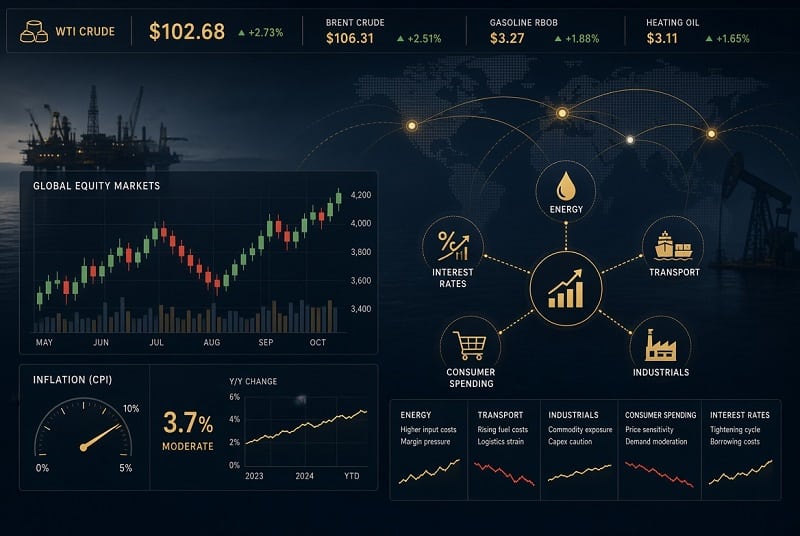
The better approach is to understand the relationships that connect energy prices with corporate earnings, inflation, interest rates and consumer spending.
The Bottom Line for Stock Investors
Oil above $100 is more than an energy-sector story.
It can affect the stock market through several different channels.
Energy producers may benefit from higher commodity prices.
Transportation companies can face higher fuel expenses.
Consumers may have less disposable income.
Businesses may face higher input and shipping costs.
Inflation expectations can rise.
Treasury yields can move higher.
And higher interest rates can create valuation pressure for some growth stocks.
The most important factor is duration.
A short-lived oil spike may have a very different impact from a prolonged period of elevated crude prices.
If oil remains above $100 for weeks or months, the effects can gradually spread from commodity markets into inflation data, interest-rate expectations, corporate earnings and household spending.
That is the scenario investors need to watch.
For income investors, the current environment also highlights the importance of looking beyond traditional stock categories. Energy producers are one option, but pipeline businesses, royalty interests and other cash-flow-oriented investments can provide different forms of exposure to the energy market.
The Oxford Income Letter is one existing resource for investors interested in that income-focused approach, with its research covering dividend strategies as well as specific energy-related opportunities.
Ultimately, the question is not whether oil above $100 is automatically good or bad for stocks.
It is which companies are positioned to benefit from higher energy prices, which companies are vulnerable to rising costs, and how long the oil-price shock lasts.
For investors, understanding those connections may be more useful than trying to predict the next move in crude.
Frequently Asked Questions
Why is oil above $100 in 2026?
Brent crude has moved above $100 amid concerns about Middle East supply disruptions and uncertainty surrounding the Strait of Hormuz. On September 28, Reuters reported Brent around $108.50 a barrel as oil prices rose sharply on renewed geopolitical and supply concerns.
How do higher oil prices affect stocks?
Higher oil prices can benefit energy producers while increasing costs for fuel-intensive companies such as airlines and transportation businesses. Higher energy prices can also contribute to inflation, potentially affecting interest rates and stock valuations.
Do higher oil prices cause inflation?
Higher oil prices can contribute to inflation because energy is an important input into transportation, manufacturing and consumer spending. The ultimate impact depends on how long prices remain elevated and how businesses and consumers respond.
What stocks benefit when oil prices rise?
Oil producers and some other energy companies can benefit when crude prices rise because higher selling prices can increase revenue and potentially improve cash flow. However, individual companies respond differently depending on production costs, debt, hedging and other factors.
Why can higher oil prices hurt technology stocks?
Technology companies are not directly dependent on crude prices in the same way as oil producers. However, higher energy prices can contribute to inflation and higher interest rates. Higher discount rates can place pressure on valuations, particularly for companies whose expected earnings are far in the future.
Are higher oil prices good for dividend investors?
Higher oil prices can potentially benefit certain energy companies and businesses connected to energy infrastructure or royalties. But investors should evaluate dividend sustainability, balance sheets, cash flow and commodity exposure rather than assuming a higher oil price automatically means a safer dividend.
What is the Oxford Income Letter?
The Oxford Income Letter is an income-focused investment newsletter associated with Marc Lichtenfeld. Steady Income’s review describes its focus on dividend and income-generating investments, model portfolios and research reports covering specific income opportunities.
Could oil prices fall below $100 again?
Yes. Oil prices can change rapidly in response to supply conditions, geopolitical developments, production levels and global demand. A reduction in supply concerns could push crude prices lower, while a prolonged disruption could keep prices elevated.