Learning how to buy into AI stock picks safely with a small portfolio starts with separating exciting headlines from investable businesses. An “AI stock” can mean anything from a chipmaker or cloud provider to a software company using AI as one feature, so the label alone is not a reason to buy.
With limited capital, your edge is discipline: understand what you own, keep individual positions modest, diversify beyond one theme, and use a plan for adding money over time. Here’s how to assess AI picks, choose a practical route to exposure, and manage the risks without overcomplicating your portfolio.
Key takeaways
- Treat AI picks as research prompts, not buy signals; verify fundamentals, valuation and risks yourself.
- Keep emergency cash and near-term spending money outside volatile AI or growth-stock positions.
- Make AI a modest satellite allocation, supported by a diversified core portfolio.
- Prefer durable revenue, cash flow, manageable debt and understandable competitive advantages over hype.
- Buy gradually, cap position sizes and rebalance when one holding becomes overly dominant.
- Review holdings periodically; avoid borrowing, chasing rallies and reacting to short-term headlines.
AI stock picks: what you are actually buying
When people talk about AI stock picks, they often mean very different things. One investor is looking to buy the businesses building the chips, cloud capacity and software behind artificial intelligence. Another is using an AI-powered stock tool to search for opportunities across the market. A third may simply be buying a large technology company after an upbeat headline about its latest model. Those are not interchangeable decisions, and treating them as such is an easy way to take more risk than intended.
In my view, AI investing starts with identifying the economic claim you are making. If you invest in AI through a company such as Nvidia, you are buying exposure to demand for the computing infrastructure that makes advanced models possible. With Meta, the case is broader: AI may improve advertising, recommendations and product development, but it sits inside a much larger business. The label “AI stock” can therefore conceal important differences in revenue sources, competitive advantages, valuation and market cap.
It also helps to separate companies that sell AI from companies that use it. A business may deploy AI to reduce costs, improve customer service or analyse data without becoming an AI business in the conventional sense. That can still be attractive, particularly where the technology strengthens already dependable cash flows. But the investment case should rest on evidence: whether adoption is lifting sales, margins or customer retention, and whether management can explain the returns on its spending.
The same discipline applies to investing tools. A stock-selection engine can process enormous quantities of company data and surface patterns that a human may miss. AI-powered stock screeners can be useful starting points for analysis, especially when they help narrow a broad universe by quality, value, growth or income measures. They do not remove the need to understand what sits behind a recommendation. Models work from historical information, assumptions and the inputs they are given; they cannot guarantee that a changing market will behave as expected.
For Steady Income readers, the practical question is not whether AI will matter, it already does, but how much of a portfolio should depend on one theme. Look beyond the excitement to balance-sheet strength, earnings durability, competitive position and price paid. The best AI stock for a portfolio is not necessarily the most talked-about name. It is the company whose prospects you can explain clearly, whose risks you can tolerate and whose role fits your wider investment plan.

Start with the basics before you invest in AI stocks
Before you invest in any AI stock, start with the basics of your own financial position. Artificial intelligence may be changing industries at a remarkable pace, but a compelling story is not the same thing as a sound investment. The first question is not which company could become the next market leader. It is whether the money you plan to invest has a clear role in your broader plan.
That means looking at your cash reserves, debt costs, time horizon and existing holdings before committing new capital. If you may need the money within a few years, for a home purchase, tuition, retirement income or an unexpected expense, it likely does not belong in a volatile growth-stock position. AI shares can move sharply on earnings reports, product announcements and shifts in market expectations. Even excellent businesses can be poor investments when bought at an overly optimistic price.
Risk tolerance matters just as much as conviction. Some investors can hold through a 25% or 40% decline without changing course; others will lose sleep and sell at the wrong moment. Neither response is a character flaw. It is useful information for building a portfolio you can actually maintain. Investing works best when the level of risk matches both your financial capacity and your temperament.
For beginners, AI can be a practical research tool: it can help explain financial statements, compare business models or define unfamiliar terms. But beginners can use AI without letting it make the decision. Treat its output as a starting point, then verify the figures, read company filings and consider what could challenge the thesis. A company’s revenue growth, margins, cash flow, competitive position and valuation all deserve more attention than a chatbot-generated price target.
At Steady Income, I encourage investors to keep the core of their portfolio diversified and purposeful. AI stocks may earn a place as a smaller, higher-growth allocation, rather than becoming the foundation of your financial future. That approach leaves room for opportunity while protecting capital from a single theme’s inevitable disappointments. Learn the basics you need, set sensible limits and invest smartly: the strongest investment decisions are usually the ones that still make sense after the excitement has faded.
AI investing readiness checklist
- Build an emergency cash reserve before committing money to volatile AI shares.
- Pay down high-cost debt; guaranteed interest savings can outweigh uncertain stock returns.
- Keep near-term goals, such as tuition or a home purchase, out of growth-stock investments.
- Match your allocation to your ability to withstand a 25% to 40% decline without selling.
- Use AI tools to learn, but verify claims through filings, financial statements, and independent research.
- Assess revenue growth, margins, cash flow, competition, and valuation, not just compelling narratives.
- Keep AI holdings a smaller allocation within a diversified portfolio built around long-term goals.
How to buy into AI stock picks safely with a small portfolio
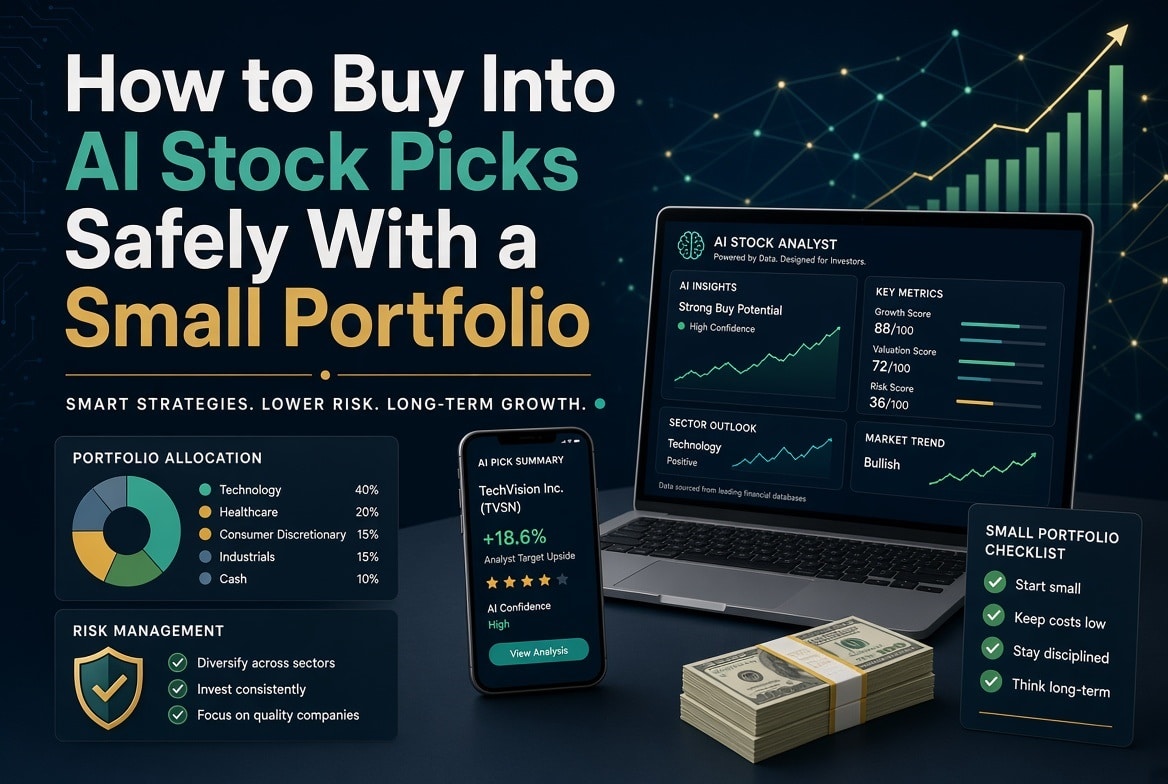
For investors asking how to buy into AI stock picks safely with a small portfolio, the first rule is to resist treating artificial intelligence as a single trade. AI is a powerful business trend, but the market has already priced great expectations into many familiar names. A small portfolio has less room to absorb a sharp loss, so the aim should be measured exposure rather than a concentrated bet on the latest headline stock.
Start by deciding what portion of your portfolio you can dedicate to higher-growth investments after covering core needs: diversified funds, income holdings, cash reserves and any near-term goals. For many investors, that means making AI stocks a satellite position rather than the foundation of the account. You might own one established company with clear AI revenue, or use a broad technology or semiconductor fund to spread company-specific risk across dozens of stocks.
Before buying, look beyond product demonstrations and announcements. Check whether the business has durable revenue, positive or improving cash flow, manageable debt and a valuation that does not depend entirely on future promises. Consider where AI fits in its operations: companies selling chips, cloud capacity, data-centre equipment and enterprise software may benefit in different ways, and their risks are not identical.
Use basic tools available through a brokerage account to review earnings dates, analyst estimates, historical valuation and trading volume. High volume can make it easier to enter or exit a position, but it is not proof that a stock is sound. Put a plan around the purchase as well. Buy in stages instead of committing all your money on one day, particularly after a rapid rally. Set a maximum position size, rebalance if one holding grows too large, and avoid borrowing to chase momentum.
Good strategies are deliberately boring: diversify, invest regularly and judge results over years rather than weeks. If the decision affects retirement income, taxes or a meaningful share of your savings, an independent advisor can help test whether the position suits your broader plan. At Steady Income, I would rather see a modest AI allocation you can hold through volatility than an oversized wager that forces you to sell at the wrong moment.
Small-Portfolio AI Investing Checklist
| Decision area | What to review before buying | Why it matters for a small portfolio |
|---|---|---|
| Portfolio allocation | Decide what portion of the portfolio can go to higher-growth investments after core needs, diversified funds, income holdings, cash reserves and near-term goals are covered. | AI holdings can remain a satellite position rather than becoming the foundation of the account. |
| Diversification | Consider one established company with clear AI revenue or a broad technology or semiconductor fund holding many stocks. | Spreading exposure can reduce company-specific risk. |
| Business fundamentals | Check for durable revenue, positive or improving cash flow, manageable debt and a valuation not based entirely on future promises. | Strong underlying finances can matter more than product announcements or demonstrations. |
| AI business exposure | Review how AI fits into the company’s operations, such as chips, cloud capacity, data-centre equipment or enterprise software. | Different AI-related businesses may benefit differently and face different risks. |
| Stock research tools | Review earnings dates, analyst estimates, historical valuation and trading volume through a brokerage account. | These tools can support a more informed purchase decision. |
| Liquidity | Check trading volume, while recognising that high volume does not prove a stock is sound. | Higher volume may make it easier to enter or exit a position. |
| Purchase approach | Buy in stages rather than committing all available money on one day, especially after a rapid rally. | Staged buying can avoid making the entire investment decision at a single market moment. |
| Position size and rebalancing | Set a maximum position size and rebalance if one holding becomes too large. | This helps prevent a single AI holding from dominating the portfolio. |
| Borrowing and time horizon | Avoid borrowing to chase momentum; diversify, invest regularly and assess results over years rather than weeks. | A measured approach can be easier to maintain through volatility. |
| Professional review | Consider an independent advisor if the decision affects retirement income, taxes or a meaningful share of savings. | An advisor can help assess whether the position fits the broader financial plan. |
Protect a small stock portfolio with portfolio risk and risk management
For a small stock portfolio, protecting capital is not an exercise in pessimism; it is what gives long-term compounding a fair chance to work. When every holding carries meaningful weight, one disappointing earnings report, dividend cut, or sector shock can have an outsized effect on the overall result. That is why portfolio risk deserves as much attention as the search for the next promising company.
Good risk management starts before purchasing stocks. I look at what can realistically go wrong with a business, not simply what might go right: weakening margins, too much debt, dependence on one customer, an unsustainable payout ratio, or an industry facing lasting change. A quality company can still be a poor investment when bought at an excessive valuation or allowed to become too large a share of the portfolio.
For most private investors, the practical answer is disciplined diversification with a clear purpose. Spread investments across businesses with different revenue drivers, sectors and, where appropriate, regions. Avoid owning several companies that appear different on the surface but are all exposed to the same interest-rate cycle, commodity price, consumer trend, or regulatory decision. Diversification will not eliminate risk, but it can prevent a single mistaken judgment from defining your returns.
Position sizing is equally important. In a small portfolio, it is tempting to put a large amount into the conviction idea, the company you know best or the stock that has recently performed well. I prefer to earn concentration over time. Start with a measured allocation, then increase it only when the business continues to deliver, the investment case remains intact, and the position has not become uncomfortably dominant through price appreciation.
Effective portfolio management also means maintaining liquidity and resisting constant intervention. Keep enough cash outside the market for near-term needs, so you are not forced to sell shares during a downturn. Review holdings periodically, but do not confuse activity with control. The most useful questions are straightforward: Would I buy this company today? Has the original thesis changed? Is the portfolio still balanced for the risks I am being paid to take?
In the end, portfolio risk is managed through preparation, not prediction. You cannot remove volatility from equity investing. You can, however, build a stock portfolio sturdy enough to absorb setbacks without abandoning the plan that made investing worthwhile in the first place.

Learn stock picking: vet the idea before you buy
To learn stock picking properly, start with a simple discipline: separate a compelling story from a sound investment case. A headline, a product launch or a surge in the share price can put a company on your radar, but it should not be the reason you buy. The useful work begins when you ask what the business actually does, how it makes money, who its customers are and whether its advantage is likely to endure.
In my experience, investors get better results from a repeatable process than from trying to identify the market’s next sensation. Read the company’s annual report and recent results. Look at revenue growth, margins, debt, cash flow and the risks that management itself has identified. Compare those figures with direct competitors rather than viewing them in isolation. A business can report impressive growth while still consuming too much cash, carrying a fragile balance sheet or relying on one customer, one commodity price or one favourable regulation.
Market cap matters, too. It tells you the market value already being placed on a business, not whether it is cheap or expensive on its own. A smaller company may have more room to grow, but it can also be less liquid and more vulnerable when conditions change. Larger companies can offer resilience, established cash generation and diversified operations, although even they can be overpriced. Good analysis weighs the quality of the business against the price being asked for it.
The current excitement around an AI stock is a useful example. Artificial intelligence may reshape industries, but not every company using the label will create lasting shareholder value. Ask whether the company has real customers, pricing power, proprietary technology or a practical route to profits. Distinguish firms building essential infrastructure from those merely attaching AI to a presentation.
Stock picking is never about eliminating uncertainty. It is about making a reasoned judgement with the information available, recognising what could prove you wrong and sizing the investment accordingly. Keep notes on why you bought, what assumptions support the thesis and which results would change your mind. That record can make you a more thoughtful investor than any tip, screen or fashionable narrative.

Use a broker account, then buy and review with discipline
A broker account is the practical gateway between your cash and the sharemarket. Choose one that gives you clear pricing, reliable execution and straightforward tax reporting; the flashiest trading screen is rarely the feature that improves long-term results. Before funding the account, check brokerage costs, minimum trade sizes, access to the markets you actually want to use, and whether the platform supports regular investing without turning every purchase into a costly event.
Once the account is open, transfer only the capital you have earmarked for investing. That distinction matters. Money needed for a home deposit, school fees, a business buffer or near-term spending should not be exposed to the daily movement of the market. A sound portfolio starts with an appropriate time horizon and a cash reserve outside it, not with a hot stock idea.
When you are ready to buy, make the decision before you enter the order. Write down why the stock deserves a place in your portfolio: perhaps durable earnings, a strong balance sheet, a sensible valuation or a role in diversifying existing holdings. Also note what would change your mind. This small exercise brings discipline to portfolio management and makes it easier to distinguish a temporary price fall from a genuine deterioration in the business.
Use limit orders when the price matters, particularly for less liquid shares, and be cautious around market open and close when spreads and volatility can be less forgiving. Avoid treating frequent activity as progress. Brokerage, bid–ask spreads and tax can quietly erode returns, while constant checking encourages decisions driven by headlines rather than evidence.
Risk management continues after the purchase. Review each holding on a scheduled basis, often twice a year is enough for a long-term investor, and review sooner only when material news affects the investment case. Look at position size, debt levels, earnings expectations and whether one company, sector or country now dominates the portfolio. Rebalance thoughtfully rather than automatically selling every winner: the aim is to keep risk aligned with your plan while allowing good businesses room to compound. Steady Income’s approach to investing is deliberately measured: own understandable assets, keep costs visible, and let process, not market noise, determine when capital is committed or withdrawn.
Disciplined broker investing checklist
- Compare brokerage, minimum trade sizes, market access, execution quality and tax reporting before opening an account.
- Invest only money allocated for long-term goals; keep emergency funds and near-term spending needs in cash.
- Document each purchase thesis, including valuation, business quality, diversification benefits and conditions that would invalidate your view.
- Use limit orders when price matters, especially for less liquid shares or during volatile market openings and closes.
- Limit unnecessary trading; brokerage, spreads and tax can reduce returns without improving portfolio quality.
- Review holdings on a schedule, assessing debt, earnings expectations, position sizes and concentration risks.
- Rebalance thoughtfully to maintain your target risk level while allowing strong businesses time to compound.
Frequently asked questions about AI stock picks and small portfolios
AI has made stock research faster, cheaper and more accessible, but it has not made investing automatic. The most common question I hear is whether AI stock picks can replace judgement. My answer is no: these tools can screen thousands of stocks, identify patterns in earnings releases and compare valuation measures in seconds, yet they work from available data and assumptions. They cannot know whether a sudden management change, a local regulatory decision or a broader market shock will alter the investment case tomorrow. Treat an AI output as a starting point for research, not an instruction to buy.
Another concern is whether a small stock portfolio can be properly diversified. It can, within limits. A portfolio with a modest number of holdings does not need to own every sector or chase every fashionable company. It does need a clear purpose: dependable income, long-term growth, capital preservation, or a considered blend. For many Steady Income readers, quality matters more than quantity. Businesses with resilient cash flows, sensible balance sheets and a record of treating shareholders well can provide stronger foundations than a crowded collection of speculative names.
Portfolio risk is not simply the chance that share prices fall. It also includes concentration risk, poor timing, exposure to one economic theme and the danger of selling a sound investment during a temporary setback. AI can highlight some of these issues, especially when it maps sector weightings or flags correlations between holdings. Still, it cannot set your risk tolerance. That depends on your time horizon, income needs, existing savings and ability to withstand volatility without abandoning your plan.
Investors also ask whether they need an advisor before acting on a promising screen or model. An advisor can be particularly valuable when investments sit alongside pensions, tax planning, property, business interests or family responsibilities. For a straightforward portfolio, disciplined self-directed investing may be appropriate, provided you understand what you own and why. The useful role of AI is to improve the quality of questions: What could go wrong? What evidence supports this forecast? How would this holding affect the rest of my stock portfolio? Those questions remain more valuable than any confident-looking buy signal.
Frequently asked questions
What are AI stock picks?
AI stock picks can mean shares in companies that build AI infrastructure, such as chips, cloud services and software, or recommendations generated by an AI-powered research tool. These are different ideas. Always identify what the company actually sells, how AI contributes to revenue and whether the valuation reflects realistic expectations.
Can AI tools choose stocks for me?
AI tools can help screen companies, compare financial data and identify patterns in earnings or valuations. They cannot guarantee returns or account for every change in management, competition, regulation or market conditions. Use an AI stock recommendation as a research prompt, then check company filings, cash flow, debt, margins and risks yourself.
Are AI stocks suitable for a small portfolio?
They can be, but a small portfolio usually benefits from measured exposure rather than a large bet on one popular name. Consider making AI shares a smaller growth allocation alongside diversified funds, income investments and cash for near-term needs. A broad technology or semiconductor fund may reduce company-specific risk.
How do I evaluate an AI stock before buying?
Look beyond product announcements and share-price momentum. Review the company’s revenue sources, customer demand, profit margins, free cash flow, debt, competitive position and valuation. Ask whether AI is already improving sales or efficiency, or whether the investment case depends mainly on distant forecasts.
How much of my portfolio should be in AI stocks?
The appropriate amount depends on your time horizon, financial goals, existing holdings and ability to handle volatility. Keep money needed in the next few years outside volatile shares. Set a maximum position size, avoid borrowing to invest and rebalance if one AI holding grows large enough to dominate portfolio risk.