Search “covered call strategy” and you’ll get two kinds of articles: one that explains the mechanics in textbook language and stops there, and one that hands you a list of tickers with no explanation of the risk you’re actually taking on. Neither tells you what actually happens to your tax bill, your upside, or your stock when the trade doesn’t go the way the premium made it look like it would. Let’s fix that.
What a Covered Call Strategy Actually Is
A covered call means you own at least 100 shares of a stock and sell a call option against those shares. In exchange for a cash premium paid to you upfront, you agree to sell your shares at a set price (the strike) if the buyer decides to exercise the option before it expires. Covered” just means you already own the shares — you’re not exposed to unlimited risk the way you would be selling a call on stock you don’t hold.
The appeal is straightforward: you get paid today, in cash, regardless of what the stock does afterward. That premium is yours to keep whether the option expires worthless or gets exercised.
How the Covered Call Income Strategy Works, Step by Step
- Own 100+ shares of a stock you’re comfortable holding long-term — ideally one you wouldn’t mind selling at a higher price anyway.
- Sell a call option against those shares, choosing a strike price above the current stock price (out-of-the-money) and an expiration date, usually 30-45 days out.
- Collect the premium immediately — this hits your account the moment the trade fills, not later.
- One of two things happens at expiration: the stock stays below the strike and the call expires worthless (you keep the shares and the premium, free to sell another call), or the stock rises above the strike and your shares get “called away” at that price (you keep the premium plus the gain up to the strike, but miss out on anything above it).
That last part is the trade-off nobody puts in the headline: your upside is capped. If you sell a $210 call on a stock trading at $200 and it rockets to $260, you’re still only getting $210 for your shares. The premium softens that, but it doesn’t erase it.
Why Income Investors Actually Use This Strategy
For investors focused on generating cash flow rather than chasing growth, covered calls turn stock ownership into something closer to a rental property — you keep collecting “rent” (premium) month after month on the same holding. It pairs naturally with a broader passive income strategy, sitting alongside dividends and interest as another repeatable income stream from assets you already hold.
Typical results across a diversified covered call program run somewhere in the range of 65-75% win rates (calls expiring worthless, letting you keep both premium and shares) with expirations targeted around 30-45 days out — long enough for meaningful premium, short enough that time decay works in your favor.
Choosing the Right Stocks for Covered Calls
Not every stock works for this. The ones that do tend to share a few traits:
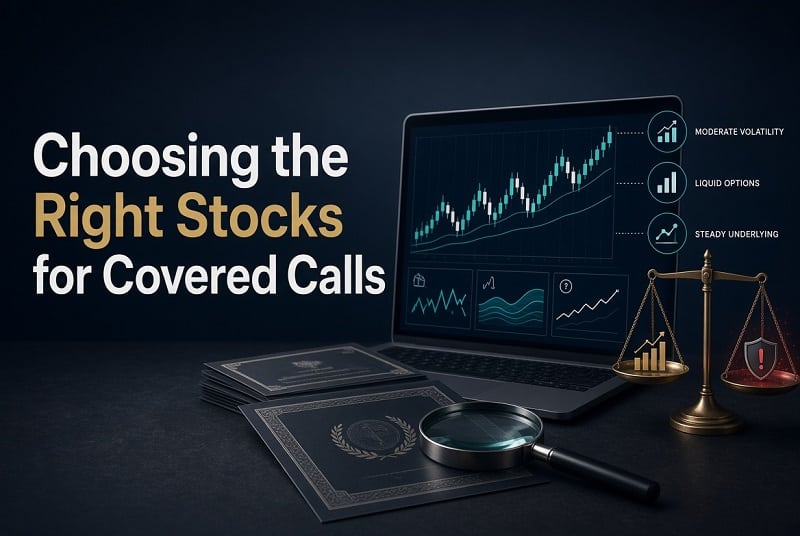
- High options volume — 1,000+ contracts traded daily at your target strike, so you’re not stuck with wide bid-ask spreads eating your premium
- Share price in the $50-400 range — enough per-contract premium to be worth the effort without needing an oversized position
- Implied volatility between 20-40% — enough to generate meaningful premium without excessive assignment risk
- A stock you’d genuinely want to keep holding — if you’re only picking it because the premium looks juicy, you’re speculating, not investing
Apple, Johnson & Johnson, and Coca-Cola show up constantly on covered call stock lists for exactly this reason — deep liquidity, predictable price behavior, and a shareholder base that’s happy holding long-term. If you’re building or refining a watchlist for this strategy, our guide on key metrics to check before investing in any stock covers the fundamentals worth confirming before you commit shares to a covered call program.
The Tax Side Nobody Warns You About
This is where a lot of covered call income looks better on paper than it actually is after April.
Premiums are taxed as capital gains, not ordinary income — but by default, they’re short-term capital gains, taxed at your regular income rate, since the option is almost never held open for the 12 months required for long-term treatment. For someone in a 32% tax bracket, that’s a meaningfully bigger bite than the 15% rate on qualified dividends.
There’s also a distinction the IRS cares about a lot: qualified vs. unqualified covered calls. A qualified covered call — generally one with more than 30 days to expiration and not deep in-the-money — leaves your stock’s holding period alone. An unqualified one (short-dated or deep ITM) can suspend your holding period clock, which matters enormously if you’re close to the one-year mark on a stock’s long-term capital gains eligibility. Sell the wrong strike on a low-basis position you’ve held for 11 months, and you could accidentally reset your gains back to short-term treatment.
One more wrinkle: a deep in-the-money call written near a dividend date can also disqualify that dividend from the lower qualified rate, converting it to ordinary income. None of this makes covered calls a bad strategy — it just means the premium you see quoted isn’t the number that ends up in your pocket.
In an IRA or Roth account, none of this applies — there’s no immediate tax event on premiums or assignment, which is a big reason many income investors run this strategy inside retirement accounts specifically.
The Real Risks of a Covered Call Strategy
- Capped upside
The strategy’s defining trade-off. You will, at some point, watch a stock you own blow past your strike price and only get partial credit for it.
- Assignment risk on low-basis stock
If you’re sitting on a large unrealized gain, getting assigned can trigger a tax bill far larger than the premium you collected to take that risk.
- Doesn’t protect against a falling stock
The premium provides a small cushion, but a stock that drops 20% will still cost you far more than the premium offsets. Covered calls generate income; they don’t function as insurance.
- Management overhead
Running this across a real portfolio of 20-50 positions means tracking multiple expiration dates, strikes, and implied volatility levels, which is a genuinely different time commitment than buy-and-hold investing.
Covered Call Strategy vs. Covered Call ETFs
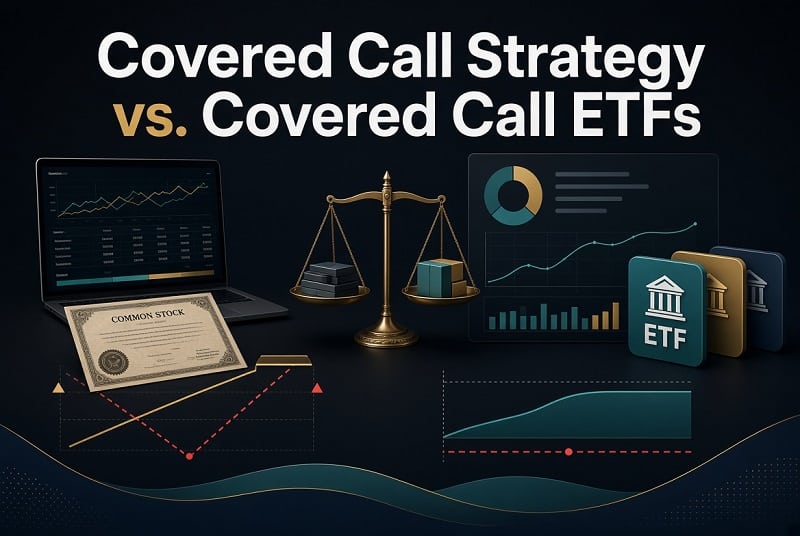
If actively managing individual positions sounds like more work than you want, covered call ETFs like QYLD or JEPI run a version of this strategy for you, distributing the premium income as a monthly or quarterly payout. The trade-off is the same capped-upside principle, just packaged and automated — you give up some control and often yield efficiency in exchange for simplicity. For a hands-on investor willing to manage strikes and expirations directly, the self-managed version typically nets a higher after-fee yield; for someone who wants the income without the spreadsheet, the ETF route removes the operational burden entirely.
Conclusion
A covered call strategy isn’t a shortcut to free money — it’s a trade-off, plain and simple. You’re exchanging unlimited upside for guaranteed income today, and the tax rules and assignment risk make that trade more complicated than most beginner guides let on. Done deliberately, on stocks you’d want to own anyway, with an eye on the qualified-covered-call rules, it’s a genuinely useful tool for turning existing holdings into a repeatable income stream. Done carelessly on low-basis stock close to a tax milestone, it can cost you more than the premium was ever worth.
Frequently Asked Questions
Is a covered call strategy good for retirement income?
It can be, especially inside an IRA or Roth where premium income and assignment don’t trigger immediate taxes. Outside a retirement account, the short-term capital gains treatment on most premiums reduces the after-tax advantage, so it’s worth running the numbers against your specific tax bracket first.
How much income can you realistically make from covered calls?
It varies by stock and strike selection, but a diversified program targeting 30-45 day expirations on moderately volatile, liquid stocks often generates premium in the range of 1-3% of the position’s value per cycle — annualized, that can add up, but it comes with the capped-upside trade-off described above.
What happens if my covered call gets assigned?
Your shares are sold at the strike price, and the premium you collected gets added to your proceeds. You keep the premium either way, but on a stock with a large unrealized gain, assignment can trigger a bigger tax bill than the premium being credited would suggest — especially if the call was “unqualified” and reset your holding period.
What’s the difference between a covered call and a cash-secured put?
A covered call starts with owning the stock and sells upside potential for premium income. A cash-secured put starts with cash set aside and sells the obligation to buy a stock at a lower price, collecting premium in exchange. Many income investors use both together, sometimes called “the wheel” strategy — selling puts to acquire shares, then covered calls once assigned.