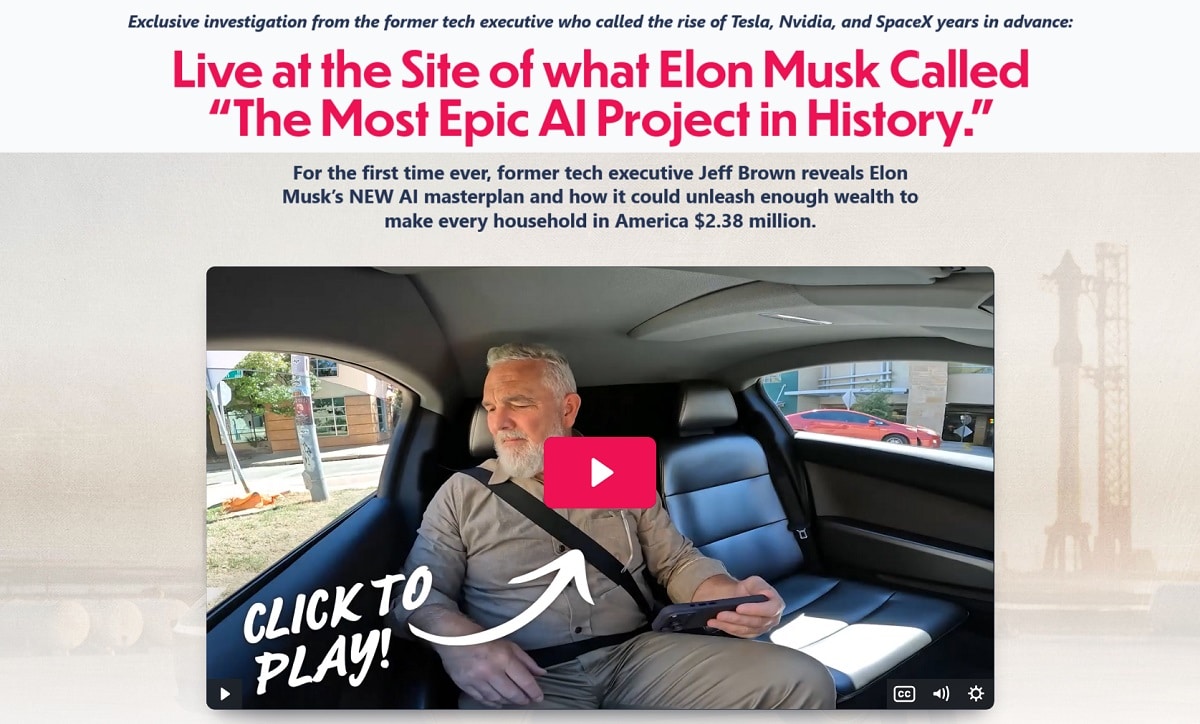
Elon Musk has a habit of announcing things that sound impossible: a payments company that would replace checks, an electric car company that would take on Detroit, rockets that land themselves. Now, according to former tech executive Jeff Brown, Musk is working on his biggest idea yet, a plan to build and control the three layers that make artificial intelligence run: the chips, the energy and the real-world applications.
Brown calls it Elon Musk’s $320 Trillion Blueprint. In a recent presentation, he walked viewers through what he says are the three steps of that blueprint, rode a Tesla Cybercab to the site of what Musk has called “the most epic AI project in history,” and explained why he believes a small group of little-known companies could benefit. He then packaged his research on those companies into three special reports, offered alongside a one-year subscription to his monthly research service, The Near Future Report.
This article walks through everything in that presentation and the offer that goes with it: who Jeff Brown is, what the masterplan actually involves, what each of the three reports covers, how much the membership costs, what the guarantee says, and, just as important, what you should think carefully about before acting on any stock idea. Where the claims are Brown’s own opinions or predictions, we say so. Where they are Musk’s projections, we say that too.
Jeff Brown reveals Elon Musk’s NEW AI Masterplan: Key Takeaways
If you only have a minute, here is what the presentation argues:
- Musk has said that the AI boom could create around $320 trillion in new wealth. Brown notes that, spread across roughly 133.97 million American households, that would work out to almost $2.4 million per household. That is a projection attributed to Musk, not a certainty, and Brown himself acknowledges it sounds crazy.
- Brown believes Musk is positioning himself to control AI from top to bottom through three steps: chips (Terafab), energy (AI data center satellites powered by the Sun) and applications (Cybercab robotaxis and Optimus humanoid robots).
- For each step, Brown says he has identified a little-known company that supplies critical technology. He does not name them in the presentation. Names, tickers and his analysis are inside three special reports.
- Those reports are included free with a 12-month membership to The Near Future Report, offered at $179 instead of the regular $499, with a 30-day, no-questions-asked money-back guarantee.
- Brown says he expects Musk to announce a new Terafab partner by the end of the month. That is a prediction, not a confirmed event, and no one can guarantee it will happen or how markets would react.
Who Is Jeff Brown?
Any investment idea is only as credible as the person behind it, so it is worth looking at how Jeff Brown describes his own background. According to the presentation, Brown spent more than two decades as a senior executive at three public technology companies: Qualcomm, NXP Semiconductors and Juniper Networks. He says those firms now generate more than $60 billion in combined annual sales.
He also describes himself as an angel investor who has taken part in hundreds of deals involving private technology companies. He cites returns as high as 5,344%, 7,367% and 11,011% on three of those investments, which he says would have turned $10,000 into roughly $544,000, $746,000 and $1.1 million respectively. These are selected best-case examples, and they say nothing about the many investments that returned less or lost money. Anyone who has spent time around venture investing knows that a handful of outliers drive results and that most early-stage companies fail.
Brown’s technical background is in aerospace. He holds a degree in aeronautical and astronautical engineering from Purdue University, which is often called the “Cradle of Astronauts” because of the number of NASA astronauts it has produced. After graduating, he says he worked as a contractor on the early Boeing 777 program, and he has followed the aerospace industry as a researcher and investor ever since. That matters because so much of the Musk story runs through SpaceX.
He also says he has consulted with senior officials at the Department of Commerce, policy makers, members of the National Institute of Standards and Technology and the Defense Intelligence Agency. Today he is the founder and CEO of Brownstone Research and the editor of The Near Future Report.
In short, the pitch is that Brown combines hands-on experience inside semiconductor and networking companies with years of independent investment research. Whether that translates into good stock picks is something each reader has to judge for themselves, which is exactly why the offer includes a 30-day trial period.
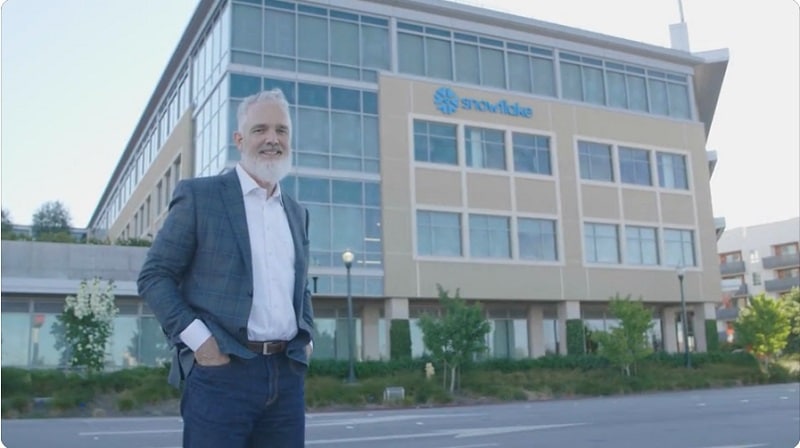
Brown’s Track Record on Elon Musk: What He Says He Called Early
A large part of the presentation is devoted to Brown’s claim that he has repeatedly seen Musk’s moves before they became mainstream news. Here is the record he points to, in his own framing.
Tesla and self-driving cars
Brown says that in 2016, Forbes called Musk’s autonomous-car plans irresponsible hype, that Bloomberg ran a piece the following year arguing Musk was wrong about self-driving cars, and that in 2018 the coverage included lines such as experts doubting full self-driving would ever be possible. He adds that the New York Post called Musk a fraud at one point and that Wall Street analysts predicted Tesla shares were about to crash.
Against that backdrop, Brown says he emailed his readers in November 2018 recommending Tesla shares. He describes the recommendation as the most hated and controversial of his career. His thesis then was that Tesla was less a car company than an artificial intelligence company, having built a software and AI platform designed to operate cars. He says those who bought and held had a chance to turn $5,000 into as much as $114,000, and that Tesla has since become worth more than all other publicly traded carmakers combined.
Starlink
Brown says that when Starlink was in its early days, the mainstream media called Musk’s plans a pipe dream, while he told readers SpaceX would disrupt the market. In 2019 he predicted Starlink would get its satellite network running and begin selling service, and he says that prediction came true a year later. According to the presentation, Starlink now has 12 million subscribers, generated more than $11 billion in sales in 2025 and is on track for around $16 billion in 2026. It is also described as the largest satellite constellation in history.
The SpaceX IPO
Brown says he began discussing a potential SpaceX IPO as early as 2020, and that just before the company went public he visited its headquarters in Starbase, Texas and predicted the IPO would be 1,000 times bigger than Tesla’s. He describes it as the biggest IPO in history, one that minted more than 4,400 millionaires overnight.
Other calls
Beyond Musk, Brown says he recommended Bitcoin before a rise of as much as 52,400%, Tesla before a rise of almost 2,200% and Nvidia before a rise of as much as 37,800%. He also points to a March 17, 2020 note to readers, written at the height of pandemic panic, in which he said it was likely one of the best opportunities to make investments in the next decade. Three days later the market began a historic rebound, and the S&P 500 has since risen roughly 200%.
He lists several model-portfolio winners, saying that investors who held and sold at the peak could have seen gains as high as 945% in Taiwan Semiconductor, 962% in Palo Alto Networks, 1,700% in Arista Networks and 4,100% in Nvidia. And he says that three years ago he recommended Taiwan Semiconductor to readers and that it is up almost 400% since.
A fair reader will notice two things. First, these are the highlights; every newsletter publishes its best calls more prominently than its worst. Second, the gains cited are peak-to-trough or best-case figures that depend on when someone bought and sold. Brown himself says the average gain for The Near Future Report is 43%, which is the more realistic number to keep in mind, and he is explicit that past performance does not guarantee future results.
The $320 Trillion Claim in Context
The headline number in the presentation is $320 trillion. Brown attributes it to Musk, saying Musk is on record predicting that the AI buildout will unleash that much new wealth. For scale, he compares it to the SpaceX IPO and says it is about 180 times larger.
It is worth slowing down here. A projection of this size is a forecast about an economic transformation, not a price target for any single stock. Even if you believe AI will be enormously valuable, there is no guarantee that value flows to the specific companies Brown recommends, or that it shows up on a timeline that benefits a shareholder. Brown’s argument is not that every reader will become a millionaire. It is that large technology shifts have, in the past, created windows in which early investors in the right companies did extremely well, and that he believes AI is the next such window.
That framing is useful, as long as you hold it loosely. The number is Musk’s projection, the interpretation is Brown’s opinion, and the outcome for your portfolio will depend on what you buy, when you buy it and what you pay.
Musk’s Four “Generational Wealth Windows”
Brown organizes Musk’s career into a series of what he calls generational wealth windows: moments when a breakthrough technology opened an unusual investing opportunity.
Window one: PayPal. In 1998, he notes, only 41% of adults were using the internet, most people still mailed checks and dial-up was the norm. Paying online sounded unimaginable to many, yet PayPal pulled it off. Today it lets individuals and businesses get paid in more than 25 currencies across more than 200 countries. Brown says one early investor turned a $1,600 stake into $3.8 million.
Window two: Tesla. A newcomer with no auto-industry experience set out to compete with Ford, GM, Toyota, Mercedes and BMW. According to Brown, the Tesla Model Y became the best-selling car in the world, not just the best-selling electric car, and Tesla is worth more than the other automakers combined. He says $5,000 invested at the IPO would now be worth more than $1.1 million.
Window three: SpaceX. Brown describes reusable rockets as Musk’s craziest idea yet: launching a rocket the size of a 20-story building into orbit and bringing it back, with the booster caught by a giant mechanical arm. He says early SpaceX investors who got in around 2002 had a chance to turn a single $100 bill into almost $6.3 million by IPO day, a gain of roughly 6.3 million percent.
Window four: AI. Brown’s thesis is that artificial intelligence is the biggest technology trend in human history and that Musk intends to dominate it. He believes this is the fourth and possibly last generational wealth window of Musk’s career.
Two caveats are worth adding. These examples are, by definition, the success stories; they are easy to see in hindsight and were far less obvious at the time. And several of those early opportunities were only available to venture capitalists and insiders, something Brown himself acknowledges when he says everyday investors were left out of the SpaceX deal. His pitch for the AI window is that retail investors can now participate through publicly traded companies that supply Musk’s projects.
Step 1 of the Blueprint: Control the AI Chips
Brown’s first step is about computing power. To dominate AI, he argues, you need more of it than anyone else. He says Musk went to the major semiconductor companies and told them he would buy all the chips they could make, but companies like Taiwan Semiconductor, Nvidia, AMD and Intel have many other customers and could not do that. Even if they could, Brown says, it would not be enough: he quotes Musk as saying all the chips on the planet account for about 2% of what Musk’s companies need.
The answer, according to the presentation, is to make the chips himself.
Inside Terafab
Brown says he visited Musk’s Austin campus and toured the Advanced Technology Fab, where Musk is preparing to start producing his own AI chips. That fab is only the first phase of a much larger project called Terafab, which Brown describes as set to be the world’s largest and most advanced chip-making operation.
To convey the scale, he compares the planned site to Tesla’s Gigafactory in Texas (about 174 football fields), the Pentagon and the Mall of America. Terafab, he says, would make them all look small. The stated goal is to produce about 50 times more chips than the entire world currently makes, with capacity of up to 200 billion chips per year, which Brown compares to roughly ten times what Taiwan Semiconductor produces.
Brown is candid that some people think Musk has lost his mind. His response is that people said the same thing about every previous Musk project. He also stresses that this is a plan, not a finished factory, and that execution is the whole question. Chip manufacturing is among the most difficult industrial processes humans have developed, and large fabs routinely take years and run into delays. Readers should treat the 50X figure as an ambition.
Why Brown says the key is a machine, not Tesla stock
Here is where the presentation turns from Musk to stock selection. Brown argues that buying Tesla shares is not the best way to profit from Terafab. He says he likes Tesla and believes it has upside, but that he has found a little-known company with a lot more potential.
His reasoning goes like this. A single chip is roughly the size of a large postage stamp and carries tens of billions of tiny switches, built with precision at the atomic level. You cannot make that with regular tools; you need one of the most precise machines humans have ever built. If Musk wants to build chips, Brown says, he will need that machine. As Brown puts it, this is not a guess but physics.
Brown says he has identified who he believes the supplier will be and that Musk has already approached this company. He predicts an official partnership announcement by the end of the month. He cites Intel as his comparison: in April 2026, he says, Musk announced a partnership with Intel on Terafab, and shares were trading 177% higher two months later. The company Brown is recommending, he says, has worked with Intel for decades and is building a new AI lab next to Intel’s large chip factory in Oregon, a factory Musk toured earlier this year.
He adds that, by some estimates, the company could be on the receiving end of up to $500 billion in 2027 alone, and that at least 26 Wall Street brokerage firms recently raised their price targets on it.
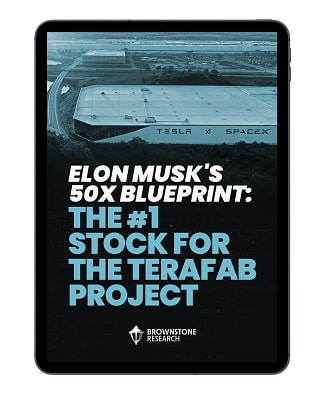
The company’s name and ticker are in the first bonus report, Elon Musk’s 50X Blueprint: The #1 Stock for the Terafab Project, which Brown values at $199.
 There is an important distinction to keep in mind. “Musk has approached this company” and “Musk will announce a partnership” are Brown’s statements and predictions. Until a company or Musk confirms a deal, it remains speculation, and stock prices that already reflect rising expectations can fall even on good news.
Step 2 of the Blueprint: Control the Energy That Powers AI
Brown’s second step addresses what he calls the biggest bottleneck in the industry: electricity. He notes that a single data center can consume as much power as 100,000 households or more, and that thousands of them are being built. He also says Goldman Sachs has called electricity AI’s biggest bottleneck, and that the power grid cannot keep up.
He runs through the alternatives and why he thinks each one falls short for Musk’s timeline:
- Solar is unreliable at night.
- Wind produces nothing when the air is still.
- Natural gas works, but gas turbines can have wait times as long as seven years because of demand.
- Nuclear involves complex permitting and regulation and can take five years or more.
Musk, Brown says, does not want to wait years for a solution.
The idea: put AI in orbit
Since SpaceX has already launched thousands of Starlink satellites, Brown says Musk’s idea is to pack satellites with powerful AI chips and send them into orbit, where they can be powered by the Sun around the clock. In Brown’s words, that means free, clean energy.
He lists the advantages he sees in orbital AI:
- There are no clouds, so solar exposure is constant.
- Space is extremely cold, around minus 270 degrees Celsius, which means radiators can shed excess heat into the void with no fans or water.
- There are no land restrictions, no noise, no pollution and no pushback from local communities.
On the surface, he admits, running AI from space sounds crazy, but he argues it makes sense once you look at the physics. It is also, in fairness, an idea that remains unproven at scale. Engineering challenges around radiation, communications latency, maintenance and launch frequency are real, and readers should view the plan as an ambitious proposal rather than a settled technology.
One million satellites
Brown points to an FCC public notice accepting Musk’s request to launch up to one million AI satellites. For context, he says Starlink has about 11,000 satellites in orbit today, so this would be roughly 100 times bigger. He says Musk has already developed special AI satellites called Starlink V3 and recently put 26 of them into orbit using Starship, which he describes as the biggest and most powerful rocket in history.
Why Brown thinks competitors can’t keep up
A big part of this section is a history lesson on reusable rockets. Before SpaceX, Brown says, rockets were discarded after one use, which kept launch costs astronomical. He compares it to throwing away a commercial airliner after every flight. After Musk joined the Mars Society in 2001 and put his PayPal fortune into SpaceX, the company developed reusable rockets, and Brown says it is now 20 times cheaper to launch objects into orbit. He says SpaceX is responsible for 99% of the mass launched to orbit in the United States, and that Starship could cut launch costs by another factor of ten.
He contrasts that with Blue Origin, which he says has worked on similar technology since 2000 but has landed a booster only a couple of times on test flights, and suffered a catastrophic explosion in early 2026. Musk, Brown says, plans to launch one Starship per day by the end of 2027 and 30 per day by the end of the decade.
His conclusion is that SpaceX is so far ahead that competitors cannot catch up. That is Brown’s opinion, and it is a strong one. Reasonable analysts will point out that technology leads can narrow and that regulators, capital markets and competitors all play roles over a multi-year horizon.
The “space chip” company
The second bonus report covers a different kind of supplier. Brown says AI satellites will need a very specific kind of chip that can convert, regulate and distribute electricity in space, one of the harshest environments imaginable. He says he has found the company that makes it, and that it is already a partner, not a prospect.
According to Brown, this company has worked with SpaceX for more than a decade and the two have co-produced more than 5 billion chips used in every Starlink satellite and ground terminal. He says SpaceX President and COO Gwynne Shotwell recently acknowledged that the company will be critical to the blueprint and confirmed the two will keep working together. The chips are made at a special factory more than 5,000 miles from Silicon Valley, which Brown says is one reason the company is not well known.
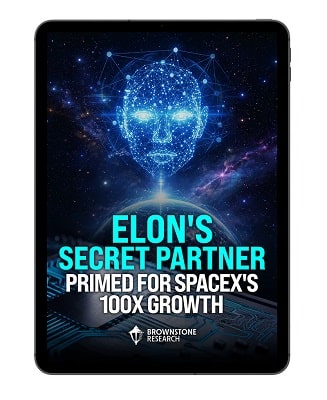
If SpaceX’s satellite network grows by 100 times, Brown reasons, this supplier’s business could grow into the tens of billions of dollars in sales. The company’s identity and Brown’s analysis are in Elon’s Secret Partner Primed for SpaceX’s 100X Growth, valued at $199.
As always, “could” is doing the heavy lifting. A supplier benefits only if the plan scales, if it keeps its contracts, if its margins hold and if the share price has not already priced in the growth.
Step 3 of the Blueprint: Control the AI Applications
The third step is where AI leaves the screen and enters the physical world. Brown argues that the biggest applications of AI will not stay locked behind a computer; they will show up through robotics and autonomous systems. He cites Nvidia CEO Jensen Huang, who has said physical AI could be ten times larger than digital AI, and he argues that when it comes to physical AI, nobody comes close to Musk.
The Cybercab
The presentation opens with Brown riding in a Tesla Cybercab through Austin. He describes a car with no steering wheel, no pedals and no rearview mirrors, fully autonomous, where the only input from the passenger is the destination. You could nap, watch a show, join a video call or get some work done.
Brown’s case for why Tesla can scale faster than rivals is that its system is vision-based. His main competitor in his telling is Google’s Waymo, whose cars are geofenced, meaning they operate inside meticulously pre-mapped and company-approved zones. Tesla, by contrast, does not require geofencing, and Brown says Teslas are already driving themselves in every U.S. state and in 16 countries on four continents. He says they have driven more than 15 billion miles autonomously, and that the company’s full self-driving software has been shown to be up to seven times safer than human drivers.
He also makes an economic argument. Using a side-by-side ride in Austin, he says Cybercab pricing was roughly half of what Uber charged for the same trip, and he expects prices to fall further as the network grows. He says tens of thousands of people have joined a waiting list, that the vehicle costs about $30,000 and that it could pay for itself within a year, and that owners could eventually run fleets of self-driving cars as a business. He also notes the National Highway Traffic Safety Administration is evaluating safety standards for this kind of vehicle, and that because it is a federal regulator, an update could allow national approval quickly.
These are bullish claims, and several of them depend on regulatory approval, real-world safety performance and unit economics that have not been proven at scale. Brown’s assertions about earnings per vehicle, for example, are projections rather than guarantees, and they should be read that way.
Optimus
Brown calls Optimus, Tesla’s humanoid robot, the “real game-changing application.” He says venture capitalist Jason Calacanis recently saw a demo of the third generation and was blown away. The biggest historical obstacle to humanoid robots, Brown says, has been the hand: the human hand is incredibly complex, and no one had managed to design a robotic one with comparable flexibility and precision. Tesla has now filed a patent, he says, on a hand with 25 motors in the forearm driving flexible composite ligaments that mimic tendons, capable of delicate tasks like cracking an egg or threading a needle as well as heavy ones.
Because Optimus uses the same vision and navigation technology as Tesla’s vehicles, Brown argues it is already ahead of other humanoid robots. And because these robots are expected to run on artificial general intelligence, he says, they would be able to work beside people in homes, factories and hospitals without special location-specific training.
He says Musk is projecting growth of more than 14 million percent for the humanoid robotics industry over the next decade, enough to turn $100 into more than $14 million, and that even if Musk is only 10% right, $100 could still grow to more than $1.4 million. He also says Musk projects production of 10 million units per year and customer shipments starting in 2027. Brown is clear that this is Musk’s projection and that it sounds crazy; investors should treat such percentages as illustrations of ambition rather than expectations to plan around.
The “power-delivery” supplier
Once again Brown’s argument is that Tesla itself may not be the best way to play the theme. Tesla was cheap when he recommended it in 2018, he says, and is not cheap now. Instead, he says he has found a little-known Tesla supplier that already provides a key piece of sensor technology and could play a role in the Optimus rollout.
He explains the technology in plain language. A humanoid robot’s arms, legs, hands and fingers all rely on tiny motors. Sending raw electricity to them wastes energy as heat, drains the battery quickly and overheats the robot. This company makes technology that controls and delivers power to those motors more efficiently than normal chips, helping a robot move efficiently, stay cool and run longer between charges.
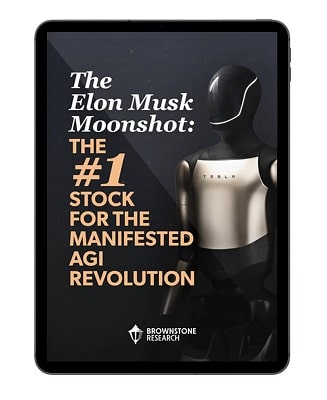
To support his view, Brown says Morgan Stanley recently named the stock as one of the key ways to play the robotics trend, and that a total of 39 hedge funds are investing in it. The third bonus report, The Elon Musk Moonshot: The #1 Stock for the Manifested AGI Revolution, valued at $199, contains the name, the ticker symbol and Brown’s full analysis.
The Three Reports at a Glance
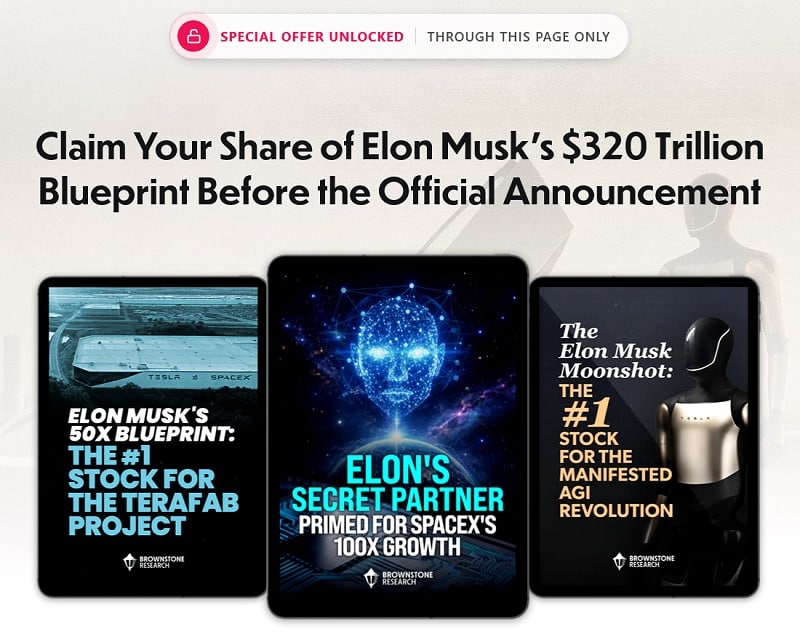
Brown’s offer centers on three special reports, one for each step of the blueprint. Here is how they line up.
Report #1: Elon Musk’s 50X Blueprint: The #1 Stock for the Terafab Project. This covers the company Brown believes will supply the precision machinery Musk needs for Terafab. According to Brown, Musk has already approached the company, and Brown expects an official announcement soon. The report includes the name, ticker and his full analysis. Stated value: $199.
Report #2: Elon’s Secret Partner Primed for SpaceX’s 100X Growth. This covers the company Brown says makes the “space chip” used to convert, regulate and distribute power in satellites. He says it has co-produced more than 5 billion chips with SpaceX for Starlink and is positioned for growth if the satellite constellation expands a hundredfold. Stated value: $199.
Report #3: The Elon Musk Moonshot: The #1 Stock for the Manifested AGI Revolution. This covers the company Brown says makes the power-control technology for Optimus’s motors and already supplies a sensor technology to Tesla. Stated value: $199.
Together with the membership, the package is valued by the offer at $1,096. As with any bundle, the stated “value” is the publisher’s own pricing and not a market price. What matters is whether the research is useful to you.
What Is The Near Future Report?
The three reports are the headline, but the core product is The Near Future Report, Brown’s monthly research service. According to the presentation, it is where he publishes his best investment ideas each month. The name reflects his view that the future is arriving faster than most people expect, and that by the time mainstream media covers a trend, the shares have often already popped and the big money has been made.
The publication focuses on technology trends on the verge of mass adoption: artificial intelligence, robotics, self-driving cars, blockchain, quantum computing and what the offer calls all the most exciting tech trends of our time. Brown says the goal is to identify these trends before they become breaking news, as he says he did with Tesla, SpaceX and Nvidia.
Beyond new ideas, he says the service helps members navigate the ups and downs of the market, such as his March 2020 call during the pandemic sell-off. The offer page adds that every month brings a new recommendation, which means at least 12 ideas across a year of membership.

Everything Included in the Membership
The offer page lists the following components. Here they are with a plain-English description of what each means for a subscriber.
1. A full year of The Near Future Report (stated value $499). A new issue each month with Brown’s top ideas in AI, blockchain, robotics, self-driving cars and other technology trends.
2. Bonus Report #1: Elon Musk’s 50X Blueprint (stated value $199). The Terafab-related pick, including the company’s name, ticker and Brown’s analysis.
3. Bonus Report #2: Elon’s Secret Partner Primed for SpaceX’s 100X Growth (stated value $199). The space-chip supplier.
4. Bonus Report #3: The Elon Musk Moonshot (stated value $199). The Optimus-related power-delivery supplier.
5. 24/7 access to the model portfolio. This shows all current open positions, so members can see which picks are still within Brown’s buy range.
6. Instant access to The Digital Tech Vault. A library of every past issue and special report, covering investment ideas across the tech world.
7. Weekly updates and urgent alerts. Regular updates on the portfolio so members can follow the research on timing, both when to get in and when to get out.
8. Customer support. Support by phone at 888-493-3156 or by email, Monday through Friday, 9 a.m. to 5 p.m. ET. The team can help with membership questions but cannot give individual investment advice.
9. Fast Action Bonus: one-year TradeStops Basic membership. Offered as a free bonus (a $299 value) from partner TradeSmith. It is a portfolio tool intended to help members track their newsletter positions and make exit decisions with less emotion. The offer says there is no automatic renewal and that it can be cancelled at any time.
Pricing: What You Pay and What You Get
Here is the pricing as presented on the order page:
- Regular price for 12 months: $499
- Discount: 64% off, limited time (a $320 reduction)
- Total due today: $179
The offer frames the $179 as less than $4 a week. Taken at face value, 12 months of research, three special reports and the other perks work out to about $15 a month. The checkout page notes 256-bit encryption, and orders can also be placed by phone at 888-493-3156.
As with any limited-time discount, it is worth asking whether the urgency is real. If you are not ready to decide, remember that Brown’s own framing is that you do not have to decide anything today about stocks; the decision you are making at checkout is whether to try the research, and the guarantee below is designed to limit your downside on that specific decision.
The 30-Day Money-Back Guarantee
Brown calls his guarantee “ironclad.” According to the offer, if you decide for any reason that the service is not for you, you can call 888-493-3156 or email the team within 30 days and receive a 100% refund of your order, no questions asked. Brown adds that you keep everything you received, including all special reports, as a gift for trying the service.
That structure matters for two reasons. First, it lets you read the three reports and judge the quality of the research before the trial ends. Second, it separates two risks that are easy to confuse. The refund protects you from the cost of the subscription. It does not protect you from losses on any stock you buy. If you purchase a stock based on a report and its price falls, the guarantee does not cover that. Please read the terms on the order page and keep a record of the date you sign up.
How to Read the Urgency Around “The Announcement”
The most striking part of the offer is the time pressure. Brown says he believes Musk will officially announce a new Terafab partner by the end of the month, and that waiting until the news is on Bloomberg, the Wall Street Journal or the Financial Times could mean paying a much higher price. He points to Intel, where he says shares were up 177% two months after Musk announced a Terafab partnership.
There are several things to weigh here.
- It is a prediction. Brown says “I believe,” and that is the right way to read it. No outside party has confirmed an announcement date, and companies and Musk do not always announce on predictable timelines.
- Price reactions are not guaranteed. Even if an announcement occurs, shares may already reflect the expectation, or may move in the opposite direction. Markets sometimes sell the news.
- One example is not a rule. Intel’s move is a single data point and may not repeat for another company.
- Position sizing is yours to decide. Many experienced investors suggest keeping any single speculative position small relative to a total portfolio, particularly in early-stage themes.
The practical takeaway is that the discount and the guarantee are a reason to try the research, but they are not a reason to rush into any stock purchase. You can use the trial period to read the reports, compare them with your own research and decide whether any of the ideas fit your plan.
Who This Offer May Suit
Based on the presentation, The Near Future Report is most likely to appeal to:
- Investors interested in technology and AI. If you already follow semiconductors, space, robotics and autonomous vehicles, the monthly format gives you a structured stream of ideas.
- People who prefer second-tier plays over household names. Brown’s whole argument is that the best opportunity may sit with suppliers rather than the famous company itself.
- Self-directed investors who want a starting point for research. The reports are meant to be a starting point for your own diligence, not a substitute for it.
- Readers who like a defined trial. A 30-day window and a refund policy lower the cost of finding out whether the style and the ideas suit you.
Who Should Be Cautious
This kind of research is not for everyone. You may want to think twice if:
- You need guaranteed income or cannot afford to lose the money you would invest. Single stocks, especially speculative technology names, can fall sharply.
- You are looking for personalized advice. The team states they cannot give individual investment advice, and the reports are written for a general audience.
- You are investing money you will need in the next few years, such as an emergency fund or a down payment.
- You are tempted to put a large share of your savings into one idea because of a deadline. The deadline is a marketing feature of the offer, not a feature of the stocks.
If you are unsure whether the strategy fits your situation, consider speaking with a licensed financial professional.
Questions to Ask Before You Invest in Any Musk-Related Idea
Whatever you decide about the membership, here is a checklist that applies to any stock idea tied to a big theme.
- What has to go right? For Terafab, a fab of that scale has to be built, staffed and run at yield. For AI satellites, the economics of launch, radiation and heat have to work. For Optimus, the hardware, software and production have to scale.
- How much is already priced in? A strong story can already be reflected in the share price, particularly after a big run-up.
- How concentrated is the company’s exposure to one customer? A supplier that depends heavily on one partner can benefit enormously if that partner grows, and suffer if the relationship changes.
- What does the valuation imply? Compare the price to earnings, cash flow and realistic growth rates, not only to the narrative.
- What is your exit plan? Decide in advance what would make you sell, either through a price level, a time horizon or a change in the facts. The TradeStops bonus is offered for exactly this purpose.
- How does it fit your whole portfolio? An exciting idea can still be a poor fit if it makes your overall holdings too concentrated.
Frequently Asked Questions
Who is Jeff Brown?
Jeff Brown is the founder and CEO of Brownstone Research and the editor of The Near Future Report. He describes himself as a former senior executive at Qualcomm, NXP Semiconductors and Juniper Networks, an angel investor in private technology companies and a graduate of Purdue University in aeronautical and astronautical engineering.
What is Elon Musk’s $320 Trillion Blueprint?
It is the name Brown gives to what he says is Musk’s three-step plan to dominate the AI industry: making his own chips through Terafab, powering AI with solar-powered satellites in orbit, and leading physical AI through Tesla’s Cybercab and Optimus robot. The $320 trillion figure is attributed to Musk as a projection of the new wealth AI could create.
What is Terafab?
Terafab is described by Brown as a planned chip-making project that begins with the Advanced Technology Fab on Musk’s Austin campus. The stated goal is to produce roughly 50 times more chips than the world currently makes, with up to 200 billion chips per year.
Does the presentation name the stocks?
Not in the video or on the offer page. The names, ticker symbols and analysis for all three companies are in the three special reports that come with the membership.
How much does it cost?
The regular price for a one-year membership is $499. The current offer is $179, a 64% discount.
What do I get besides the three reports?
Twelve monthly issues of The Near Future Report, access to the model portfolio, the Digital Tech Vault of past issues and reports, weekly updates and urgent alerts, customer support and a free one-year TradeStops Basic membership.
Can I get a refund?
Yes. According to the offer, you can request a full refund within 30 days by calling 888-493-3156 or emailing the team, and you keep everything you received. Please check the order page for the exact terms.
Is this personalized financial advice?
No. Brown’s team states they cannot provide individual investment advice. The research is general information and opinion for a broad audience.
Are the results in the testimonials typical?
No. The presentation explicitly says the investment results in the testimonials are not typical, that investing in securities carries a high degree of risk and that you may lose some of your investment. Brown also gives the average gain for The Near Future Report as 43%.
Will Musk really announce a Terafab partner this month?
Nobody knows. That is Brown’s belief, based on his reading of the situation. It should be treated as an opinion, not a fact, and it should not be your only reason for acting.
Do I need to buy Tesla or SpaceX stock to follow this plan?
Brown says no. His view is that the better opportunity is in suppliers to Musk’s projects rather than in Tesla or SpaceX themselves. Whether that proves correct depends on prices, execution and timing.
The Bottom Line
Elon Musk’s AI masterplan, as Jeff Brown describes it, is a bold three-part idea: make the chips, power them from space and put the resulting intelligence into cars and robots. Brown argues that every step depends on specialized technology from companies most investors have never heard of, and he has packaged his research on three of them into reports that come with a one-year subscription at a steep discount.
The case is compelling if you believe in the premise, and Brown has built much of his reputation on early calls about Musk’s companies. But the same ingredients that make the story exciting also make it risky: ambitious timelines, unproven technology at scale, regulatory dependence, predictions about announcements that have not happened and stocks whose prices may already reflect much of the enthusiasm.
The sensible way to approach the offer is as a way to read the research, not to follow it blindly. You have 30 days. Read the reports, check the claims, run your own numbers and decide whether any of the ideas deserve a place in your portfolio and at what size. If the research is not useful to you, the guarantee gives you a way out.
To review Jeff Brown’s presentation and claim the offer, use the link below.
Start your 30-day risk-free trial of The Near Future Report for $179