

Quick Verdict
Market downturns can create an opportunity for investors to reduce their tax burden through a strategy known as tax-loss harvesting. By selling an investment that has declined in value and realizing the loss, an investor may be able to offset capital gains from other investments, subject to applicable tax rules.
The strategy can be useful even when the broader stock market is experiencing volatility. A losing stock does not necessarily have to be a permanent mistake. In some situations, realizing a loss can help an investor manage their portfolio and potentially reduce their tax bill.
However, tax-loss harvesting is not a way to turn a bad investment into a guaranteed profit. Selling an asset creates a real economic loss, and the tax benefits depend on factors such as realized gains, income, holding periods, and the investor’s tax situation. The wash-sale rule and the risk of selling an investment that later rebounds also need to be considered.
The central idea: Investors should evaluate tax-loss harvesting as part of a broader investment and tax-planning strategy, not as a reason to sell stocks simply because their prices have fallen.
Key Takeaways
-
Market volatility can create tax-planning opportunities. Declining stock prices may allow investors to realize capital losses that can offset eligible capital gains.
-
Tax-loss harvesting involves selling an investment at a loss. A paper loss becomes a realized capital loss when the investment is sold.
-
Capital losses can offset capital gains. For many individual taxpayers, net capital losses can also reduce ordinary income by up to $3,000 per year, subject to applicable rules and filing status.
-
Unused losses may generally be carried forward. Investors with more eligible losses than they can use in the current year may be able to apply the remainder in future tax years.
-
The wash-sale rule matters. Buying back substantially identical securities within the relevant 30-day period before or after a sale can affect whether the loss is currently deductible.
-
Tax savings should not be confused with investment returns. Selling a losing position may reduce taxes, but it does not eliminate the underlying investment loss.
-
The best strategy depends on the investor. Portfolio allocation, investment goals, tax bracket, transaction costs, and the potential for future price recovery all matter.
-
Tax-loss harvesting should be planned carefully. Investors should understand the rules and consider consulting a qualified tax professional when the situation is complicated.
Could a Market Decline Actually Help You Save on Taxes?

Stock market volatility is usually associated with uncertainty.
One day, an investor might see a technology stock rise 8%. A few weeks later, the same stock could fall 15% after an earnings report, a change in interest-rate expectations, or a broader market sell-off.
For long-term investors, these price movements can be frustrating. Watching a portfolio lose value can make it tempting to stop checking account balances or wait for the market to recover.
But there is another aspect of market declines that investors may want to consider: tax planning.
When an investment trades below the price an investor originally paid, the position may contain an unrealized capital loss. If the investor decides to sell that investment, the loss generally becomes realized for tax purposes. Under applicable rules, realized capital losses can potentially be used to offset capital gains from other investments.
This is the basic principle behind tax-loss harvesting.
Imagine an investor who sold one stock earlier in the year and realized a $5,000 capital gain. Later, another stock in the portfolio falls below its purchase price, creating a potential $3,000 loss.
If the investor sells the losing stock and the loss is eligible for tax purposes, the $3,000 loss could offset $3,000 of the earlier capital gain. That could reduce the investor’s net taxable capital gain, depending on the relevant tax rules and circumstances.
The investor has still lost money on the stock that declined. But realizing the loss may improve the overall tax outcome.
This distinction is important because tax-loss harvesting is often misunderstood. It is not a way to make a losing investment profitable. It is a strategy for managing the tax consequences of investment activity while reassessing whether a particular holding still belongs in a portfolio.
The strategy also becomes more relevant during periods of significant market swings. When stock prices move sharply, investors may have more opportunities to review positions, identify investments they no longer want to hold, and consider whether realizing certain losses fits their long-term plans.
At the same time, selling an investment for tax reasons without considering its future prospects can create new problems. An investor might sell a stock that later rebounds, trigger transaction costs, or unintentionally violate the wash-sale rule by buying back a substantially identical security too soon.
The question, therefore, is not simply whether market losses can reduce taxes.
The more useful question is:
How can investors use market volatility to make thoughtful tax and portfolio decisions without allowing the tax benefit to dictate their entire investment strategy?
This article examines how tax-loss harvesting works, what investors need to know about capital gains and losses, the potential benefits and limitations of the strategy, and practical considerations before making a sale.
What Is Tax-Loss Harvesting?
Tax-loss harvesting is an investment tax strategy in which an investor sells an investment that has declined in value to realize a capital loss. That realized loss may then be used to offset eligible capital gains or, when applicable, a limited amount of ordinary income.
The strategy is most commonly discussed in the context of taxable brokerage accounts. Unlike many retirement accounts, taxable investment accounts can generate capital gains and losses when securities are sold.
The process sounds straightforward, but it helps to understand the difference between an unrealized loss and a realized loss.
Unrealized Loss vs. Realized Loss
An unrealized loss occurs when an investment is worth less than its adjusted cost basis, but the investor has not sold it.
For example, suppose you purchase 100 shares of a stock for $50 per share.
Your original investment is:
100 shares × $50 = $5,000
The stock subsequently declines to $35 per share. Your position is now worth:
100 shares × $35 = $3,500
The difference is a $1,500 unrealized loss.
You have not yet sold the shares, so the loss has not been realized through a sale.
If you sell the 100 shares for $3,500, your realized loss is generally $1,500, assuming no other adjustments affect the calculation.
The tax treatment of that loss depends on applicable rules, including the holding period, cost basis, and whether the transaction is subject to restrictions such as the wash-sale rule.
This distinction is central to tax-loss harvesting. Investors cannot generally claim a tax deduction merely because a stock’s market price has declined. A qualifying sale or other taxable disposition is typically required to establish the loss.
Why Investors Consider Harvesting Losses
The primary reason to consider tax-loss harvesting is that investment gains can create a tax liability.
Suppose an investor has realized several profitable trades during the year. The investor may also hold other investments that are trading below their purchase prices.
Selling certain losing positions can potentially reduce the net capital gain reported for tax purposes.
However, the investor should not assume that every loss automatically produces an immediate tax refund. The amount of tax benefit depends on the type and amount of gains, the investor’s tax situation, and the applicable rules.
A $2,000 realized loss, for example, does not necessarily mean the government sends the investor $2,000. The loss may offset eligible gains, and any remaining net capital loss may be subject to annual deduction limits.
The economic and tax effects are different.
How Capital Gains and Capital Losses Work
Before using tax-loss harvesting, investors need a basic understanding of capital gains and losses.
The IRS generally treats stocks and other investment assets as capital assets. When an investor sells a capital asset, the difference between the adjusted basis and the amount realized generally determines whether the transaction produces a capital gain or capital loss.
The adjusted basis is often the original purchase cost, although it can change because of factors such as reinvested distributions, corporate actions, or other adjustments.
A Simple Capital Gain Example
Suppose you purchase 50 shares of a company for $40 per share.
Your total cost is:
50 × $40 = $2,000
Later, the stock rises to $70 per share, and you sell your shares.
Your proceeds are:
50 × $70 = $3,500
Ignoring transaction costs and other adjustments, your capital gain is $1,500.
The gain may be classified as short-term or long-term based on how long you held the investment.
The holding period can affect the tax treatment of the gain, so investors should not focus solely on the amount of profit. They should also consider the nature of the gain and their overall tax circumstances.
A Simple Capital Loss Example
Now imagine a different investment.
You purchase 50 shares at $40 per share, for a total cost of $2,000. The stock declines to $25 per share, and you sell.
Your sale proceeds are:
50 × $25 = $1,250
Your realized capital loss is:
$2,000 − $1,250 = $750
This $750 loss may be available to offset eligible capital gains, assuming the transaction is not disallowed or otherwise restricted.
The loss does not automatically qualify for a specific tax benefit in every circumstance. Investors need to account for their other capital transactions and the relevant tax rules.
Short-Term and Long-Term Capital Gains
Capital gains and losses are generally classified according to the holding period.
Under the general rules, an asset held for one year or less before disposal produces a short-term capital gain or loss. An asset held for more than one year generally produces a long-term capital gain or loss.
This distinction matters because short-term gains are generally taxed at ordinary income tax rates, while qualifying long-term capital gains may receive preferential federal tax treatment.
The interaction between short-term and long-term gains and losses can affect how an investor’s net capital gain or loss is calculated. Consequently, harvesting a loss is not simply about choosing the investment with the largest decline. The holding period and overall capital-gain picture should be considered as well.
Investors should verify the applicable rules for the tax year in question and use their tax records to determine holding periods accurately. More complicated situations, including multiple purchases of the same security, can make this calculation less straightforward.
How Tax-Loss Harvesting Can Reduce Your Tax Bill
The potential tax benefit of harvesting losses becomes easier to understand through an example.
Imagine an investor who has realized the following transactions in a taxable brokerage account.
|
Investment |
Result |
|---|---|
|
Stock A |
$8,000 realized gain |
|
Stock B |
$3,000 realized gain |
|
Stock C |
$5,000 unrealized loss |
The investor has realized $11,000 in gains, while Stock C has declined by $5,000 relative to its adjusted basis.
If the investor sells Stock C and realizes the full $5,000 loss, the loss may offset $5,000 of eligible capital gains, subject to the applicable netting rules.
The simplified result would be:
-
Realized capital gains: $11,000
-
Realized capital losses: $5,000
-
Remaining net capital gain: $6,000
This is an illustrative example, not a complete tax calculation. The final result can depend on the holding periods, other transactions, carryovers, and applicable tax provisions.
The important concept is that the investor may reduce the amount of net capital gain subject to tax.
What If You Have More Losses Than Gains?
Consider another example.
An investor has:
-
$4,000 in realized capital gains.
-
$10,000 in eligible realized capital losses.
The investor has a net capital loss of $6,000 before considering any carryovers or other applicable adjustments.
For an individual taxpayer, the federal capital loss deduction against ordinary income is generally limited to the lesser of $3,000, or $1,500 for married filing separately, and the net capital loss amount. Any eligible excess can generally be carried forward to future tax years.
The investor may therefore use the loss to offset the gains and potentially deduct part of the remaining loss against ordinary income, subject to the rules.
The remaining eligible loss may be carried forward.
This is one reason tax-loss harvesting can be useful beyond the simple situation of offsetting gains. Nevertheless, investors should avoid treating the annual deduction limit as a guarantee that every loss will produce a tax benefit in the current year.
A Tax Benefit Is Not the Same as a Dollar-for-Dollar Refund
One of the most common misconceptions about tax-loss harvesting is that realizing a loss means receiving an equivalent amount of money from the IRS.
That is not how the strategy works.
Suppose an investor realizes a $5,000 capital loss and is able to use it to offset taxable capital gains. The investor does not automatically receive a $5,000 refund.
The loss reduces the amount of gain that may be subject to tax. The actual tax savings depend on the applicable tax rate and the taxpayer’s overall circumstances.
For example, if a hypothetical $5,000 eligible loss offsets gains taxed at a hypothetical 15% rate, the direct federal tax reduction associated with that offset could be approximately $750. This is only an illustration, and it does not account for the full tax calculation, other taxes, or changes in the investor’s situation.
The tax savings can differ substantially depending on whether the loss offsets short-term gains, long-term gains, or other income under the applicable rules.
The takeaway is simple: Tax-loss harvesting can reduce taxes, but it does not erase the investment loss itself.
A Practical Example: Harvesting a Loss During a Market Downturn
Imagine that an investor named Michael has built a portfolio of technology and growth stocks.
Earlier in the year, he sold a position in a semiconductor company for a $7,000 realized gain. He also owns shares in another technology company that have declined significantly.
His position looks like this:
|
Item |
Amount |
|---|---|
|
Original investment |
$12,000 |
|
Current market value |
$8,000 |
|
Unrealized loss |
$4,000 |
|
Earlier realized gain |
$7,000 |
Michael is considering whether to keep holding the losing stock or sell it.
If he sells and realizes the $4,000 loss, the loss may offset $4,000 of eligible capital gains, subject to the tax rules.
The simplified calculation would be:
$7,000 gain − $4,000 loss = $3,000 net gain
Michael has not made money by selling the losing stock. He has realized a loss. But if he already believes the position no longer fits his investment plan, the tax treatment may be a useful consideration in deciding whether to sell.
What If Michael Still Likes the Company?
This is where the decision becomes more complicated.
Suppose Michael believes the company has strong long-term prospects. He does not want to abandon exposure to the sector merely because the stock has fallen.
He might consider whether another investment could provide a similar, but not substantially identical, market exposure during the relevant period. However, determining whether securities are substantially identical can be fact-specific, and an investor should not assume that two different ticker symbols automatically avoid the wash-sale rule.
He also needs to consider whether a replacement investment has the risk characteristics, diversification profile, and investment thesis he actually wants.
Tax planning should not override the decision about what assets belong in the portfolio.
If Michael sells solely to capture a tax loss and then makes an unsuitable replacement investment, the tax benefit may not justify the new investment risk.
What If the Stock Rebounds Immediately?
This is another risk.
Suppose Michael sells the stock at an $4,000 loss, then watches the shares rebound 20% shortly afterward.
If he does not own the stock during the rebound, he may miss some or all of that price recovery. If he buys back substantially identical shares within the relevant period, the wash-sale rule may affect the current deductibility of the loss.
Tax-loss harvesting therefore involves a trade-off. An investor must consider the possibility that a security will recover after it is sold.
The decision is not simply about whether the stock is down. It is about whether selling it is consistent with the investor’s broader objectives.
The Wash-Sale Rule: What Investors Need to Know

The wash-sale rule is one of the most important restrictions associated with tax-loss harvesting.
In general, the rule applies when an investor sells or otherwise disposes of stock or securities at a loss and, within 30 days before or after the sale, acquires substantially identical stock or securities, acquires substantially identical securities in a qualifying trade, enters into a contract or option to acquire them, or engages in certain other transactions covered by the rule.
The IRS generally disallows the loss deduction in a wash-sale transaction, subject to applicable exceptions. For many replacement purchases, the disallowed loss is added to the basis of the replacement securities, which generally postpones the loss deduction. Special rules apply when substantially identical stock is acquired in an IRA or Roth IRA.
The rule is more complex than simply waiting 30 days after selling a stock.
The 61-Day Window
The commonly discussed wash-sale period covers:
-
The 30 days before the sale.
-
The day of the sale.
-
The 30 days after the sale.
This creates a 61-day window.
For example, suppose an investor sells a stock at a loss on December 15. The investor needs to consider purchases of substantially identical securities during the relevant 30-day period before the sale and the 30-day period following the sale.
An investor who purchased shares in late November may need to account for those shares when determining whether the loss is subject to the wash-sale rule.
Similarly, purchasing substantially identical shares in the weeks after the sale may affect the treatment of the realized loss.
Why the Rule Exists
The wash-sale rule is designed to prevent an investor from claiming a tax loss while effectively maintaining the same investment position through a substantially identical replacement purchase.
Without the rule, an investor could potentially sell shares at a loss to obtain a tax deduction and immediately repurchase the same shares without meaningfully changing their market exposure.
The tax system therefore restricts the immediate deduction in situations covered by the rule.
Example of a Wash Sale
Suppose you purchase 100 shares of a company for $10,000.
The stock declines, and you sell the shares for $7,500.
Your realized loss is $2,500.
If you purchase substantially identical shares within the relevant wash-sale period, the loss may be disallowed for current deduction purposes.
For a replacement purchase that is subject to basis adjustment, the disallowed loss is generally added to the cost basis of the replacement shares.
The tax consequences can therefore be deferred rather than permanently eliminated. However, IRA and Roth IRA transactions have special treatment, and the outcome may not be the same as a taxable-account repurchase.
Does the Wash-Sale Rule Apply Across Accounts?
Investors should not assume that the wash-sale rule only applies to transactions within one brokerage account.
The IRS rules can cover transactions involving a spouse or other accounts and certain IRA or Roth IRA acquisitions. Broker reporting may not capture every transaction across all accounts, so investors should maintain their own records.
This is particularly relevant for investors who have:
-
Multiple taxable brokerage accounts.
-
Automatic dividend reinvestment plans.
-
Employer stock plans.
-
An IRA or Roth IRA.
-
A spouse who owns substantially identical securities.
-
Recurring purchases of an ETF or mutual fund.
An investor who uses automated investing should review purchase schedules before realizing a loss.
What About Buying a Similar ETF?
Investors sometimes consider selling one ETF at a loss and buying another fund that tracks a similar market segment.
Whether two securities are substantially identical is not always obvious. Similar investment objectives do not automatically establish that two securities are substantially identical, but investors should not assume that a different fund name eliminates all potential issues.
The specific securities, structure, holdings, and applicable facts matter. Investors should seek professional tax advice when the distinction is uncertain.
When Market Volatility Creates Tax-Loss Harvesting Opportunities
Market volatility is not automatically good or bad for investors. Its effects depend on portfolio construction, investment time horizon, financial needs, and the reasons behind price movements.
From a tax-planning perspective, however, significant market swings can create situations worth reviewing.
A portfolio that has appreciated for years may contain some positions with large unrealized gains and others with losses. During a market decline, investments that were purchased at higher prices may trade below their adjusted cost basis.
This can give investors an opportunity to reconsider holdings that no longer fit their plans.
Broad Market Declines
A broad market decline can push many stocks lower at the same time. Some of those declines may reflect temporary changes in market sentiment, while others may reflect genuine deterioration in a company’s business prospects.
An investor who has already decided to reduce exposure to certain companies might use the opportunity to evaluate whether selling a losing position is appropriate.
However, market-wide declines do not automatically mean that all losing investments should be sold.
For example, an investor may own a diversified index fund with a long-term investment purpose. Selling it solely because its price declined could interfere with the investor’s allocation strategy.
Tax-loss harvesting is most useful when it is integrated into a decision that the investor would otherwise consider making.
Sector-Specific Sell-Offs
A market swing affecting one sector can create different opportunities and risks.
Suppose a group of semiconductor stocks declines after investors revise their expectations for technology spending. One investor might see the decline as a reason to reduce exposure. Another might view it as a temporary setback and intend to continue holding the same investments.
The tax consequences of realizing a loss may be relevant to either investor, but the investment decision is different.
A person who wants to sell a position regardless of tax considerations may find tax-loss harvesting worth evaluating. A person who wants to maintain the same security without interruption needs to consider the wash-sale rule and the potential consequences of selling and repurchasing.
The tax strategy should follow the investment decision, rather than becoming the only reason for making it.
Volatility Near the End of the Tax Year
Tax-loss harvesting is often discussed near year-end because investors may be reviewing their realized gains, losses, and tax documents.
But the process should not be limited to the final few trading days of the year.
Waiting until December can create practical problems, including limited time to review transactions, identify wash-sale exposure, and confirm the tax treatment of complicated positions.
Investors may find it more useful to review their taxable portfolios throughout the year and then complete a more detailed review before the relevant tax-year deadline.
Year-end trading also requires attention to settlement procedures, transaction records, and the specific tax year in which the sale is recognized. Investors should not rely on assumptions about deadlines without checking the applicable rules.
The Difference Between Tax-Loss Harvesting and Selling a Bad Investment
Tax-loss harvesting is sometimes presented as a way to turn losing investments into tax benefits.
That framing can be misleading.
An investor may own a stock that has declined because the company’s business prospects have deteriorated. In such a case, selling may be a sensible portfolio decision regardless of the tax implications.
In another situation, the stock may have declined because of temporary market conditions, while the investor still believes the original investment thesis remains intact.
These two situations require different thinking.
Selling Because the Investment Thesis Changed
Suppose an investor purchases a company because it has a strong balance sheet, growing revenue, and a competitive position in its industry.
A year later, the company loses a major customer, lowers its earnings outlook, and increases its debt.
The stock falls 30%.
The investor now believes the original investment thesis is no longer valid.
In this situation, selling the position may be appropriate to consider even if there is no tax benefit. If the sale produces a capital loss, that tax treatment becomes one factor in the decision.
Selling Only Because the Price Fell
Now consider a different investor.
The investor owns a diversified index fund and has a 15-year investment horizon. The fund falls during a temporary market correction, but the investor’s allocation and financial goals have not changed.
Selling the fund solely because it has declined may undermine the investment strategy.
If the investor buys back substantially identical shares during the wash-sale period, the tax loss may not be currently deductible. If the investor does not buy back the shares, they may lose exposure to the market’s subsequent recovery.
The point is not that investors should never sell losing investments. It is that the reason for selling matters.
A Useful Question to Ask
Before realizing a loss, an investor can ask:
If there were no tax benefit from selling this investment, would I still consider selling it?
If the answer is yes, tax-loss harvesting may be worth evaluating as part of the transaction.
If the answer is no, the investor should carefully examine whether the tax benefit is causing them to make an investment decision they would not otherwise make.
This question is not a formal tax rule, but it can help prevent tax considerations from overwhelming portfolio discipline.
Tax-Loss Harvesting and Portfolio Rebalancing
One of the practical advantages of combining tax-loss harvesting with portfolio management is that a sale may serve more than one purpose.
An investor might realize a loss while also reducing an oversized position, adjusting sector exposure, or moving toward a more diversified portfolio.
Example: Reducing Concentration Risk
Suppose an investor owns a large position in a technology company. The stock has fallen, and the investor believes the position is now too concentrated relative to the rest of the portfolio.
The investor is considering selling some shares anyway.
If the shares are sold at a loss, the realized loss may have tax consequences that can be evaluated alongside the portfolio decision.
The investor might then direct the proceeds toward other assets, such as a diversified fund or another investment that fits the desired allocation.
The tax strategy is not the entire reason for the sale. It is part of a broader decision about risk management.
Rebalancing Can Have Tax Costs
Rebalancing a portfolio can create both gains and losses.
For example, an investor may want to reduce exposure to an asset that has risen substantially in value. Selling it could produce a capital gain.
At the same time, another holding may be trading below its adjusted basis. Realizing that loss may help offset eligible gains, depending on the tax situation.
The investor should still consider whether the transactions align with the intended portfolio allocation.
Rebalancing should not be performed solely to generate losses. An investor might sell a security at a loss and then purchase an unsuitable replacement, leaving the portfolio less aligned with their needs.
Avoiding Unintended Portfolio Changes
A common challenge is that an investor may sell a losing investment but fail to account for the role it played in the portfolio.
For example, a particular fund may provide exposure to a broad group of companies, while a replacement fund focuses on a narrower sector. Although the two funds might appear similar at first glance, their risk profiles may be different.
Before making a replacement purchase, the investor should consider:
-
Asset allocation.
-
Diversification.
-
Sector concentration.
-
Geographic exposure.
-
Investment costs.
-
Liquidity.
-
Investment horizon.
-
Potential tax consequences.
The objective is to manage the portfolio intentionally, not simply to replace one ticker symbol with another.
What Happens When You Have More Capital Losses Than Gains?
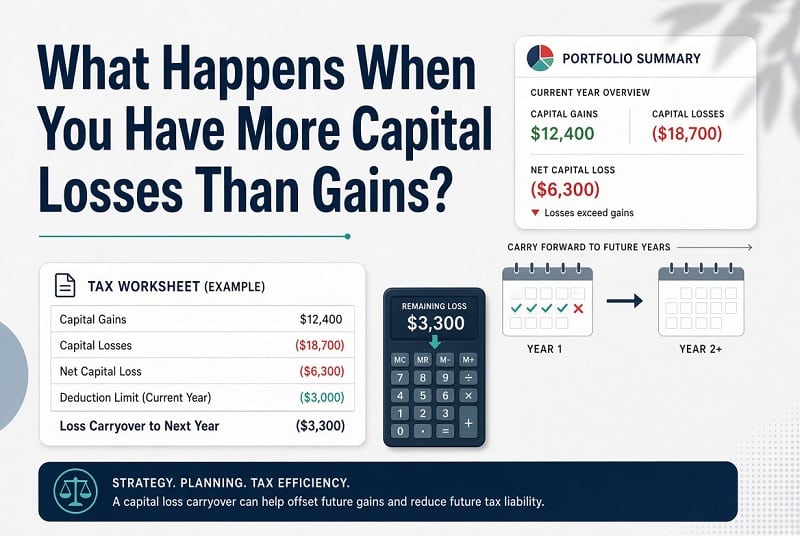
This question is particularly relevant during a major market decline.
An investor who realizes several losses may end the tax year with more capital losses than capital gains.
The IRS generally allows individuals to deduct a net capital loss against ordinary income, subject to the applicable annual limit. For most individual taxpayers, the limit is $3,000 per year, while the limit is $1,500 for married individuals filing separately.
If the net loss exceeds the allowable deduction, the unused portion can generally be carried forward to future tax years.
Example of a Capital Loss Carryforward
Suppose an investor has the following results:
-
Capital gains: $2,000.
-
Capital losses: $12,000.
The simplified net capital loss is $10,000.
The investor may be able to use the loss to offset the $2,000 in gains and deduct up to $3,000 against ordinary income, subject to applicable rules.
The remaining eligible loss could generally be carried forward.
This means the tax benefit is not necessarily limited to the year in which the investment is sold. The unused loss may become relevant in future tax years.
Why Carryforwards Matter
Investors should keep track of capital loss carryforwards rather than assuming that all tax benefits must be used immediately.
A carryforward can be useful in a later year when the investor realizes capital gains from selling an appreciated investment.
For example, an investor who has accumulated eligible losses may be able to apply those losses against future gains, subject to the applicable rules and documentation requirements.
The timing of future gains is not guaranteed, however. Investors should not realize losses solely on the assumption that a large gain will occur later.
Keep Accurate Records
Tax-loss harvesting becomes more difficult when investors do not maintain reliable records.
Important information may include:
-
Purchase dates.
-
Purchase prices.
-
Number of shares.
-
Adjusted cost basis.
-
Sale dates.
-
Sale proceeds.
-
Transaction fees and adjustments.
-
Prior-year capital loss carryforwards.
-
Wash-sale adjustments.
Brokerage statements are useful, but investors should understand that broker reporting may not capture every transaction or every potential wash-sale situation, especially across accounts.
A tax professional can help resolve discrepancies and determine the appropriate reporting treatment.
Common Tax-Loss Harvesting Mistakes
Tax-loss harvesting may be a useful strategy, but investors can make mistakes that reduce its effectiveness or create unexpected tax consequences.
Mistake 1: Selling a Stock Without Understanding Why It Declined
A stock may decline because of a temporary market correction, a change in investor sentiment, or a fundamental deterioration in the business.
Selling without understanding the reason for the decline can lead to decisions that do not align with the investor’s strategy.
Investors should consider whether the investment still fits their objectives before focusing on the tax consequences.
Mistake 2: Ignoring the Wash-Sale Period
An investor might sell a stock at a loss and then automatically reinvest dividends or purchase additional shares.
That purchase could affect the tax treatment of the realized loss if the securities are substantially identical and the transaction falls within the applicable wash-sale period.
Automatic reinvestment plans deserve particular attention because the purchase may happen without the investor actively placing a trade.
Mistake 3: Assuming the Brokerage Account Captures Everything
Brokerage firms generally provide tax reporting documents for relevant transactions, but investors should not assume that the information automatically covers every possible transaction involving substantially identical securities.
Purchases in another account, a spouse’s account, or certain retirement accounts may create additional considerations.
Investors should review their entire investment activity when assessing the wash-sale rule.
Mistake 4: Focusing Only on the Tax Benefit
A tax benefit does not necessarily make a sale economically attractive.
An investor may realize a loss and then pay transaction costs, lose exposure to an investment, or purchase a replacement that does not suit the portfolio.
The tax outcome should be considered alongside the investment consequences.
Mistake 5: Waiting Until the Last Minute
Investors who wait until the end of the year may have less time to review records, consider replacement investments, and identify potential wash-sale transactions.
A year-round process can help investors make decisions more deliberately.
Mistake 6: Believing Every Loss Is Immediately Deductible
Certain transactions and circumstances can restrict the use of capital losses.
The wash-sale rule is one example. Other special rules can apply to particular investments or transactions.
Investors should not assume that the loss shown in a trading account is necessarily the amount they can deduct on their tax return.
Tax-Loss Harvesting in a Taxable Brokerage Account vs. Retirement Account
The type of account matters when considering tax-loss harvesting.
Taxable brokerage accounts and retirement accounts have different tax structures, and investors should not assume that a strategy that makes sense in one account will work the same way in another.
Taxable Brokerage Accounts
In a taxable brokerage account, the sale of an investment may create a capital gain or loss that needs to be reported under the applicable tax rules.
This is the account type most commonly associated with tax-loss harvesting.
An investor may review holdings, identify potential losses, and decide whether selling a position is consistent with the portfolio’s objectives.
Traditional IRAs and Roth IRAs
Retirement accounts have different tax treatment.
Investors should not assume that selling an investment at a loss inside a retirement account creates the same deductible capital loss that might arise from a qualifying sale in a taxable brokerage account.
The IRS also provides special treatment for certain wash-sale situations involving substantially identical securities acquired in an IRA or Roth IRA.
Because retirement-account transactions can create complicated consequences, investors should exercise particular care when moving between taxable and retirement accounts.
Why Account Coordination Matters
Suppose an investor sells a stock at a loss in a taxable account but has a recurring purchase of the same stock in an IRA.
The investor should not assume that the retirement-account purchase is irrelevant to the wash-sale analysis.
The applicable rules can affect the current deductibility of the loss, and the tax treatment may differ from a replacement purchase in a taxable account.
Investors should review all relevant accounts and consult a qualified tax professional when the circumstances are unclear.
How to Build a Tax-Loss Harvesting Checklist
A checklist can help investors approach tax-loss harvesting more carefully.
Rather than selling investments based on a market headline or a sudden price decline, investors can work through several questions before placing an order.
Step 1: Review Your Realized Gains and Losses
Start by reviewing the transactions already completed during the tax year.
Determine whether you have realized capital gains, capital losses, or both. Check whether you have any unused capital loss carryforwards from previous years.
This provides context for whether realizing an additional loss could be useful.
The investor should avoid relying solely on an account’s overall performance percentage. A portfolio may show a loss even when some positions have realized gains and others have unrealized losses.
Step 2: Identify Potential Loss Positions
Review holdings that are currently worth less than their adjusted cost basis.
Not every losing investment should be sold. Instead, identify positions that may already be under consideration for portfolio changes.
For example, an investor might have a stock that no longer fits their preferred allocation or an investment that has become too concentrated.
Step 3: Evaluate the Investment Thesis
Ask whether the investment still fits the portfolio.
Consider the company’s financial performance, competitive position, risk, and the reason the investment was purchased.
Investors should be careful about using tax-loss harvesting as a substitute for fundamental analysis.
Step 4: Check for Wash-Sale Exposure
Review purchases of substantially identical securities during the relevant period before and after the proposed sale.
This includes checking for automatic reinvestments and relevant activity in other accounts.
If the investor is uncertain whether a replacement security is substantially identical, professional advice may be appropriate.
Step 5: Consider the Replacement Investment
If the investor wants to maintain market exposure, evaluate whether a replacement security fits the investment plan.
The replacement should be considered based on its investment characteristics, not simply its ability to avoid an immediate tax restriction.
Step 6: Review the Tax Impact
Consider the type of gain or loss, the potential amount that may be used, and whether there are relevant carryforwards or other adjustments.
The investor should not assume that a tax estimate from a simple online calculator is sufficient for a complicated portfolio.
Step 7: Maintain Documentation
Keep transaction confirmations, cost-basis information, and records of any relevant adjustments.
Good documentation can help investors and their tax professionals determine the appropriate reporting treatment.
Is Tax-Loss Harvesting Worth It for Every Investor?
Tax-loss harvesting is not equally useful for everyone.
The potential value depends on the investor’s tax situation, investment objectives, account type, and ability to manage the consequences of selling.
Investors With Realized Capital Gains
An investor who has already realized capital gains during the year may have a reason to evaluate whether additional eligible capital losses could offset some of those gains.
The potential benefit depends on the applicable rules and the nature of the gains and losses.
This does not mean that the investor should sell every losing position. The sale still needs to make sense in the context of the portfolio.
Investors With Long-Term Buy-and-Hold Strategies
Long-term investors may have fewer opportunities to realize losses if their investments have generally appreciated.
However, market declines can create unrealized losses even in portfolios intended for long-term ownership.
The investor should consider whether realizing a loss is consistent with their long-term allocation and investment objectives.
A buy-and-hold strategy does not necessarily mean that no position should ever be sold. But tax planning should not encourage unnecessary portfolio turnover.
Investors With Limited Taxable Investments
Tax-loss harvesting is generally more relevant to investments held in taxable accounts than to investments held in tax-advantaged retirement accounts.
Investors who primarily use retirement accounts may have fewer opportunities to apply the conventional tax-loss harvesting strategy.
Investors Who Prefer Simplicity
Tax-loss harvesting can add administrative complexity.
An investor who manages multiple accounts, owns many securities, or makes frequent trades may need to track basis adjustments, holding periods, and wash-sale considerations carefully.
The potential tax benefit should be weighed against the time and effort required to manage the transactions accurately.
Investors Who Need to Sell for Financial Reasons
Sometimes an investor needs to sell an investment because of a financial requirement, a change in risk tolerance, or a change in investment objectives.
In that case, the tax implications may be an important part of the decision.
The investor should not delay a necessary portfolio adjustment simply because a tax-loss harvesting strategy is unavailable or inconvenient.
How Much Can Tax-Loss Harvesting Actually Save You?
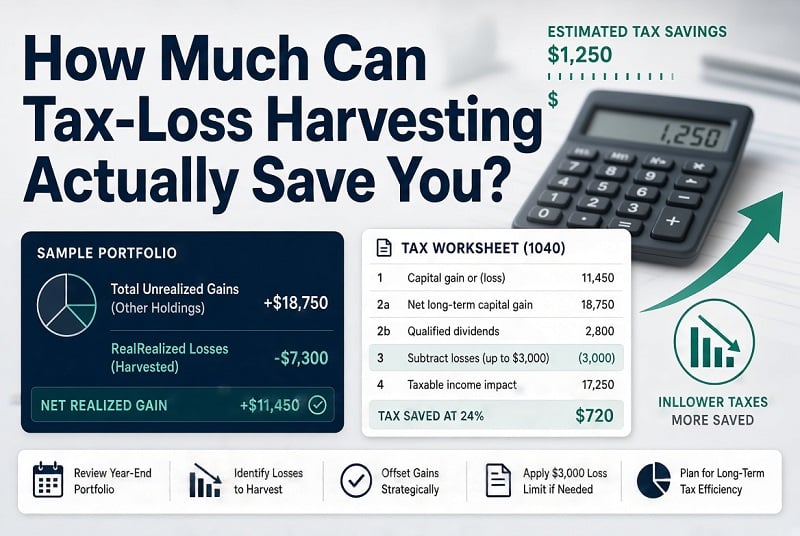
The potential tax savings from realizing a capital loss depend on the amount of eligible gain or income offset and the applicable tax treatment.
It is important to distinguish the size of the realized loss from the actual reduction in taxes.
Example: Offsetting a Capital Gain
Suppose an investor has:
-
A realized capital gain of $10,000.
-
An eligible realized capital loss of $4,000.
The simplified net gain is $6,000.
If the loss is eligible to offset the gain, the investor’s taxable capital gain may be lower than it would have been without the loss.
The actual tax savings depend on the applicable rates and the investor’s complete tax situation.
Example: A Net Capital Loss
Suppose another investor has:
-
$1,000 in capital gains.
-
$8,000 in eligible capital losses.
The investor has a simplified net capital loss of $7,000.
The investor may be able to use the losses to offset the $1,000 gain and potentially deduct up to the applicable annual amount against ordinary income. The remaining loss may generally be carried forward under the relevant rules.
The investor should not automatically assume that the full $7,000 produces a current-year deduction against ordinary income.
Why Your Tax Bracket Matters
The tax impact can differ based on the type of income being offset.
Short-term capital gains are generally taxed at ordinary income rates, while qualifying long-term capital gains may be taxed at preferential federal rates.
The value of a loss therefore depends on the investor’s tax circumstances and the specific gains being offset.
Investors should consider the tax implications of realizing gains and losses together rather than looking at each transaction in isolation.
Tax-Loss Harvesting and Year-End Investment Planning
Many investors review their portfolios toward the end of the calendar year.
They may consider whether to rebalance, realize gains, review dividend income, or prepare for the upcoming tax filing season.
Tax-loss harvesting can be part of this broader review.
Start With a Portfolio Review
A useful year-end process might include:
-
Reviewing realized gains and losses.
-
Checking unrealized gains and losses.
-
Reviewing prior-year loss carryforwards.
-
Identifying investments that no longer fit the portfolio.
-
Checking potential wash-sale exposure.
-
Considering whether any transactions are consistent with the investment plan.
-
Organizing documentation for tax reporting.
This process can help investors avoid making decisions based solely on the last few trading days of the year.
Avoid Making Decisions Based on the Calendar Alone
December 31 can be an important tax-year boundary, but the calendar should not replace investment judgment.
An investor may be tempted to sell a stock simply because it has declined and the year is ending.
But the investor should consider whether the security still fits the portfolio and whether selling it creates a risk of losing desired exposure.
If a sale is being considered, the investor should also understand the relevant reporting and transaction deadlines.
Consider the Next Tax Year
Tax planning should not end with the completion of a sale.
Investors may have capital loss carryforwards, future gains, or ongoing automatic investment activity that affects future tax decisions.
Keeping accurate records can help with planning across multiple tax years.
Frequently Asked Questions About Tax-Loss Harvesting
What is tax-loss harvesting in simple terms?
Tax-loss harvesting involves selling an investment that has declined in value to realize a capital loss. The loss may then be used to offset eligible capital gains or, subject to applicable limits, reduce ordinary income.
The strategy is generally associated with taxable investment accounts.
Can I claim a tax deduction if my stock falls but I do not sell it?
Generally, a decline in market value alone does not create a realized capital loss for tax purposes. A qualifying sale or other taxable disposition is generally needed.
Special rules can apply to different types of transactions, so investors should verify the treatment of their specific investment.
How much capital loss can I deduct in one year?
For individuals, the federal deduction for a net capital loss against ordinary income is generally limited to $3,000 per year, or $1,500 for married individuals filing separately.
Eligible losses that exceed the applicable limit may generally be carried forward to future tax years.
Can capital losses offset capital gains?
Yes. Capital losses can generally be used to offset capital gains under the applicable netting rules.
The treatment depends on the nature of the gains and losses, their holding periods, and other relevant circumstances.
What is the wash-sale rule?
The wash-sale rule generally restricts the current deduction of a loss when an investor sells or disposes of stock or securities at a loss and acquires substantially identical stock or securities within the relevant 30-day period before or after the sale.
Other covered transactions can also trigger the rule.
Can I buy a different stock after harvesting a loss?
An investor may consider purchasing another investment, but the replacement should be evaluated for both investment suitability and potential tax consequences.
A different ticker symbol does not automatically establish that the securities are not substantially identical.
Does tax-loss harvesting work in a Roth IRA?
The conventional tax-loss harvesting strategy is generally associated with taxable accounts. Investors should not assume that a loss in a Roth IRA creates the same deductible capital loss.
Acquisitions of substantially identical securities in an IRA or Roth IRA can also have special wash-sale treatment.
Should I sell a stock that has lost money just to reduce my taxes?
Not necessarily.
The decision should consider the investment’s role in the portfolio, the reasons for the decline, the potential tax consequences, and the risks of selling.
A tax benefit alone does not guarantee that selling is the right investment decision.
Can I use losses from previous years?
Eligible capital loss carryforwards may generally be used in later tax years, subject to the applicable rules.
Investors should maintain accurate records and confirm the amount available for carryforward.
Is tax-loss harvesting the same as rebalancing?
No. Tax-loss harvesting focuses on realizing eligible capital losses for tax purposes. Rebalancing focuses on adjusting a portfolio’s asset allocation toward a desired target.
The two strategies can overlap when an investor sells a losing position as part of a broader portfolio adjustment.
A Practical Tax-Loss Harvesting Example for Investors
To bring the concepts together, consider a hypothetical investor named Sarah.
Sarah holds a taxable brokerage account containing several investments. During the year, she sold a stock and realized a $6,000 gain.
She also owns a second stock that has declined from $15,000 to $10,000.
Sarah’s potential realized loss is $5,000.
She is considering whether to sell the second stock because she has become less comfortable with its risk and wants to reduce her exposure.
The Potential Tax Effect
If Sarah sells the stock and realizes a $5,000 eligible capital loss, that loss may offset $5,000 of the earlier capital gain, subject to the applicable rules.
The simplified result would be:
$6,000 realized gain − $5,000 realized loss = $1,000 net gain
This does not mean Sarah has recovered the $5,000 investment loss. She has still sold an investment for less than her adjusted basis.
The potential tax benefit is associated with the reduction in net taxable capital gain.
The Investment Decision
Sarah should consider whether selling the stock makes sense even without the tax benefit.
She may conclude that the investment no longer fits her portfolio, or that she prefers a different allocation.
If she wants to maintain exposure to the same investment, she needs to consider the wash-sale rule before making a replacement purchase.
She should also review her other accounts and automatic purchases.
The Documentation
Sarah should maintain records of the original purchase, adjusted basis, sale proceeds, and any relevant transactions that could affect the loss.
The brokerage account may provide much of the information needed, but she should verify whether other transactions could affect the tax treatment.
The Broader Lesson
Sarah’s example illustrates an important principle:
Tax-loss harvesting can be most useful when the investor is already making a thoughtful portfolio decision and the tax consequences are considered as part of that decision.
The tax benefit should not be treated as a reason to ignore the investment risks associated with selling.
A More Disciplined Way to Think About Market Swings
Investors often think of volatility as something they must endure.
A market decline can create uncertainty, especially when the investor sees a significant reduction in portfolio value.
But market volatility can also encourage a review of investment decisions.
Instead of asking only whether a stock is likely to rebound, an investor may ask:
-
Does this investment still fit my goals?
-
Is my portfolio properly diversified?
-
Do I have too much exposure to one sector?
-
Have I realized capital gains this year?
-
Are there eligible losses that I may want to evaluate?
-
Could a sale trigger the wash-sale rule?
-
What are the consequences of replacing the investment?
-
Do I need professional tax advice?
These questions help move the conversation away from short-term market emotions and toward a more structured investment process.
The Tax Benefit Should Support the Plan
An investor should avoid treating tax-loss harvesting as a prediction about where the market will go next.
The strategy does not require the investor to know whether a stock will rise or fall tomorrow.
Instead, it involves evaluating whether realizing a loss is consistent with the investor’s financial objectives and the applicable tax rules.
An investor who wants to maintain a particular market exposure may need to think carefully about replacement investments and the wash-sale period. An investor who wants to exit a position may find that realizing a loss is relevant to the overall tax picture.
There is no single approach that works for every investor.
Why a Long-Term Perspective Matters
The stock market can recover after a decline, but the timing and magnitude of any recovery are uncertain.
An investor who sells a position at a loss should consider whether the decision affects the portfolio’s ability to participate in a future recovery.
That does not mean investors should hold every losing investment indefinitely. It means that the consequences of selling should be considered alongside the potential tax benefit.
A tax strategy is more useful when it fits the investment plan rather than replacing it.
When You Should Consider Getting Professional Tax Advice
Tax-loss harvesting can be relatively straightforward in a simple taxable brokerage account, but more complicated situations may require professional guidance.
Investors should consider consulting a qualified tax professional when they have multiple accounts, substantial investment gains or losses, or uncertainty about how a transaction will be treated.
Situations That May Require Extra Care
Some examples include:
Multiple brokerage accounts. Transactions across different accounts may affect the wash-sale analysis, and the investor needs to maintain complete records.
IRA or Roth IRA purchases. Special rules apply when substantially identical securities are acquired in retirement accounts.
Large capital gains or losses. A substantial transaction may have tax consequences that extend beyond a simple capital gain or loss calculation.
Complex investment products. Options, short sales, certain funds, and other securities may be subject to specialized rules.
Unclear cost basis. Older holdings, inherited investments, corporate actions, and multiple purchase lots can complicate basis calculations.
Tax planning across multiple years. Investors with significant carryforwards or anticipated gains may need to consider how current transactions interact with future tax years.
A qualified tax professional can help determine how the rules apply to the specific facts.
Investors should not rely on a general article as a substitute for individualized tax advice.
The Bigger Picture: Market Swings, Taxes, and Long-Term Wealth Building
Tax-loss harvesting is one tool within a broader investment management process.
It can be useful because taxes affect the amount of investment returns an investor ultimately keeps. But the strategy should be evaluated alongside diversification, risk management, investment costs, and long-term financial goals.
The fact that a stock has declined does not automatically make it a good candidate for a tax-loss harvesting transaction. Similarly, the fact that a tax benefit is available does not mean an investor should sell an investment that continues to serve an important purpose in the portfolio.
The strategy becomes more meaningful when investors understand the relationship between investment decisions and tax consequences.
Market Losses Are Not Necessarily the End of the Story
A realized capital loss may be disappointing, but the investor can use the transaction as an opportunity to review the portfolio.
Perhaps the original investment thesis has changed. Perhaps the position has become too large. Perhaps the investor needs to adjust risk exposure.
In these circumstances, tax-loss harvesting may be a useful consideration alongside the investment decision.
The investor should still recognize that the tax benefit is conditional. It depends on applicable rules and the investor’s tax situation.
Taxes Should Be Considered, Not Feared
Investors sometimes delay making portfolio changes because they are concerned about taxes. Other investors may sell investments solely to generate tax deductions.
Both approaches can create problems when tax considerations overwhelm investment judgment.
A more balanced approach is to understand the tax consequences before making a decision, then evaluate whether the transaction is consistent with the investor’s broader goals.
That is the role tax-loss harvesting can play.
Conclusion: Can Market Swings Help You Save on Taxes?
Market volatility can create opportunities for investors to review their portfolios and evaluate whether realizing capital losses makes sense.
Through tax-loss harvesting, an investor may be able to use eligible realized losses to offset capital gains and potentially reduce taxable income within the applicable limits. Unused capital losses may generally be carried forward to future tax years.
But the strategy is not a guaranteed way to make money from a declining stock.
Investors need to consider the wash-sale rule, the possibility of missing a market recovery, the suitability of replacement investments, and the broader consequences of selling a position.
The most important principle is to treat tax-loss harvesting as part of an investment plan rather than as an isolated tax trick.
Before selling a losing investment, ask whether the position still fits your goals, review your realized gains and losses, and consider the tax consequences of the transaction. When the situation is complicated, professional tax guidance can help.
A market decline may create a tax-planning opportunity, but the right decision depends on the investor’s circumstances, not simply on the size of the loss.
Tax-Loss Harvesting: Question & Answers
Can market losses help reduce taxes?
Yes. Eligible realized capital losses may offset capital gains. If capital losses exceed capital gains, individuals may generally deduct up to the applicable annual limit against ordinary income, with eligible unused losses generally carried forward.
How does tax-loss harvesting work?
An investor sells an investment at a loss to realize a capital loss. The loss may be used to offset eligible capital gains, subject to tax rules such as the wash-sale rule and applicable deduction limits.
What is the $3,000 capital loss rule?
For many individual taxpayers, the federal deduction for net capital losses against ordinary income is generally limited to $3,000 per year, or $1,500 for married individuals filing separately. Eligible excess losses may generally be carried forward.
What is the wash-sale rule in tax-loss harvesting?
The wash-sale rule generally restricts the current deduction of a loss when an investor sells stock or securities at a loss and acquires substantially identical stock or securities within the relevant 30-day period before or after the sale. Other covered transactions can also trigger the rule.
Is tax-loss harvesting worth it?
The usefulness of tax-loss harvesting depends on the investor’s tax situation, portfolio objectives, realized gains, investment risks, and applicable rules. It should be evaluated as part of a broader investment strategy.
Should you sell a losing stock before the end of the year?
Not automatically. Investors should evaluate whether selling fits their investment plan, consider the tax consequences, and review potential wash-sale exposure. The timing of a transaction should be based on the relevant facts rather than a general assumption that year-end selling is always beneficial.
Sources and Further Reading
The following official resources can help readers verify the core federal tax concepts discussed in this article.
Overview of capital gains, capital losses, holding periods, deduction limits, and carryforwards.
IRS Publication 550: Investment Income and Expenses
Detailed information about investment income, capital gains and losses, and wash-sale rules.
IRS Instructions for Schedule D (Form 1040)
Instructions for reporting capital gains and losses and relevant wash-sale adjustments.
Investor education resource explaining the basic wash-sale concept.