A portfolio yielding four percent does not pay you four percent. What reaches your account depends on costs most investors never add up.
Income investors tend to be careful people. They compare dividend yields to the second decimal place, check payout ratios and worry about whether a distribution is covered by earnings. Yet many of the same investors could not say, to the nearest tenth of a percent, what their account costs them each year. That gap matters more for income portfolios than for almost any other strategy, because the cost comes straight out of the thing you are investing for.
Yield is a gross number
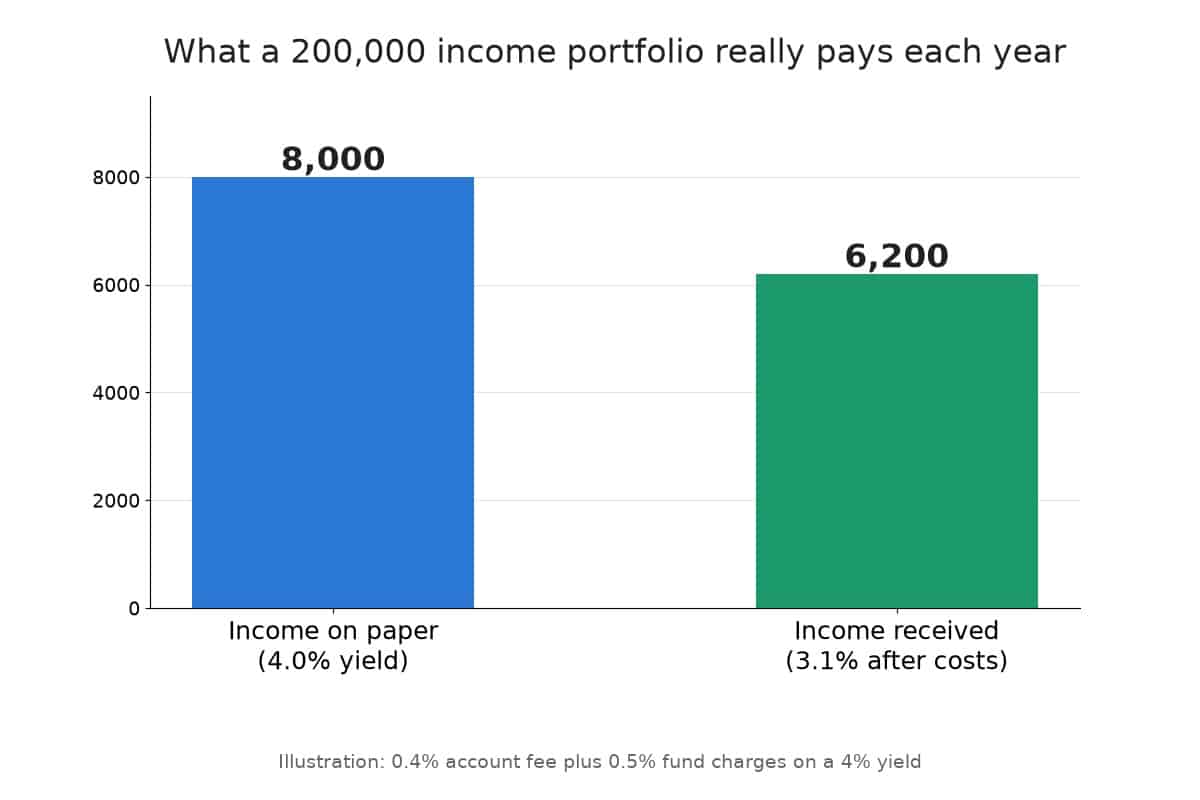
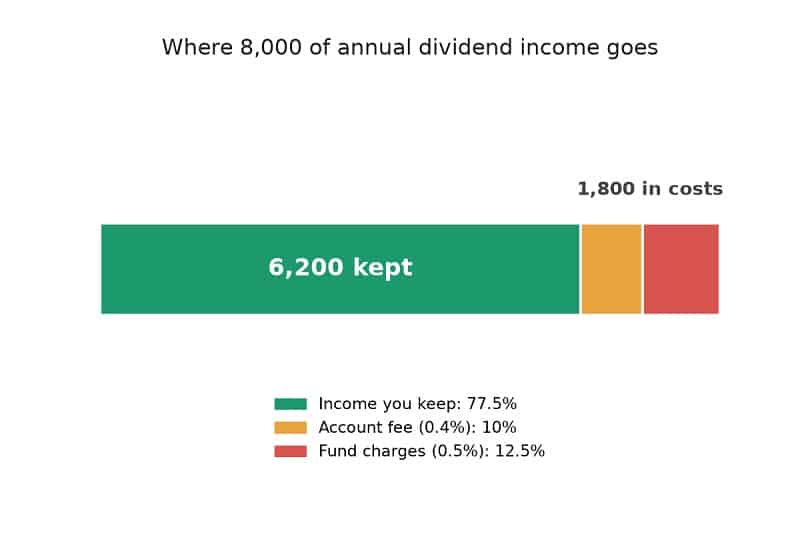
Take a portfolio of 200,000 producing a 4 percent yield. On paper that is 8,000 a year. Now subtract an account fee of 0.4 percent and average fund charges of 0.5 percent. Together those remove 1,800 a year, which is 22.5 percent of the income. The portfolio still yields 4 percent on the fact sheet. In the investor’s bank account it yields 3.1 percent.
For a growth investor, a 0.9 percent drag is painful but partly hidden inside a rising balance. For someone living on the income, it is a visible pay cut every single year.
The four places costs hide
Account or custody fees are the most obvious. Some providers charge a percentage of assets, others a flat fee. Percentage fees are cheap on small balances and expensive on large ones, so the right structure depends on the size of the portfolio.
Fund charges are the second. An income fund charging close to 1 percent has to out-yield a low-cost index fund by that margin just to break even, and it has to do so every year.
Currency conversion is the third, and the one international investors underestimate. When dividends arrive in a foreign currency, many platforms convert them automatically and take a margin each time. On a stream of quarterly dividends, that margin is charged four times a year, forever.
Dealing costs are the fourth. Income investors who reinvest dividends in small amounts can pay a disproportionate commission on each purchase unless the platform offers free or low-cost automatic reinvestment.
Why platform choice is a yield decision
Seen this way, choosing where to hold an income portfolio is not an administrative detail. It is a yield decision. Two investors holding identical assets can receive noticeably different income purely because of where the account sits. Comparing the best trading platforms on total annual cost for your own balance and trading pattern, rather than on headline commission, is one of the few ways to raise net income without taking any extra risk.
Income investing is not trading, and the costs differ
It also helps to be clear about which game you are playing. Active traders care about spreads, execution speed and financing, which is why reviews of day trading platforms focus on those numbers. A buy-and-hold income investor should weight the opposite things: custody fees, dividend handling, currency conversion and reinvestment costs. A platform that is excellent for one can be poor value for the other.
A simple annual check
Once a year, add up everything the account actually charged: platform fees, fund charges, conversion margins and commissions. Divide by the average balance. That is your true cost, and subtracting it from your portfolio yield gives your net yield, the only figure that pays the bills.
If the number surprises you, it is worth comparing alternatives. Independent research publishers such as The Investors Centre, which tests platforms with funded accounts and records what is actually charged, can make that comparison quicker than reading fee schedules line by line.
The bottom line
Nobody controls what dividends companies pay or where interest rates go. Costs are the one part of an income portfolio that is entirely in the investor’s hands. Trimming half a percent from them is the equivalent of finding a higher-yielding portfolio with no additional risk, and it keeps paying every year.
This article is for general information only and is not investment advice. The value of investments and the income from them can fall as well as rise.