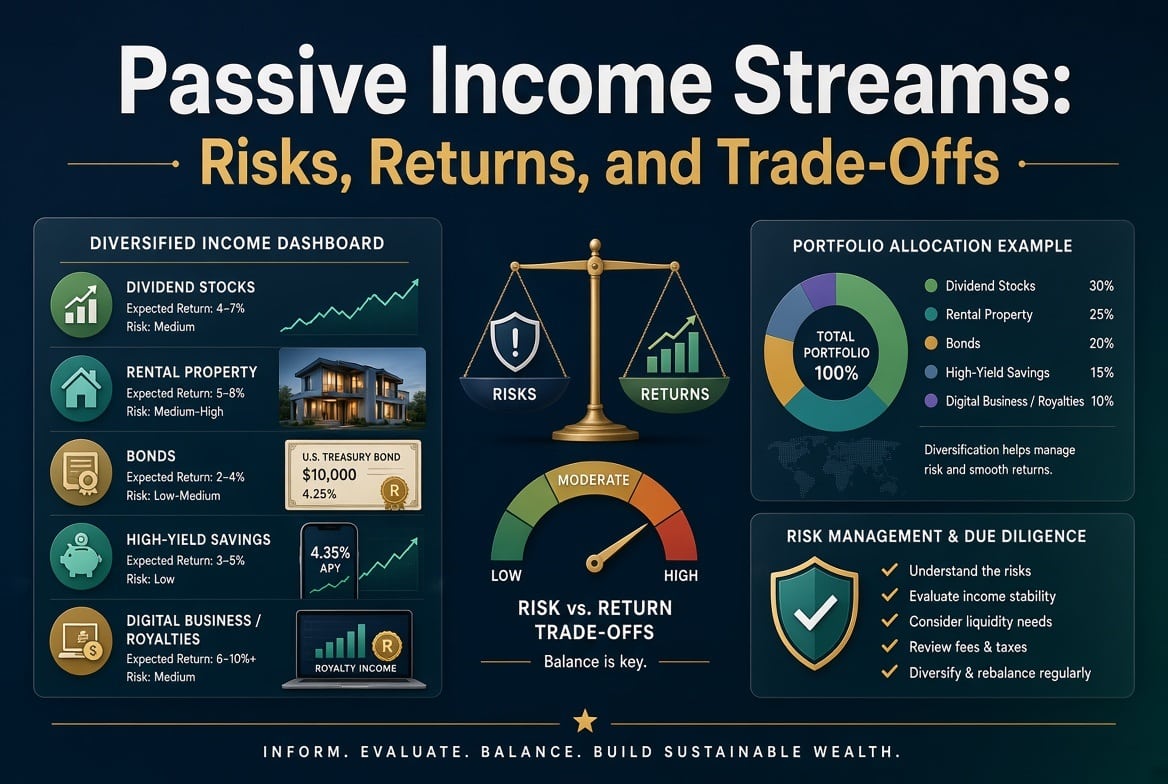
Passive income streams can help investors build cash flow beyond a salary or trading gains, but “passive” rarely means effortless. Passive income can come from dividend shares and bond funds to rental property, covered calls, or digital assets, but every option asks you to trade something: capital, time, liquidity, tax efficiency, or risk. Common income ideas include dividend income from dividend stocks and dividend-paying stocks, rental income from real estate rentals, digital products, asset sharing, or a business; each can generate passive or recurring income, but each still requires work, management, savings, or an upfront investment.
The useful question is not which income stream pays the highest yield. It is whether the return is durable, understandable, and appropriate for your portfolio. For an investor, a sound passive income strategy weighs financial goals, estate planning, securities selection, mutual funds, options, and other investments against the practical demands of renting and ongoing management. Here is how to compare the main choices, spot the compromises behind attractive payouts, and decide where hands-off income genuinely fits.
Key takeaways
- Passive income usually requires upfront capital, expertise, ongoing oversight, or acceptance of meaningful uncertainty.
- Compare opportunities by capital required, time commitment, liquidity, risk, and reliability of after-cost cash flow.
- High yield is not total return; distributions can accompany falling asset values or unsustainable payouts.
- Diversifying across income sources reduces reliance on one employer, market, property, customer, or investment.
- Rental property and asset sharing are operating businesses requiring reserves for vacancies, repairs, taxes, and management.
- Prioritize accessible cash reserves and investments you can understand and hold through changing conditions.
Passive Income Streams Are a Spectrum, Not a Shortcut
“Passive income” is one of the most useful, and most abused, phrases in personal finance. It suggests money arriving without a clock to punch, a boss to answer to, or another task on tomorrow’s list. That outcome is possible, but at Steady Income, we think it is more honest to view passive income streams as a spectrum. For anyone exploring passive income, the key is to understand how much attention each source still needs. At one end are assets that can produce recurring income with very little ongoing attention: a diversified portfolio of dividend-paying shares, bond interest, or a professionally managed property fund. At the other are businesses, rental homes, digital products, and royalties that may become less demanding over time but still require judgment, maintenance, and occasional problem-solving.
The distinction matters because every income stream asks for something upfront. It may require capital, specialized knowledge, patient planning, a willingness to take risk, or a meaningful amount of work before the returns become reliable. A rental property can provide monthly cash flow, for example, but vacancies, repairs, financing costs, and tenant decisions do not disappear because the rent is deposited automatically. Likewise, an online course or small business can earn after the initial launch, yet its value may depend on updates, customer service, marketing, and competition.
That does not make these pursuits less worthwhile. It simply replaces the shortcut story with a better question: what kind of effort, capital, and uncertainty are you prepared to exchange for recurring income? A sound passive income approach starts with clear expectations about the time and oversight each source will require. The strongest passive income strategy is usually not to chase a single supposedly effortless source of passive income. It is to build income streams that suit your resources and temperament, then gradually reduce dependence on any one employer, market, property, or customer. Real financial resilience is rarely completely hands-off. It is built deliberately, monitored calmly, and designed to keep working when your time is needed elsewhere.

How to Compare Passive Income Streams Before You Commit
A sound income strategy starts with comparison, not enthusiasm. Before investing capital, weigh what each investment asks of you: upfront cash, ongoing involvement, access to funds, and the reliability of its return. The most suitable financial strategies are rarely the flashiest. They are the ones that fit your goals, risk tolerance, and ability to keep cash available when life changes. At Steady Income, I encourage investors to assess the trade-offs before committing.
A Practical Scorecard for Capital, Time, Liquidity, and Risk
Use a simple scorecard to compare options side by side. First, note the capital required: can you begin with existing savings, or will the opportunity tie up money you may need elsewhere? A dividend portfolio, for example, can be built gradually, while property or private investments may require a larger initial commitment.
Next, be honest about time and management. “Passive” income is often less passive at the beginning. Rental assets can provide regular income, but they may involve tenant issues, repairs, bookkeeping, and local compliance. Funds, bonds, and professionally managed investments generally demand less day-to-day attention, though they still deserve periodic review.
Then rate liquidity. Ask how quickly you could turn the asset into cash without taking a meaningful loss. Publicly traded investments are usually easier to sell than real estate, private lending arrangements, or a small business stake. Liquidity matters because it protects your flexibility; it can keep you from selling long-term assets at the wrong moment.
Finally, assess risk in practical terms: the chance of lost principal, uneven income, rising costs, or a return that fails to keep pace with inflation. I prefer comparing a range of options rather than relying on one promising yield. The strongest plan balances dependable income with accessible reserves and assets you understand well enough to hold through changing markets.
Practical comparison checklist
- List the upfront capital required and whether using savings would limit other important financial needs.
- Estimate ongoing management time, including setup, maintenance, records, repairs, and compliance responsibilities.
- Rate liquidity: how quickly can you access cash without accepting a significant loss?
- Assess principal-loss risk, income variability, unexpected costs, and whether returns may lag inflation.
- Compare several options side by side rather than choosing solely on the highest advertised yield.
- Keep accessible reserves so you are less likely to sell long-term assets during unfavorable market conditions.
- Favor investments you understand well enough to hold confidently through changing markets and income fluctuations.
Common Income Ideas at a Glance
When people ask me where dependable income comes from, I start with a practical distinction: some income ideas ask you to put capital to work, while others ask you to build, own, or operate something. The first group includes interest-bearing accounts, bonds, dividend-paying securities, and professionally managed funds. These can offer a relatively hands-off way to pursue regular cash flow, though the trade-off is that yields, prices, fees, and tax treatment all matter.
The second group includes a business, real estate, and other assets that may produce income through rent, sales, licensing, or services. These routes can offer more control and potentially stronger returns, but they also demand more attention, judgment, and tolerance for uneven results. In my experience, the most durable plans rarely rely on one source alone. A retiree may pair bond interest with dividends and rental income; an entrepreneur may use business profits to build a portfolio of funds and securities outside the company.
The right mix depends on how much capital you have, how quickly you need cash flow, your ability to handle risk, and whether you want to spend time managing the asset. It also helps to separate income streams that are truly recurring from those that only look that way during favorable market conditions. A high distribution rate, for example, is not automatically a stable return, and a property with attractive rent still carries vacancies, repairs, insurance, and local market risk. The useful question is not simply, “What pays income?” It is, “What can reasonably keep paying after costs, taxes, and changing conditions?” The categories below provide a clear starting point for comparing the common options on that basis.
Common Income Ideas: What to Compare Before You Rely on Them
| Income category | How income is generated | Typical management involvement | Key costs and risks to evaluate |
|---|---|---|---|
| Interest-bearing accounts | Interest on deposited capital | Relatively hands-off | Yield, tax treatment, and changing conditions |
| Bonds | Bond interest | Relatively hands-off | Yields, prices, fees, tax treatment, and risk tolerance |
| Dividend-paying securities | Dividend payments | Relatively hands-off | Prices, distribution rates, tax treatment, and market conditions |
| Professionally managed funds | Fund distributions and income from underlying holdings | Relatively hands-off | Fees, yields, tax treatment, and changing market conditions |
| Business ownership | Sales, services, and business profits | More attention and judgment required | Uneven results, operating demands, costs, and risk tolerance |
| Real estate | Rental income | More attention and judgment required | Vacancies, repairs, insurance, local market risk, costs, and taxes |
| Other income-producing assets | Rent, sales, licensing, or services | May require active ownership or operation | Costs, taxes, changing conditions, and uneven results |
Portfolio Income: Dividend-Paying Stocks, Bonds, Funds, and REITs
A durable income portfolio rarely relies on one source alone. Dividend-paying stocks can provide growing dividend income, while bonds may add contractual interest and REITs can offer exposure to income-producing property. Mutual funds and other funds make it easier to hold a broad mix of securities. For an investor, the work is matching each holding’s role to cash-flow needs, time horizon, and tolerance for changing markets.
Yield Is Not the Same as Total Return
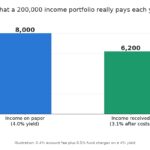
Yield is the income an investment distributes relative to its price: a bond’s interest, a stock’s dividend, or a fund’s stated payout. It is useful for estimating near-term cash, but it is not a complete measure of what an investor earns. Total return includes that income plus or minus changes in the value of the investment.
That distinction matters most when a high yield is treated as a shortcut for quality. A stock can show an attractive dividend yield because its share price has fallen sharply. A bond fund may distribute substantial income while its net asset value declines as rates rise. In either case, spending the distribution does not erase the loss of capital. Conversely, lower-yielding investments may deliver stronger long-term return if their earnings, dividends, or underlying values compound over time.
- Income received: distributions paid to the investor.
- Change in value: gains or losses in the investment’s price.
- Total return: the combined result of both.
As I evaluate an income portfolio, I look beyond the headline yield. Is the payout supported by earnings or cash flow? Does the issuer carry manageable debt? How much interest-rate, credit, market, or sector risk is being accepted for that income? And will the investments still suit the plan if distributions are reduced?
The practical goal is not to chase the highest yield available. It is to build a mix that can produce usable cash while preserving enough capital and growth potential to support future spending.
Income Portfolio Review Checklist
- Compare yield with total return, including income, price changes, and fund net asset value.
- Check whether dividends or distributions are supported by earnings, cash flow, or portfolio income.
- Assess debt levels, refinancing needs, and the issuer’s ability to maintain payments during weaker conditions.
- Identify interest-rate, credit, market, sector, and concentration risks behind each source of income.
- Consider whether a high yield reflects a falling share price or declining underlying asset value.
- Model the plan if distributions fall, ensuring spending needs do not depend on unchanged payouts.
- Balance current cash needs with capital preservation and growth potential for future spending.
Real Estate Income: Rental Property, REITs, and Private Deals
Real estate can add durable income to a portfolio, but the route matters. A rental property can produce direct rental income and potential appreciation, while REITs offer exposure without the daily demands of rentals. Private deals may provide access to specialized opportunities, though they often require more capital and due diligence. The right estate strategy reflects how much liquidity, control, and hands-on involvement you want from your investment.
Renting and Asset Sharing Require Active Management
Direct renting is often presented as a straightforward path to income: buy an asset, find a tenant, collect the monthly payment. In practice, a rental home is an operating business. Owners must set competitive rates, screen applicants, maintain the property, respond to repairs, carry appropriate insurance, and budget for vacancy. Even a well-kept unit in a desirable local market can have uneven cash flow when turnover, taxes, or a major replacement arrives.
Asset sharing follows a similar pattern. A spare room, second home, vehicle, parking space, or storage area can create income, but each arrangement introduces management work. Listings need current photos and clear rules; guests or users need communication; cleaning, scheduling, wear, and local regulations need attention. Short-term rentals can command higher nightly rates than a traditional lease, yet their revenue may fluctuate with seasonality and platform demand.
The useful question is not simply whether an asset can earn money, but whether its expected return compensates you for the work and risk. Some owners enjoy improving a property and running the business closely. Others may prefer a property manager, a long-term tenant, or a more passive real estate vehicle. Build repair reserves, account for your time, and treat projected income as a range rather than a guaranteed monthly result.

Business Assets, Digital Products, and Licensing Revenue
For owners willing to build beyond a single service, digital products and licensing can turn hard-won expertise into durable business assets. A well-documented process, specialist template, training resource, or proprietary tool may continue to earn money after the original work is complete. The appeal is clear: these assets can generate passive income, but only when the underlying offer, audience, and distribution model are managed with the same care as any operating business.
Distribution Risk Can Matter More Than Product Quality
A strong product does not automatically create reliable income. In practice, distribution is often the more consequential risk: who introduces the offer to buyers, how visible it remains, what platform controls access, and whether a single channel can change its rules overnight. A useful course, software tool, or licensed resource can sit unnoticed if its creator has no dependable route to the right audience.
That is why sensible asset management begins with the path to market, not only the product itself. Review where leads come from, what each channel costs, who owns the customer relationship, and how quickly sales would be affected by a platform suspension, algorithm change, distributor dispute, or lost referral partner. Income streams built entirely on one marketplace or social platform may look efficient until the channel stops performing.
Practical strategies include building an email list, maintaining direct customer records, developing referral relationships across several partners, and testing more than one sales route before relying on projected revenue. Licensing agreements deserve equal attention: define permitted use, renewal terms, reporting obligations, audit rights, and what happens when a licensee is acquired or fails to pay. Product quality earns trust; resilient distribution protects the income it is meant to produce.

What Investors and Traders Should Treat Differently
An investor and a trader may own the same security, yet they are making two fundamentally different decisions. Trading is centred on price movement, timing and the discipline to act when a position no longer supports the original thesis. Investment is centred on ownership: what a business, property or fund can earn over time, how reliably it can protect capital, and whether its cash flows justify staying invested through ordinary market turbulence.
That distinction matters most when headlines turn noisy. A trader may reasonably respond to momentum, technical levels or a short-term catalyst. An investor should be slower to react, asking whether the underlying source of returns has changed. A dividend reduction, weakening balance sheet or deteriorating competitive position deserves attention; a single volatile session often does not. Confusing these approaches can lead people to sell durable assets at precisely the point patience is required, or to hold a speculative position long after its premise has failed.
For readers of Steady Income, the practical question is whether an asset belongs in a passive income strategy. That means looking beyond yield alone. Sustainable distributions depend on resilient earnings, sensible debt, management discipline and a valuation that leaves room for disappointment. High income can be attractive, but not if it comes at the expense of permanent capital loss.
- Keep a clear reason for every holding.
- Set the conditions that would change your mind.
- Review those conditions periodically rather than emotionally.
In my view, a well-built passive portfolio should make daily trading largely unnecessary. Trading can have a place for those with the time, process and tolerance for it. But for most long-term investors, compounding income and preserving capital are better goals than trying to capture every move in the market.
Investor and trader checklist
- Define each holding’s role: long-term income ownership or a time-limited trading position.
- For investments, assess earnings resilience, debt, competitive strength, and distribution sustainability, not yield alone.
- For trades, establish entry, target, stop-loss, and the specific catalyst supporting the position.
- Review business fundamentals periodically; avoid reacting to routine daily price volatility or noisy headlines.
- Act when the original thesis changes, such as weaker cash flows, dividend cuts, or balance-sheet deterioration.
- Prefer valuations with a margin for disappointment to reduce the risk of permanent capital loss.
- Keep written reasons for ownership and predefined conditions that would justify selling or reassessing.
Match Income Ideas to Your Capital and Available Time
The best income ideas are not necessarily the most fashionable; they are the ones that suit your capital, savings buffer, existing assets, and weekly capacity for work. A landlord with a paid-off flat faces a different decision from a professional with £5,000 in cash and limited evenings. Start with the resources you can genuinely commit, then choose an income route whose demands, costs, and likely rewards remain manageable.
Start Small, Diversify Deliberately, and Scale Only After Review
When beginning, treat every new income stream as a measured trial rather than a declaration of confidence. Allocate an amount you could leave untouched through a disappointing year, particularly when investing in markets or buying equipment for a small venture. Keep enough cash aside for household surprises, tax bills, and the ordinary costs that arrive regardless of how an idea performs.
Diversification should be purposeful. Holding several near-identical investments is not much protection if they all respond to the same economic pressure. A more resilient mix may combine accessible savings, broadly spread funds, and, where appropriate, income from skills or property. The right balance depends on your time horizon and whether you need regular payments now or can prioritise longer-term return.
Review each commitment after a defined period; six or 12 months is usually more useful than reacting to a single slow month. Compare the actual return with the hours spent, fees paid, tax due, and risk accepted. If an approach is producing dependable results without straining your finances or schedule, scale gradually. If it is not, reduce exposure, preserve what you have learned, and redirect capital rather than doubling down. Steady Income is built more often through disciplined adjustments than dramatic moves.
Due Diligence, Ongoing Work, Taxes, and Red Flags
As I tell clients, a property’s purchase price is only the opening number. Reliable real estate income comes from understanding the full operating picture before you commit capital, and from staying engaged after closing. Review leases, recent rent collections, utility bills, insurance costs, property-tax assessments, maintenance records, and any pending municipal requirements. For a multifamily building, ask to see tenant ledgers and service contracts; for a single-family rental, confirm the condition of the major systems rather than relying on a fresh coat of paint. A professional inspection is important, but it does not replace careful financial due diligence.
Good management is equally central to the investment. Someone must screen tenants, respond to repairs, document payments, renew leases, and make practical decisions when a vacancy or unexpected expense arises. If you hire a manager, read the agreement closely: know the monthly fee, leasing fee, maintenance markup, approval thresholds, and how often you will receive reporting. Passive ownership is possible, but it is never entirely hands-off.
Taxes deserve attention before an offer is written, not just at filing time. Rental income is generally taxable, though eligible expenses, depreciation, mortgage interest, and repairs may affect the result. The distinction between a repair and a capital improvement can matter, as can the timing of a sale and any potential capital gains. Work with a qualified tax professional who understands real estate in your state and your broader income picture.
Finally, be alert to red flags: numbers that depend on unusually high rents, unexplained vacancies, deferred maintenance, inconsistent lease records, pressure to waive contingencies, or promises of guaranteed returns. Real estate is not a substitute for diversified securities or a plan to pay every near-term expense. The right property should withstand conservative assumptions, leave room for repairs, and fit the level of risk you can comfortably carry.
Property due diligence checklist
- Review leases, rent collections, tenant ledgers, utility bills, insurance premiums, tax assessments, maintenance records, and municipal notices.
- Inspect major systems, not cosmetic updates; obtain professional inspections while independently verifying the property’s financial performance.
- Stress-test projected income using conservative rents, realistic vacancy assumptions, repair reserves, and likely operating-cost increases.
- Understand management duties or contract terms, including monthly fees, leasing charges, maintenance markups, approval limits, and reporting frequency.
- Consult a real-estate tax professional before offering; evaluate taxable income, depreciation, interest, repairs, improvements, and future sale timing.
- Question unexplained vacancies, inconsistent lease records, deferred maintenance, inflated rents, waived contingencies, and guaranteed-return promises.
- Confirm the investment leaves cash for repairs and fits your risk tolerance without replacing diversified investments or near-term cash needs.
Frequently asked questions
What counts as passive income?
Passive income is recurring cash flow that does not require trading your time for every payment. Few sources are fully hands-off: investments need review, rentals need maintenance, and digital businesses may need updates. The key is understanding the capital, effort, and risk required.
What are common passive income streams?
Common options include interest-bearing accounts, bonds, dividend-paying stocks, income funds, REITs, rental property, private investments, royalties, and digital products. Each differs in required capital, liquidity, ongoing management, costs, and reliability of income.
Is dividend income safer than rental income?
Neither is automatically safer. Dividend income can fall when companies reduce payouts, and share prices can decline. Rental income can be interrupted by vacancies, repairs, tenant issues, taxes, and insurance costs. Diversifying across assets can reduce reliance on either source.
Why is a high investment yield not always a good sign?
A high yield may reflect higher risk or a falling asset price rather than a durable payout. Review the source of distributions, underlying cash flow, debt levels, fees, credit quality, and total return, not just the headline income rate.
What is the difference between yield and total return?
Yield measures income paid relative to an investment’s price. Total return includes that income plus or minus changes in value. An investment can pay substantial income while losing principal, so both measures matter when evaluating long-term income.
Are REITs more passive than owning a rental property?
Generally, yes. REITs provide real estate exposure without directly handling tenants, repairs, leasing, or property operations. However, their market value and distributions can fluctuate. Direct ownership offers more control but requires more management and often has lower liquidity.
How should I compare passive income investments?
Compare upfront capital, time required, liquidity, expected income, total-return potential, costs, taxes, and downside risk. Also consider whether you can keep emergency cash available instead of tying up funds in an asset that may be difficult to sell.
Can passive income replace a full-time salary?
It can over time, but it usually requires substantial capital, a profitable asset, or years of reinvesting. Build a plan around realistic after-tax income, reserves, changing market conditions, and multiple income sources rather than assuming one stream will remain constant.