
Finding the best electric vehicle stock picks right now means looking past the volatility headlines. Actually paying attention to which businesses have something real underneath them. Easier said than done this year. 2026 has turned into one of the more confusing stretches this sector has seen in a while, and if you’ve been watching the news you probably already know why.
Short version: pure EV sales growth in the U.S. has cooled off. BEV market share is projected to slip to around 6% this year, down from roughly 7.4% in 2025 — not a huge drop on paper, but it’s the direction that matters. Ford quietly scrapped its all-electric F-150 project. Put that money into hybrids instead. GM pushed its electric truck production back to mid-2026 and is bringing plug-in hybrids back to North America, something it had walked away from a few years back. And Toyota, which never fully bought into the BEV-only future everyone else chased, cut its 2026 global battery-electric production target by roughly a third. Its stock has looked pretty smart for it, honestly. Meanwhile the stuff underneath all of this — chips, raw materials, charging networks — keeps growing no matter which brand ends up winning.
That’s really the whole point of this guide. Most “top ev stocks” roundups just line up Tesla, Rivian, and Lucid against each other and call it a day. Fine, if you want a pure growth bet. But that’s also a bet on which car company survives a brutal, capital-intensive shakeout, and a few names competitors love featuring have already lost most of their value doing exactly that. So this one splits differently: growth plays for people who want in on the story, steady dividend names for people who’d rather get EV stocks to buy without staking everything on one manufacturer’s fortunes.
New to investing generally? Our guide on how to start investing your first $1,000 covers the basics before jumping into something this volatile.
Top Best EV Stocks Comparison Matrix (2026 Overview)
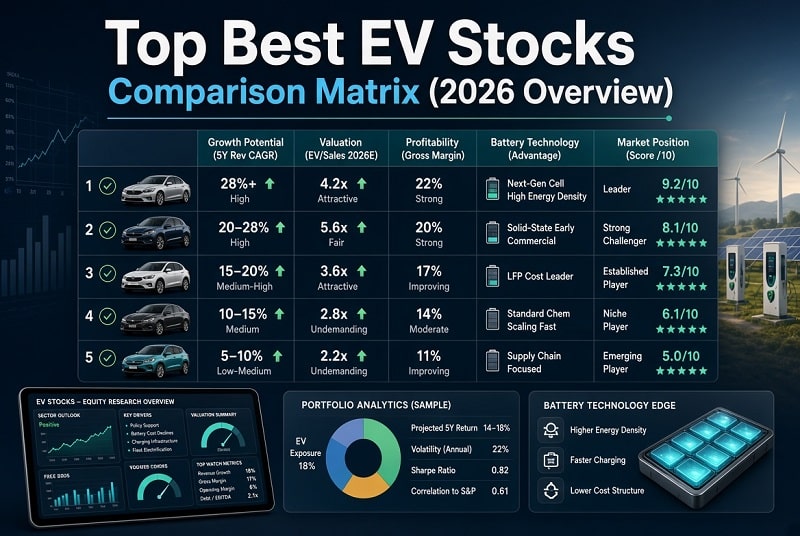
Before the weeds — here’s how the main names stack up. Notice the split: pure-play manufacturers, legacy automakers, infrastructure, and the chip layer underneath everything else.
| Stock / Ticker | Category | Approx. Market Cap Tier | Dividend Yield | Core Advantage |
| Tesla, Inc. (TSLA) | Pure-Play EV | Mega-cap | None | Brand dominance, energy storage, autonomy bet |
| BYD Company (OTC: BYDDY) | Pure-Play EV | Large-cap | Modest, variable | Vertical integration, global volume leader |
| Rivian Automotive (RIVN) | Pure-Play EV | Small/mid-cap | None | Commercial fleet electrification (Amazon vans) |
| General Motors (GM) | Legacy / Hybrid | Large-cap | Moderate | Ultium platform + reinstated hybrid lineup |
| Ford Motor Company (F) | Legacy / Hybrid | Large-cap | Moderate-high | Hybrid volume leader among Detroit automakers |
| ON Semiconductor (ON) | Battery/Chip Supplier | Mid-cap | None | Silicon carbide chips powering next-gen EV platforms |
| BHP Group (BHP) | Raw Materials Supplier | Mega-cap | High | Nickel supply for EV batteries |
| ChargePoint / EVgo / Blink | Charging Infrastructure | Small-cap | None | Direct exposure to charging demand growth |
| LIT / DRIV (ETFs) | Diversified | ETF | Varies | Broad basket exposure, lower single-stock risk |
Dividend numbers move with earnings and capital decisions. Treat this as directional. Check current figures yourself before you place anything.
The “Pick-and-Shovel” EV Strategy: Why Infrastructure Outperforms Pure-Plays
During the California Gold Rush, the people who reliably made money weren’t the miners betting on finding gold. They sold picks, shovels, and blue jeans to everyone else doing the gambling. Same logic here, more or less. Whether the winning EV brand five years out is Tesla, BYD, some Chinese manufacturer nobody’s heard of yet, or some mix of all three — they’re all going to need the same basic stuff. Semiconductors. Battery-grade metals. A way to actually charge the things.
1. ON Semiconductor (NASDAQ: ON) – Powering the Next-Gen EV Chips
One of the more interesting EV battery stocks angles, and it doesn’t even involve a battery maker. ON Semiconductor makes silicon carbide (SiC) chips, which handle high voltage and high heat far better than older silicon components do — exactly what’s needed as automakers shift to 900-volt EV architectures for faster charging and longer range. By ON’s own account, its silicon carbide tech showed up in roughly 55% of new EV models on display at the 2026 Beijing Auto Show. The company’s also expanded partnerships with NIO and Geely specifically around this shift, and there’s a smaller, faster-growing side business supplying chips for AI data centers — a second growth lever that has nothing to do with EV demand at all.
The risk is cyclicality. Chip demand swings hard with automotive and industrial spending, and ON’s stock has felt that before. Sometimes painfully. But as a way to bet on EV adoption broadly without betting on which specific brand wins, it’s about as close to the “shovel” as this sector gets.
2. BHP Group / Nickel Miners – Essential Battery Raw Materials
Every EV battery needs raw materials, and BHP made a deliberate call here worth understanding. Rather than chase lithium — where it expects thinner long-term margins as new supply floods in — BHP has focused its battery-materials strategy on nickel, expanding nickel sulphide operations specifically to meet EV battery demand. Nickel cuts down the need for cobalt in battery chemistry and helps stretch vehicle range. So as automakers push for longer ranges, the metal gets more strategically important, not less. For anyone chasing best EV battery stocks exposure without betting on one specific battery brand, a diversified miner supplying the raw inputs is a genuinely different kind of bet than owning a battery company outright.
For EV charging stocks, similar logic, riskier execution. The pure-play charging names — ChargePoint, EVgo, Blink Charging — are smaller, less profitable companies still working toward positive cash flow. The long-term demand story is solid. These stocks are volatile in the meantime, and that’s putting it gently.
Best Electric Vehicle Stocks for Pure Growth
If infrastructure is the conservative bet, this is the aggressive one. Betting directly on which manufacturer wins market share.
Tesla, Inc. (NASDAQ: TSLA) – Autonomous Driving & Energy Storage Ecosystem
Tesla’s still the name most people think of first, and honestly it isn’t purely a car company anymore anyway. Its energy storage business (Powerwall, Megapack) and its autonomous driving ambitions give it more than one lever to grow, even if overall EV sales growth keeps cooling off. That said — Tesla trades at a valuation that already prices in a lot of future success. Which means the stock tends to swing hard around anything that even hints the growth story might be slowing down.
BYD Company (OTC: BYDDY) – The Global Volume & Vertical Integration Giant
BYD makes its own batteries, its own chips where it can, and controls more of its supply chain than almost any other automaker on the planet. That’s let it undercut competitors on price while holding onto margins most rivals can’t match. It’s also the global volume leader, particularly across China and expanding export markets. The catch for U.S. investors: BYD trades over-the-counter rather than on a major U.S. exchange, and carries the same Chinese electric car stock exposure to trade tensions and tariff policy that any China-based manufacturer does right now — which, given the current climate, is not nothing.
Rivian Automotive (NASDAQ: RIVN) – Commercial Fleet Electrification
Rivian’s consumer vehicles get most of the headlines. Its commercial van partnership with Amazon is arguably the more interesting long-term story here, though — fleet electrification tends to be a steadier, more predictable demand driver than consumer purchase cycles ever are. Rivian’s still burning cash. It remains one of the more speculative names on this list. Better suited as a smaller position inside something diversified than as anyone’s core holding.
Best Legacy Automakers for Steady Income & Dividends
This is the section most competitor listicles skip entirely, and honestly? It’s the more interesting story in 2026 anyway. With pure EV demand growing slower than expected, the “boring” legacy automakers leaning into hybrids have looked like the smarter operators lately. Funny how that works out sometimes.
General Motors (NYSE: GM) – Dividend Reliability & Ultium Platform Expansion
GM suspended its dividend in 2020, reinstated it in August 2022, and has kept paying since — all while expanding its Ultium battery platform for EVs. At the same time, CEO Mary Barra has confirmed GM is still developing plug-in hybrids for North America, targeting a 2027 rollout, even while she keeps insisting pure electric vehicles remain the company’s long-term “end game.” Hybrid flexibility now, EV commitment later. That combination is exactly the kind of balanced positioning good car stocks investors tend to reward when a sector’s this uncertain.
Ford Motor Company (NYSE: F) – High Yield Commercial Transit Strategy
Ford’s EV division has been genuinely unprofitable, and the company hasn’t tried to hide it — losing billions, openly. In response, Ford redirected serious capital toward its hybrid lineup, aiming to grow hybrid sales significantly rather than force BEV adoption before the market’s actually ready for it. Ford also suspended and later restored its dividend around the same COVID-era timeline as GM, and has stated a policy of returning a meaningful share of free cash flow to shareholders. Looking for electric vehicle shares with an income angle rather than pure growth? Ford leaning into profitable hybrids over money-losing BEV volume is a big part of the bull case right now.
If dividend income from cyclical, capital-heavy businesses like automakers makes you nervous — fair enough — it’s worth stacking these up against other low-risk, high-return investment options to see how auto dividends actually fit into a broader income strategy.
High-Risk, High-Reward: Are Low-Priced & Penny EV Stocks Worth It?
Plenty of best EV penny stocks lists out there promise the “next Tesla” for a few dollars a share. Almost none of them are being straight with you about the risk. Small EV manufacturers and charging startups sitting at penny-stock valuations are usually there because the market has genuine doubts about their path to profitability. Not because they’re undiscovered gems nobody’s noticed yet. That’s rarely how it works.
Before touching anything in this category, check a few basics. Cash runway — how many quarters of losses can the company absorb before it needs to raise money again. Share dilution history — has it been issuing new shares repeatedly, quietly eating into what existing shareholders actually own. And whether there’s a real production and delivery track record, versus just prototypes and glossy investor decks. A huge share of failed EV startups over the past several years followed the exact same pattern: big promises, minimal deliveries, repeated capital raises that diluted early shareholders into practically nothing. Our breakdown of five metrics to check before investing in any stock is a decent starting checklist before putting real money anywhere near this corner of the market.
How to Build a Low-Volatility EV Stock Portfolio
Want exposure here without betting your whole portfolio on one manufacturer’s survival? A simple allocation framework helps.
Something like 60% in infrastructure and legacy dividend plays. Names like ON Semiconductor, BHP, GM, and Ford give you exposure to the EV transition’s underlying demand without the volatility that comes with a single pure-play automaker. Maybe 30% in pure growth names — Tesla, BYD, whatever — sized specifically because these carry more valuation and execution risk than the infrastructure side does. And the last 10% in thematic ETFs or more speculative names. Funds like LIT (lithium and battery supply chain) or DRIV (broader autonomous and EV theme) spread that risk across dozens of holdings instead of stacking it all onto one or two stocks.
From there — watch delivery numbers and gross margins each quarter. Not headlines. A manufacturer shipping fewer vehicles at worse margins is a very different story than one growing revenue profitably, even when both show up in the same news cycle, on the same day, sometimes in the same article. If this allocation’s part of a broader retirement or income plan rather than a standalone bet, it’s worth reading how it fits alongside other retirement-focused investment options and passive income strategies more generally.
Conclusion
Choosing the best electric vehicle stock for your portfolio in 2026 comes down to balancing growth potential against reliable cash flow. Not picking whichever car brand had the flashiest product announcement this quarter. The pure-play manufacturers offer real upside if you pick correctly, but 2026’s slower-than-expected EV adoption curve has shown exactly how much execution risk sits underneath that upside. The infrastructure layer — chips, raw materials, charging networks — along with legacy automakers now leaning hard into profitable hybrids, offers a steadier way to stay invested in the broader electrification trend without needing to guess which single brand comes out on top.
Whichever mix you land on: keep checking the actual fundamentals quarter over quarter instead of reacting to headlines. And bookmark steadyincomeinvestments.com for ongoing stock analysis and financial planning insights as this sector keeps shifting under everyone’s feet.
Frequently Asked Questions
What is the best electric vehicle stock to buy for long-term growth?
Tesla and BYD are the two names most commonly pointed to here. Largely because of their vertically integrated supply chains — both companies control more of their own battery, software, and manufacturing stack than most competitors, which gives them more say over costs and margins as the sector matures.
Which EV stocks pay dividend income?
Legacy automakers navigating the electrification shift — Ford and General Motors especially — are the more reliable dividend payers in this space. Both suspended dividends during the pandemic, both brought them back, and both are now leaning on profitable hybrid and traditional vehicle sales to keep funding shareholder returns while their EV divisions work toward profitability.
Are EV battery stocks better investments than EV car manufacturers?
Depends on your risk tolerance, honestly. Battery and battery-material suppliers like ON Semiconductor or nickel miners like BHP benefit from EV adoption broadly, no matter which car brand ends up winning. That risk diversification is the whole appeal of the pick-and-shovel approach. Direct car manufacturers offer more upside if you pick the right winner. They also carry the risk of a wrong pick losing serious value — which a few pure-play EV startups have already demonstrated, painfully, over the past few years.
What are the top EV charging station stocks to watch?
ChargePoint, EVgo, and Blink Charging are the three most-watched pure-play charging names. All three are still working toward consistent profitability. The long-term demand story for charging infrastructure looks solid as EV adoption grows, but these carry meaningfully more volatility than a diversified charging-and-infrastructure ETF would.