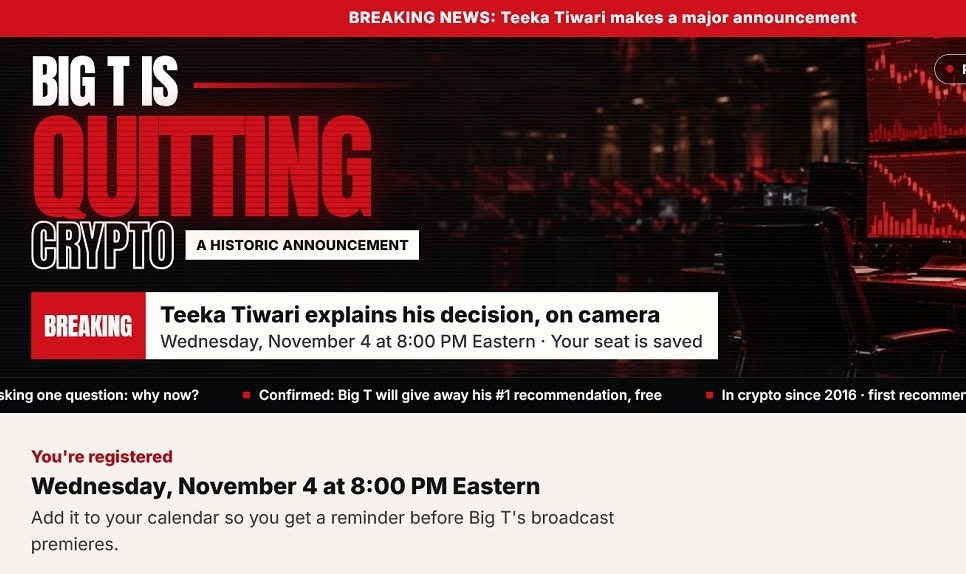
Teeka Tiwari, known to readers as Big T, is making the biggest public decision of his crypto career on Wednesday, November 4, 2026. At 8:00 p.m. Eastern Time he will go on camera and explain why he is walking away from an important sector of the crypto market he has covered and traded for years. The broadcast is called Big T’s Big Announcement.
The decision lands after more than a decade of continuous involvement in the market. Tiwari first recommended Bitcoin near $430 and Ethereum near $9 in 2016. He stayed active through the 2018 crypto winter, the China mining restrictions of 2021, the FTX collapse, and the recovery that followed. Bitcoin later reached highs around $126,000, a peak gain of more than 29,000 percent from the $430 level. Its market value has grown to roughly $1.55 trillion.
Readers who followed those early calls now face a different message. Tiwari is leaving one niche of the market. He has not named the exact sector in advance. The full explanation, including what the change means for investors over the next 60 days, is reserved for the live broadcast.
Recommended:
 Move Your Money Out of SpaceX (And Into This Stock)
Elon Musk has gone “all in” on Texas, home of SpaceX. But Texas just froze ALL new AI data center buildouts. The reason? Data center demand in Texas has soared from 48 gigawatts to 474 gigawatts… since 2023, according to Reuters.
But according to 60-year Wall Street legend Marc Chaikin, one company has the solution. Its “micro cluster” technology will consume an estimated 99% less electricity and water. And it’ll come online as soon as the end of the year. When it does, it’ll make current data centers obsolete when it comes to major AI breakthroughs – including Elon’s Grok.
Go here for the company name and ticker.
Why the Timing Matters
Bitcoin entered November 2026 in a state of extreme volatility compression. On October 19 the Bollinger Bands around its recent trading range stood only about 6.5 percent apart, roughly half their recent median width and one of the tightest readings in two and a half years.
When Bitcoin’s range tightens this severely, larger moves often follow. The last two comparable squeezes produced moves of roughly 30 percent or more—one lower, one higher. The pattern signals that a bigger move is likely. It does not indicate direction.
At the same time, the calendar pointed to a historically more volatile stretch. Tiwari’s research team examined Bitcoin’s behavior after the three prior midterm elections with usable data: 2014, 2018, and 2022. In the 30 days after those elections, daily volatility averaged 4.24 percent. After presidential elections the average was 2.55 percent. Volatility ran about two-thirds higher in the post-midterm windows.
Several factors limit the strength of the comparison. Each of those earlier periods also coincided with points in Bitcoin’s longer market cycle and with crypto-specific events—the Bitstamp hack, the Bitcoin Cash split, and the FTX unraveling. Bitcoin is a more mature asset today, with substantial ownership through exchange-traded funds and deeper institutional participation. Still, the combination of extreme compression and a historical window of elevated swings is the setup Tiwari cites as reinforcing his decision.
Additional short-term data points support the same focus. Across 55 Federal Reserve decisions since 2020, Bitcoin’s average absolute move on decision days was 2.8 percent, compared with 2.1 percent on ordinary days. The first hour after the announcement often produced moves roughly twice a typical hour. In many cases the spike faded and the market returned to its prior compressed range.
A major exchange incident in the same period showed a similar pattern. Bitcoin absorbed the shock more cleanly than it had during earlier exchange crises. The reaction itself carried more information than the headline.
A Shift in Method
For years Tiwari’s first question after major news—Fed decisions, exchange problems, elections—was what the event should mean for Bitcoin. He studied the catalyst, weighed likely consequences, and tried to anticipate the move.
Earlier in 2026 he added a new member to the research team. The colleague approaches these moments differently. He spends less time predicting what a headline will do and more time watching how buyers and sellers actually behave once the news is known. He looks for evidence of real strength, signs that a move is losing momentum, and situations where the risk is simply not worth taking.
Tiwari spent months observing the process—studying setups, managing risk, and making decisions while the market moved quickly. The results forced a hard question: if someone on the team can execute this reaction-focused approach more effectively and place readers in a stronger position, why continue the previous method out of habit?
The answer produced the decision now being announced. Tiwari is not leaving because volatility intimidates him. He has lived through 80 percent drawdowns, exchange failures, and sharp selloffs. He is leaving this sector because he believes a better method exists for serving readers inside it—one that surfaces opportunity earlier and supports more consistent capture of large moves when volatility expands.
Recommended:
 Elon Musk’s Insane Projection: 7,692,207%
Where should you invest $100 right now?
Elon Musk just invented and patented this new AI technology…
And he’s predicting it will launch a NEW industry that will grow more than 7 million percent in the coming years. Even if he’s only 10% right, that would still be enough to grow $100 into more than $700,000.
Click here to see the details on what Elon Musk called “an infinite money glitch.”
Election Night and the Reaction Lesson
By the time of the broadcast, the midterm results were known. Democrats gained control of both the House and Senate. As the returns came in Tuesday night, Bitcoin fell from roughly $78,000 to below $76,000. The initial reaction suggested the election had triggered another leg lower. Buyers then returned. By early Wednesday the price had climbed above $80,000. The S&P 500 recovered from overnight weakness and posted gains of as much as 1.64 percent in morning trading.
Investors who sold solely because the first move looked negative watched the market reverse. The episode illustrates a recurring pattern: it is possible to be correct about the news and still wrong about the trade. Knowing the political outcome in advance would not have revealed the optimal timing for buying, selling, or standing aside, nor whether the initial reaction would prove lasting.
Three distinct events in a short window—the Fed decision, the exchange incident, and the election—each carried the potential to move large amounts of capital through the crypto market. Each also demonstrated the value of watching the actual behavior of price and participants rather than relying solely on the headline.
Institutional Backdrop
BlackRock’s activity provides additional context. The firm filed paperwork for a proposed iShares Bitcoin Managed Protection ETF that would use options and fixed-income instruments to pursue some of Bitcoin’s upside while seeking to moderate part of the downside. BlackRock already operates the iShares Bitcoin Trust, which had accumulated more than $66 billion in net assets by mid-October 2026. The new product targets investors who want Bitcoin exposure but remain uncomfortable with full volatility.
The filing arrives while volatility is compressed and institutional infrastructure continues to expand. When Wall Street builds products that make an asset easier to hold and the asset itself is coiling tightly, the probability of a meaningful subsequent move rises. Smaller crypto assets often amplify those moves in either direction.
What the Broadcast Will Cover
Big T’s Big Announcement session is structured around five questions that have remained open in the lead-up:
- Why now, after ten years and some of the largest calls in the market?
- Exactly what sector is Tiwari leaving?
- What does the change mean for readers and for portfolios over the next 60 days?
- What is the November Bitcoin Effect, and why does he believe it is already underway?
- Why is he still handing out a free number-one recommendation if he is walking away from part of the market?
Attendees will also receive a downloadable announcement guide for notes and will have the chance to submit questions for a live Q&A. Tiwari has stated he will stay on after the main presentation to answer them.
Recommended:
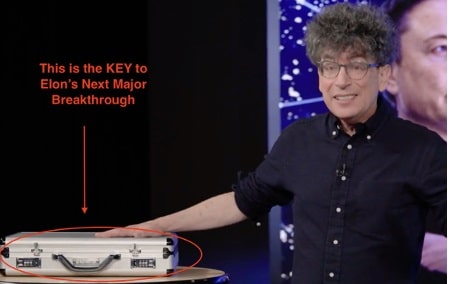 Altucher: Inside This Case is Elon’s Next Major Wealth Boom
James Altucher – the man who predicted the rise of SpaceX years in advance – has just released a shocking new prediction about Elon Musk.
Inside, he explains why he thinks Elon’s latest project will be even BIGGER than SpaceX – and create up to 1.8 million new millionaires over the coming years.
The pieces behind all of it, he says, are sitting inside this case.
Click here now for all the details.
Practical Position for Investors
The decision does not declare the broader crypto market finished. It applies to one sector Tiwari has covered for years. The new framework emphasizes observation of real-time market response over prediction of headline impact. It prioritizes risk management inside short volatility windows and seeks to identify strength or exhaustion earlier than the crowd.
Preparation is the consistent theme. Large discretionary moves in crypto are best delayed until the full explanation and recommended steps are clear. Historical patterns based on limited cycles can fail. Institutional products do not eliminate volatility. Any approach that seeks to capitalize on short windows of elevated movement carries execution and timing risk. Individual circumstances, risk tolerance, and time horizon remain the final filters for any action.
Tiwari’s track record includes early recommendations on Bitcoin and Ethereum, 27 picks that later rose 1,000 percent or more, and continuous coverage through multiple market cycles. The current decision is presented as an application of the same principle that guided those earlier calls: follow the evidence even when it requires changing long-standing practice.
The broadcast begins at 8:00 p.m. Eastern on November 4. Once the announcement is public, the industry reaction will follow. Readers who want the explanation from the source rather than through second-hand accounts have the opportunity to hear it directly. The market will continue to move between periods of compression and expansion. The framework introduced that night is intended to improve recognition of the next meaningful expansion when it arrives.