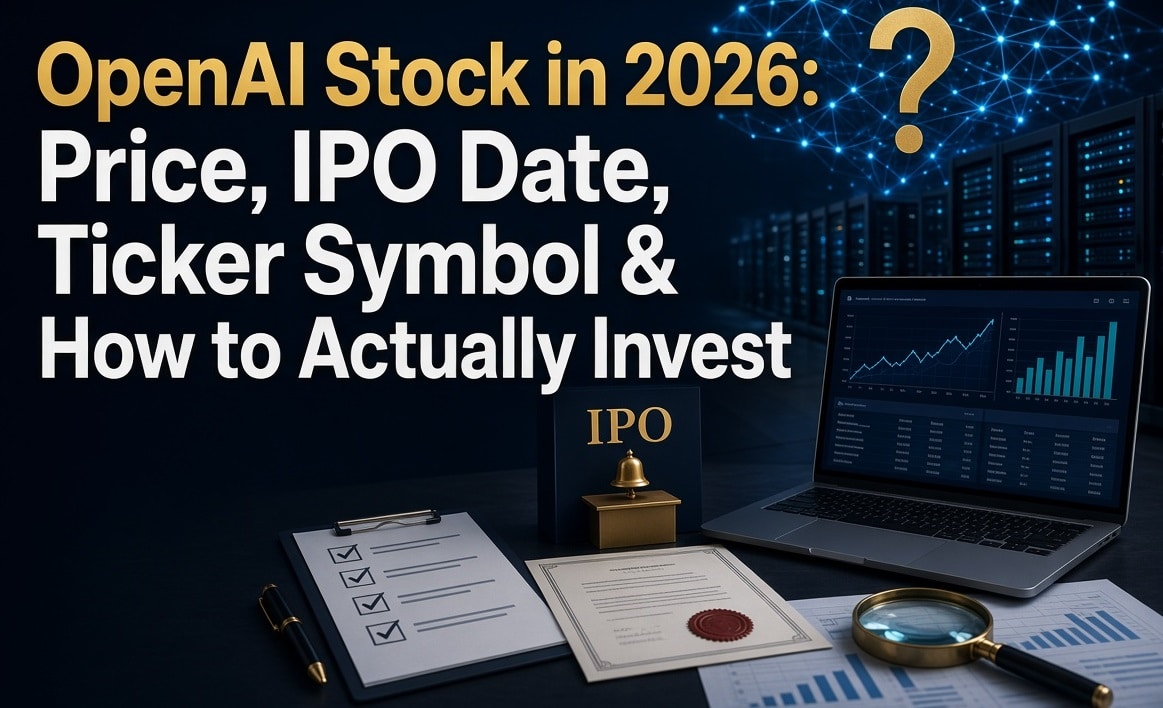
If you open your brokerage account today and type in “OpenAI stock,” you are going to come up empty-handed. There is no ticker, no live chart, and no “buy” button. Why? Because the company behind ChatGPT is still private.
But don’t let that fool you into thinking there is no value attached to it. Behind the scenes, the hype is translating into massive numbers. In private secondary markets, the demand for OpenAI shares has pushed the price to a staggering “$954.70” as of October 2026.
Most retail investors feel locked out of this growth, but that isn’t entirely true. In this guide, I’m going to break down the actual valuation of the company, the realistic IPO timeline, and the “backdoor” ways you can get exposure to OpenAI right now. If you are new to the market, it might be worth brushing up on how to invest in stocks for beginners before chasing these high-valuation targets.
Why OpenAI Isn’t Public Yet (The PBC Shift)
OpenAI’s corporate structure is confusing, even for seasoned investors. It started as a non-profit, moved to a “capped-profit” model, and as of late 2025, transitioned into a “Public Benefit Corporation (PBC)”.
This move was calculated. It allows the company to raise billions of dollars from Wall Street while still keeping its core mission—Artificial General Intelligence (AGI)—as the priority. Currently, Microsoft and Thrive Capital hold the biggest slices of the pie. This is a classic example of what we discuss in our growth stock investing strategies, where a company prioritizes long-term ecosystem dominance over short-term quarterly profits.
OpenAI Stock Price Today: What the Private Markets Say
Since there is no official ticker symbol for OpenAI stock, we have to look at secondary markets like Forge Global and EquityZen. These platforms allow employees and early investors to sell their shares to “Accredited Investors.”
“Current Forge Price”: ~$954.70 per share.
“Implied Valuation”: Following the massive funding round in March 2026, OpenAI’s valuation is sitting at roughly “$852 Billion”.
To put that in perspective, that puts OpenAI within striking distance of the world’s most valuable tech giants. However, remember that private market prices are volatile and don’t always reflect what the price will be on the day of an actual IPO.
The OpenAI IPO Timeline (2026 vs. 2027)
The billion-dollar question: When can the average person buy in?
In June 2026, OpenAI reportedly filed a confidential S-1 with the SEC. This is the first official step toward going public. However, CEO Sam Altman has been very vocal about not rushing the process. Most analysts and internal leaks suggest an “OpenAI IPO in mid-to-late 2027”.
Why wait? Because OpenAI just raised $122 billion in the largest private funding round in history. When a company has that much cash in the bank, they don’t need the headache of public market regulations just yet.
How to Buy OpenAI Stock (Indirect Methods)

If you don’t want to wait until 2027, you have three legitimate ways to play this:
1. The Microsoft Proxy (MSFT)
Microsoft owns roughly **27% of OpenAI**. Every time ChatGPT gains a new enterprise customer, Microsoft wins. I’ve detailed exactly how this partnership works in my Microsoft (MSFT) stock analysis. It is currently the safest and most direct public way to own a piece of the OpenAI pie.
2. The AI Infrastructure Play
OpenAI cannot survive without massive computing power. This means companies like Nvidia and AMD are essentially “arms dealers” for the AI war. You can find my list of the best AI stocks to buy that are riding the coattails of OpenAI’s growth.
3. Pre-IPO Platforms
If you meet the “Accredited Investor” criteria (typically a high net worth or high annual income), you can use platforms like Forge Global to buy OpenAI shares directly from former employees. For everyone else, this door remains closed until the IPO.
Is the Hype Justified? Risks to Consider
Before you go all-in on the AI dream, let’s look at the cold hard facts. OpenAI is burning cash at an incredible rate.
Computing Costs:
Training models like GPT-6 costs billions in electricity and hardware.
Regulatory Heat:
Governments are constantly breathing down the neck of AI companies regarding copyright and safety.
Google’s Shadow:
Google Gemini is a massive threat that shouldn’t be ignored.
This is why I always recommend balancing high-risk tech plays with best dividend stocks for passive income. It protects your portfolio if the “AI bubble” ever takes a breather.
Conclusion
The bottom line is that OpenAI stock is the most anticipated listing of the decade, but it’s still a “waiting game” for retail traders. We are looking at a likely 2027 debut with a valuation that could top $1 Trillion.
Until then, your best bet is to stay positioned through Microsoft or broad AI ETFs. I will keep this page updated the second a ticker symbol or firm date is announced. Don’t let FOMO drive your decisions—stick to the data.
FAQs
What is the stock symbol for OpenAI?
There is no official symbol yet. While people search for “OPENAI” or “CHATGPT,” the company is still private. On private tracking platforms, it is sometimes listed under the placeholder “OPAI.PVT”.
Can I buy $1,000 worth of OpenAI stock right now?
No. Because it is private, you generally cannot buy small amounts through apps like Robinhood. You would need to buy Microsoft (MSFT) stock to get indirect exposure.
What is OpenAI’s current net worth?
Based on the latest private funding round in early 2026, the company is valued at approximately “$852 billion”, making it one of the most valuable private entities in the world.
Does Elon Musk still own part of OpenAI?
No. Elon Musk left the board in 2018 and has since started a competing company, xAI. He does not hold a direct stake in the current for-profit structure of OpenAI.
Is there a ChatGPT stock?
No. ChatGPT is a product, not a company. To own ChatGPT, you would need to own shares of its parent company, OpenAI.