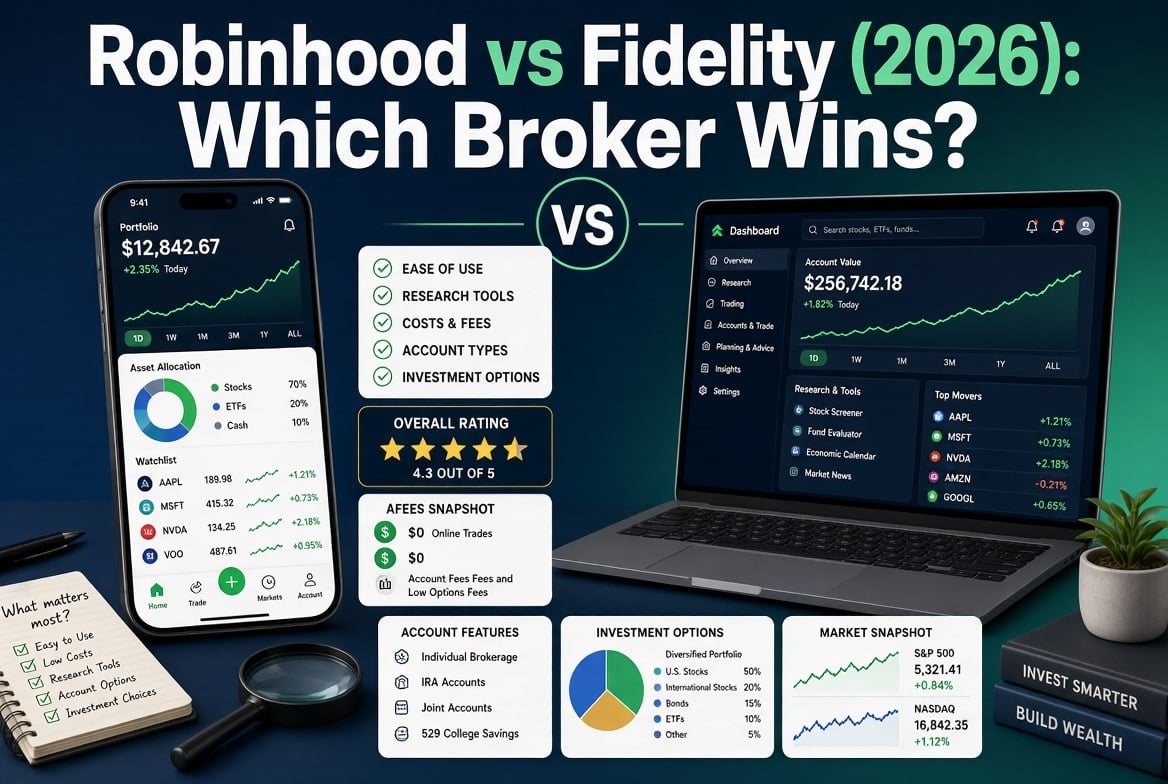
If you’re weighing Robinhood vs Fidelity for where to actually put your money, here’s the short version: pick Robinhood if you’re an active trader chasing the cheapest options pricing, and pick Fidelity if you’re building long-term wealth and want mutual funds, bonds, and a full retirement lineup under one roof. The rest of this guide walks through exactly why, with the real numbers behind each claim.
| Feature | Robinhood | Fidelity |
| Stock/ETF commissions | $0 | $0 |
| Options fee (per contract) | $0 (regulatory pass-through pennies apply) | $0.65 |
| Uninvested cash yield | Up to 3.35% APY (Gold) | Variable, via SPAXX/FZFXX sweep |
| IRA contribution match | 1% free, 3% with Gold | None |
| Crypto selection | 15-20+ coins, self-custody wallet option | Bitcoin & Ethereum only, custodial |
| Account transfer-out fee | $100 | $0 |
If you’re comparing more than just these two, our breakdown of Robinhood vs Schwab covers how a third major player stacks up on fees, tools, and account features.
Who Is Each Platform Best For?
Choosing between Robinhood vs Fidelity for beginners really comes down to what kind of investor you already are, not what either app promises in its marketing.
Why Choose Robinhood?
Robinhood built its whole reputation on stripping fees down to nothing, and options trading is where that shows up most. Zero-dollar options contracts, a 3% IRA match if you’re on Gold, cash sweep rates that beat most savings accounts, and a mobile app that genuinely doesn’t feel like homework to open. Add 24-hour trading five days a week and the newer Robinhood Legend desktop platform, and you’ve got a setup aimed squarely at people who trade often and don’t want to pay for the privilege.
Why Choose Fidelity?
Fidelity plays a different game entirely — it wants to be the one place you never have to leave. Roth IRA, Traditional IRA, SEP IRA, SIMPLE IRA, HSA, 529 plan, even a full banking arm. Its zero expense ratio index funds like FNILX let you build a diversified portfolio without fund fees eating your returns year after year, and outgoing transfers cost nothing if you ever decide to leave. If you’re brand new to investing altogether, our guide to the best brokerage for beginners compares Fidelity against other beginner-friendly platforms in more detail.
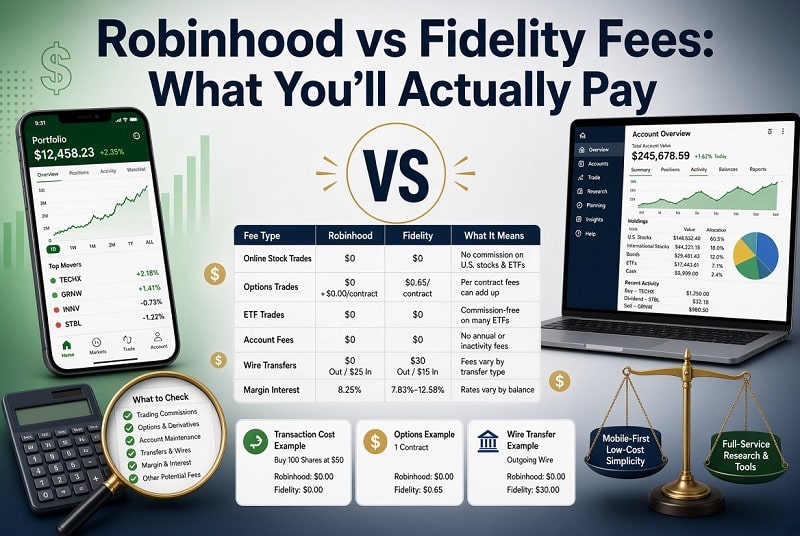
Robinhood vs Fidelity Fees: What You’ll Actually Pay
Trading Commissions & Options Fees Compared
Both brokers ditched stock and ETF commissions years ago, so that part’s a wash. The real gap shows up the moment you trade options. This is the classic Fidelity $0.65 options contract fee vs Robinhood $0 fee comparison — Fidelity charges $0.65 per contract, standard industry pricing that’s barely budged in years. Robinhood charges nothing per contract, just a few cents in regulatory pass-through fees every broker is legally required to collect. If you’re trading options regularly, this difference adds up fast: someone running 20 contracts a month pays roughly $156 a year at Fidelity for something that costs next to nothing at Robinhood.
Mutual funds flip the script. Robinhood doesn’t offer them at all, while Fidelity’s own funds trade with zero transaction fees (some third-party funds do carry a fee, so check before you buy).
Margin Rates & Premium Subscription Tiers
If you ever borrow against your portfolio, the rate gap here is enormous. Fidelity charges north of 12% on balances under $25,000. Robinhood Gold members pay closer to 5.75-6%, roughly half. That’s part of what makes the $5/month Gold subscription worth considering even if you never touch the IRA match — it also unlocks Level II market data and research access that free accounts don’t get.
Hidden & Administrative Fees You Won’t Notice Until You Leave
This is the one nobody mentions until it’s too late: Robinhood charges a $100 ACATS transfer-out fee to fully move your account elsewhere. Fidelity charges nothing. It’s a small detail that matters a lot if you ever want the freedom to switch brokers without a penalty attached to your exit.
Fidelity Price Improvement vs Robinhood PFOF Order Routing
This is the part most comparison articles skip entirely, and it’s genuinely worth understanding before you decide where your orders actually go.
How Robinhood Handles Order Routing
Robinhood makes money on most trades through payment for order flow (PFOF) — it routes your order to market makers who pay for the privilege of filling it. This is legal and standard practice at plenty of brokers, and it’s part of how Robinhood keeps commissions at zero. The tradeoff is execution price: PFOF-routed orders can occasionally fill at a slightly worse price than what’s technically available elsewhere, even if the difference is often just fractions of a cent per share.
Fidelity’s Internal Price Improvement Engine
Fidelity doesn’t accept PFOF on equity trades. Instead, it runs its own internal routing system built to capture price improvement — filling your order at a better price than the quoted one whenever the market allows it. Over thousands of shares and years of trading, this can genuinely save active investors real money, even without a visible line-item fee attached to it. This Fidelity price improvement vs Robinhood PFOF order routing distinction rarely gets mentioned in fee tables, but it affects your actual returns just as much as the commissions do.
Robinhood Gold vs Fidelity Cash Management: Where Your Idle Money Earns More
Robinhood Cash Sweep and Gold APY
Robinhood Gold members currently earn up to 3.35% APY on uninvested cash, swept into FDIC-insured partner banks. That’s a genuinely competitive rate for money just sitting there between trades, and it’s one of the more underrated reasons people upgrade to Gold in the first place.
Fidelity Auto-Sweep Money Market Funds
Fidelity handles this differently — uninvested cash sweeps automatically into a money market fund like SPAXX or FZFXX, with no subscription required to access it. The yield floats with market rates rather than being a fixed advertised number, so Fidelity SPAXX auto sweep vs Robinhood cash sweep APY can edge one way or the other depending on where interest rates sit at any given moment. Neither approach is objectively better; it depends whether you want a locked-in headline APY or a rate that tracks the broader money market automatically.
Robinhood vs Fidelity IRA Match: Retirement Accounts Compared
Robinhood’s 3% IRA Match, and the Rules Behind It
Here’s Robinhood’s single biggest selling point for retirement savers. Free accounts get a 1% match on IRA contributions with no cap. Gold members get 3% — on a full $7,000-7,500 annual contribution, that’s up to $225 in free money a year, against a $50 annual Gold subscription. Run the math and you come out roughly $165-175 ahead purely from the match, before counting the margin discount or cash sweep rate.
The catch worth knowing: understanding the Robinhood 3 percent ira match rules matters before you commit. This isn’t a no-strings bonus — Robinhood requires you to keep the matched funds and stay subscribed to Gold for a set holding period, commonly around one year for the match itself, with longer asset-hold requirements tied to keeping the full match amount. Pull the money out early, and Robinhood can claw the match back.
Fidelity’s Full Retirement Suite and Zero-Expense Funds
Fidelity doesn’t match a single dollar of your IRA contributions. What it offers instead is breadth: SEP IRA and SIMPLE IRA for the self-employed (Robinhood offers neither), a 529 education account, an HSA, and its now-famous ZERO fund lineup — FZROX for total market exposure, FNILX tracking a large-cap index, FZILX for international — all at a 0.00% expense ratio. Over a few decades, permanently eliminating fund fees on a large balance can rival what Robinhood’s match delivers, just through a completely different mechanism.
Robinhood Legend vs Fidelity Active Trader Pro
Charting, Indicators, and Execution Speed
Robinhood Legend, the newer desktop platform, ships with 90+ technical indicators and a genuinely modern interface — a big step up from Robinhood’s old mobile-only reputation. Fidelity Active Trader Pro has been the incumbent here for years: deeper charting tools, more customizable layouts, and tighter integration with Fidelity’s research desk. The Robinhood Legend vs Fidelity Active Trader Pro comparison really boils down to this: Legend feels built for someone who wants power without complexity; ATP feels built for someone who wants every dial available, even if it takes longer to learn.
Market Hours & Order Types
Robinhood offers 24-hour trading five days a week, letting you react to news the moment it breaks rather than waiting for the opening bell. Fidelity offers extended-hours trading too, but on a narrower window around the standard session rather than around-the-clock access.
Robinhood vs Fidelity for Crypto: Custody, Coins, and Insurance
Fidelity Crypto Custodial vs Robinhood Non-Custodial Web3 Wallet
Robinhood offers direct crypto trading across roughly 15-20 coins, plus an optional self-custody Robinhood Wallet if you’d rather hold your own private keys instead of leaving assets with the platform. Fidelity Crypto sticks to Bitcoin and Ethereum only, held in a fully custodial model — Fidelity controls the keys, full stop. The fidelity crypto custodial vs robinhood non custodial web3 wallet difference is the single biggest factor for anyone who cares about direct control over their coins; Robinhood’s non-custodial option is the only one of the two that actually offers it.
Insurance & Protection: SIPC and Fidelity Excess SIPC Insurance Limit
Standard SIPC coverage protects up to $500,000 in securities and cash (with a $250,000 sub-limit on cash) at both brokers if the firm itself fails — though crucially, this never extends to crypto holdings at either platform. Robinhood backs this up with a private policy covering securities and cash up to $1 billion in aggregate, with a per-customer cap that includes $1.9 million in uninvested cash. Fidelity carries its own excess SIPC insurance limit through Lloyd’s of London syndicates, pushing per-customer protection well past standard SIPC limits for larger accounts. Neither covers market losses, phishing, or your own trading mistakes — that part’s on you either way.
How to Transfer Stocks From Robinhood to Fidelity (Step-by-Step)
- Open a matching account type at Fidelity first. An individual brokerage account transfers into an individual brokerage account, a Roth IRA into a Roth IRA — mismatched account types will get your transfer rejected.
- Grab your Robinhood account number and a recent statement. You’ll need both on hand to initiate the request accurately.
- Start a Transfer of Assets (TOA) directly through Fidelity’s transfer tool, not through Robinhood — Fidelity as the receiving broker handles the ACATS request on your behalf.
- Decide between a full or partial transfer, and know going in that fractional shares and crypto holdings sometimes can’t transfer directly — they may need to be liquidated to cash first, which can trigger a taxable event outside a retirement account.
- Expect the $100 outgoing fee from Robinhood to hit your account around the time the transfer completes — Fidelity doesn’t reimburse this automatically unless a current promotion says otherwise.
Conclusion
There isn’t a universal winner in the Robinhood vs Fidelity debate, and honestly, anyone who tells you there is hasn’t looked closely enough at what each platform is actually built for. Pick Robinhood if you’re trading options actively, want the IRA match, and value zero-cost execution over deep research tools. Pick Fidelity if you’re building a long-term, diversified portfolio and want mutual funds, retirement account variety, and research depth in the same place you do your day-to-day investing. Plenty of investors end up using both — and given that neither charges a dime to hold an account, there’s no real cost to hedging your bets that way.
Frequently Asked Questions
Is Fidelity safer than Robinhood?
Both are SEC-regulated, FINRA-member brokerages with SIPC protection up to $500,000, plus additional private insurance beyond that. Neither is meaningfully “safer” in terms of regulatory standing — the real difference is in product scope and execution quality, not solvency risk.
Can I hold both Robinhood and Fidelity accounts at the same time?
Yes, and a lot of people do exactly this — using Robinhood for active options trading and crypto, while keeping long-term retirement money and index funds at Fidelity. There’s no rule against running both.
Does Fidelity match IRA contributions like Robinhood?
No. Fidelity has never offered a contribution match program. It competes instead through its zero-expense-ratio index funds and broader account lineup, including SEP and SIMPLE IRAs that Robinhood doesn’t offer at all.
Which broker has lower options trading fees?
Robinhood, by a wide margin — $0 per contract versus Fidelity’s $0.65. For anyone trading options frequently, this is usually the single biggest cost difference between the two platforms.
Is Robinhood or Fidelity better for beginners?
Robinhood’s simpler interface and instant account setup tend to suit first-time investors who just want to buy stocks or ETFs without a learning curve. Fidelity has more educational resources and human support options, which some new investors actually prefer once they start asking bigger financial-planning questions.