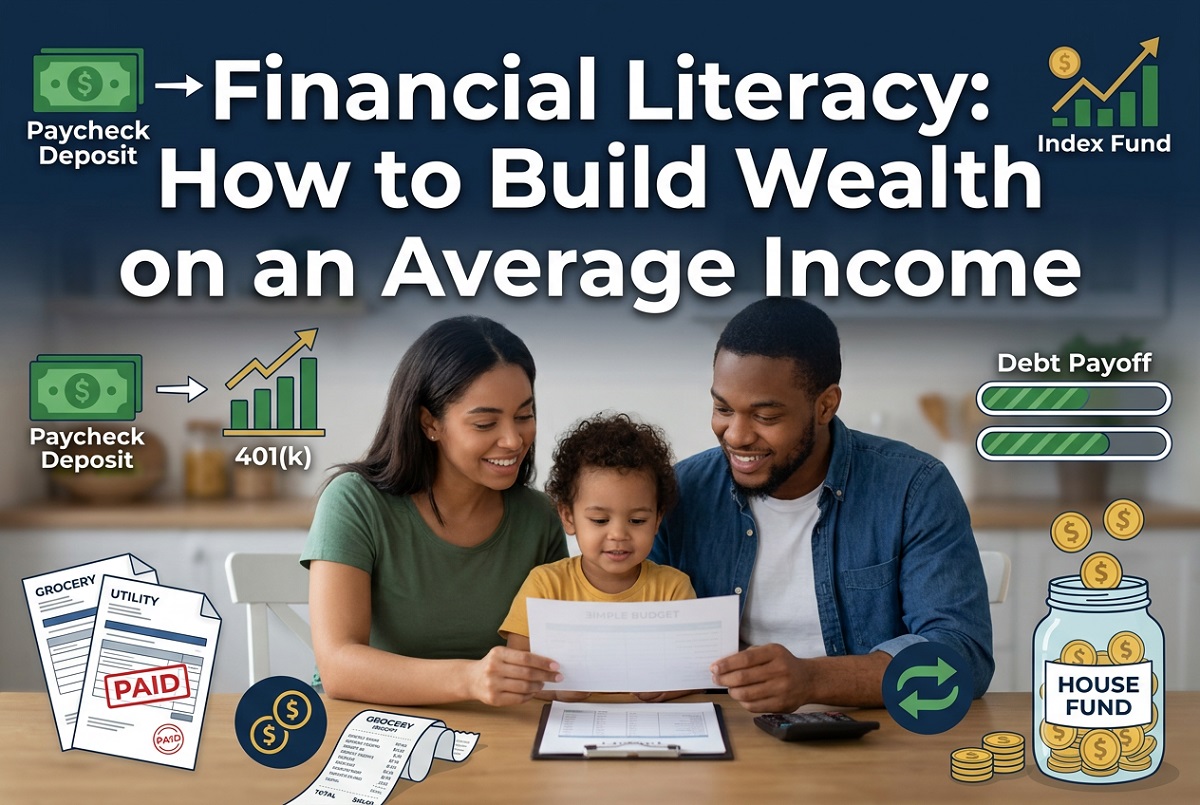
Most of us grow up hearing the same message: “If you want to get ahead, you just need to earn more.” Raises feel like the magic solution to money stress. But when economists dig into real‑world data, they find a different truth. Income helps, but financial literacy — how well you understand and manage money — is often a bigger driver of who actually ends up with savings, investments, and options.
That’s especially true for Gen Z and millennials. Studies show that overall financial literacy in the U.S. has remained stubbornly low, and younger generations score the lowest on basic money questions. At the same time, they face high housing costs, student debt, and a constant stream of financial “advice” from social media and influencers. Without solid money skills, it’s easy to feel like you’re working hard but never moving forward.
The good news: you don’t need to wait for a huge salary jump to start changing your trajectory. You can begin right where you are, with the income you have today, by building specific financial skills and systems. Let’s explore why financial literacy often beats a bigger paycheck, where the biggest gaps are, and how to put practical steps in place — starting now.
Why Financial Literacy Beats a Bigger Paycheck
If more money automatically created wealth, high‑income professionals would rarely be stressed about money. But many doctors, lawyers, executives, and tech workers live paycheck to paycheck, just at a fancier level. Studies help explain why: financial literacy has a strong, independent effect on household wealth that remains even after controlling for income, education, and demographics.
One influential study in the American Economic Review found that higher financial literacy is strongly associated with higher net worth, and when researchers corrected for measurement issues, the impact of literacy on wealth looked even larger than it first appeared. Another line of research shows that people with better financial knowledge are more likely to save, invest in stocks, and plan for retirement — all core drivers of wealth accumulation.
Why does literacy matter so much?
-
It helps you avoid expensive mistakes. Financially literate people are less likely to carry high‑interest credit card debt, fall into predatory loans, or chase speculative fads without understanding the risk.
-
It improves investment decisions. They’re more likely to participate in retirement plans, hold diversified portfolios, and stay invested through volatility instead of panic‑selling.
-
It supports planning instead of reacting. Knowing basic concepts like compounding, inflation, and risk helps you build emergency funds, set goals, and stay focused when markets or life get bumpy.
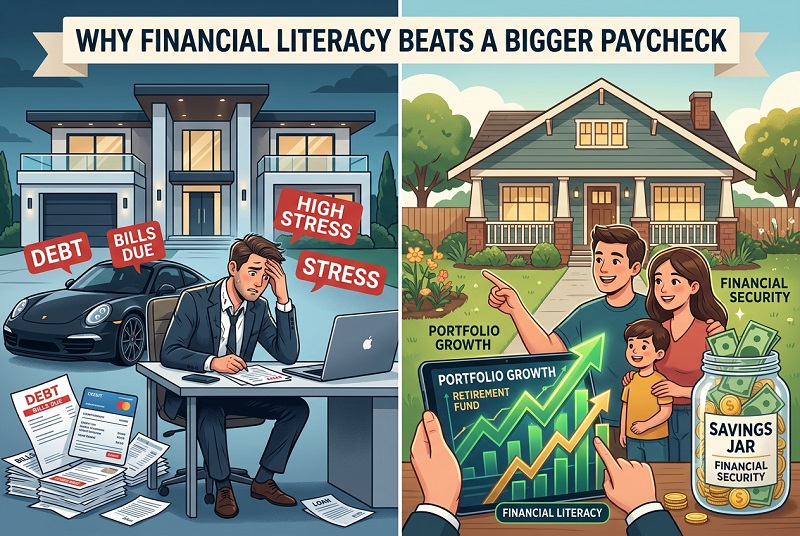
In contrast, a higher income without these skills is like pouring more water into a leaky bucket. You might feel a brief boost when your paycheck increases, but without systems and understanding, the extra money quickly disappears into higher spending and interest payments.
Long‑term studies reinforce the point: improvements in financial literacy over time are associated with higher income, greater savings, and more wealth. Literacy doesn’t just help you manage what you earn now; it also supports better career and life decisions that can increase your income down the road.
What “Financial Literacy” Really Means
“Financial literacy” gets thrown around so much it can feel vague or intimidating. But you don’t need a degree in finance. In practical terms, financial literacy is a bundle of specific skills and mental models that change how you behave with money from day to day.
Researchers and national surveys break personal finance into several core areas, and most adults score below 50% overall. Gen Z, in particular, answers only about 38% of financial literacy questions correctly on average — the lowest of any generation measured.
In real life, financial literacy comes down to six key buckets:
-
Cash‑flow awareness
This is the foundation. It means knowing:-
How much you actually take home each month.
-
What your fixed bills are (rent, utilities, loan payments) and what fluctuates (food, entertainment).
-
Where your money goes — not just in theory, but with real numbers.
About one in four Gen Z adults say their income doesn’t cover expenses, and another share can cover expenses but can’t save. Without a clear view of cash flow, it’s almost impossible to change that.
-
-
Saving and buffers
A key literacy skill is understanding why you need an emergency fund, how much to target, and where to keep it.-
Around 32% of Gen Z say building an emergency fund is a top savings goal, which is a healthy sign.
-
But long‑term goals like retirement often get much less attention because they feel distant.
An emergency buffer isn’t about being paranoid. It’s about avoiding high‑interest debt when something goes wrong and giving yourself breathing room to make better decisions.
-
-
Debt, interest, and credit
Misunderstanding interest and credit is one of the costliest gaps.-
Risk and interest concepts are the hardest topic across all generations in financial literacy surveys.
-
Many younger adults carry credit card or personal loan balances without fully grasping how quickly interest adds up or which debts to prioritize.
Literacy here means knowing what an APR really means, why minimum payments can be a trap, and how your credit score affects everything from loan approvals to insurance rates.
-
-
Investing basics
You don’t need to pick individual stocks. You do need to know:-
How compounding works and why starting early matters.
-
The trade‑off between risk and return.
-
Why diversification reduces risk.
-
The difference between long‑term investing and short‑term speculation.
People with higher financial literacy are more likely to own stocks or stock funds, participate in retirement plans, and stick with their investments — behaviors strongly linked to higher net wealth.
-
-
Using tax‑advantaged accounts and benefits
This includes understanding:-
How 401(k)s, 403(b)s, and other employer plans work, especially employer matching.
-
Basic differences between traditional and Roth IRAs.
-
How tax‑advantaged accounts can boost your long‑term returns.
Many younger workers under‑use workplace plans or misunderstand how matches work, effectively leaving free money and tax advantages on the table.
-
-
Risk management and protection
This is about protecting your progress:-
Understanding why health, renter’s, and disability insurance matter.
-
Recognizing that an uninsured accident or illness can wipe out years of savings.
-
Knowing when to self‑insure (with savings) and when to transfer risk (with insurance).
-
Financial literacy isn’t about perfection. It’s about having enough knowledge to avoid obviously bad deals, say yes to good ones, and connect your day‑to‑day choices to your bigger life goals.
How Average Earners Can Out‑Wealth High Earners
One of the most powerful mindset shifts is accepting that you can build serious wealth even on an “average” income — and sometimes faster than someone who earns more but manages money poorly. Research confirms that households with higher financial literacy accumulate more wealth than peers with similar incomes but weaker money skills.
Consider a realistic example.
Mia vs. Jason
-
Mia is 27, earns $52,000 a year as a teacher.
-
Jason is 28, earns $90,000 a year in a sales role.
They live in similar cities with moderate costs of living. On paper, Jason has the advantage. But their behavior is very different.
Mia (average income, strong financial literacy):
-
Uses a budgeting app, knows her numbers, and targets a 20% savings rate.
-
Has built a $2,500 emergency fund and is working toward three months of expenses.
-
Contributes 10% of her salary to her workplace retirement plan and gets a 5% employer match.
-
Adds $200 per month to a Roth IRA invested in a broad index fund.
-
Has paid off high‑interest credit card debt and now pays her card in full each month.
-
Every raise triggers a 1–2% increase in her retirement contributions before lifestyle changes.
Jason (higher income, weak financial literacy):
-
Doesn’t budget; spends based on his checking account balance.
-
Has about $1,000 in savings that he frequently dips into.
-
Contributes a flat $100 a month to his 401(k) and doesn’t understand the match, leaving free money unused.
-
Carries $11,000 in credit card debt at ~19% APR, plus a high car payment on a luxury lease.
-
Each raise leads to lifestyle upgrades — bigger apartment, more nights out, nicer vacations.
Fast‑forward ten years:
-
Mia is investing around 15% of her gross income, plus receiving a 5% match — effectively saving 20% of her pay. With compounding, her retirement balances could easily reach six figures, even if markets are bumpy.
-
Jason is investing perhaps 1–2% of his income and paying thousands a year in interest. His net worth might be close to zero or even negative once debts are subtracted.
This pattern lines up with what studies see: literacy drives participation in retirement plans, diversification, and proactive saving, all of which translate into higher household wealth over time. The income difference matters — but how efficiently each dollar is used matters more.
Biggest Money Gaps for Gen Z and Millennials
Gen Z and millennials face a unique financial landscape: higher education and housing costs, complex products, and a relentless stream of content about money, much of it conflicting. Against that backdrop, several consistent literacy gaps show up in research.
1. Low overall literacy
-
The national Personal Finance Index shows U.S. adults answer only 49% of basic finance questions correctly.
-
Gen Z scores the lowest of any generation, at around 38% correct, and lags across all eight topics the survey tracks, from saving to investing to risk.
-
One analysis suggests that around 60% of Gen Z and 59% of millennials experience financial challenges due at least in part to weak financial literacy.
2. Weak understanding of risk and long‑term planning
-
Concepts related to risk — volatility, risk–return tradeoffs, probability of loss — are consistently the hardest for all age groups.
-
YouGov data reports that Gen Z focuses heavily on short‑term goals like emergency funds and big purchases, while relatively few prioritize retirement or long‑term wealth goals.
3. Debt stress and confusion
-
Many younger adults report significant worries about debt, with a meaningful share carrying between $10,000 and $49,999 in unsecured debt.
-
Some surveys highlight large average debt burdens for Gen Z (including student loans and consumer debt), and media coverage increasingly frames this as a “mounting debt crisis.”
-
Yet, many still lack clear strategies for prioritizing repayment based on interest rates and risk.
4. Budgeting and cash‑flow struggles
-
Roughly a quarter of Gen Z say their income doesn’t cover their expenses, and another share can cover expenses but cannot save.
-
A significant percentage report difficulty budgeting or tracking their money, and many use just one bank account for everything, making it harder to separate spending from saving.
5. Overconfidence vs. hesitation
-
Some millennials report feeling financially confident, but their behaviors — low emergency savings, high unsecured debt — reveal a gap between confidence and skill.
-
Gen Z often shows caution about debt and certain investments but may be reluctant to discuss money openly, limiting opportunities to learn from peers.
These gaps aren’t personal failings. They’re what you’d expect in a society that offers complex financial products but little structured education. The opportunity is that targeted learning in these areas can yield outsized benefits.
How Low Financial Literacy Shows Up Every Day
Lack of financial literacy seldom appears as one big mistake. Instead, it’s a pattern of small, everyday choices that feel normal but slowly erode your financial position.
Spending
-
No intentional plan. Without a budget or spending framework, money flows toward whatever feels urgent or appealing in the moment.
-
Subscription creep. Multiple streaming services, software, memberships, and delivery subscriptions come to feel essential, even if you rarely use them.
-
Lifestyle drift. Upgrades in food, clothing, gadgets, and entertainment become standard, not special — often without any corresponding increase in saving.
Over time, these “tiny” choices can easily consume hundreds of dollars a month. That’s money that could be building an emergency fund, paying off debt, or compounding in investments.
Saving
-
Inconsistent contributions. Without automation, saving happens only when “there’s something left over,” which often means not at all.
-
Short‑term only. Many young adults prioritize emergency funds and specific purchases, while long‑term goals like retirement barely register because they feel abstract.
-
All in low‑yield accounts. Fear or confusion about investing leads some to keep everything in basic savings accounts, where inflation slowly erodes value.
Surveys show that fewer than half of Americans feel financially secure, and many younger adults say they want to save more but don’t manage to follow through. That’s often an execution problem, not a motivation problem.
Credit and debt
-
Using credit as income. Credit cards and “buy now, pay later” offers effectively expand your lifestyle beyond what your cash flow comfortably supports.
-
Payment‑focused thinking. Decisions center on “Can I afford the monthly payment?” rather than “What will this cost me in total, including interest?”
-
Mis‑prioritized repayment. Without literacy, people may aggressively pay off low‑interest loans while leaving high‑interest credit cards lingering — the exact opposite of what builds wealth.
National surveys indicate that Americans worry deeply about debt, with over 80% saying just being in debt causes stress. Yet, the strategies that would reduce that stress — prioritizing high‑interest balances, consolidating smartly, and avoiding new bad debt — require basic financial knowledge.
Investing
-
Not investing at all. Fear of “losing money in the market” keeps many on the sidelines, unaware that not investing exposes them to inflation risk and missed compounding.
-
Chasing hot tips. Others jump into meme stocks, speculative crypto, or trending “plays” they barely understand, driven by FOMO and social media.
-
Ignoring employer matches. Many younger workers fail to contribute enough to get the full 401(k) match, literally walking away from guaranteed returns.
Each decision, in isolation, doesn’t feel disastrous. Together, over years, they create a large gap between what you earned and what you keep.
Why Higher Paychecks Don’t Guarantee Wealth
A bigger paycheck can reduce financial pressure and create more possibilities — but it does not automatically generate wealth. There are both structural and behavioral reasons why.
Structural pressures
Some challenges are outside individual control:
-
Housing costs in many cities have grown faster than wages, consuming a large portion of income.
-
Healthcare, childcare, and education can claim thousands per month.
-
Student loans can limit early saving capacity.
Even high earners can feel squeezed when fixed costs are heavy. But beyond that, behavior and literacy explain why so many high incomes don’t translate into strong balance sheets.
Behavioral patterns
-
Lifestyle creep absorbs raises
When every raise becomes an excuse to upgrade your car, housing, wardrobe, or weekends, your savings rate doesn’t improve. You feel richer without actually becoming richer. -
No saving and investing infrastructure
If saving is “whatever’s left at the end of the month,” higher income simply leads to higher spending. People who don’t automate saving or set clear targets rarely build meaningful wealth, regardless of income level. -
More income = more borrowing capacity
Lenders are happy to extend large credit lines and loans to high earners. Without literacy, this turns into oversized mortgages, expensive car leases, and bigger credit card balances that quietly drain future wealth. -
Complex situations require more knowledge
Stock options, RSUs, variable bonuses, and complex tax situations are more common at higher incomes and require higher literacy to optimize. Without it, people miss opportunities or incur avoidable taxes.
Income is potential energy. Financial literacy and behavior are what convert that potential into actual wealth.
Lifestyle Creep: The Silent Wealth Killer

Lifestyle creep (or lifestyle inflation) happens when your expenses rise in step with your income, turning once‑special luxuries into everyday “needs.” It often starts quietly:
-
You upgrade to a nicer apartment after a raise.
-
You trade in your car for a more expensive model because the payment “fits” your new salary.
-
You add subscriptions and start dining out more because you “can finally afford it.”
Individually, these decisions can be reasonable. The problem arises when your lifestyle upgrades eat the entire raise — or more — leaving your savings rate stagnant or even lower.
Experts highlight several consequences:
-
Your savings rate stalls. Even substantial salary growth doesn’t translate into bigger investments.
-
Your fixed costs climb. Higher rent or mortgage payments and car loans lock you into an expensive baseline, making job changes or downturns more stressful.
-
Major goals drift out of reach. Homeownership, early retirement, business building — all require consistent surplus cash. Lifestyle creep quietly consumes that surplus.
Lifestyle creep is closely tied to financial literacy because understanding opportunity cost and compounding helps you see the long‑term trade‑offs. When you realize that an extra $400 a month in lifestyle spending could easily become six figures over a couple of decades if invested, you start weighing upgrades more deliberately.
The goal isn’t to live like a monk. It’s to let your lifestyle grow more slowly than your income so that each raise increases your freedom, not just your monthly bills.
One High‑Impact Habit for Long‑Term Wealth
If you had to choose a single habit that does the most to build wealth over time, it would be:
Pay yourself first, automatically, into diversified investments — every month.
This habit captures several key literacy concepts in one move.
Why it works so well
-
Compounding: Steady contributions over long periods let compounding work in your favor. Wealth studies show that households who understand and apply basic investing principles accumulate significantly more assets.
-
Automation: By moving money on payday — before you see it in your checking account — you bypass willpower and make saving non‑negotiable.
-
Forced frugality: When a portion of your income goes straight to investments, you naturally adjust your lifestyle to fit what remains, keeping lifestyle creep in check.
-
Market discipline: Automatic investing through market ups and downs (dollar‑cost averaging) reduces the temptation to time the market based on emotion or headlines.
How to implement it
A practical version might look like this:
-
Contribute enough to your employer’s retirement plan to capture the full match — it’s essentially free money.
-
Set up an automatic monthly transfer from your checking account to a Roth IRA or brokerage account invested in low‑cost index funds.
-
Increase your contribution by 1–2 percentage points whenever you get a raise.
-
Keep your investment choices simple and diversified rather than chasing hot tips.
Financial literacy makes this habit less intimidating because you understand how markets work, why volatility is normal, and how fees and taxes affect returns. Once in place, this single habit quietly does much of the heavy lifting for your future wealth.
First Steps If You Feel Behind
If you’re in your 20s or 30s and feel behind, you’re in good company. Many Gen Z and millennials say they’re stressed about money, want to save more, and worry that they’re not where they “should” be. The key is not to freeze. Instead, take a few targeted steps that shift you from stuck to moving.
Step 1: Get a clear picture
-
List your monthly take‑home pay, fixed bills, typical variable expenses, all debts (with interest rates), and current savings and investments.
-
This snapshot might feel uncomfortable at first, but it turns vague fear into concrete information, which you can work with.
Step 2: Build a mini‑emergency fund
-
Aim for an initial $500–$1,000 in a separate savings account. This small buffer reduces the odds that a flat tire or medical bill pushes you back into high‑interest debt.
-
It’s not the final goal, but it’s a powerful first milestone. Emergency funds are already a top savings priority for many Gen Z adults, which aligns with what financial planners recommend.
Step 3: Tackle toxic debt
-
Rank your debts by interest rate. Focus extra payments on the highest‑interest balance while paying minimums on others.
-
Paying off a 20% APR credit card is like earning a guaranteed 20% return, risk‑free. Very few investments can match that consistently.
Step 4: Capture easy free money
-
If your employer offers a retirement plan with a match and you’re not contributing enough to get the full match, adjust your contributions as soon as you can.
-
Even if it’s only a small percentage at first, this move gives you an instant return and starts your compounding clock.
Step 5: Learn one topic at a time
-
Each month, pick one theme: budgeting, credit scores, investing basics, retirement accounts, insurance, etc.
-
Watch a few videos or read a couple of solid articles. Many universities, nonprofits, and financial institutions offer free financial literacy modules.
You don’t have to fix everything at once. The combination of small structural changes plus steady learning is what pulls you out of “behind” and into “in control.”
Simple Tools to Build Money Skills Fast
You don’t need to do this alone or reinvent the wheel. There’s an entire ecosystem of tools and resources designed to help you understand and improve your finances without getting overwhelmed.
Apps and automation
-
Budgeting apps: Linking your accounts and categorizing spending turns vague “I’m bad with money” feelings into clear pictures of where your cash actually goes. This is especially helpful for combating lifestyle creep.
-
Automatic savings features: Many banks let you set recurring transfers on payday or round up card purchases into savings. These small automations build buffers without requiring daily discipline.
-
Robo‑advisors and simple brokerages: These platforms can build and manage diversified portfolios based on your goals and risk tolerance, lowering the barrier to investing.
Education and support
-
Free courses and modules: Schools, nonprofits, and financial institutions increasingly offer accessible financial literacy programs to address persistent knowledge gaps and reduce long‑term inequality.
-
Employer financial wellness programs: Many workplaces now offer workshops, planning tools, and one‑on‑one guidance. They’re often underused and free to employees.
Simple systems and rules
-
Monthly money check‑in: A recurring calendar reminder to review your accounts, adjust your plan, and choose one improvement for the next month.
-
Percent‑based spending rules: For example, aim to keep fixed needs around 50% of take‑home pay, wants around 30%, and savings/investing at least 20%, adjusting to your reality.
-
Raise and bonus rules: Decide in advance that a fixed portion of every raise or bonus (say 50%) goes straight to savings, investing, or debt payoff. This stops lifestyle creep before it starts.
Surveys show that while many younger adults feel under‑prepared financially, a large share also say they intend to save more and be more careful with money in the coming year. The right tools and systems convert that intention into real, compounding progress.
Final Word
You may never control everything about your income, job market, or economy. But you can control how financially literate you become and how you use the money you earn. For Gen Z and millennials — and anyone who’s tired of feeling stuck — that’s the real leverage point. Start where you are, learn one skill at a time, automate what you can, and let time and compounding do their work.
FAQ: You Don’t Need a Higher Salary to Build Wealth – You Need This Instead
Do I really need financial literacy if I just focus on earning more?
Yes. Earning more gives you more raw material to work with, but financial literacy determines what actually sticks and grows. Studies show that people with higher financial literacy accumulate significantly more wealth, even after controlling for income and education, because they save more, invest more effectively, and avoid costly mistakes like high‑interest debt. Without those skills, higher paychecks often disappear into lifestyle upgrades, interest payments, and fees.
What are the most important financial skills to learn first?
Start with the skills that impact your daily life the most:
- Understanding your cash flow (what you earn, spend, and can save each month).
- Building an emergency fund so you don’t rely on high‑interest debt.
- Knowing how interest works on credit cards and loans.
- Learning the basics of investing and how to use tax‑advantaged accounts like 401(k)s or IRAs.
Research shows that gaps in these areas — especially risk, interest, and long‑term planning — are where many Gen Z and millennials struggle most, and where small improvements can have big payoffs.
How can I build wealth if my income is only average?
You can build wealth on an average income by focusing on high‑impact habits instead of headline salary. People with strong financial literacy tend to:
- Keep their lifestyle below their income and avoid lifestyle creep.
- Save and invest a consistent percentage of their pay, even if it starts small.
- Use employer retirement plans and matches.
- Prioritize paying off high‑interest debt.
Studies find that households with better money skills often end up with higher net worth than peers who earn more but manage money poorly, because they convert a larger share of every paycheck into long‑term assets.
Why do so many Gen Z and millennials feel behind with money?
Because they’re navigating a complex financial world with relatively low average financial literacy. National surveys show U.S. adults answer only about half of basic financial questions correctly, and Gen Z scores lowest of all generations. At the same time, younger adults face high housing and education costs, rising consumer debt, and constant social‑media pressure to spend.
That combination — complex decisions, high stakes, and limited education — makes it easy to feel behind, even if you’re working hard. The upside is that targeted learning and a few structural changes (like automating savings and tackling high‑interest debt) can dramatically improve your trajectory.
What’s one simple step I can take this month to start building wealth?
Pick one concrete action that improves both your behavior and your literacy at the same time. For example:
- Set up an automatic transfer to savings or a retirement account for a small amount each payday.
- At the same time, spend an hour learning the basics of budgeting, credit, or investing from a reputable source.
Even modest, automated contributions — combined with basic investing knowledge — can compound into meaningful wealth over time, and research shows that increasing financial literacy has a measurable long‑term impact on savings and net worth.