Everyone’s seen the ads. “Turn $1,000 into $50,000,” Tom and David Gardner grinning next to a chart that only ever goes up. Before you hand over $99 (or $499, or nearly $2,000 depending on which tier they push you toward), this Motley Fool review breaks down what’s actually going on with the service in 2026—the good, the annoying, and the stuff most other reviews conveniently leave out.
What Is The Motley Fool?
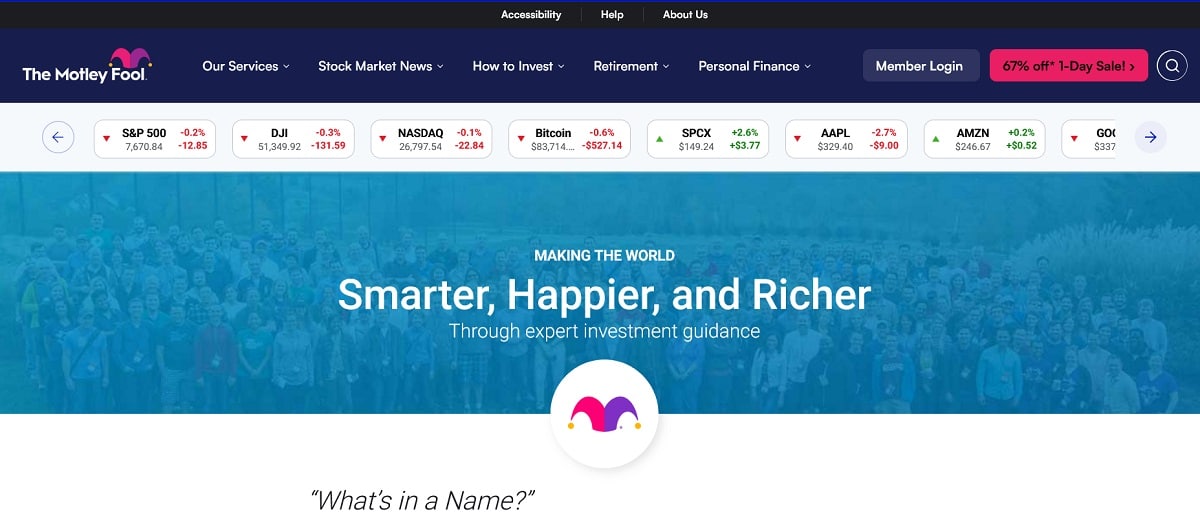
The Motley Fool has been around since 1993, started by two brothers out of Alexandria, Virginia, who named the company after a Shakespeare reference—the court jester who was allowed to tell the king uncomfortable truths. Cute origin story. These days it’s less “jester speaking truth to power” and more “subscription business with four different pricing tiers.”
The main product is Motley Fool Stock Advisor. Twice a month you get an email with a stock pick. There are also Rule Breakers for riskier, higher-growth companies and Epic, which bundles everything together along with newer AI screening tools rolled out in 2025. Anyone comparing services before subscribing usually starts exactly here—with a plain Motley Fool review that lays out what each tier actually includes.
Motley Fool Pricing & Plans (2026)
Here’s something most Motley Fool reviews gloss over: the cost structure has shifted a lot in the last two years. Stock Advisor still hooks you in around $99 for year one, jumping to $199 on renewal. Fine, that’s reasonable for what you get.
| Plan | First-Year Price | Renewal Price | Best For |
| Stock Advisor | ~$99 | $199/year | Beginners wanting 2 stock picks a month |
| Rule Breakers | — | $299/year | Growth and tech-focused investors |
| Epic (bundle) | — | 499–1,999/year | Investors wanting the full research suite + AI tools |
But Epic? That’s now sitting anywhere from $499 to nearly $1,999 a year depending on the offer you’re shown—doubled in some cases from what it used to cost. Nobody’s advertising that part loudly. Most Motley Fool subscription reviews you’ll find online skip straight past this and just quote the cheapest entry price.
Does Stock Picking Actually Work? (Motley Fool Performance)
This is the part that matters, and the honest answer is mostly yes, if you’re patient.
Since Stock Advisor launched back in 2002, the picks have returned somewhere north of 900% cumulatively, compared to roughly 150–200% for the S&P 500 over the same period. That’s a real gap. But—and this gets buried in a lot of glowing Motley Fool Stock Advisor reviews—about a third of their picks have actually lost money. The whole strategy only works if you buy a big basket of recommendations, something like 25 or more, and just sit on them for five years minimum.
Buy two picks and expect to get rich in six months? You’ll probably be disappointed, and honestly, a little annoyed you subscribed at all.
I Checked Trustpilot So You Don’t Have To (Is Motley Fool Legit?)
Here’s where it gets interesting. Motley Fool’s Trustpilot score sits around 2.4 out of 5, labeled “Poor,” across more than 9,000 reviews. But the distribution is weird—it’s not a normal bell curve of mediocre opinions. About a third of people give it 5 stars, and 16% give it 1 star. Barely anyone sits in the middle.
Read enough of the negative reviews, and a pattern shows up fast. People aren’t mad about the stock picks losing money. They’re mad about:
- Getting bombarded with emails pushing them toward the $500–2,000 tiers right after signing up for the cheap one
- Auto-renewal being sneaky or hard to cancel
- Feeling like the “free” content is bait for something more expensive
So it’s less “this service is a scam” and more “this company will not stop trying to upsell you.” Worth knowing before you hand over your email address. If you’re searching “Is Motley Fool legit,” that’s really the honest, complete answer.
What They Don’t Tell You About the New AI Tools
In 2025, Motley Fool quietly added four AI-powered screening tools—they’re calling them Moneyball, Microball, Cryptoball, and AIball. Moneyball, the flagship one, scores about 4,200 companies on things like business quality, growth potential, and valuation, rolling it all into something they call a “Superscore.”
One thing worth flagging: a high superscore is explicitly NOT the same as a “buy this stock” recommendation. Motley Fool says so themselves, buried in the fine print. It’s a shortlist tool, not a crystal ball. A lot of screeners do something similar for free elsewhere, so don’t assume this feature alone justifies the higher-tier price tag.
Motley Fool Stock Advisor vs. Rule Breakers vs. Epic—Which One?
- Stock Advisor—the entry point. Two picks a month, blue-chip leaning, best if you’re new to this.
- Rule Breakers—riskier, growth-stock-hunting, higher volatility, higher potential upside.
- Epic—everything bundled, plus the AI screening tools, at the steepest price.
If you’re only going to buy one, Stock Advisor is the sane starting point. Don’t jump to Epic just because an email tells you it’s “limited time.”
Motley Fool vs. Alternatives
| Service | Focus | Starting Price |
| Motley Fool Stock Advisor | Long-term stock picks | $199/year |
| Seeking Alpha Premium | Crowd-sourced analysis + data | Similar range |
| Zacks Premium | Quantitative stock ranking | Lower entry price |
| Morningstar | Fund & ETF research | Lower entry price |
Motley Fool is best if you want done-for-you stock picks; Seeking Alpha suits investors who prefer reading varied analyst opinions before deciding themselves. Zacks and Morningstar lean more toward quantitative rankings and fund research rather than a curated pick-of-the-month format. If you’re still comparing services, check out our full roundup of top-rated investment newsletters for a side-by-side breakdown.
Who Should Actually Subscribe to Motley Fool?
Be honest with yourself here. A Motley Fool subscription makes sense if:
- You can hold a diversified set of picks for 5+ years without panic-selling on a bad week
- You’re okay ignoring the upsell emails without unsubscribing entirely
- You want stock ideas but don’t have time to build your own screening process. If you’d rather lean on automated screening instead of a human-picked newsletter, take a look at how AI-powered stock-picking services compare before you decide.
It’s probably not for you if you’re day trading, chasing dividends, or expecting to double your money by next quarter.
Conclusion
Stock Advisor’s long-term numbers are genuinely good—better than most paid newsletters out there. But the company’s marketing behavior drags the experience down, and that’s reflected honestly in how polarized the reviews are. If you can tune out the noise and treat this Motley Fool review as confirmation that it’s a long-term research subscription rather than a get-rich-quick signal service, it’s reasonably priced and has the track record to back it up. Just don’t get talked into the $1,999 tier in your first week.
Frequently Asked Questions
Is the Motley Fool Stock Advisor worth the money?
If you’re patient enough to hold a large, diversified set of picks for five years or more, the historical numbers back it up. If you want fast results from one or two stocks, you’ll likely walk away disappointed.
Is the Motley Fool a scam?
No—it’s been operating since 1993, and the stock picks are real, documented recommendations. The low Trustpilot score comes mostly from aggressive email marketing and upsell tactics, not from fraud.
How much does Motley Fool actually cost?
Stock Advisor runs about $99 the first year and $199 after that. Rule Breakers is roughly $299/year. Epic, the full bundle, ranges from $499 up to $1,999 depending on the deal you’re shown.
What’s the real difference between stock advisors and rule breakers?
Stock advisors lean toward safer, established growth companies. Rule Breakers hunts for riskier, more disruptive picks with bigger upside and bigger swings. Epic combines both plus extra tools.
Is it hard to cancel a Motley Fool subscription?
There’s a 30-day refund window for new members, no questions asked. After that, plenty of Trustpilot reviewers mention having to actively contact support to stop auto-renewal—it doesn’t always feel like a one-click process.