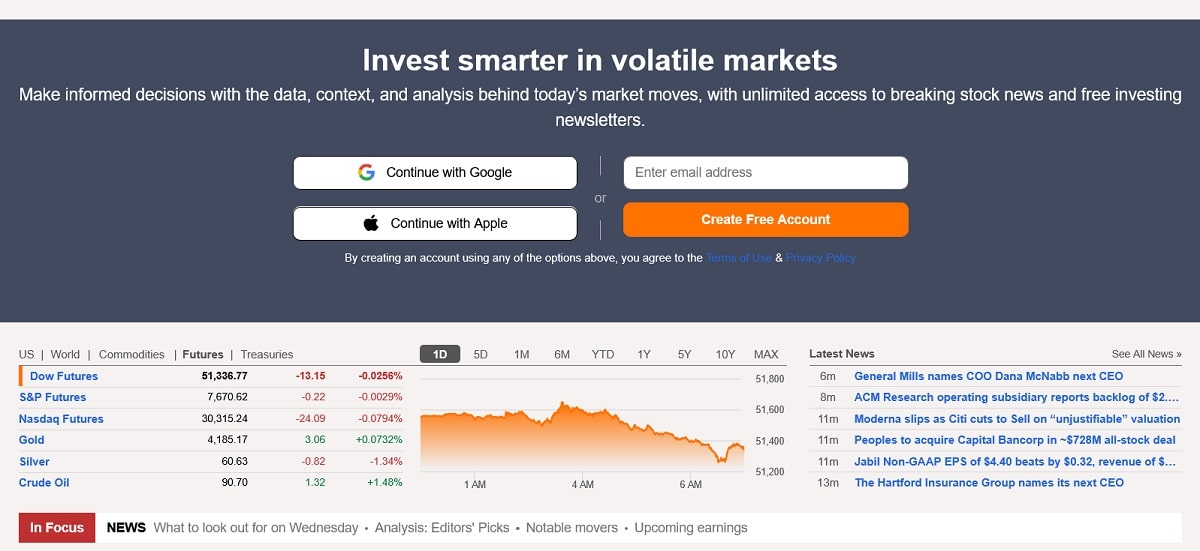
Twenty million people visit Seeking Alpha every month. That’s either a sign it’s genuinely useful or a sign a lot of people are paying for something that doesn’t move the needle much. I dug through the pricing history, the Quant Ratings performance data, and a pile of Trustpilot complaints to figure out which one it actually is.
What Seeking Alpha Even Is
Seeking Alpha started in 2004, founded by David Jackson, a former Morgan Stanley tech analyst who apparently got tired of reading the same recycled research everywhere else. Two decades later it’s grown into one of the biggest crowd-sourced investing platforms around, with thousands of contributing writers publishing bull and bear takes on pretty much every stock you can think of. It’s headquartered in Israel these days, with a sizable US operation running the show stateside.
The free version gets you a taste—some articles, basic data, and following a handful of tickers. To actually use the platform for anything serious, you need Premium.
How Much Does Seeking Alpha Actually Cost?
Here’s where it gets a little messy, honestly. The list price has crept up steadily—Premium ran $239 back in 2023, hit $269 in 2024, and now sits at $299/year as the “official” number. But almost nobody pays that. Seeking Alpha runs promotions constantly, so real first-year prices bounce around anywhere from $199 to $269 depending on when you sign up and what deal you land on, usually preceded by a 7-day free trial.
There’s also Alpha Picks, a separate curated stock-picking product that runs independently of Premium (roughly $375-449/year depending on the offer), and Pro, aimed at professional and high-net-worth investors, which can run anywhere from $1,800 to $2,400+ a year. Pro adds VIP author access and curated top-ideas lists, but honestly, most individual investors have zero reason to go anywhere near it.
Do the Quant Ratings Actually Work?
This is the part everyone actually wants to know, so let’s get into it.
Seeking Alpha’s Quant system scores roughly 10,000 US-listed stocks across five factors—Value, Growth, Profitability, Momentum, and EPS Revisions—and rolls it all into one rating from Strong Buy down to Strong Sell. It updates daily as new financial data comes in, which is more than you can say for most human-written research that gets stale the moment it’s published.
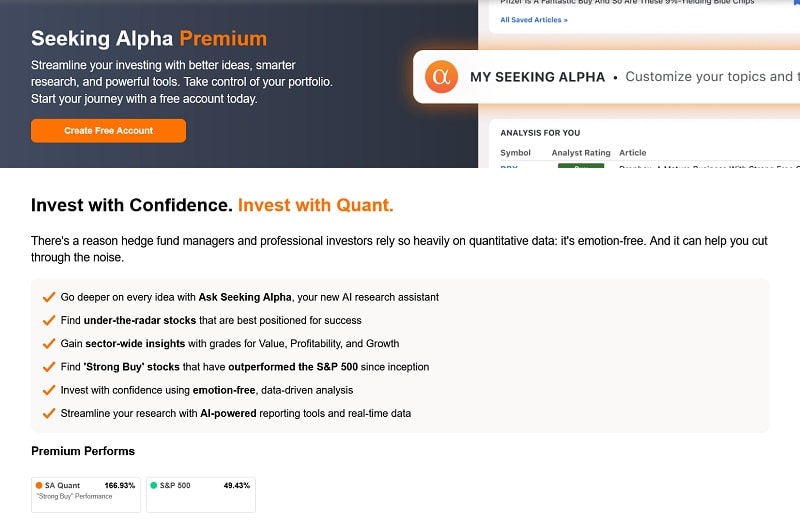
The performance numbers are genuinely striking if you take them at face value. Depending on which study window you look at, Strong Buy-rated stocks have outperformed the S&P 500 by somewhere around 8x since 2010. One breakdown put five-year cumulative returns for Quant Strong Buy stocks near 164%, versus about 46% for the S&P 500 over the same stretch, and well ahead of what Wall Street analysts’ own Strong Buy lists managed. That’s not a small gap.
Should you blindly buy every Strong Buy stock the algorithm spits out? No. Quant scores can lag when market conditions shift suddenly, and they’re a starting filter, not a final verdict. But as a way to quickly narrow 10,000 stocks down to a shortlist worth actually researching, it does what it says on the tin.
Is Seeking Alpha Legit, or Is This a Billing Trap?
Short answer: the platform is legitimate. Long answer: their billing practices have generated a genuinely alarming number of complaints.
The BBB gives Seeking Alpha an F rating, with dozens of complaints filed over a recent three-year stretch—the company reportedly didn’t even respond to most of them. The recurring theme isn’t “the stock picks lost me money.” It’s unauthorized renewals, cards getting charged without clear consent, and refund requests getting flatly denied even when the company acknowledges something went wrong.
Trustpilot tells a slightly different story—sitting around 4.1 out of 5 from 800+ reviews, which sounds solid on the surface. But scroll through the actual reviews and you’ll see the same pattern repeating: people praising individual support reps by name for personally sorting out a billing mess that shouldn’t have happened in the first place. Good customer service and cleaning up bad billing systems isn’t really a five-star experience; it’s damage control.
There was also a 2017 SEC enforcement action involving paid stock promotions published on the platform without proper disclosure—Seeking Alpha responded by tightening its verification and disclosure rules. And a 2024 federal court case tried to argue the platform was operating as an unregistered investment adviser; the court dismissed it, ruling Seeking Alpha qualifies for the publishers’ exclusion since it’s providing research, not personalized financial advice.
What Do You Actually Get With Premium?
- Unlimited article access—thousands of contributor pieces published monthly, covering both bullish and bearish angles on the same stock
- Quant Ratings—the five-factor scoring system across roughly 10,000 tickers, updated daily
- Stock screener—filter by rating, dividend yield, sector, market cap, and a long list of other criteria
- Earnings call transcripts—full transcripts across thousands of companies, useful for catching management tone shifts without listening to the whole call
- Dividend grades—payout safety scores and growth trend data, handy if you’re building an income-focused portfolio
- Portfolio tracking—links to your brokerage and scores your holdings based on how many are sitting in Strong Buy vs. Sell territory
Is $299 a Year Worth It?
Depends entirely on your portfolio size and how much you’d actually use the tools.
Against a $5,000 portfolio, $269 is a meaningful chunk—call it over 5% of your assets just for research access. Against a $50,000 or $100,000 portfolio, it barely registers, and one avoided bad picks more than covers the cost. If a strong sell warning keeps you out of a stock that would’ve dropped 30% on a $5,000 position, that’s $1,500 saved—several years of premium paid for in one decision.
The honest caveat: if you’re not going to actually open the platform regularly, none of this math matters. A subscription you don’t use is just $299 gone.
If you’re still weighing this against other services before committing, our roundup of the best investment newsletters breaks down how Seeking Alpha stacks up against alternatives side by side.
Who Seeking Alpha Is Actually Built For
This isn’t a beginner-friendly platform, and it doesn’t pretend to be. Free content is heavily paywalled, and the interface assumes you already know what a P/E ratio and EPS revision mean. It’s aimed at intermediate-to-advanced, self-directed investors who want to research individual stocks themselves rather than follow a curated newsletter.
If quant-driven stock scoring specifically is what draws you in, it’s worth seeing how a different, human-analyst-built quant approach compares—this review of a quant-based investing portfolio looks at a service built around a similar factor-scoring philosophy but run by a single research team rather than a crowd-sourced model.
Conclusion
The Quant Ratings genuinely deliver something useful—a fast, data-driven way to sort through thousands of stocks without doing all the legwork by hand. The content library and earnings transcripts save real time if you’re the kind of investor who reads filings for fun. But the billing complaints are not a minor footnote. If you sign up, set a calendar reminder before the renewal date and don’t leave a card on file longer than you have to. Treat this Seeking Alpha review as your heads-up: the research is solid, but the checkout experience needs a chaperone.
FAQs
Are Seeking Alpha’s Quant Ratings accurate?
Backtested data shows Strong Buy-rated stocks have significantly outperformed the S&P 500 over multiple time windows, but the ratings can lag during sudden market shifts and shouldn’t be used as an automatic buy/sell trigger on their own.
Is Seeking Alpha hard to cancel?
Plenty of Trustpilot and BBB complaints describe difficulty cancelling auto-renewals and getting refunds after being charged unexpectedly, so it’s worth cancelling well before your renewal date and confirming it in writing.