
Quick Verdict
Third-quarter earnings season is getting underway with unusually high expectations.
FactSet estimates that S&P 500 companies could report 29.5% year-over-year earnings growth for the third quarter. If that estimate holds, it would mark the third consecutive quarter in which S&P 500 earnings growth exceeded 25% and the eighth consecutive quarter of double-digit earnings growth. Revenue is also expected to increase 12.3%.
That is a strong backdrop for stocks, but it also creates a problem for investors.
When expectations are this high, good earnings may not be good enough.
Companies may need to beat estimates, raise guidance or demonstrate stronger-than-expected demand to keep their stocks moving higher. A company can report record profits and still see its shares fall if investors were expecting even more.
That makes this earnings season less about simply asking, “Did the company beat earnings estimates?”
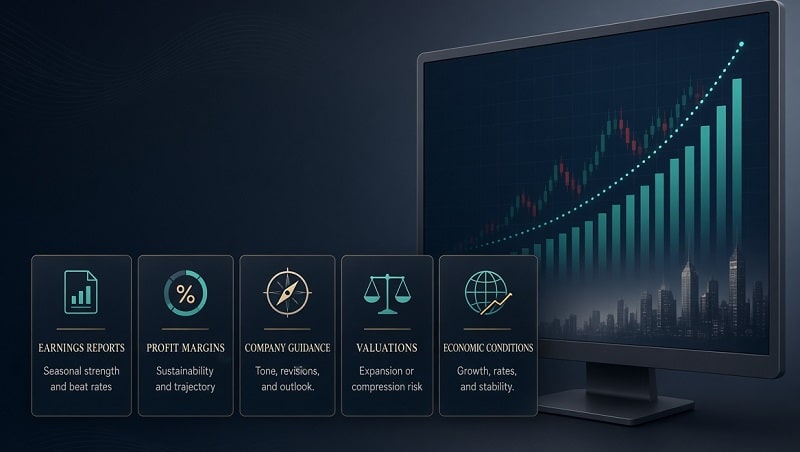
Investors should be asking five bigger questions:
Are revenues growing? Are profit margins holding up? Is AI spending producing real returns? What is management saying about the future? And does the stock price already reflect the good news?
Those questions could matter just as much as the headline earnings numbers.
Key Takeaways
- S&P 500 earnings are expected to rise 29.5% year over year in the third quarter, according to FactSet.
- Analysts have actually raised their earnings estimates during the quarter, which is unusual and points to stronger-than-normal expectations.
- Revenue growth matters because earnings increases driven only by cost cutting may be harder to sustain.
- Investors should pay close attention to margins, management guidance and AI-related spending.
- Strong earnings do not automatically make a stock attractive if its valuation already assumes years of exceptional growth.
- Stock-selection tools such as the Chaikin Power Gauge can provide another way to evaluate individual companies beyond the headline earnings number.
- Investors should focus on the quality and durability of earnings rather than trying to predict which stock will move the most after its report.
Why This Earnings Season Could Be Different
Earnings season is always important, but the current setup deserves extra attention.
The S&P 500 is approaching record levels, while technology and AI-related companies continue to drive much of the market’s momentum. The Nasdaq recently reached a record high, with Nvidia and other large technology companies leading the advance. Nvidia’s market value has approached $6 trillion.
At the same time, investors are dealing with elevated interest rates and unusually high Treasury yields.
That creates an interesting tension.
On one side, corporate earnings are growing rapidly.
On the other, stock valuations are already elevated in parts of the market, and higher borrowing costs can make it more difficult for companies to maintain rapid growth.
The result is a market where earnings reports could produce larger-than-normal reactions.
A company that delivers a major earnings beat could see investors reward it with an even higher valuation.
A company that merely meets expectations could see its stock fall.
And a company that misses expectations could be punished heavily.
This is why investors should look beyond the earnings-per-share figure.
Watch Revenue Growth, Not Just Earnings
The first thing investors should examine is revenue.
Earnings can increase for several reasons. A company can sell more products, raise prices, reduce costs, buy back shares or benefit from temporary factors.
Revenue growth provides a clearer look at whether customers are actually spending more money with the business.
That is particularly important during a period when companies are investing heavily in artificial intelligence.
FactSet expects S&P 500 revenue to grow 12.3% year over year in the third quarter. If that forecast proves accurate, it would mark the third consecutive quarter of double-digit revenue growth for the index.
That is encouraging.
But investors should also look at individual companies.
Suppose a technology company reports 30% earnings growth but only 5% revenue growth. Investors should ask where the additional earnings came from.
Was the company cutting costs?
Did margins improve?
Did share buybacks reduce the number of shares outstanding?
Were there temporary benefits?
Those details matter because revenue growth can help determine whether earnings growth is sustainable.
A business that is growing sales rapidly has more opportunities to increase profits in the future.
A business that is growing earnings mainly by cutting expenses eventually has fewer costs left to remove.
This is especially important for companies trading at high valuations.
The more investors pay for future growth, the more important it becomes to see evidence that the growth is actually happening.
Watch Profit Margins
The second major indicator is profit margins.
A company can grow revenue and still disappoint investors if rising costs consume the additional sales.
This is particularly relevant in the current environment because companies are dealing with several potential cost pressures, including labor expenses, energy prices, tariffs, financing costs and investment in new technology.
Investors should therefore look at whether operating margins are expanding, stable or shrinking.
For example, imagine two companies both report 15% revenue growth.
Company A increases operating margins from 20% to 23%.
Company B sees margins fall from 20% to 17%.
The two businesses have the same revenue growth, but their financial situations are very different.
Company A is converting more of its sales into operating profit.
Company B is generating more revenue but keeping less of each dollar.
That difference can become especially important if economic conditions weaken.
Companies with strong margins generally have more room to absorb higher costs.
Investors should therefore pay attention to management commentary about pricing power, wages, raw-material costs, cloud expenses, data-center spending and other major operating costs.
For technology companies, AI-related expenses deserve particular attention.
Some companies are spending enormous amounts on data centers, processors and networking equipment.
Investors need to determine whether those investments are strengthening future earnings or simply increasing costs.
Watch Whether AI Spending Is Producing Real Returns
AI will be one of the biggest themes of this earnings season.
The technology sector has already benefited enormously from the AI investment boom, but the market is entering a new phase.
The question is no longer simply:
How much are companies spending on AI?
The more important question is:
What are they getting for that spending?
Major technology companies continue to invest heavily in AI infrastructure.
That spending benefits semiconductor companies, memory manufacturers, networking businesses, data-center operators and other suppliers.
But eventually, the companies making those investments need to generate returns.
If a cloud provider spends billions of dollars building AI capacity, customers need to pay for that capacity.
If a software company spends heavily integrating AI into its products, customers need to see enough value to justify paying for those products.
If businesses use AI to improve productivity, investors eventually want to see that improvement reflected in revenue, margins or lower operating expenses.
This is why AI monetization could become one of the defining themes of earnings season.
Reuters reported that AI monetization and productivity are expected to be central themes during the current earnings period, while about 70% of S&P 500 companies are expected to report earnings by the end of October.
Investors should listen carefully when executives discuss AI.
Are customers increasing spending?
Are AI products generating meaningful revenue?
Are businesses seeing measurable productivity gains?
Are capital expenditures rising faster than expected?
And perhaps most importantly, when does management expect the investment to produce meaningful returns?
These answers could help determine which companies benefit most from the next stage of the AI boom.
Watch Management Guidance
The fourth thing investors should watch is what companies say about the future.
Earnings reports tell investors what happened during the previous quarter.
Guidance tells them what management expects to happen next.
That distinction can be more important for the stock price.
FactSet’s latest earnings-season analysis contains an encouraging signal: analysts actually raised their S&P 500 earnings estimates during the third quarter.
Estimated third-quarter earnings per share increased 1.4% between June 30 and September 30. That is notable because analysts typically lower earnings estimates during a quarter. Over the past five years, estimates declined by an average of 2.2% during the quarter.
Corporate guidance has also been relatively strong.
Of the 116 S&P 500 companies that had issued third-quarter EPS guidance as of October 2, 72 provided positive guidance and 44 provided negative guidance. The 62% positive-guidance rate was well above both the five-year and 10-year averages.
That suggests businesses entered earnings season with relatively favorable expectations.
But investors should not assume the trend will continue automatically.
Management teams could become more cautious if they see weaker consumer demand, rising costs or slowing orders.
They may also discuss the effects of interest rates, tariffs, currency movements and geopolitical risks.
For investors, the most important part of an earnings call may therefore come after the earnings numbers.
Listen for changes in language.
If management was previously confident about the next two quarters but suddenly becomes cautious, that could be meaningful.
If executives raise their full-year outlook or describe accelerating demand, that can be equally important.
Watch Valuations and the Market’s Expectations
The fifth and perhaps most overlooked factor is valuation.
A strong earnings report does not automatically mean a stock is a good investment.
Why?
Because the stock price already reflects expectations about the future.
Consider a hypothetical company trading at a very high valuation because investors expect earnings to grow 40% per year.
The company reports earnings growth of 30%.
That sounds excellent.
But the stock could still fall because investors expected 40%.
This is one of the most important concepts to understand during earnings season.
Stocks do not trade based solely on whether a company is performing well. They trade based on whether the company is performing better or worse than investors expected.
This is particularly important for AI-related companies.
Some technology stocks have experienced enormous gains, and investors have already priced in substantial future growth.
That creates a higher hurdle.
The company has to keep delivering.
Recent market action demonstrates the point. The S&P 500 has remained close to record highs while a relatively narrow group of technology and semiconductor companies has driven much of the rally. The Financial Times noted that the equal-weighted S&P 500 and several sectors have lagged the technology-heavy parts of the market.
That concentration creates both opportunity and risk.
If the leading companies continue producing strong earnings, the market could remain supported.
But if expectations disappoint, the effect could spread beyond individual stocks because major technology companies now represent a significant portion of major indexes.
Strong Earnings Don’t Always Mean Strong Stocks
This is where investors need to be careful.
A company can beat earnings expectations and still have its stock decline.
There are several reasons.
Maybe the earnings beat was already expected.
Maybe management issued weak guidance.
Maybe margins deteriorated.
Maybe revenue growth slowed.
Or perhaps the stock was simply too expensive before the earnings report.
This is why earnings season can be useful for stock selection.
Investors are given a huge amount of fresh information about companies within a relatively short period.
But processing all that information can be difficult.
One option is to use a stock-rating framework alongside traditional fundamental research.
One Tool Investors Can Use to Evaluate Stocks
For investors who want another way to evaluate individual stocks during earnings season, the Chaikin Power Gauge is worth exploring.

The system, developed by veteran market analyst Marc Chaikin, evaluates stocks using 20 factors and combines fundamental and technical information into an overall rating ranging from Very Bearish to Very Bullish. The system is designed to assess a stock’s potential future performance rather than simply looking at one earnings metric.
That can be useful during earnings season because a strong earnings report is only one piece of the investment puzzle.
An investor may want to know how the stock’s fundamentals compare with its price action, whether institutional activity is supportive and whether other factors are pointing in the same direction.
The Power Gauge provides another framework for looking at those questions.
If you want to learn more about how Marc Chaikin’s research is being applied to current AI and technology opportunities, you can read our Chaikin American Atlas Portfolio review.
The important point is that a tool like this should be viewed as another research input, not a guarantee of what a stock will do after earnings. Investors should still examine the company’s financial statements, valuation, competitive position and guidance.
Why Earnings Estimates Matter So Much Right Now
One of the more encouraging aspects of the current earnings setup is that expectations have been moving higher rather than lower.
That matters because earnings surprises are measured against expectations.
If analysts have been steadily lowering estimates, it becomes easier for companies to beat those expectations.
The current situation is different.
Analysts raised third-quarter earnings estimates by 1.4% during the quarter, compared with the historical pattern of downward revisions.
That means companies may face a higher hurdle.
It also means that investors should pay attention to estimate revisions after earnings reports.
One strong quarter is interesting.
A series of upward revisions is more powerful.
If analysts begin raising their forecasts for 2027 after hearing management commentary, that could provide evidence that the earnings cycle has further to run.
If estimates begin falling, investors may want to reassess whether current valuations are justified.
Which Sectors Deserve the Most Attention?
All 11 S&P 500 sectors are currently projected to report year-over-year earnings growth for the third quarter, according to FactSet. Five sectors are expected to deliver double-digit growth, led by Energy, Information Technology, Communication Services and Materials.
That breadth is encouraging.
But the sources of growth are important.
Technology remains central because of AI infrastructure and software.
Energy deserves attention because earnings can be heavily influenced by commodity prices.
Materials can provide clues about industrial and economic demand.
Communication Services include several companies with substantial exposure to digital advertising, cloud services and AI.
Investors should therefore avoid focusing exclusively on the biggest technology companies.
A broader earnings picture can tell investors whether corporate America is growing across the economy or whether the market is relying too heavily on a small group of companies.
What About Interest Rates?
Interest rates could become an important wildcard during earnings season.
Higher rates can increase borrowing costs and put pressure on companies that rely heavily on debt financing.
They can also affect stock valuations.
The issue is particularly important for growth stocks because investors generally place a higher value on current cash flows when interest rates are low.
Today, the 10-year Treasury yield remains elevated, although it has recently pulled back from its highest levels. Reuters reported that softer employment data helped reduce expectations for another Federal Reserve rate increase this month, while falling oil prices also provided some relief on the inflation front.
That could help technology stocks.
But the situation can change quickly.
If inflation remains stubborn or Treasury yields rise again, investors may become less willing to pay very high multiples for future earnings.
This is another reason earnings guidance matters.
Investors need to know not only whether companies are growing but how sensitive that growth is to borrowing costs and broader economic conditions.
What Should Investors Do During Earnings Season?

The easiest mistake during earnings season is to react to every headline.
One company beats earnings.
Another misses.
A third raises guidance.
A fourth lowers it.
Share prices can move dramatically before investors have time to understand what happened.
Long-term investors may be better served by taking a step back.
Instead of asking, “Should I buy this stock because it beat earnings?”, consider asking:
Is revenue growth accelerating or slowing?
Are profit margins improving?
Is management raising or lowering guidance?
Are analysts revising future estimates higher or lower?
Is the company generating enough cash to support its investment plans?
How much future growth is already reflected in the stock price?
And finally:
Does the investment thesis remain intact?
Those questions can help investors avoid making decisions based purely on one day’s market reaction.
The Bigger Picture for the Stock Market
The current earnings season arrives at an interesting point for the market.
Stocks are near record highs.
AI continues to drive enormous investment.
Corporate earnings are expected to grow at a rapid pace.
Yet interest rates remain relatively high, market concentration is elevated and expectations are already substantial.
That creates a market where earnings could become the next major test.
If companies deliver strong results and raise their outlooks, investors may have more reason to believe the current rally is supported by fundamentals.
If earnings are strong but guidance becomes more cautious, investors may start questioning how much growth is already priced into stocks.
And if earnings disappoint broadly, high valuations could make the market more vulnerable to a larger correction.
The good news is that investors do not need to predict which outcome will occur.
They can simply watch the evidence as it arrives.
Bottom Line
The S&P 500 could be heading into one of its strongest earnings seasons in years.
FactSet currently expects 29.5% year-over-year earnings growth for the third quarter, with revenue expected to increase 12.3%. Analysts have also been raising their estimates rather than cutting them, while corporate positive guidance has been running well above historical averages.
That is a strong starting point.
But it also means expectations are high.
Investors should look beyond the headline EPS number and focus on five things: revenue growth, profit margins, AI spending and monetization, management guidance, and valuation.
Those factors can tell investors much more than whether a company simply “beat earnings.”
The market is already pricing in significant growth from many of its most popular companies, particularly in technology and AI. That means the difference between good results and better-than-expected results could become increasingly important.
For long-term investors, the goal should not be to predict which company will jump 10% after its earnings report.
The better approach is to understand whether the underlying business is becoming stronger, whether future earnings estimates are moving in the right direction and whether the stock price still makes sense relative to those expectations.
That is where disciplined research—and, for investors who want it, additional stock-selection tools such as the Chaikin Power Gauge—can help.
Earnings season will provide the data.
Investors still have to decide what that data means.
Frequently Asked Questions
How much are S&P 500 earnings expected to grow in the third quarter of 2026?
FactSet’s latest estimate calls for S&P 500 earnings to grow 29.5% year over year in the third quarter. If achieved, that would represent the third consecutive quarter of earnings growth above 25%.
What should investors watch during earnings season?
Investors should look beyond earnings per share. Revenue growth, profit margins, management guidance, cash flow, capital spending, analyst estimate revisions and valuation can all provide important information about a company’s outlook.
Why can a stock fall after beating earnings?
A stock can decline after an earnings beat if investors expected an even larger result, management provides weak guidance, revenue growth slows, margins deteriorate or the valuation was already too high.
Why is AI important during the 2026 earnings season?
AI has become a major source of corporate investment and earnings growth, particularly across semiconductors, cloud computing and technology infrastructure. Investors are increasingly looking for evidence that AI spending is translating into revenue, productivity and profits rather than simply increasing capital expenditures.
Are S&P 500 earnings estimates rising or falling?
For the third quarter of 2026, estimates have been rising. FactSet reported that analysts increased estimated S&P 500 earnings per share by 1.4% from June 30 through September 30. That is unusual because estimates have historically declined during a quarter.
What is the Chaikin Power Gauge?
The Chaikin Power Gauge is a stock-rating system developed by Marc Chaikin. According to Chaikin Analytics, it combines 20 factors, including fundamental and technical information, to assign stocks ratings ranging from Very Bearish to Very Bullish.
Can the Chaikin Power Gauge predict earnings?
The Power Gauge should not be viewed as a guarantee of an earnings result or future stock performance. It is a stock-ranking and research tool that investors can use alongside fundamental analysis and other information.
Should investors buy a stock immediately after a strong earnings report?
Not necessarily. A strong earnings report may already be reflected in the stock price. Investors should consider valuation, guidance, future earnings estimates and the company’s long-term fundamentals before making an investment decision.
What could cause the current earnings-driven rally to weaken?
A combination of disappointing earnings, weaker guidance, falling earnings estimates, declining profit margins, persistently high interest rates or a slowdown in AI-related spending could put pressure on stocks.
What is the most important lesson for investors?
Do not confuse strong earnings with an automatically strong investment.
The best investment decisions require looking at the entire picture: what the company earned, how quickly revenue is growing, where margins are heading, what management expects next and how much of that future growth is already reflected in the stock price.