
Gold has long occupied a unique place in investment portfolios. For centuries it served as money, a store of value, and a hedge against currency debasement. In recent decades many individual investors treated it mainly as a non-yielding asset or a speculative commodity. That perception is shifting again. Central banks have been steady buyers, institutional funds have increased allocations, and a small number of specialized gold securities have begun offering yields that stand out sharply against both traditional equities and conventional gold miners.
One of the more discussed opportunities in this niche is the high-yield gold security highlighted by veteran analyst Garrett Goggin. Marketed as a “High-Yield Gold Annuity,” the vehicle is described as combining annuity-like payment security with the tradability of a stock, backed by a highly profitable South American gold mine, and currently delivering yields that can approach or reach 10 percent. Goggin, a 31-year market participant with a background as a former NYSE floor trader and Chartered Financial Analyst, has issued a dedicated research report on the opportunity and is offering it at a low introductory price.
This review examines the claims surrounding the security, the analyst behind the research, the fundamental attributes of the underlying mine and corporate structure, the broader market context that makes such a product attractive to some investors, and the practical considerations any prospective buyer should weigh. The goal is to provide a clear, evidence-based look at whether the opportunity appears legitimate and how it might fit—or not fit—within a diversified portfolio.
Who Is Garrett Goggin?

Understanding the source of the recommendation is a sensible starting point for any specialized investment idea. Garrett Goggin has spent more than three decades in financial markets. Early in his career he worked on the floor of the New York Stock Exchange. He later shifted focus almost exclusively to precious-metals equities and has maintained that specialization for roughly twenty years.
His formal credentials include the Chartered Financial Analyst (CFA) designation—a rigorous professional standard with a historically low completion rate—and the Certified Market Technician (CMT) designation. He holds graduate degrees (MS and MBA) from Babson College. Over the years he has spoken at major industry gatherings such as the Prospectors & Developers Association of Canada (PDAC) convention in Toronto, the Denver Gold Show Europe in Zurich, and the Swiss Mining Institute Conference. Porter Stansberry has publicly referred to him as “the best gold mining analyst in the world,” a notable endorsement within the natural-resources investment community.
Goggin’s research service, Golden Portfolio 10X, is positioned as a higher-priced offering that tracks dozens of gold-related positions in an audited model portfolio. Reported historical results within that service include substantial percentage gains on certain names, though past performance is never a guarantee of future results and individual outcomes vary widely. The High-Yield Gold Annuity report is presented as a standalone product extracted from that broader body of work and priced far lower than the full service, making the research accessible to a wider audience for the first time.
In short, Goggin is a long-tenured specialist whose professional energy has been concentrated on gold securities. That background lends weight to his analysis of a niche opportunity, while also reminding readers that specialists can develop strong convictions that may not always align with consensus views.
What Exactly Is the High-Yield Gold Annuity?
The security in question is not a traditional annuity issued by an insurance company, nor is it a conventional gold mining stock listed on the New York Stock Exchange or Nasdaq. According to the research, it is a unique instrument that functions like an annuity in the sense that its distributions are described as highly secure and covered by underlying assets many times over, while it trades like a stock and can be bought and sold through most standard brokerage accounts.
It is issued out of South America and is said to be backed by one of the richest and most profitable gold mining operations currently in production. The yield is characterized as reaching up to 10 percent—materially higher than the average dividend yield on the broader equity market and several times higher than the typical yield offered by most gold mining equities or royalty companies.
Because the security is not listed on a major U.S. exchange, information about it does not appear in the usual SEC filings searchable by retail investors. That opacity is one reason many market participants have never encountered it. At the same time, it remains available for purchase on the large majority of brokerage platforms; the primary exception noted is Robinhood. Investors who hold accounts at major full-service or discount brokers can generally acquire positions without unusual friction.
The corporate policy is described as returning essentially 100 percent of normalized free cash flow to shareholders via a variable dividend or distribution mechanism. Management has stated in earnings commentary that the quarterly payout represents the return of all available free cash flow under that policy. The mine itself is already built, future exploration is funded, and the operation generates substantial annual cash flow—on the order of $1 billion according to the research. With no debt on the balance sheet and strong operating margins, the bulk of free cash flow is available for distribution rather than being consumed by capital expenditures or interest payments.
These structural features—zero debt, high margins, full free-cash-flow payout policy, and asset coverage—are the primary reasons the security is framed as annuity-like in its reliability while still offering equity-style upside if gold prices rise or the market re-rates the shares.
The Underlying Gold Mine: Grades, Costs, and Margins
Any claim of high, sustainable yield ultimately rests on the economics of the mine that generates the cash. The research emphasizes several distinctive attributes.
Most operating gold mines report all-in sustaining costs well above $1,700 per ounce. The mine backing this security is said to produce gold for under $1,200 per ounce. That cost advantage stems in large part from unusually high ore grades. The industry average for producing mines is often cited around 1.5 grams of gold per tonne of ore. This operation is described as processing material grading 7–9 grams per tonne—roughly five times richer. Higher grade means far less rock must be moved and processed to extract each ounce of gold, which directly lowers unit costs and expands margins.
Operating margins are reported in the vicinity of 70 percent at recent gold prices. Because the cost base is relatively fixed in the short term, higher gold prices translate into sharply higher profits. The research notes that at $5,500 gold the margin could approach or exceed 100 percent, and at still higher prices the leverage becomes even more pronounced. This operational gearing is a classic feature of well-run, low-cost producers and explains why certain gold mines historically delivered double-digit yields during strong gold markets.
The mine is already in production and generating cash. Capital for future exploration and sustaining needs is already funded, reducing the risk that free cash flow will be diverted to large unexpected outlays. Combined with a clean balance sheet (zero debt), the structure supports the claim that distributions can remain elevated as long as gold prices stay reasonably firm and operational performance continues.
Management Alignment and Track Record
Corporate governance and incentive alignment matter especially when a company commits to returning virtually all free cash flow. Management is reported to own approximately 26 percent of the entity. That substantial insider ownership means the people running the business have the same interest as outside shareholders in maximizing sustainable distributions and long-term value.
The team behind the operation is portrayed as highly experienced. Collectively the group is said to run eleven companies with a combined market capitalization exceeding $11 billion and to employ more than 15,000 people. Individual members bring decades of experience advancing projects from exploration into production. One frequently cited example is the successful development of a Swedish gold mine in roughly five years—about half the industry-average timeline from discovery to first pour. Such a track record, if accurate, suggests operational competence that reduces execution risk relative to less seasoned management teams.
The stated corporate goal is explicit: return all normalized free cash flow to shareholders. Recent earnings commentary reinforces that the quarterly dividend reflects that policy. When incentives, ownership, and stated policy all point in the same direction, the probability that cash is returned rather than retained or misallocated rises.
Institutional Ownership and Validation
One of the more striking claims is the presence of high-profile institutional holders. The research states that the Rothschild family’s asset-management fund, Sprott (with the security appearing among the top holdings of a Sprott gold equity fund), BlackRock, Vanguard, Fidelity, and JPMorgan have all accumulated ownership stakes. These are among the largest and most sophisticated capital allocators in the world. Their presence does not guarantee future performance, but it does indicate that professional investors with extensive due-diligence resources have found the risk-reward profile attractive enough to establish positions.
Institutional accumulation can also create a more stable shareholder base and may contribute to improved liquidity over time. For a security that is not exchange-listed in the conventional sense, the participation of major funds provides a form of external validation that retail investors often find reassuring.
Historical Precedents for High-Yielding Gold Securities
High yields from gold-related securities are not unprecedented. Goggin places the current opportunity in a longer historical context. Homestake Mining, one of the most famous U.S. gold producers, raised its dividend throughout the Great Depression; by 1936 the yield on cost for early investors reached extraordinary levels. Wiluna Gold in Australia delivered yields around 22.5 percent in 1934. Asa Limited paid dividends in the 8–12 percent range through much of the 1970s gold bull market.
These examples illustrate that when a low-cost producer operates in a rising gold-price environment and maintains a shareholder-friendly payout policy, double-digit yields have occurred. The current security is presented as a modern iteration of that historical pattern. Because the market has grown accustomed to gold equities yielding 1 percent or less, a vehicle offering several times that level stands out. Markets eventually tend to reprice such disparities; early owners can lock in higher yields on cost before the price adjusts upward and the forward yield moderates.
The Broader Monetary Backdrop
The attractiveness of any gold-linked investment is inseparable from the macroeconomic and monetary environment. Several trends cited in the research and visible in public data support a constructive medium-term outlook for gold:
- Central banks have been net buyers of gold for many consecutive years and now hold more of the metal than at any point in the past half-century. Gold’s share of global official reserves has surpassed that of U.S. Treasuries for the first time since the 1990s in some data series.
- Basel III banking regulations have elevated the treatment of gold as a high-quality liquid asset, encouraging financial institutions to hold more of it.
- Tether Gold and similar tokenized products have accumulated substantial physical backing, with steady weekly purchases reported.
- Discussions within the BRICS grouping about gold-linked settlement mechanisms, while still evolving, reflect a desire among certain large economies to reduce reliance on pure fiat arrangements.
- Retail investor allocation to gold and gold equities remains near multi-decade lows—often estimated below 1 percent of financial assets—leaving room for increased participation if confidence in fiat currencies continues to erode.
The post-1971 experiment with fully fiat monetary systems has delivered decades of rising asset prices alongside persistent inflation that erodes the purchasing power of wages and fixed incomes. Younger cohorts in particular face elevated housing costs, higher education expenses, and wage growth that has lagged in real terms for long stretches. Against that backdrop, assets that cannot be printed and that historically preserve purchasing power attract renewed attention.
Goggin argues that the world is gradually returning to an “old normal” in which gold again plays a structural role in monetary and investment systems. The high-yield security is positioned as an early beneficiary of that shift: it offers both the safety of gold-backed cash flows and a current income stream that most pure gold holdings lack.
How the Security Compares with Alternatives
Traditional gold ETFs provide pure price exposure with negligible yield and ongoing management fees. Major gold mining equities often carry operational, jurisdictional, and balance-sheet risks while delivering low single-digit yields at best. Royalty and streaming companies offer more predictable cash flows but typically trade at premium valuations and still yield far less than 10 percent. Conventional annuities or high-grade corporate bonds currently offer yields that, after inflation and taxes, may struggle to preserve real purchasing power.
The security under review attempts to occupy a middle ground: gold-linked cash flows with a high current distribution, no debt, and the potential for capital appreciation if gold prices rise or the market assigns a higher multiple to the cash-flow stream. Its non-traditional listing status is both a drawback (limited research coverage, potential liquidity constraints) and a reason the yield remains elevated. Once wider recognition arrives, the price is likely to adjust and the forward yield to decline—exactly the dynamic that creates an opportunity for early entrants.
Potential Risks and Caveats
No investment is without risk, and a candid review must address the downside scenarios.
Commodity-price risk. Although the mine’s low cost structure provides a cushion, a sustained decline in the gold price would reduce free cash flow and therefore distributions. Gold has historically been volatile.
Operational and jurisdictional risk. Mining is an inherently operational business. Equipment failures, labor issues, weather events, or regulatory changes in the host country could interrupt production. South American jurisdictions vary widely in political and regulatory stability; investors must assess the specific country risk independently.
Liquidity and information risk. Because the security is not listed on a major U.S. exchange, bid-ask spreads may be wider than those of large-cap stocks, and detailed public disclosure may be less readily available. Retail investors reliant on SEC EDGAR filings will find little or nothing.
Currency and geopolitical risk. Cash flows originate outside the United States. Exchange-rate movements and any future capital controls or tax changes could affect net returns to U.S. holders.
Reinvestment and distribution variability. The payout is described as variable and tied to free cash flow. In a weaker gold-price environment the distribution could fall, even if the company remains profitable.
Analyst and promotional risk. The research is sold as a commercial product. While Goggin’s track record and credentials are strong within his niche, any analyst can be wrong. Readers should treat the report as one informed opinion rather than guaranteed insight.
These risks are real. They do not automatically render the opportunity illegitimate, but they do require that any position size remain appropriate to an investor’s overall risk tolerance and that due diligence extend beyond a single research report.
Accessing the Research and Practical Considerations
Goggin’s full analysis is packaged in a report titled “The High-Yield Gold Annuity.” For the first time he has made the research available independently of his higher-priced subscription service, pricing it at $23. Purchasers also receive ongoing updates around earnings periods and material corporate developments, plus access to his regular e-letter Golden Opportunity and a multi-part masterclass on gold investing.
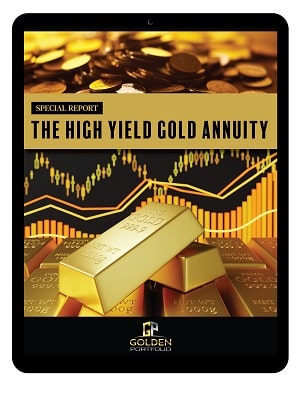
The low price point lowers the barrier to obtaining specialized research that would otherwise be embedded in a multi-thousand-dollar service. Investors who decide the opportunity warrants further study can acquire the report, review the detailed mine economics, management history, and target-price analysis, and then decide independently whether to establish a position through their existing brokerage account.
As with any investment research, the report should be read critically, cross-checked against primary sources where possible, and considered in the context of an individual’s complete financial situation, time horizon, and risk capacity.
Conclusion: Is the High-Yield Gold Annuity Legit?
Based on the information presented, the security appears to be a real, operating corporate instrument backed by a producing low-cost gold mine, carrying no debt, returning essentially all free cash flow to shareholders, and held by a roster of sophisticated institutional investors. The analyst promoting the research possesses decades of specialized experience, recognized professional credentials, and a public track record within the gold-equity space. The yield claim is consistent with the mine’s reported cost structure and payout policy, and historical precedents exist for high distributions from well-run gold producers during favorable price environments.
“Legit” does not mean “risk-free” or “guaranteed to outperform.” It means the claims are grounded in identifiable economic attributes rather than pure fabrication. On that narrower definition, the opportunity passes a basic legitimacy test. Whether it is an appropriate investment for any particular individual depends on risk tolerance, portfolio construction, time horizon, and the investor’s own assessment of gold’s medium-term prospects.
For those already inclined toward gold exposure and seeking current income rather than pure price appreciation, the combination of high yield, strong operational metrics, and institutional sponsorship is noteworthy. For more conservative investors, the jurisdictional, liquidity, and commodity-price risks may counsel smaller position sizes or further independent verification. In either case, the existence of a low-cost research report provides a convenient on-ramp for deeper due diligence.
Gold’s role in the global financial system is evolving. Central banks, regulations, and shifting geopolitical alignments are all pushing the metal back toward the center of monetary discussions. Specialized securities that offer both gold linkage and meaningful income are likely to attract increasing attention. The vehicle reviewed here is one early example. Investors who understand its strengths, acknowledge its risks, and size positions accordingly will be better positioned to evaluate whether it deserves a place in their portfolios.