Dollar devaluation isn’t some abstract economics term anymore — the devaluation of the US dollar has been sitting in the middle of everyday financial news for over a year now, and if you’ve checked a gas pump, a grocery receipt, or a brokerage statement lately, you’ve probably felt it whether you knew the name for it or not.
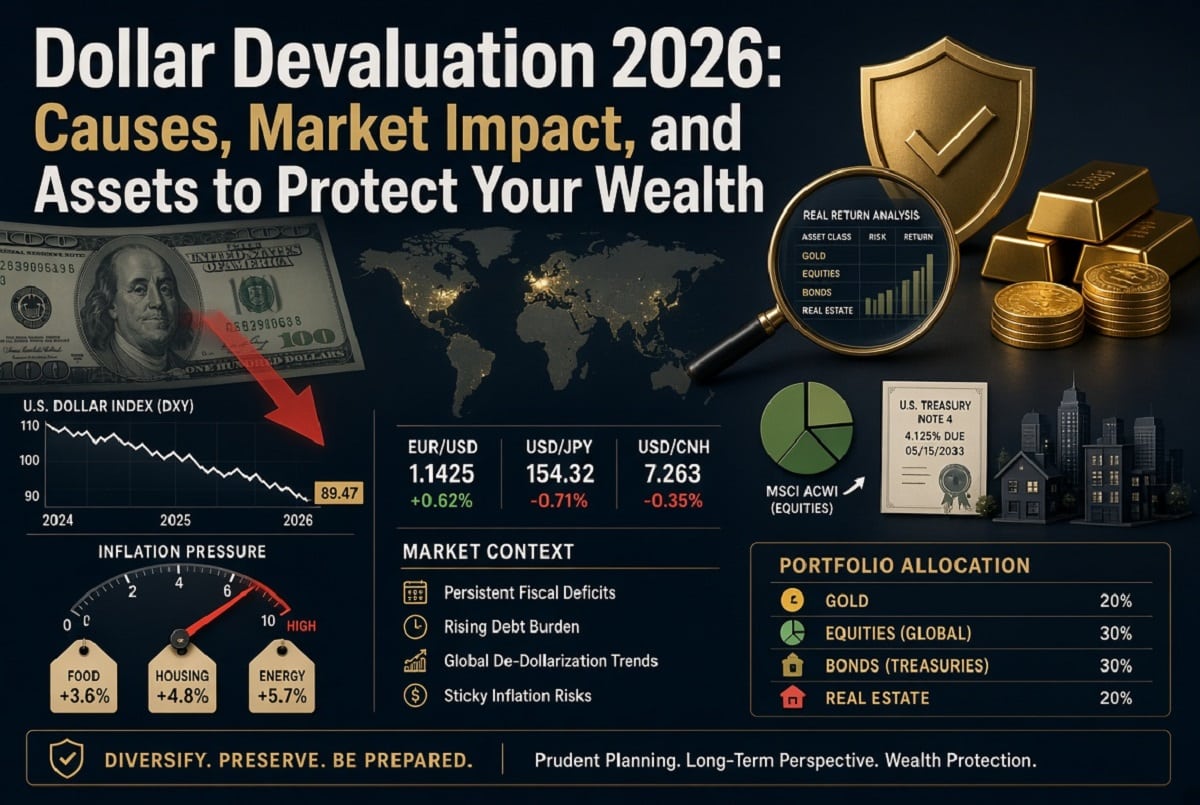
Here’s the number that tells the story best: the Dollar Index (DXY), which measures the greenback against six major currencies, fell roughly 10% through 2025, dropping from highs near 110 down into the high-90s by early 2026. That’s one of the dollar’s worst annual stretches in decades. It’s not a random wobble either. There’s a specific chain of causes behind it, and — more importantly for anyone reading this instead of a Wall Street trading desk — there are specific, practical moves you can make with your own money in response. That’s really what this guide is for. Not another theory lecture. An actual plan.
What Does Dollar Devaluation Actually Mean?
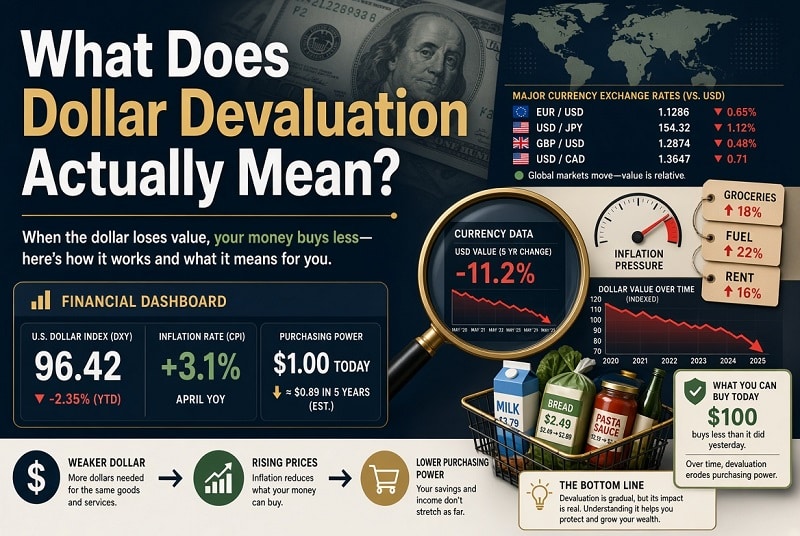
Quick definition first, because a lot of coverage on this topic throws the term around loosely. Devaluation technically refers to a government or central bank deliberately lowering its currency’s value, usually under a fixed or managed exchange rate. What’s happening to the dollar right now is closer to depreciation — a market-driven decline based on investor behavior, interest rate differentials, and fiscal conditions rather than a formal policy decision. In everyday conversation, though, “usd devaluation” and “dollar depreciation” get used interchangeably, and honestly, for the purpose of protecting your money, the distinction matters less than understanding why it’s happening and what to do about it.
Why Is the Dollar Weakening Right Now?
A few forces are stacked on top of each other here, and it’s worth walking through each one rather than lumping them into one vague “the economy is bad” explanation.
The debt load has gotten genuinely enormous
US national debt hit $38.56 trillion in February 2026, up $2.35 trillion from a year earlier. The Congressional Budget Office expects debt to cross 101% of GDP in 2026 and keep climbing toward record territory by 2030. That kind of debt load creates what economists call “fiscal dominance” — a situation where the Fed effectively gets pressured into keeping rates lower than it otherwise would, or into buying more government debt, just to keep the interest payments manageable. Investors see that pressure building and start pricing in a weaker dollar ahead of time, because more currency in circulation, chasing the same amount of goods, is the textbook setup for American dollar devaluation over time.
Federal Reserve independence has come under real pressure
Political scrutiny of Fed leadership, including a public investigation into the sitting Fed Chair and speculation around a more market-friendly (or politically aligned) successor, has rattled the kind of investors who care less about any single rate decision and more about whether the institution setting rates is doing so independently. Currency markets tend to punish that kind of uncertainty fast.
Tariff policy added another leg down.
When a broad round of new tariffs was announced in April 2025, the dollar index broke below the 100 mark for the first time in a while and kept sliding from there. Tariffs tend to work against the currency issuing them in ways that aren’t always obvious upfront — they raise costs for domestic businesses, invite retaliatory measures, and generally increase the kind of policy unpredictability that currency traders hate.
And then there’s de-dollarization — real, but probably overstated in the headlines.
The dollar’s share of global central bank reserves has fallen from around 71% in 1999 to somewhere in the 56-57% range now, with central banks in Asia and among BRICS nations steadily adding gold and diversifying away from US Treasuries. That’s a genuine, multi-decade shift. But it’s worth being honest about scale here too: the dollar still handles roughly half of all global SWIFT transactions, and some currency strategists argue the “de-dollarization” narrative gets exaggerated relative to how resilient actual capital flows into US markets have remained. Both things are true at once — a slow structural decline in dollar dominance, and a dollar that still runs most of the world’s plumbing.
What Dollar Devaluation Actually Does to Your Money
This is the part most coverage skips past to get to the more exciting macro debate, but it’s the part that actually matters if you’re not a hedge fund.
A weaker dollar makes imported goods more expensive, full stop — electronics, cars, clothing, anything with a global supply chain gets pricier, which shows up as inflation you feel directly. It makes travel abroad noticeably more expensive too; the same $2,000 European vacation costs meaningfully more when the dollar’s buying less euro than it used to. On the flip side, it can help US exporters and multinational companies whose overseas revenue translates back into more dollars than before — which is part of why some large-cap stocks have actually held up better than you’d expect during this stretch. And for anyone holding a lot of cash in a savings account, a devaluing dollar is a slow, quiet tax: the number in your account stays the same, but what it can actually buy keeps shrinking.
The Debasement Trade: Where Gold and Bitcoin Fit In
You’ve probably seen the term “debasement trade” floating around financial media — it refers to investors buying hard assets specifically as a hedge against currency devaluation and government debt monetization. Gold has been the most visible expression of this, pushing toward the $5,000 level amid strong safe-haven demand, driven in large part by exactly the central bank buying mentioned above. Bitcoin gets lumped into the same conversation as “digital gold,” though it behaves with a lot more volatility and a much shorter track record through a real debasement cycle, so treating it as a direct substitute for gold in a conservative portfolio is a stretch most of the institutional coverage on this topic glosses over.
Here’s where most of the big-name coverage on dollar devaluation — the Morgan Stanleys and Investopedias of the world — stops. They’ll walk you through the gold-versus-Bitcoin debate at a theoretical level and leave it there. Fine if you’re a macro analyst. Less useful if you’re actually trying to figure out where to put next month’s paycheck.
The Debasement Hedge: A Practical Action Plan
If the dollar in your bank account is quietly losing purchasing power, the response isn’t panic — it’s reallocation. Here’s a framework built specifically for investors who want steady income and capital preservation, not just theoretical inflation protection.
Dividend Aristocrats (roughly 35-40% of the hedge allocation)
These are companies that have raised their dividends for 25+ consecutive years, and a lot of them have pricing power that lets them pass rising costs on to customers — which matters a great deal when the currency backing their revenue is losing value. They also keep paying you in the meantime, which pure gold or commodities don’t.
Real Estate / REITs (roughly 25-30%)
Real assets tend to hold value better than cash during currency depreciation, and REITs specifically give you that real-asset exposure with liquidity you don’t get from owning property directly, plus income distributions that often get adjusted upward as rents rise with inflation.
Commodities / Gold (roughly 20-25%)
This is the direct debasement hedge — gold specifically has centuries of history as a store of value when paper currencies wobble, and the current central-bank buying trend mentioned earlier is adding structural demand on top of the usual safe-haven flows.
Foreign High-Yield ETFs (roughly 10-15%)
A small allocation to income-generating assets denominated in other currencies gives you a partial offset if the dollar keeps sliding against a basket of global currencies, without requiring you to actually open a foreign brokerage account.
None of this is about abandoning dollar-denominated assets entirely — that would be its own kind of overreaction. It’s about not having 100% of your wealth exposed to one currency’s ups and downs, which is a risk most people don’t think about until a stretch like the one we’re in right now. If you want a broader look at how these pieces fit into a full portfolio rather than just the devaluation-hedge slice, our guide to low-risk investments with high returns and our breakdown of the most popular investment types right now are both worth reading alongside this one.
A Simple Decision Matrix for Your Cash Savings
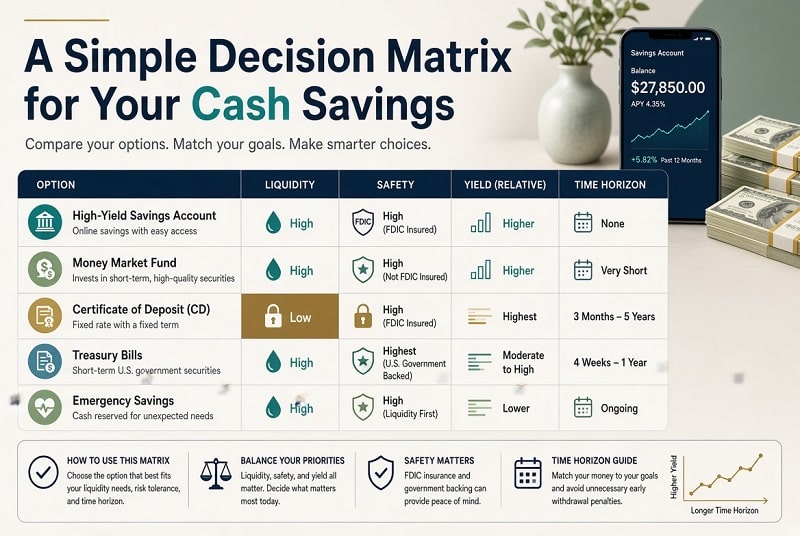
If you’re sitting on a chunk of cash and wondering what to actually do with it right now, run it through this quick framework instead of guessing:
If your cash is for an emergency fund (3-6 months of expenses) → Keep it liquid, but consider splitting a portion into a high-yield savings account or short-term Treasury bills rather than a standard 0.01%-interest checking account. You still want safety, but there’s no reason to eat the full brunt of devaluation on money you might need next month.
If your cash is earmarked for retirement, 10+ years out → This is where the debasement hedge allocation above makes the most sense. Time horizon gives you room to ride out gold and REIT volatility in exchange for real protection against a currency that’s been trending the wrong way.
If your cash is sitting there simply because you haven’t gotten around to investing it → This is the group most exposed to quiet, invisible losses. Every month that money sits in a low-yield account while the dollar loses purchasing power is a month of returns you’re not getting back. Our guide on long-term investments to maximize your returns is a reasonable next stop if this describes you.
If you’re specifically investing for retirement income → Pair the debasement hedge concept above with a broader look at retirement investment options built for financial security, since income stability matters just as much as growth when you’re no longer earning a paycheck.
Conclusion
Dollar devaluation in 2026 isn’t a fringe theory anymore — it’s a documented trend backed by a rising national debt, real questions about Fed independence, tariff-driven trade friction, and a slow but real shift away from dollar dominance in global reserves. What separates a useful response from just doom-scrolling headlines about it is having an actual plan: knowing which assets historically hold up when a currency weakens, and building a portfolio split that reflects your own timeline instead of copying a hedge fund’s playbook wholesale. Start with the decision matrix above, match it to your own situation, and build from there.
Frequently Asked Questions
Is the US dollar weakening right now?
Yes. The Dollar Index has fallen significantly from its 2025 highs, and multiple factors — rising national debt, Federal Reserve independence concerns, tariff policy, and gradual central bank de-dollarization — are all putting sustained downward pressure on the currency into 2026.
Why is the dollar weakening today?
The short answer is a combination of a growing national debt approaching 101% of GDP, expectations that the Fed will keep rates lower to manage that debt burden, political pressure on Fed leadership, and tariff-driven trade uncertainty. No single cause explains it — it’s the overlap of all of them at once that’s driven this particular stretch of dollar devaluation.
How much has the dollar devalued?
The Dollar Index dropped roughly 10% over the course of 2025 alone, moving from highs near 110 down into the high-90s range by early 2026 — one of its steepest annual declines in recent memory. A dollar devaluation chart tracking the DXY over the past two years shows this clearly as a sustained downtrend rather than a brief dip.
Is the US dollar crashing?
“Crashing” implies a sudden, disorderly collapse, and that’s not quite what’s happening — this has been a gradual, multi-month depreciation rather than a single dramatic event. That said, the cumulative decline has been steep enough that some analysts now describe it using exactly that kind of language, particularly when discussing the broader de-dollarization trend alongside it.
What assets protect against dollar devaluation?
Dividend-paying stocks with pricing power (particularly Dividend Aristocrats), real estate and REITs, gold and other commodities, and a modest allocation to foreign currency-denominated assets are the combination most commonly used to hedge against a weakening dollar, since each responds differently to currency depreciation than cash does.