

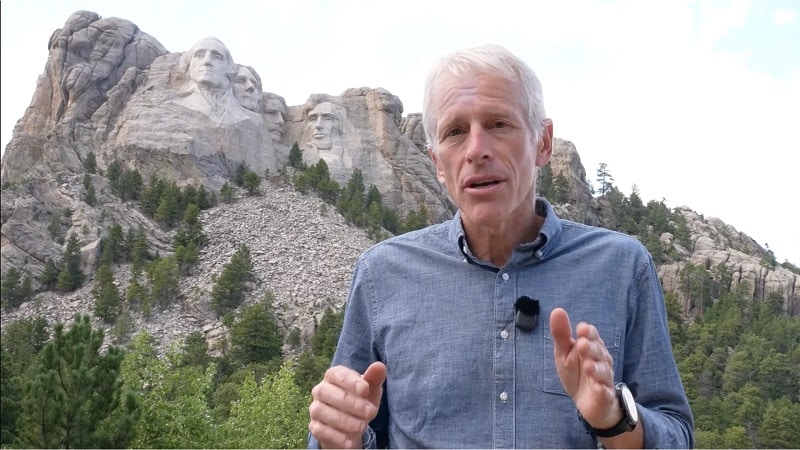
A small mining company trading around $6 has uncovered one of the biggest gold finds in American history. The discovery sits in the hills near Mount Rushmore in South Dakota. According to reports tied to the find, the company has identified roughly 114 tons of high-grade gold. That amount carries an estimated value near $22 billion. It equals about 64 percent of all the gold mined in the United States in a recent year.
The firm is Dakota Gold, ticker symbol DC. It is working to bring that gold out of the ground. Production is not expected to begin until 2029, so the company is not yet generating revenue from the deposit. Still, the size of the find has drawn quiet interest from large institutional investors, including firms such as BlackRock and Vanguard.
Whitney Tilson, a longtime Wall Street investor and editor of Commodity Supercycles, has highlighted this discovery as the opening chapter in a much larger story. He argues that artificial intelligence is now mapping and unlocking mineral deposits across the United States that remained hidden for decades. Tilson places the total potential value of America’s untapped mineral wealth at $200 trillion, a figure he attributes to estimates from the Secretary of the Interior.
Below, I’ll lay out the evidence Tilson presents, the four factors he says are driving the current resource boom, the specific examples of stocks that have already moved higher, and the research reports he offers to subscribers who want the names and tickers of the companies he currently favors.

The Mount Rushmore Gold Discovery
The Black Hills of South Dakota saw a major gold rush in the 1870s. Prospectors pulled large quantities of gold from the ground with simple tools. One mine in the region supplied roughly 10 percent of the world’s gold for a period of years. Over time the easy deposits were exhausted and activity slowed. Many assumed the remaining gold had already been found.
Recently a South Dakota company fed 145 years of historical records—old maps, drill results, and surveys—into AI-powered mining software. The system identified a previously unrecognized body of high-grade gold totaling about 114 tons. The deposit sits close enough to Mount Rushmore that descriptions place it “almost in the shadows of the presidents’ noses.”
Tilson notes that the sculptor who carved the monument a century ago had no knowledge of this wealth, nor did the millions of tourists who visit each year. The gold remained invisible until the new technology processed the old data. Dakota Gold is now advancing the project. Because commercial production is still years away, Tilson treats the stock primarily as a name to watch rather than an immediate core holding. He points instead to four other companies that he believes sit closer to cash-flow generation and could deliver faster returns.
How Artificial Intelligence Is Changing Resource Discovery
Traditional mineral exploration has a low success rate. Industry averages place the hit rate for new discoveries around 0.5 percent. Exploration budgets have also declined, and new finds fell by roughly 75 percent over the past decade. AI systems are reversing both trends.
These systems ingest decades of geological maps, drill logs, satellite imagery, and geophysical surveys. They identify patterns that human geologists often miss. One California firm, Earth AI, reports a discovery hit rate near 75 percent—150 times the traditional average—while cutting discovery costs by about 80 percent. Another system processes geophysical data 125,000 times faster than conventional methods. A third analyzes satellite data with claimed accuracy near 80 percent.
The results appear in several recent finds:
- In Sheridan County, Wyoming, scientists used AI to examine a 100-year-old coal mine owned by Randall Atkins. The system indicated large quantities of rare-earth elements under the property. Subsequent work confirmed about 1.7 million tonnes of rare earths valued near $37 billion—enough, according to the reports, to supply U.S. needs for more than a century. Shares of Ramaco Resources rose more than 700 percent in a little over six months after the news.
- In Arkansas, the U.S. Geological Survey used predictive AI on mineral samples and mapped roughly 19 million tons of lithium. That quantity is described as enough to cover all current U.S. lithium imports and to meet global demand for electric-vehicle batteries several times over. Related stocks moved sharply: one nearly doubled in three months, another rose more than 400 percent, and a third gained more than 300 percent.
- Near Mount Rushmore the same approach located the 114-ton gold deposit already described.
Tilson calls AI the largest change in mining technology since the mechanical drill. He ranks it ahead of hydraulic fracturing, open-pit methods, and steam power in its potential impact. The technology is now being applied not only to discovery but also to production efficiency and cost reduction inside existing mines.
Boom Factor 1: AI Has Mapped America’s Mineral Endowment
America has long been mineral-rich. The California gold rush of the mid-1800s extracted an estimated $50 billion (in modern terms) with picks and shovels. The Texas oil boom that began at Spindletop in 1901 produced nearly a million barrels in nine days from a single well. The more recent shale revolution added roughly $2.5 trillion to the U.S. stock market and made the country the world’s leading natural-gas producer.
AI is now producing the most detailed map yet of remaining resources. Pentagon researchers ran tens of thousands of historical maps and data sets through a system called MinMod. The result was a catalog of approximately 670,000 mineral sites across the United States. That list includes roughly 184,000 gold sites, 100,000 silver sites, and 93,000 copper sites.
Secretary of the Interior Doug Burgum has publicly valued the total endowment at $200 trillion. Independent commentary from research institutes has described American mineral and metal resources as among the largest on Earth. With the locations now more precisely known, both private companies and government agencies are accelerating efforts to develop them.
Boom Factor 2: Policy Support for Domestic Resource Production
For years the United States has imported large shares of critical minerals. Official data show complete import dependence for 16 key commodities and more than 50 percent dependence for 54 others. These materials include gallium for advanced chips, lithium for batteries, titanium for aircraft and military equipment, copper for data centers and electric vehicles, antimony for ammunition, and rare-earth elements for a wide range of modern technologies. China supplies a majority of several of these inputs.
Recent executive actions have reversed the earlier policy stance. Multiple orders aim to expand domestic mining, streamline permitting, establish price supports for certain minerals, and build strategic stockpiles. One initiative, Project Vault, commits $12 billion to mineral reserves. Official statements describe an unprecedented mobilization of resources to secure critical mineral supply chains. Companies that can locate and produce these materials with greater speed and lower cost stand to benefit directly from the policy shift.
Boom Factor 3: AI as a Practical Tool Inside Operating Mines
Beyond discovery, AI is improving output at existing operations. One copper producer used AI to identify an additional 200 million pounds of copper inside an Arizona mine. Management described the gain as equivalent to building a new mine without the capital cost or construction time. The extra production is generating hundreds of millions of dollars in annual revenue, and the company is now applying the same tools at other U.S. sites.
Another firm has created a centralized AI system that remotely controls fleets of hydraulic fracturing equipment across multiple states. The system processes roughly one billion data points each day to optimize extraction rates. Leadership has stated a goal of automating every stage of the process.
A third company is using AI to select optimal drilling locations for oil and natural gas in West Texas. It has also signed a long-term power-supply agreement with a major technology firm for a data center, linking resource production directly to the energy demands of the AI industry itself.
These operational improvements translate into higher cash flow, lower unit costs, and faster development timelines—advantages that appear in share-price performance.
Boom Factor 4: AI Has Already Lifted Stocks in Other Sectors
Whenever AI has entered a new industry, related equities have risen sharply. Semiconductor names such as Nvidia, Teradyne, and Micron recorded multi-thousand-percent gains over multi-year periods. Data-center and power-related stocks—CoreWeave, Vertiv, Hut 8, MasTec, Constellation Energy, and Bloom Energy—also delivered triple-digit and higher returns. Even computer-memory shares produced extreme moves in short windows.
Resource equities are now experiencing the same pattern. Recent examples cited by Tilson include:
- Equinor up approximately 95 percent
- Rio Tinto up 100 percent
- Intrepid Metals up 227 percent
- Cameco up 260 percent
- Ero Copper up 318 percent
- Albemarle up 329 percent
- Ivanhoe Electric up 378 percent
- Standard Lithium up 433 percent
- K2 Gold up 711 percent
- Ramaco Resources up 773 percent
These figures are historical and not typical of all investments. Past results do not guarantee future performance. Still, the pattern matches what occurred in earlier AI-driven sectors. Industry surveys indicate that full-scale AI deployment in mining is only beginning and that the market for AI mining tools is projected to expand more than twenty-fold over the next seven years.
The Four Stocks Tilson Highlights
Tilson’s research focuses on four companies he believes are positioned at the center of the AI-resource intersection. He does not name them in public presentations; the names, tickers, and full analysis appear only inside a special report titled “AI Miners: Four Stocks Unlocking America’s $200 Trillion Natural Resource Bounty.”

In outline form the four are described as follows:
- A diversified miner applying AI across exploration, production, and planning. The company aims to generate an additional $250 million in annual earnings through higher copper recovery, increased iron-ore output, and faster geological analysis. It has also partnered with a pure-play AI exploration firm that recently identified a large copper deposit valued near $80 billion.
- A copper producer that has already used AI to unlock 200 million pounds of additional copper at an Arizona operation, adding roughly $500 million in yearly revenue. Management is expanding the same technology to every other mine the company operates in the United States.
- An energy company that runs an AI “hive mind” from a central headquarters. A small team of operators remotely directs AI-controlled hydraulic fracturing fleets across seven states. The system processes a billion data points daily. The firm maintains close ties to federal policy makers.
- An oil-and-gas producer using AI to select high-probability drilling locations in West Texas. It has secured a multi-decade power-supply contract with a major technology company for a data-center project.
Tilson argues these four names offer more immediate exposure to cash-flow growth than the longer-dated Dakota Gold project.
Income-Oriented Resource Plays
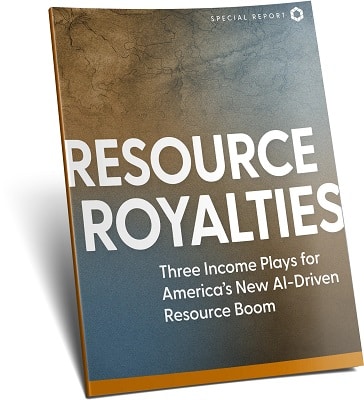
Alongside the growth-oriented miners, Tilson also recommends a second report titled “Resource Royalties: Three Income Plays for America’s New AI-Driven Resource Boom.” The three companies are structured to collect royalties or lease payments rather than operate mines or wells themselves.
- One firm holds royalty and income rights on 145 mines across North America. It receives payments on nearly four million ounces of silver and gold production, in some cases 100 percent of the stream. Collected income has risen 164 percent over the past decade, and distributions to shareholders have increased by a far larger multiple.
- A second company owns hundreds of thousands of acres of land in West Texas that contain oil and water resources. Other operators pay lease fees for access. Demand for both oil and water is expected to rise with data-center construction and continued domestic energy production.
- A third firm has accumulated land holdings over 150 years and now controls assets valued near $2 billion. It generates hundreds of millions of dollars in annual royalties. As domestic resource development expands, both the value of the land and the royalty income are projected to increase.
These three names are presented as vehicles for investors who prefer recurring cash distributions while still participating in the broader resource expansion.
A Third Report on Enhanced Geothermal Energy
A third research report, “Limitless Energy: Four Stocks That Could Power America for 30,000 Years,” covers enhanced geothermal systems (EGS). The Department of Energy has described EGS as a potential 50-state solution capable of providing virtually limitless clean energy by tapping heat trapped deep underground.
The technology is compared to the early stages of the shale revolution. The four stocks profiled are companies developing or enabling EGS projects. Tilson notes that government support, oil-and-gas industry participation, and clean-energy advocacy are all aligned behind the effort.

Whitney Tilson’s Background and Track Record
Tilson spent three decades on Wall Street. He founded a hedge-fund firm in the 1990s with minimal capital and grew it into a $200 million operation that tripled client capital over time. Public calls he made include identifying the market bottom in late 2008 on 60 Minutes, warning of the dot-com peak in 2000, and recommending Netflix in 2012 before a multi-thousand-percent rise. He also purchased Amazon in 1999 and Apple at a split-adjusted price of roughly $0.35.
Outside finance he has hiked the Presidential Traverse in New Hampshire, climbed El Capitan in Yosemite, traversed Red Rock Canyon, and explored Joshua Tree. He has also recommended a series of resource stocks that doubled or more for subscribers of Commodity Supercycles. Recent examples (names redacted while still active) produced gains of several hundred percent. The publication’s average annualized return over a recent three-year period was reported at 42.4 percent, substantially higher than the Bloomberg Commodity Index over the same window. All investments carry risk, and past performance is not a guarantee of future results.
Commodity Supercycles is published by Stansberry Research, a firm that has operated for 27 years and reaches nearly one million readers worldwide. Notable subscribers have included several well-known hedge-fund managers. Each monthly issue covers energy and natural-resource investment opportunities, provides updates on existing recommendations, and includes new ideas when warranted.
How to Obtain the Research

The three special reports and ongoing access to Commodity Supercycles are available only through a subscription. The regular annual price is $499. A limited introductory offer reduces the first-year cost to $129—a 74 percent discount. After the first year the renewal rate is $199. The subscription includes:
- Twelve monthly issues of Commodity Supercycles
- The report “AI Miners: Four Stocks Unlocking America’s $200 Trillion Natural Resource Bounty”
- The report “Resource Royalties: Three Income Plays for America’s New AI-Driven Resource Boom”
- The report “Limitless Energy: Four Stocks That Could Power America for 30,000 Years”
- Full access to the model portfolio of more than 40 active recommendations
- Two daily e-letters
- Instant access to the complete research archive
- A complimentary one-year membership to TradeStops Basic for portfolio tracking and exit-strategy tools
A 30-day money-back guarantee applies. If a subscriber is not satisfied for any reason within the first month, a full refund is issued upon request.
Tilson emphasizes that the AI-driven resource expansion is still in its early stages. Institutional capital, government policy, and technological capability are already aligned. The stocks that successfully apply AI to discovery and production have delivered large percentage gains in relatively short periods. Investors who wish to review the specific names and analysis can obtain them by starting a trial subscription.
The opportunity centers on tangible assets—gold, copper, lithium, rare earths, oil, natural gas, and geothermal heat—located inside the United States and now more precisely mapped and more efficiently extracted because of artificial intelligence. Dakota Gold’s Mount Rushmore-area discovery is one visible example. The four AI miners, the three royalty companies, and the geothermal names form the broader portfolio Tilson believes will participate in the larger trend.
Readers who want the full details, including tickers and entry guidance, can review the secure order page linked to the Commodity Supercycles offer. The research is delivered immediately upon enrollment, and the 30-day guarantee removes financial risk from the initial trial period.