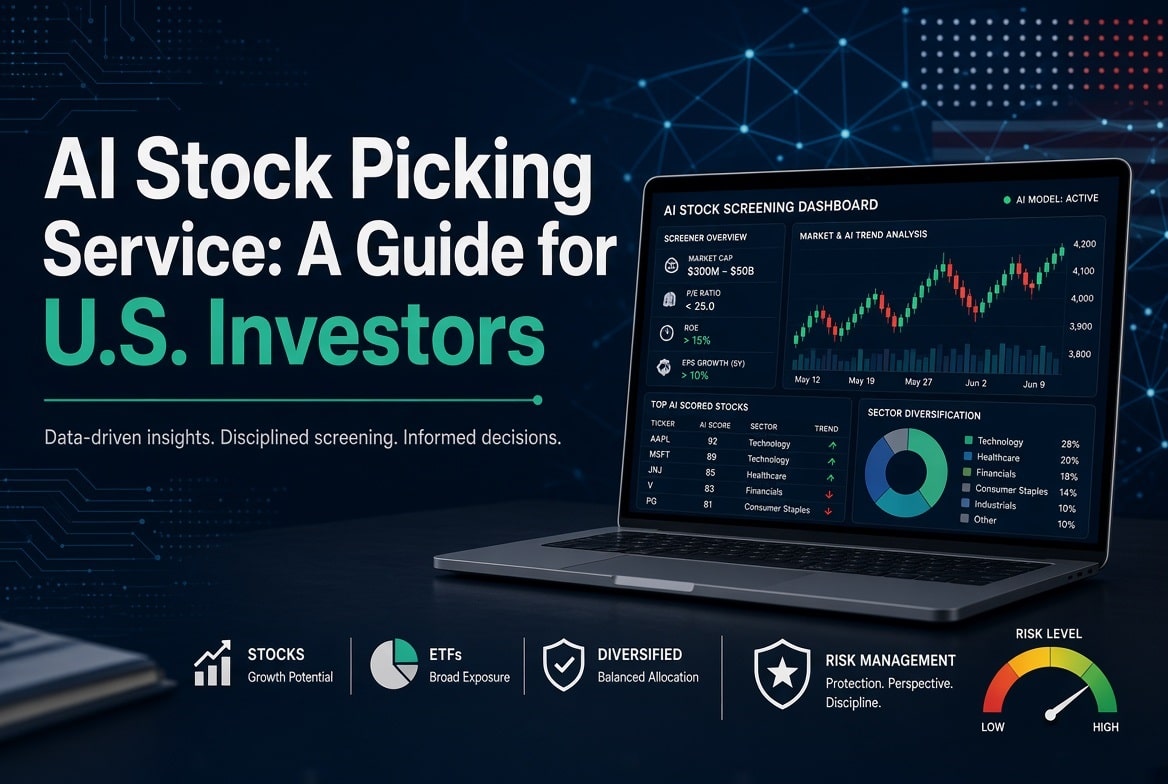
An AI stock picking service uses machine learning, market data and defined rules to identify shares that may deserve a closer look. For U.S. investors, the appeal is clear: faster analysis across thousands of stocks, earnings reports, price trends and changing market conditions.
But AI-generated picks are not the same as guaranteed winners, or fully automated trading. Here’s how these services work, how they differ from screeners and trading systems, and what to evaluate before relying on one.
Key takeaways
- Use AI stock picks to accelerate research, not replace investment judgment.
- Prioritize transparent methodology, current data, and clear explanations of each recommendation’s drivers and risks.
- Evaluate backtests carefully; favor complete, independently verifiable live results across varied market conditions.
- Check valuation, cash flow, balance-sheet strength, dividend durability, and portfolio fit before investing.
- AI models can fail when markets change, data is incomplete, or sentiment creates short-term noise.
- Diversification, patience, and a strategy aligned with your goals remain more important than any AI score.
What Is an AI Stock Picking Service?
An AI stock picking service uses artificial intelligence to sift through far more market information than any individual investor can reasonably review each day. It may assess company financials, earnings-call transcripts, price trends, analyst revisions, economic data, and news sentiment to identify potential stock picks or flag changing risks. The goal is not to replace judgment with a black box.
At Steady Income, I view AI as a powerful research assistant: one that can surface patterns, rank opportunities, and generate timely investment ideas, while investors still decide whether a recommendation fits their goals, time horizon, and tolerance for risk. Different services take different approaches to stock picking. Some focus on short-term signals and frequent trading; others look for durable businesses, dividend strength, or improving fundamentals. The quality of the underlying data, the clarity of the methodology, and a service’s record through varied market conditions matter far more than an “AI” label. Used thoughtfully, an AI stock picking service can make stock research faster and more systematic, not certain.

AI Stock Pickers, Stock Screeners and Algorithmic Trading
AI stock pickers are becoming a familiar part of the modern investor’s toolkit, but they are best treated as research assistants rather than automatic routes to returns. A good stock screener can quickly narrow a large market into companies that meet clear criteria: dependable cash flow, reasonable valuation, dividend cover or a particular growth profile. That saves time and can make the first stage of investing more disciplined.
A stock picker powered by artificial intelligence may go further, scanning news, earnings releases, price patterns and market data for signals a human could miss. Algorithmic trading applies similar technology to placing and managing trades according to pre-set rules, often at speeds that are irrelevant to most private investors. The important question is not whether these tools are sophisticated, but whether their output supports a sound investment case. I use data-driven tools to test ideas, not to outsource judgement. For long-term investing, a clear strategy, sensible diversification and an understanding of risk remain more valuable than any black-box trading signal.
How AI Stock Tools Differ
| Tool | Primary role | Typical inputs | Useful for private investors | Key limitation |
|---|---|---|---|---|
| Stock screener | Narrows a large market to companies meeting defined criteria. | Cash flow, valuation, dividend cover and growth characteristics. | Saving time and making the first stage of investment research more disciplined. | Identifies candidates but does not establish a complete investment case. |
| AI stock picker | Searches for potential signals that a human may miss. | News, earnings releases, price patterns and market data. | Testing investment ideas and supporting research. | Its output should not replace personal judgement, strategy or risk awareness. |
| Algorithmic trading system | Places and manages trades according to pre-set rules. | Similar market and price data, combined with trading rules. | Limited value for most private investors, as its speed is often irrelevant to them. | Does not replace sensible diversification, a clear strategy or an understanding of risk. |
How Machine Learning Turns Market Data Into Stock Selections
Machine learning gives investors a more disciplined way to work through the volume of data that moves modern markets. Rather than relying on a single ratio or a headline, a model can compare thousands of observations across company fundamentals, price behavior, earnings trends, economic indicators and market sentiment. The goal is not to predict every move in the market. It is to identify patterns that may help distinguish stronger stock selections from weaker ones.
At Steady Income, I view this as an extension of sound investment analysis, not a replacement for it. A machine-learning model can be trained on historical data, analyzing how combinations of variables have related to returns, volatility or dividend reliability. It may incorporate earnings revisions, valuation measures, balance-sheet quality, trading signals, relevant news and broader sentiment. The output is often a set of scores: a relative score for each company based on the factors the model finds meaningful. An AI score is most useful when it is transparent about what it measures and is considered alongside business quality, valuation and current market conditions, not as a black-box instruction to buy or sell.

How to Evaluate an AI Stock Picking Service Before You Subscribe
An AI stock picking service should earn your confidence with a process you can inspect, not a stream of impressive-looking recommendations. Before subscribing, I look at the quality and range of the underlying data, how clearly the provider explains its research methodology, and whether its analysis translates into a usable investing strategy.
The best tools do more than assign an AI score or flag a possible opportunity; they show what is driving the assessment, where the risks sit, and how current the information is. It is also worth checking whether results are presented across different market conditions rather than only during a favorable stretch. For example, Prospero AI may appeal to investors who want data-led ideas, but the important question is how its signals fit your own time horizon, risk tolerance, and portfolio rules. Treat any score as a starting point for further research, not a substitute for judgment. A worthwhile service makes your decision-making more disciplined and efficient while leaving you in control of the final buy, sell, or hold decision.
Subscription evaluation checklist
- Inspect data sources, market coverage, update frequency, and whether the provider explains how information is verified.
- Look for a clear methodology behind each recommendation, including the factors that drive scores, rankings, and signals.
- Check whether performance results include multiple market conditions, drawdowns, fees, and realistic assumptions rather than favorable periods alone.
- Confirm that recommendations match your investment horizon, risk tolerance, diversification needs, and existing portfolio rules.
- Prioritize services that explain key risks, uncertainty, and possible counterarguments alongside potential opportunities.
- Review how current each signal is and whether the tool identifies material news, earnings changes, or shifting fundamentals.
- Treat AI-generated ideas as research prompts; retain responsibility for every final buy, sell, or hold decision.
How to Read Backtests, Live Results and Risk Claims
A polished record of stock picks can be useful, but it is not the same as proof that a strategy will work with your money in the live market. As investors, we should separate a backtested model from live, independently verifiable results. Backtests apply today’s rules to historic data; that process can reveal whether an investment idea has merit, but it can also hide assumptions about trading costs, taxes, liquidity and the availability of information at the time. Look for a clear methodology, a sensible benchmark and full disclosure of losing periods, not simply a headline return. With live results, check dates, position sizing, entry prices and whether every recommendation is included.
Risk claims deserve the same scrutiny. “Lower risk” should mean something measurable: drawdowns, volatility, diversification and the likelihood of permanent capital loss. No stock strategy removes risk, particularly when market conditions change. At Steady Income, I would rather see a credible process and candid data than a model presented as certainty.

A Disciplined Workflow for Using AI Investment Ideas
AI can widen the field of investment ideas, but it cannot replace the judgment required to turn a prompt into a sound decision. I treat its output as a starting point for research, not a shortcut around it. A useful workflow begins with a clear question: are you looking for income, durable growth, value, or a specific industry exposure? From there, use AI to surface relevant stocks, including individual stocks that fit your criteria, summarize filings, compare business models, and identify questions worth testing. Then do the essential analysis yourself: read the latest results, assess balance-sheet strength, examine cash flow, and understand what could challenge the investment case.
Keep a written record of why a company made your shortlist and what would prove you wrong. That discipline improves stock selections and prevents exciting narratives from driving stock picking. For investors, AI is most valuable when it saves time on routine research while leaving valuation, risk tolerance, portfolio fit, and trading decisions in human hands. Good investing still depends on patience, skepticism, and knowing the business behind the ticker.
AI Research Workflow
- Define your objective: income, growth, value, or targeted industry exposure.
- Use AI to screen ideas, summarize filings, compare businesses, and surface research questions.
- Verify AI findings through current earnings reports, regulatory filings, and reliable primary sources.
- Assess balance-sheet strength, cash-flow quality, competitive position, and valuation independently.
- Document why each company belongs on your shortlist and which facts would invalidate the thesis.
- Test portfolio fit, downside risks, position size, and alignment with your personal risk tolerance.
- Let AI save research time, while keeping investment decisions grounded in patient human judgment.
Using AI Stock Picks for Long-Term and Income Investing
AI stock picks can be a useful starting point for investors, but they are not a substitute for understanding what you own. The best tools can sift through earnings reports, valuation measures, price trends and analyst revisions far faster than any individual investor. That can sharpen your research process, especially when you are comparing a broad list of stocks for a long-term investment portfolio. Still, I view AI-driven analysis as an input, not the strategy itself. A sound income approach also considers dividend durability, balance-sheet strength, cash flow, management discipline and the role each stock plays alongside your other holdings.
An attractive yield means little if future earnings cannot support it. Likewise, a highly rated stock pick may not fit an investor who needs reliable income, lower volatility or diversification across sectors. Use AI to surface ideas and challenge assumptions, then apply your own investing framework before committing capital. The most durable results usually come from patience, sensible valuation and a strategy built around your financial goals.
Key Risks of AI Stock Picks and Who Should Be Careful
AI stock-picking tools can be useful research assistants, but they are not a substitute for judgement, patience or a clear investment plan. Artificial intelligence works from data: company filings, price histories, news flows and technical indicators. That data can be incomplete, backward-looking or distorted by unusual events. A model may identify patterns that performed well in previous markets without recognising when the conditions behind them have changed.
Market sentiment is another weak point. Trading systems can react quickly to headlines and social-media signals, yet they cannot reliably separate temporary noise from a lasting shift in a business’s prospects. Investors should be especially careful if they are new to markets, need access to their money in the near term, or are tempted to concentrate a portfolio behind a single AI recommendation. Treat any automated pick as a prompt for further work: check valuation, balance-sheet strength, dividend cover and the risks specific to the company. At Steady Income, we see technology as an aid to disciplined analysis, not a replacement for it.
AI Stock Picking Service FAQs and the Bottom Line
An AI stock picking service can be a useful research assistant, but it is not a substitute for judgment. The best AI stock pickers sift through large data sets, flag changing fundamentals, compare valuations, and surface stock ideas that may deserve a closer look. That can save time for investors who want a more disciplined starting point. Still, every stock picker has limits: models work from available information, can misread unusual conditions, and cannot eliminate market risk.
Before acting on stock picks, I would check the underlying thesis, the company’s financial position, valuation, and how the investment fits your income needs and risk tolerance. Ask how the service produces its recommendations, how often results are reviewed, and whether its historical record includes losing periods as well as winners. The bottom line is simple: use AI to strengthen research, not to hand over responsibility for your portfolio. A sound investment process still depends on diversification, patience, and knowing why you own each stock.
Frequently asked questions
Are AI stock picking services worth using?
They can be useful if they save research time and help you compare opportunities systematically. Their value depends on transparent methodology, reliable data and how well the ideas fit your own investment strategy. Treat AI-generated stock picks as research prompts, not instructions to trade.
Can AI predict which stocks will go up?
No. AI can identify historical patterns in fundamentals, valuations, earnings revisions, price data and sentiment, but markets change and future returns are uncertain. A strong AI score is not a guarantee that a share price will rise or that a dividend will remain secure.
What should I look for in an AI stock picker?
Look for clear explanations of the data and factors used, regular updates, realistic risk disclosures and results shown across different market conditions. Check whether backtests account for costs, liquidity and timing, and whether live recommendations include losing positions as well as winners.
What is the difference between an AI stock picker and a stock screener?
A stock screener filters shares using rules you choose, such as dividend yield, price-to-earnings ratio or debt levels. An AI stock picker may analyze a wider set of inputs and rank companies using machine-learning models. Both are starting points for further research.
Are AI stock picks suitable for long-term income investors?
They can help investors find candidates, but income investing still requires analysis of dividend cover, free cash flow, debt, earnings resilience and valuation. A highly rated AI pick may not suit a portfolio built for dependable income, lower volatility or sector diversification.
How should I use an AI stock recommendation?
Use it to begin your due diligence. Read recent results and filings, understand the business model, assess the balance sheet and compare valuation with peers. Decide in advance how the holding would fit your portfolio, what could invalidate the investment case and how much risk you can accept.
What are the main risks of AI investing tools?
Models can rely on incomplete or backward-looking data, overfit historical results or struggle when market conditions shift. News and sentiment signals may also mistake short-term noise for a meaningful change. Avoid concentrating capital in one recommendation and retain control of buy, sell and hold decisions.