Quick Verdict
Jeff Brown’s M.A.G.I. promotion presents a high-growth technology investing thesis centered on artificial intelligence, humanoid robotics, semiconductors, Tesla Optimus, and the suppliers that could benefit if embodied AI moves from demonstration to mass commercialization.
The package’s most compelling feature is not any one “secret” M.A.G.I. stock. It is the combination of Jeff Brown’s technology-focused Near Future Report with Marc Chaikin’s Power Gauge research system, which evaluates stocks using 20 factors spanning financials, earnings, technical behavior, and market sentiment. That combination may appeal to self-directed investors who want both thematic research and a repeatable stock-screening framework.
Still, investors should approach all headline projections—including claims about a “$1 quadrillion wealth wave,” future Tesla chip output, or enormous potential returns—with caution. These are promotional forecasts, not guarantees. Humanoid robotics is an early, uncertain, capital-intensive market, and smaller technology suppliers can be especially volatile.
Key Moments
- Jeff Brown’s M.A.G.I. thesis stands for “Manifested AGI,” or artificial intelligence designed to operate in the physical world through systems such as Tesla Optimus.
- The investment narrative connects Tesla’s robotics hardware, xAI’s software ambitions, semiconductor capacity, automation equipment, power-management components, sensors, actuators, and advanced manufacturing.
- Rather than suggesting Tesla itself is the highest-upside play, the presentation emphasizes smaller companies in Tesla’s potential supply chain.
- The offer combines The Near Future Report and Marc Chaikin’s Power Gauge Report, alongside stock ratings, model-portfolio access, updates, alerts, archived research, and bonus reports.
- The advertised introductory price is $179 for 12 months, versus a cited regular price of $499, with renewal terms that investors should verify before subscribing.
- The central risk is simple: a compelling AI story does not automatically produce profitable investments, especially when valuations, execution risks, competition, and adoption timelines are uncertain.
What Is Jeff Brown’s M.A.G.I.?
Jeff Brown’s M.A.G.I. investment pitch is built around a provocative concept: the next major AI opportunity may not be another chatbot, cloud platform, or semiconductor designer. Instead, it may come from artificial intelligence leaving the screen and entering the physical world.
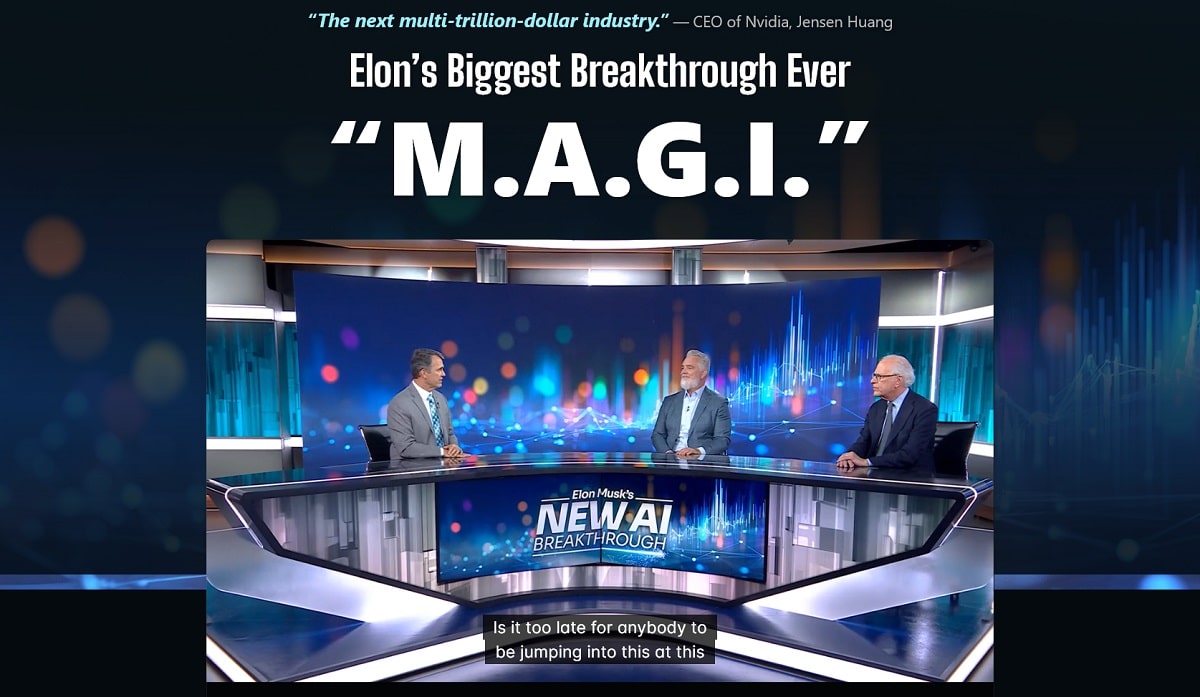
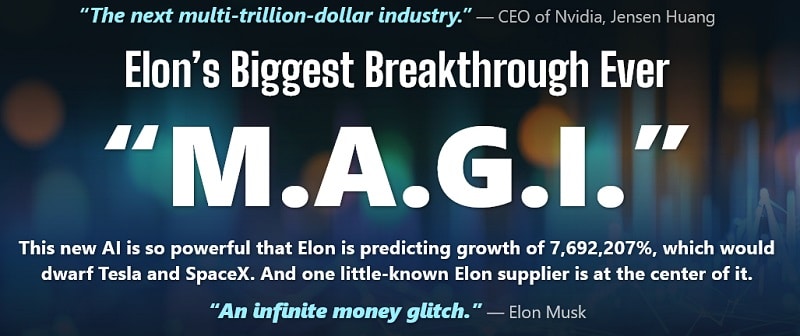
In the promotional language surrounding the offer, M.A.G.I. means Manifested AGI. The phrase refers to highly capable AI systems that can perceive the world, reason about tasks, make decisions, and physically perform work through machines. Tesla Optimus, often described as a humanoid robot program, is positioned as the central example of this theme.
The idea is easy to understand. Generative AI can write, analyze, code, translate, summarize, and interact through text, images, audio, and software interfaces. A humanoid robot needs to do more. It needs to move safely, balance, manipulate objects, understand physical surroundings, react to change, conserve power, and complete tasks repeatedly in an unpredictable environment.
That is a much harder challenge than producing a polished language-model response.
For investors, however, the M.A.G.I. thesis is not solely about whether one humanoid robot succeeds. It is about the potential industrial ecosystem that may emerge if robots become commercially useful across factories, warehouses, logistics facilities, healthcare environments, construction sites, retail operations, and eventually homes.
A humanoid robot cannot operate without a broad stack of technologies:
- AI chips and computing hardware
- Training data and machine-learning software
- Cameras, sensors, and vision systems
- Motors, gears, actuators, and precision components
- Batteries and energy-management systems
- Power semiconductors and thermal-control systems
- Advanced manufacturing equipment
- Connectivity, cloud infrastructure, and edge computing
- Safety systems and industrial automation software
That is why Jeff Brown’s M.A.G.I. message focuses heavily on potential suppliers rather than only on Tesla. A large platform company may capture a sizable share of a new market, but specialized suppliers sometimes experience faster revenue growth when a new production cycle begins.
This does not mean every Tesla-linked company will become a winner. Supply-chain investing can be difficult because commercial relationships evolve, supplier contracts can be short-lived, margins may be pressured, and investors often price in future success before revenue materializes. But it explains the logic behind the “smaller supplier” angle.
The M.A.G.I. Stock Thesis
The core investment argument is that humanoid robotics could become a major technology platform, comparable in significance to smartphones, cloud computing, electric vehicles, the internet, or generative AI.
That comparison should be treated as a long-term possibility, not a settled fact. Yet the building blocks are increasingly visible. AI models have improved rapidly. Computer vision has advanced. Battery technology is improving. Factories are already highly automated. Semiconductor companies are producing more capable chips. Robotics companies are developing better mechanical systems.
The question is not whether robots will exist. They already do.
The question is whether humanoid robots can reach a point where they are affordable, reliable, safe, productive, and easy enough to deploy at scale. If that happens, the demand for the components and infrastructure behind those robots could rise dramatically.
Jeff Brown’s M.A.G.I. thesis essentially asks investors to look beyond the most obvious names. Nvidia has become synonymous with AI infrastructure. Tesla has become synonymous with electric vehicles and increasingly with robotics ambitions. AMD, Taiwan Semiconductor, Micron, Palo Alto Networks, and Arista Networks have all been important names in different technology investment cycles.
But when a new hardware category forms, the largest gains sometimes occur in companies that solve a specific bottleneck.
For embodied AI and humanoid robotics, those bottlenecks could include:
- Energy efficiency
- Motion control
- Precision actuation
- Heat management
- Sensor fusion
- Semiconductor fabrication
- AI inference hardware
- Advanced packaging
- Robotics software
- Manufacturing scalability
An investor evaluating a potential M.A.G.I. stock should therefore ask more precise questions than, “Does this company work with Tesla?”
A stronger research process would examine:
- Does the company disclose a real commercial relationship, pilot program, or supply agreement?
- Is its technology genuinely differentiated?
- Can the product be used across several robotics or industrial markets, rather than depending on one customer?
- Are revenues already growing, or is the investment case mostly speculative?
- Does the company have adequate margins, cash flow, and balance-sheet flexibility?
- Is the stock valuation reasonable relative to execution risk?
- What would invalidate the thesis?
The Power Gauge framework is relevant here because it attempts to move beyond a story-driven investment decision. The system combines 20 factors into a single rating designed to assess a stock’s momentum and potential for growth.
Those factors are generally organized around four broad categories:
| Power Gauge category | What it is designed to evaluate |
|---|---|
| Financial metrics | Valuation, debt, profitability, cash flow, and financial quality |
| Earnings performance | Growth, surprises, revisions, estimates, and consistency |
| Technical indicators | Price strength, relative performance, momentum, and volume behavior |
| Expert sentiment | Analyst ratings, institutional activity, industry strength, and insider behavior |
This matters because a company can be part of an exciting technology narrative while still being a poor investment at a given price. A compelling story cannot replace financial analysis, risk assessment, or discipline around position sizing.
Tesla Optimus and Manifested AI
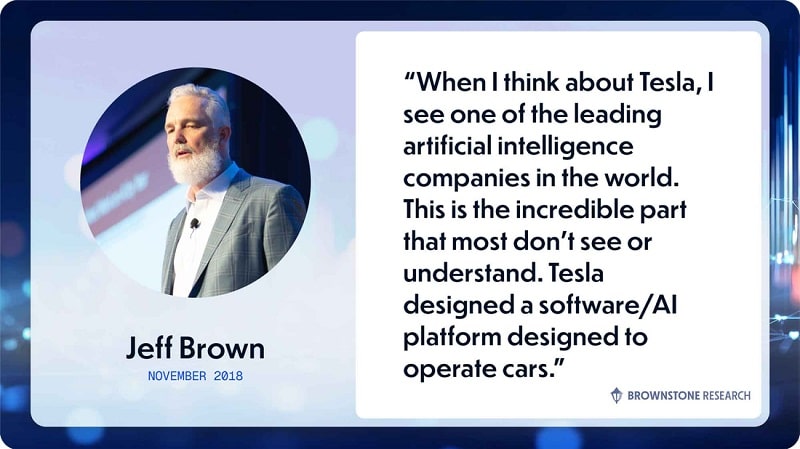
Tesla Optimus is at the center of the M.A.G.I. presentation because it represents the ambition to combine AI software with a physical humanoid machine.
The long-term vision is ambitious: a robot that can navigate human-designed environments, use tools, carry materials, perform repetitive tasks, and eventually help address labor shortages or reduce the cost of routine work. In theory, a broadly capable robot could have applications far beyond manufacturing.
However, the distance between an impressive demonstration and large-scale commercial deployment can be substantial.
A robot designed for the real world must deal with variability. A warehouse aisle might be cluttered. A tool may be misplaced. Lighting can change. A package may be damaged. A surface can be slippery. An object may break. A person can suddenly enter its path.
Software must interpret these situations. Hardware must respond accurately. The machine needs enough battery capacity to be economically viable. It needs to be repairable, safe, manufacturable, and inexpensive enough that a business can justify buying or leasing it.
That is why the suppliers behind robotics may be as important as the robot maker itself.
Power management
Humanoid robots require significant electrical power. Their joints, arms, legs, hands, sensors, and onboard computing systems all consume energy. Efficient power management can influence battery life, heat generation, performance, reliability, and operating cost.
Power-control chips, motor drivers, voltage regulators, inverters, battery-management systems, and related equipment may therefore become important components of an embodied-AI supply chain.
Actuators and motors
A humanoid robot needs to translate software instructions into movement. That requires actuators, motors, control systems, gears, sensors, and precision mechanical parts.
The challenge is not merely to make a robot move. It is to make it move with enough precision, speed, durability, and energy efficiency to perform useful work.
Semiconductors
AI systems require immense computational power. Training models requires data-center-scale infrastructure, while operating robots may require compact, efficient inference hardware that can process sensor data and make decisions in real time.
Tesla’s AI chip roadmap is a prominent part of the promotional M.A.G.I. narrative. The appeal is clear: if Tesla or another major platform company produces chips in high volumes, companies supplying fabrication equipment, packaging technology, manufacturing systems, materials, or testing equipment could potentially benefit.
Yet chip manufacturing is one of the most complex industries in the world. Production plans can shift, timelines can move, and capital spending can fluctuate sharply. Investors should differentiate between confirmed orders, preliminary discussions, long-range targets, and promotional speculation.
AI software and training
A robot’s mechanical system is only part of the equation. It also needs intelligence.
The M.A.G.I. pitch connects xAI and Grok to the broader Musk ecosystem. Conceptually, that makes sense: language models, vision models, reinforcement learning, simulation, and multimodal AI could help robots understand instructions and operate in physical spaces.
But investors should resist oversimplifying the relationship between large language models and real-world robotics. A chatbot that can answer questions is not automatically a safe, reliable industrial robot controller. Robotics requires low-latency control, perception, planning, safety constraints, and continuous adaptation.
What Is The Near Future Report?
The Near Future Report is Brownstone Research’s flagship technology-focused investment advisory. It is designed for self-directed investors seeking exposure to technologies nearing mass adoption while balancing established companies with high-growth opportunities.

Jeff Brown’s research often centers on themes such as:
- Artificial intelligence
- Advanced semiconductors
- Robotics and automation
- Blockchain and digital assets
- Autonomous vehicles
- Quantum computing
- Cybersecurity
- Wireless technology
- Biotechnology and innovation
- Emerging computing infrastructure
The newsletter format generally appeals to investors who want a curated idea pipeline rather than trying to track every development in rapidly changing technology sectors.
According to the promotion, the M.A.G.I. bundle includes 12 months of The Near Future Report, with one new issue per month. Each issue is positioned as a research report explaining a stock idea, the underlying trend, the investment rationale, and the intended way to approach the recommendation.
Subscribers are also said to receive access to a model portfolio, archived material, ongoing updates, and alerts related to portfolio positions.
What Marc Chaikin Adds
Marc Chaikin’s Power Gauge Report is positioned as the second major component of the M.A.G.I. package.
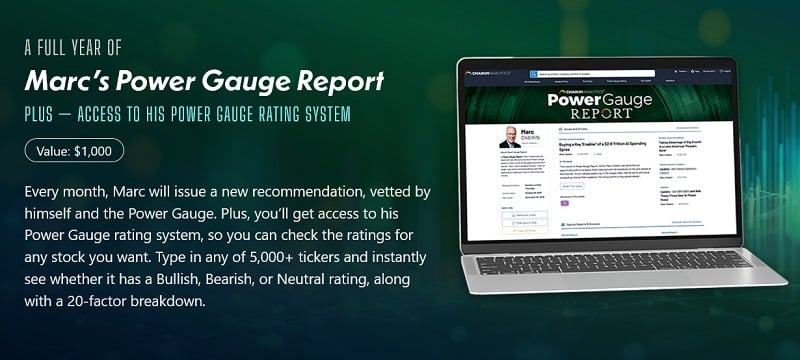
Where Jeff Brown’s work is theme-driven and technology-focused, the Power Gauge is positioned as a systematic stock-ranking tool. The Power Gauge combines 20 factors affecting potential price movement into a simplified rating.
The value proposition is straightforward. Investors frequently face too much information:
- A company has an exciting AI narrative.
- Analysts are raising price targets.
- The stock is already up sharply.
- The valuation looks expensive.
- Earnings are improving.
- Insider activity is mixed.
- Technical momentum is strong.
- The industry may be weakening.
It can be difficult to weigh all those signals consistently. A quantitative scoring framework attempts to bring order to that decision-making process.
The Power Gauge rating system may classify a stock as bullish, bearish, or neutral, using factors tied to financial quality, earnings, price behavior, and sentiment. The underlying methodology is proprietary, but its evaluation process includes areas such as debt, price-to-book value, free cash flow, earnings growth, earnings surprises, relative strength, volume trends, analyst estimate changes, short interest, insider activity, and industry performance.

This type of tool can be particularly relevant for speculative technology stocks. In fast-moving sectors, an investor can become attached to a compelling story and ignore deteriorating fundamentals or negative price behavior.
A disciplined screening process may help investors identify questions such as:
- Are earnings estimates rising or falling?
- Is the company generating free cash flow?
- Is the stock outperforming or underperforming its industry?
- Are analysts becoming more optimistic or less optimistic?
- Does the price trend confirm the thesis?
- Is the company overleveraged?
- Is the stock’s valuation disconnected from its financial progress?
The Power Gauge does not eliminate risk. No stock-rating system can guarantee returns. Quantitative models can lag sudden events, fail during unusual market conditions, or underperform when market leadership shifts.
Still, the combination of thematic research and quantitative screening is more balanced than relying solely on a dramatic prediction about Elon Musk, AI, or a future robotics boom.
The “Elon’s Biggest Breakthrough” Claim
The phrase “Elon’s biggest breakthrough ever” is designed to capture attention. It suggests that Tesla Optimus, xAI, AI chips, robotics, and a broader Musk-linked technology ecosystem could become larger than previous Musk-related ventures.
It is an ambitious claim.
Elon Musk has already been associated with companies that have shaped major sectors:
- Tesla helped accelerate global interest in electric vehicles.
- SpaceX has become a central player in commercial launch services and satellite connectivity.
- Neuralink has pursued brain-computer interface technology.
- xAI has entered the competitive generative-AI market.
- Tesla’s energy-storage business is part of the broader electrification trend.
Humanoid robotics could potentially become another large category. But potential market size and investor returns are not the same thing.
A company can lead a major technological shift while its stock produces weak returns if investors paid too much in advance. Conversely, suppliers with less glamorous businesses can benefit significantly if they sell critical equipment or components to multiple winners in the ecosystem.
That is the strategic appeal of the M.A.G.I. supplier thesis.
Instead of trying to predict exactly which company will dominate humanoid robotics, an investor might seek exposure to businesses supplying the “picks and shovels”:
- Semiconductor equipment manufacturers
- Motion-control specialists
- Power-management chip makers
- Automation equipment producers
- Vision and sensing companies
- Data-center infrastructure providers
- Industrial software companies
- Component manufacturers
The weakness is that “picks and shovels” is not automatically a safe strategy. Suppliers can be cyclical. Their revenue may depend on capital expenditure. Customers can demand lower prices. New technologies can change who captures value.
The correct question is not, “Is this company part of the AI supply chain?”
The better question is, “Does this company have a durable competitive advantage, rising demand, solid economics, and an investable valuation?”
The $1 Quadrillion Wealth Wave
The M.A.G.I. pitch includes a claim that humanoid robotics and manifested AI could potentially create a $1 quadrillion wealth wave.
This is the kind of forecast investors should interpret carefully.
Large market-size estimates are common in promotional investment copy because they help communicate the theoretical scale of an opportunity. A number in the trillions—or in this case, quadrillions—can make a trend feel urgent and transformational.
But these projections are usually built on assumptions about productivity gains, labor substitution, economic output, market adoption, hardware costs, regulation, infrastructure, and global deployment. Small changes in those assumptions can produce radically different estimates.
For example, a humanoid robot industry would need to solve several practical economic questions:
- What will a robot cost to purchase, lease, insure, maintain, and upgrade?
- How many tasks can it complete per hour?
- How reliable will it be?
- How much supervision will it require?
- What is the payback period for an employer?
- How will safety standards and liability rules evolve?
- Will workers, customers, unions, and regulators accept deployment?
- Will specialized robots outperform general-purpose humanoids in many settings?
The long-term opportunity may indeed be large. Automation has repeatedly reshaped manufacturing, logistics, agriculture, and information work. But the path can be uneven, and early expectations can be overly optimistic.
A prudent investor should separate three ideas:
- Humanoid robotics could become a major industry.
- Several companies could profit from that industry.
- Any specific stock recommendation will deliver extraordinary returns.
The first may be plausible. The second depends on business execution. The third is impossible to know in advance.
The Midterm Election Cycle Thesis
Another part of the M.A.G.I. presentation involves the U.S. midterm election cycle.
Marc Chaikin’s thesis is that a midterm-year market correction could create a lower-cost entry point into technology and robotics stocks before the broader M.A.G.I. theme becomes more widely recognized.
Historical seasonality can be useful context, but it should never become a standalone investment strategy.
Markets do not rise or fall simply because an election cycle says they should. Inflation, interest rates, corporate earnings, economic growth, credit conditions, wars, fiscal policy, trade policy, commodity prices, valuations, and investor positioning can all matter more than seasonal patterns.
The argument may be most useful as a reminder that volatility can create opportunities. Investors who have a long time horizon, maintain liquidity, and use disciplined position sizing may be better positioned to take advantage of broad market weakness.
However, buying simply because the market has declined can be dangerous. A falling market may reflect a real deterioration in earnings, growth, liquidity, or financial conditions.
A better framework is:
- Identify companies you would want to own at reasonable valuations.
- Establish target entry prices or valuation ranges.
- Avoid concentrating too heavily in one speculative theme.
- Use market pullbacks to review quality rather than to buy indiscriminately.
- Reassess the thesis when facts change.
- Maintain a diversified core portfolio.
The presentation references historical analysis suggesting the market was higher 12 months after every midterm-year decline examined since 1950. Even if a historical pattern is accurate, it does not guarantee a repeat in any future period. Historical datasets can be sensitive to definitions, selection criteria, starting and ending dates, and the small number of election cycles available for study.
Seasonality is context, not certainty.
What Comes With the M.A.G.I. Offer?
The M.A.G.I. package is structured as a bundled investment-research subscription.
| Included feature | What subscribers are told they receive | Why it may matter |
|---|---|---|
| The Near Future Report | A 12-month technology research subscription with new monthly issues | Provides a stream of thematic ideas tied to AI, chips, robotics, and other emerging technologies |
| Power Gauge Report | A 12-month Chaikin research service | Adds a separate stock-selection methodology |
| Power Gauge ratings | Access to stock and ETF ratings based on 20 factors | Can help investors compare fundamental, technical, and sentiment signals |
| Model portfolio | Online access to current recommended positions and stated buy ranges | Helps distinguish active recommendations from old archived ideas |
| Weekly updates | Ongoing research updates on companies and themes | Provides follow-up rather than leaving subscribers with a one-time report |
| Urgent alerts | Time-sensitive notices when the publisher believes action may be needed | Can be useful during earnings, market volatility, or thesis changes |
| Digital Tech Vault | Archive access to prior reports and issues | Lets members review past research and historical recommendations |
| M.A.G.I. bonus reports | Three reports focused on Tesla suppliers, chip manufacturing, and election-cycle picks | Adds targeted research around the central promotion |
| Customer support | Billing, access, navigation, cancellation, and report-location assistance | Helps with administrative issues but is not personalized investment advice |
A bundle can be more valuable than a single newsletter when the services are genuinely complementary. In this case, Brown’s technology research and Chaikin’s factor-based rating approach address different parts of an investment decision.
Brown’s research attempts to answer, “What technological transformation may matter next?”
Chaikin’s framework attempts to answer, “What does the current market and financial data suggest about this stock?”
That said, subscribers should review the exact order page, confirmation email, renewal conditions, and the service-specific terms before buying.
The Three M.A.G.I. Bonus Reports
These reports are central to the presentation because they promise targeted access to the names behind the M.A.G.I. thesis.
The Elon Musk Moonshot
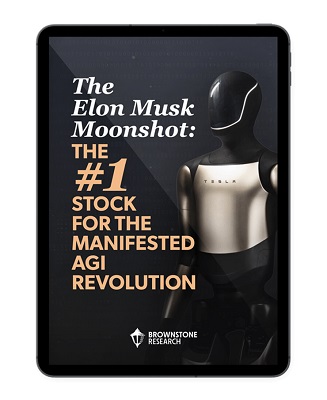
The first report is described as identifying a lesser-known company supplying Tesla with power-control technology that may also be relevant to humanoid robotics.
The proposed logic is reasonable at a high level. Robots need efficient electrical systems. Motors and actuators require energy. Heat can reduce performance and reliability. Battery life is a major constraint. A company with differentiated power-management technology could be relevant to several fast-growing industries, including EVs, industrial automation, renewable energy, data centers, and robotics.
But an investor should verify several things before treating a company as a high-conviction M.A.G.I. stock:
- Is the Tesla relationship officially disclosed?
- What percentage of revenue comes from Tesla or related customers?
- Is the company profitable?
- How dependent is it on cyclical semiconductor demand?
- Does it face commodity, pricing, or customer-concentration risk?
- Does its technology have a defensible moat?
- Has the stock already priced in the robotics narrative?
How to Profit From Elon Musk’s New Terafab Project
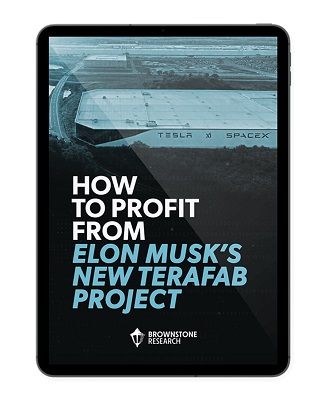
The second bonus report focuses on Tesla’s proposed semiconductor manufacturing ambitions and identifies a company said to provide equipment needed to manufacture advanced chips.
This is a classic semiconductor “picks and shovels” angle. Chip fabrication requires complex equipment, materials, automation tools, metrology systems, testing technologies, packaging services, and highly specialized manufacturing know-how.
If Tesla builds or expands chip manufacturing capacity, the beneficiaries may include equipment suppliers rather than only the chip designer. This is why investors closely track semiconductor capital-expenditure cycles.
However, semiconductor equipment investing carries its own risks:
- Fab projects can be delayed or scaled back.
- Spending may be cyclical.
- Export controls and geopolitics can affect demand.
- Equipment suppliers can experience sharp valuation swings.
- Customer concentration can be significant.
- Advanced-node manufacturing is dominated by powerful incumbents with established ecosystems.
A supplier story becomes more compelling when the company has diverse customers and exposure to several long-term drivers, rather than relying on one high-profile project.
The Chaikin Buy List for the Midterm Election Cycle

The third report is described as a list of companies selected through Chaikin’s Power Gauge system for the current election cycle.
This is arguably the least dependent on the Musk narrative. It offers a broader screen of stocks that score well under a systematic model.
The potential benefit is diversification. Rather than putting all attention on humanoid robots or Tesla-linked suppliers, a quantitative buy list may surface opportunities in other sectors where earnings, valuation, technical strength, and sentiment align.
The limitation is that quantitative rankings are dynamic. A stock’s score can change as earnings estimates, price trends, market conditions, industry behavior, and analyst opinions shift. Investors should not assume that a list created at one point remains equally relevant months later.
Jeff Brown’s Track Record
The presentation cites large historical peak gains associated with Jeff Brown’s technology recommendations, including figures for Nvidia, Tesla, AMD, Taiwan Semiconductor, Micron Technology, Palo Alto Networks, and Arista Networks.
Those companies have all participated in significant technology trends over time:
- Nvidia benefited from leadership in graphics processing and AI computing.
- Tesla became a major force in electric vehicles and energy storage.
- AMD gained share in CPUs, GPUs, and data-center chips.
- Taiwan Semiconductor became essential to advanced global chip manufacturing.
- Micron has benefited from memory-demand cycles.
- Palo Alto Networks has been a major cybersecurity company.
- Arista Networks has benefited from cloud networking and data-center growth.
Past winners can demonstrate that a researcher recognized an important trend early. But investors should evaluate performance claims with precision.
“Peak gain” is not the same as “typical subscriber return.”
A peak gain may assume buying at a particular entry price and holding through a specific high point. Actual results can vary because subscribers may buy late, sell early, use different position sizes, miss updates, pay taxes, trade in a different currency, or hold through volatility differently.
The presentation appropriately notes that cited gains are peak figures and that timing and exit prices affect actual outcomes.
This distinction is crucial. Promotional materials often highlight the most successful historical recommendations because they are memorable. Investors should also ask:
- How many recommendations were made in the same period?
- What were the losses and drawdowns?
- What was the average return?
- What was the median return?
- How long were positions held?
- How concentrated was the portfolio?
- Were results independently audited?
- How did performance compare with relevant benchmarks?
A strong research service does not need every pick to be a winner. It needs a disciplined process, transparent updates, risk controls, and a record that can be evaluated in context.
M.A.G.I. Offer Price and Renewal
The supplied promotion lists the following pricing structure:
| Pricing item | Advertised amount |
|---|---|
| First-year subscription | $179 |
| Cited regular annual price | $499 per year |
| Stated renewal price | $199 per year |
At $179, the effective cost is under $15 per month. For investors who would independently subscribe to both a technology newsletter and a stock-rating service, the bundle may appear attractive.
But subscription pricing deserves careful attention.
The standard pricing for The Near Future Report can vary, and introductory discounts may differ by promotion, order page, or campaign. Before purchasing, check:
- The exact first-year price.
- Whether applicable taxes are added.
- The renewal price.
- Whether renewal is automatic.
- The date by which cancellation must occur.
- How cancellation must be submitted.
- The exact refund period.
- Whether bonus reports are retained after cancellation.
- Whether access to tools or archives ends immediately after a refund.
The subscription automatically renews unless canceled at least one day before the renewal date. Because promotions and policies can change, it is prudent to rely on the checkout page and order confirmation rather than any third-party summary.
Refund Policy and Customer Support
The M.A.G.I. promotion describes a 30-day “Ironclad” money-back guarantee. It says subscribers can review the newsletters, reports, ratings tool, and other materials during that period and request a refund if the service is not a fit.
That kind of trial window can reduce the upfront commitment, but investors should verify it before ordering.
Use the guarantee period actively if you subscribe:
- Read the latest report and at least several archived issues.
- Review the model portfolio and determine whether the risk level matches your expectations.
- Test the Power Gauge with companies you already know.
- Read all disclosures attached to recommendations.
- Locate the cancellation instructions before the guarantee deadline.
- Save your confirmation email and billing documentation.
- Put a reminder on your calendar well before the renewal date.
The goal is not simply to consume a compelling story. It is to evaluate whether the service improves your actual investment process.
Pros and Cons
Pros
- Combines technology-focused research with a quantitative stock-rating framework.
- Targets major long-term themes, including AI, semiconductors, robotics, and automation.
- Includes model-portfolio access, ongoing updates, alerts, and archived research.
- Offers a more structured approach than buying technology stocks based on headlines alone.
- The Power Gauge uses a multi-factor methodology rather than relying entirely on subjective forecasts.
- The promotional price may offer a lower-cost way to sample two research products.
- A stated refund period gives prospective subscribers a chance to evaluate the service, subject to the specific order terms.
Cons
- The central M.A.G.I. thesis is speculative and depends on uncertain robotics adoption timelines.
- Humanoid robotics stocks and Tesla-adjacent suppliers can be volatile.
- “Secret stock” framing can encourage investors to overfocus on one name rather than build a diversified portfolio.
- Past peak gains do not predict future returns.
- Quantitative ratings can be useful but cannot protect against market shocks or company-specific events.
- Subscription services typically auto-renew, making it essential to understand cancellation and renewal conditions.
- The product may be less suitable for investors seeking conservative income, low volatility, or broad-market simplicity.
Who May Find It Worth Considering?
Jeff Brown’s M.A.G.I. offer may be worth considering for a specific type of investor: a self-directed investor who is already interested in disruptive technology and wants a repeatable flow of research, updates, and stock-screening tools.
It may be most relevant for someone who:
- Understands that speculative technology investing can produce significant volatility.
- Wants to study AI, robotics, chipmakers, industrial automation, and related supply chains.
- Prefers research-driven stock selection over social-media hype.
- Values a model portfolio and ongoing updates.
- Can treat newsletter ideas as inputs for personal due diligence, not as automatic buy orders.
- Has a diversified portfolio and can limit thematic positions appropriately.
- Is willing to monitor subscription renewal and refund terms.
It may be a weaker fit for someone who:
- Needs stable income from investments.
- Cannot tolerate large drawdowns.
- Is looking for guaranteed results.
- Wants financial planning or personalized investment advice.
- Prefers passive index investing.
- Is tempted to chase every urgent alert or promotional deadline.
- Would put a large percentage of retirement assets into a single AI, robotics, Tesla, or semiconductor idea.
The most productive way to use a research service is as a source of hypotheses.
For example, if a newsletter identifies a robotics supplier, do not stop at the name and ticker. Read the report, then verify the business model, customer concentration, earnings trend, valuation, competition, balance sheet, and downside risks. Compare it with peers. Decide how much exposure fits your financial plan.
That approach turns a newsletter from a source of excitement into a tool for better decision-making.
Final Assessment
Jeff Brown’s M.A.G.I. Stocks pitch is compelling because it connects several of the market’s most powerful narratives: AI, Tesla Optimus, xAI, chip manufacturing, robotics, automation, and the search for the next Nvidia-style winner.
The strongest part of the offer is the package structure. The Near Future Report provides thematic research on technologies nearing mass adoption, while Marc Chaikin’s Power Gauge adds a 20-factor framework for evaluating stocks through financial, earnings, technical, and sentiment data.

For the right investor, the M.A.G.I. offer can be a useful research subscription—particularly at an introductory price—if it is used with discipline, diversification, and healthy skepticism. It should not be viewed as a shortcut to life-changing wealth or as a replacement for independent research.
The real opportunity may not be finding a single “Elon breakthrough” stock before everyone else. It may be learning how to identify durable businesses that benefit from the long-term convergence of AI, semiconductors, automation, and real-world robotics—while refusing to let a powerful story override sound investing principles.