Quick Verdict
Weiss Ratings Safe Money Report delivers a clear, independent warning about risks in the $3 trillion private credit market and provides practical steps to protect savings and seek growth. Backed by decades of track record in identifying financial weaknesses ahead of major crises, the service stands out for its conflict-free ratings and actionable reports. At a low trial price with a full-year money-back guarantee, it offers solid value for anyone holding banks, annuities, insurance products, or stocks who wants early insights and concrete protection plans.
Key Takeaways
- Weiss Ratings identifies a potential crisis in the private credit market, a $3 trillion sector larger than the subprime mortgages that fueled 2008, already showing stress through company collapses and fund redemption pressures.
- Dr. Martin Weiss and Weiss Ratings have a long history of early warnings on institutions that later failed, including accurate calls ahead of Bear Stearns, Lehman Brothers, and many banks, with government and independent studies supporting superior performance versus traditional rating agencies.
- The Safe Money Report and related materials outline five specific steps: assess immediate dangers, access endangered lists for banks/insurance/stocks, use a gold-related strategy, focus on crisis-resilient assets, and generate cash flow amid volatility.
- Current offer includes multiple special reports, monthly newsletter access, real-time ratings on over 65,000 investments and institutions, daily updates, and more, starting at $49 for a full year with a complete 365-day refund guarantee.
- The service suits retirees, annuity holders, bank depositors, stock investors, and anyone seeking independent safety analysis free from issuer payments that can influence traditional ratings.
- Pros include strong historical accuracy claims, comprehensive tools, and risk-free trial; cons involve the inherently uncertain nature of future market predictions and the need for personal due diligence before acting on any recommendations.
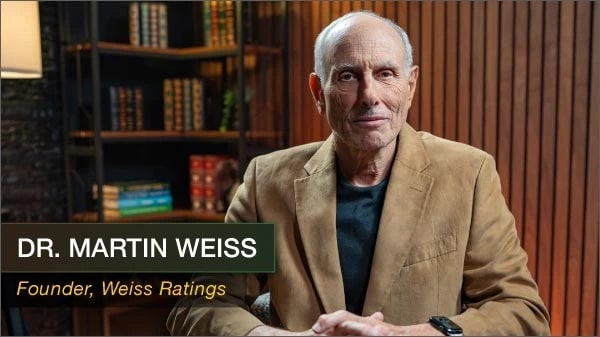
America’s Next Subprime Crisis Pitch
The presentation is an urgent briefing sponsored by Weiss Ratings, America’s only fully independent rating agency that does not accept payment from the companies it grades. It opens with a vivid scenario that feels like a future crisis but is grounded in real events already unfolding. A large American auto-parts company collapses under more than $11 billion in debt. Money thought to back the obligations is missing or in limbo. Annuity providers, banks, and investment funds scramble. Investors begin questioning their own holdings. Redemption requests surge at major alternative investment managers. A retired individual named Frank, who followed conventional advice for decades, discovers he cannot freely access his money because of temporary restrictions designed to protect remaining investors.
The briefing makes clear that the only fictional element is the character Frank. The real events involve First Brands (the auto-parts supplier with $11 billion in liabilities), Tricolor (a subprime auto lender where collateral was reportedly double-pledged), HPS Corporate Lending Fund controlled by BlackRock (where withdrawal requests roughly doubled normal limits), BCRED, and the broader alternative investment space involving Blackstone, Blue Owl, Apollo, Ares, and KKR. At the center sits the private credit market, which has drawn roughly $3 trillion in investor funds. This is not a small niche. It is larger than the subprime mortgage market that helped trigger the 2008 financial crisis.
The core idea is straightforward. Private credit consists largely of loans to companies, many of them weaker or lower-quality borrowers, arranged outside traditional public markets. In recent years, insurance companies, annuity providers, pension funds, banks, and other institutions have shifted substantial amounts of capital into this sector in search of higher yields. When stress appears—company failures, questions about collateral quality, or sudden demands for withdrawals—the effects can spread quickly because the same loans sit inside products that ordinary people own through annuities, retirement accounts, and bank-related holdings.
The presentation draws a direct parallel to earlier crises. Before the 2008 collapse, the stock market sat near highs. The same pattern appeared ahead of the 1987 crash and the early-2000s tech bust. Ratings from major agencies remained high until very late. Weiss Ratings, by contrast, issued public warnings months in advance on key institutions. The briefing argues that the same dynamics—layered risk, optimistic grades from agencies paid by the rated companies, and money funneled into less transparent corners of the market—are present again. The difference this time is that the “subprime” borrowers are companies rather than homeowners, and the exposure sits inside products marketed as safe or guaranteed for retirees.
The purpose of the briefing is twofold. First, it aims to alert ordinary savers and investors that risk has migrated into places many do not monitor closely. Second, it lays out five concrete steps for protection and potential opportunity, delivered through the Safe Money Report and accompanying special reports. The tone is urgent but practical: the early signs are already visible, time still exists to act, and preparation can include both defensive moves and strategies designed to benefit from the very volatility that a crisis produces.
The Guru Behind the Warning: Dr. Martin Weiss and the Weiss Family Legacy
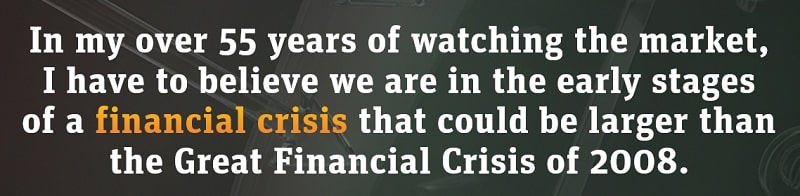
Dr. Martin Weiss is the founder of Weiss Ratings and the central voice of the presentation. He has spent more than 55 years observing markets and financial institutions. His family’s involvement in finance stretches back nearly a century. His father, Irving Weiss, began working on Wall Street in 1926 at age 18. In 1929, Irving advised clients to exit the stock market. Senior brokers dismissed him as a young upstart. Weeks later the market suffered its historic crash. Clients who followed the advice preserved their capital while the broader market lost the great majority of its value over the following years and thousands of banks failed.
In 1959 Irving Weiss warned that unchecked federal spending threatened the dollar. He organized a national campaign that generated millions of letters, telegrams, and calls to Congress. The effort contributed to the last truly balanced federal budget under President Eisenhower. The longer-term struggle against monetary debasement continued. When President Nixon closed the gold window in 1971, the elder Weiss anticipated the inflation and bank stresses that followed. Martin Weiss founded Weiss Ratings in response, continuing the family mission of providing independent analysis of banks, insurance companies, stocks, and other financial products.
Weiss Ratings distinguishes itself by refusing payment from the entities it rates. Traditional rating agencies typically collect fees from the companies or issuers seeking grades. This creates an inherent conflict: the agency has a financial incentive to keep clients happy. Weiss Ratings operates solely for the benefit of investors and savers. The firm has published safety ratings for decades and has been subject to independent review. A multi-year study by the U.S. Government Accountability Office examined Weiss insurance company ratings against those of major competitors. The GAO concluded that Weiss identified future failures far more accurately than A.M. Best and that the leading Wall Street agencies were not competitive on that measure. A separate study published in The Wall Street Journal ranked Weiss stock ratings first for profit performance among the research firms examined.
Martin Weiss has testified twice before the United States Congress on the safety of major financial institutions. The firm’s warnings have been covered by major media outlets including The New York Times, The Wall Street Journal, Fortune, Bloomberg, Forbes, and television networks. Since 2018 more than 247,000 paying members have used the ratings and research. More than one million readers follow the firm’s work.
Working alongside Martin Weiss is Nilus Mattive, co-editor of the Safe Money Report. Mattive spent years inside one of the major Wall Street rating agencies early in his career, on the equity side of the business. He observed the practical realities of the issuer-pay model: agencies competing for business by offering higher grades, advance notice of potential downgrades that allowed companies to appeal or shop ratings, and the general atmosphere that accompanied the fee-driven structure. He left that environment and joined Weiss Ratings roughly twenty years ago precisely because of its independence. In the presentation he reinforces the message that the conflicts of interest that contributed to the failures of 2008 remain structurally present today.
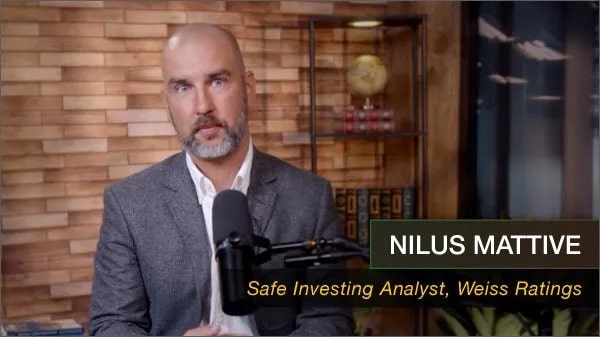
Together, Weiss and Mattive present a consistent philosophy. Financial safety is not guaranteed by size, brand recognition, or high grades from agencies that are paid by the rated parties. Independent data, early identification of weaknesses, and clear action steps matter more. Their track record includes naming Bear Stearns as vulnerable 102 days before its collapse, Lehman Brothers 181 days in advance, Citigroup 110 days before its bailout, and Fannie Mae years before its problems became public. In the 2008 period they broadcast a list of weak banks that included institutions that later required rescue or failed. Across subsequent years Weiss Ratings has claimed a high success rate in identifying banks that ultimately failed. The same independent methodology is now applied to the private credit exposures inside insurance companies, banks, funds, and the broader market.
What the Safe Money Report Service Is and How It Works
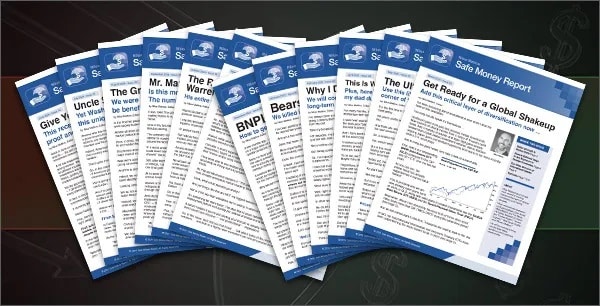
Safe Money Report is a monthly research advisory published by Weiss Ratings. Its purpose is to help ordinary investors and savers identify risks to their money and locate opportunities that can perform through different market environments, including periods of stress. The service does not claim to predict exact dates of market events. Instead it focuses on structural vulnerabilities, safety ratings, and practical steps that individuals can implement with ordinary brokerage or banking accounts.
The core product is the monthly newsletter. Each issue examines sectors and assets that may face pressure, highlights areas that historically hold up better or even benefit during turmoil, and provides updates on precious metals, stocks, real estate-related ideas, and alternative approaches. Subscribers also receive flash alerts and daily commentary through Weiss Ratings Daily when developments warrant attention. A members’ Q&A portal allows general questions to be considered for future coverage.
A major component is unrestricted access to the Weiss Ratings database. This includes safety and performance ratings on more than 65,000 investments and institutions: individual stocks listed on U.S. exchanges, more than 2,800 ETFs, more than 21,000 mutual funds, banks, and insurance companies. The ratings are updated continuously. Safety ratings for banks and insurers focus on capital strength, asset quality, liquidity, and other measurable factors that historically precede failures. Stock ratings combine safety considerations with profit potential. Independent studies have ranked these ratings highly for both early identification of problems and subsequent investment performance.
The service also maintains “X-Lists”—curated rankings of the weakest and strongest institutions in key categories. These lists have served as a first line of defense for members for roughly two decades. When major institutions appear on the weak side of an X-List, the implication is that capital should be moved or exposure reduced before problems become widely recognized. The corresponding strong lists identify institutions with better measured resilience.
In addition to the ongoing newsletter and ratings access, new subscribers receive a package of special reports timed to the current private credit concerns. These reports translate the broader analysis into specific checklists and strategies. The overall approach is designed for people who are not professional traders. Recommendations focus on identifiable assets, clear criteria for safety, and methods that can be executed through standard accounts. The firm emphasizes that past performance of ratings or strategies does not guarantee future results, and that every individual must evaluate suitability for their own situation.
Weiss Ratings generates revenue primarily from subscription fees paid by the people who use the research. It does not accept compensation from the banks, insurers, or companies it rates. This structure is presented as the foundation of its independence and the reason its conclusions sometimes diverge sharply from those of agencies that operate under the issuer-pay model.
The Private Credit Warning in Greater Detail
Private credit refers to loans and credit instruments arranged directly between lenders and borrowers outside the public bond markets. Over the past decade and a half, this market has expanded rapidly as traditional bank lending faced tighter regulation and as investors sought higher yields than those available in government or high-grade corporate bonds. Assets under management in the sector have reached approximately $3 trillion. Large asset managers and alternative investment firms have raised substantial capital from pensions, endowments, insurance companies, and high-net-worth individuals to deploy into these loans.
Many of the borrowers are companies that would be considered higher risk—leveraged firms, middle-market businesses, or entities with limited access to public markets. The loans often carry floating rates, covenants that can be more flexible than traditional bank loans, and structures that prioritize the private lenders. Because the loans are not publicly traded, valuation and liquidity can be opaque. When a borrower runs into trouble, the process of recognizing losses, seizing collateral, or restructuring can be slower and less transparent than in public markets.
Recent real-world cases illustrate the emerging stress. First Brands, an auto-parts supplier, collapsed with liabilities exceeding $11 billion. Questions arose about the true backing behind certain financing. Tricolor, focused on auto loans to lower-income borrowers, experienced collapse accompanied by reports of collateral pledged more than once. At funds such as HPS Corporate Lending Fund and BCRED, investors requested withdrawals far in excess of normal quarterly limits, forcing partial fulfillments and highlighting liquidity mismatches. Large managers including Blackstone and peers have faced heightened scrutiny as redemption pressures appear.
Insurance companies and annuity providers have increased allocations to private credit in recent years. Portfolios that once held primarily government bonds and investment-grade corporates now contain meaningful private credit exposure. Because annuities and certain insurance products are marketed with guarantees or predictable income features, any material losses or liquidity constraints in the backing assets can create tension between the promises made to policyholders and the actual ability to meet those promises without restriction. Banks also hold related exposures through lending facilities, investments, or counterparty relationships.
The briefing argues that the same pattern observed before 2008 is visible again. Layered risk has been built: weak borrowers at the base, private credit funds and insurance portfolios in the middle, and ordinary retirement accounts and bank deposits at the top. Traditional rating agencies continue to assign high grades in many cases. Weiss Ratings contends that the conflicts inherent in the issuer-pay model reduce the reliability of those grades, just as they did with mortgage-backed securities and the institutions that held them in the prior crisis. Independent analysis that focuses on underlying cash flows, leverage, collateral quality, and liquidity mismatches is therefore essential.
A broader systemic concern is the potential for a freeze in short-term funding markets. Roughly $12 trillion in short-term instruments trade daily to keep corporations, banks, and the global system functioning. When confidence evaporates, as it did after Lehman Brothers failed in 2008 and again in a more limited episode in 2019, these markets can seize up. Payrolls, daily bank obligations, and ordinary commerce become difficult. The Federal Reserve can intervene, but the process is disruptive and the recovery can take years. The presentation positions the private credit stresses as a potential trigger for wider contagion precisely because the exposures sit inside institutions that ordinary people rely upon for savings and income.
The Five Specific Steps Recommended
The presentation organizes its practical advice into five steps. Each step is supported by a dedicated special report or set of lists provided to new Safe Money Report subscribers.
Step 1: Find Out What Money Is in Immediate Danger
The primary tool is the report titled The Next Subprime Crisis Playbook. It walks through concrete checks: how to evaluate the safety of a bank using Weiss data and what actions to consider if the rating is weak; how to assess an annuity provider or insurance company and the implications of a below-average grade; identification of funds with heavy private credit exposure and guidance on exiting before liquidity gates close; a method for reviewing an entire stock portfolio for concentration risk; and the specific actions Martin Weiss is taking with his own family’s retirement capital. The report translates the broad warning into a personal checklist so that holders of different types of assets can prioritize the most urgent reviews.
Step 2: Get Immediate Access to the X-Lists
Three lists form the second line of defense.
- X-List #1 covers America’s weakest and strongest banks, with names, states, and current Weiss Ratings. An earlier version of this list, broadcast in 2008, included Citigroup, Wachovia, and Washington Mutual—institutions that later required rescue or failed. The updated list continues the same methodology.
- X-List #2 ranks the weakest and strongest insurance companies, with particular attention to those that issue annuities. Some large, well-known names appear on the weaker side according to the data.
- X-List #3 examines every stock in the S&P 500 and assigns buy, hold, or sell guidance based on the likelihood of sharp declines if private credit stress intensifies.
Subscribers also receive ongoing access to the full ratings database so that any subsequent upgrades or downgrades can be monitored in real time.
Step 3: Use the Vancouver 5X Gold Secret
Gold has historically performed well during periods of financial stress and monetary uncertainty. After the 1971 closure of the gold window, gold rose substantially over the decade. After the 2008 crisis it advanced as much as 185 percent from its lows. The report The Vancouver 5X Gold Secret describes a method of participating in gold that originated in Vancouver more than twenty years ago. According to the presentation, the approach has produced returns as high as 5,000 percent since 2004 and has outperformed physical gold by a factor of approximately five over that period. The report explains the mechanics and how an ordinary investor can implement the idea.
Step 4: Buy the Assets Likely to Grow Because of the Crisis
Certain assets have historically risen during or after major financial dislocations. One example highlighted is an income-oriented asset that has paid cash distributions every year for more than five decades, increased its payments dozens of times, and delivered a long-term total return on the order of 27 percent per year since the mid-1980s. Independent academic work cited in the presentation shows extraordinary long-term compounding for the underlying category. Another area of focus is structured notes that can offer downside cushions (for example, absorbing the first 20 percent of market decline) while still participating in upside. Fractional approaches to farmland and other real assets are also discussed. The report The Most Profitable Income Asset of All Time provides the details and historical context.
Step 5: Turn Market Chaos into Weekly Cash
In a crisis environment, liquid cash becomes valuable both for survival and for purchasing discounted assets. The report How to Turn Market Mayhem into Cold, Hard Cash outlines a strategy designed to generate income of up to $1,000 per week or more, with an average historical win rate cited at approximately 82 percent. The approach is presented as usable in rising, falling, or sideways markets and particularly effective when volatility is elevated. The presentation notes that similar techniques have been employed by major investors, including publicly reported examples associated with Warren Buffett. The report breaks the process into simple steps that can be started quickly through standard accounts.
An additional bonus report, How to Protect and Grow Your Wealth Off Wall Street, covers alternative assets such as art, precious metals in physical form, and collectibles that sit outside traditional brokerage systems.
What Is Included with the Current Offer
New subscribers receive the following package:
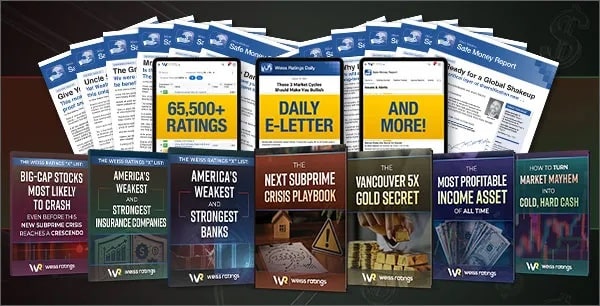
- The Next Subprime Crisis Playbook (complete analysis and personal action plan)
- Weiss X-List #1: The World’s Weakest and Strongest Banks
- Weiss X-List #2: America’s Weakest and Strongest Insurance Companies
- Weiss X-List #3: Big-Cap Stocks Most Likely to Crash Even Before This New Subprime Crisis Reaches a Crescendo
- The Vancouver 5X Gold Secret
- The Most Profitable Income Asset of All Time
- How to Turn Market Mayhem into Cold, Hard Cash
- Bonus: How to Protect and Grow Your Wealth Off Wall Street
- 12 monthly issues of the Safe Money Report newsletter
- Full access to Weiss Ratings on more than 65,000 investments and institutions, updated in real time
- Weiss Ratings Daily e-letter and flash alerts
- Complete research library of prior special reports and ranking lists
- Safe Money Model Portfolio trade alerts and position tracking (premium level)
- Members Q&A portal
Two membership levels are offered. The standard membership provides digital delivery of the newsletter and all reports for $49. The premium membership adds print delivery of the monthly newsletter and is priced at $99. Both levels include the full package of special reports, ratings access, and the 365-day guarantee.
Pricing and Guarantee
The introductory price is $49 for a full year of the standard (digital) membership or $99 for the premium membership that includes print. These prices represent substantial discounts from the regular rates cited for individual reports and the newsletter. Payment is a one-time fee for the year.
The guarantee is straightforward and generous. Subscribers have a full 365 days to evaluate every report, every newsletter issue, and the ratings access. If for any reason they are not satisfied, they may request a complete refund of the entire subscription fee. All materials received up to that point remain theirs to keep. No questions are asked beyond the refund request itself. This structure places the risk of dissatisfaction entirely on Weiss Ratings rather than on the subscriber.
Who This Service Is For
The Safe Money Report and the accompanying private credit materials are designed primarily for:
- Retirees and near-retirees who hold annuities, fixed or variable, or other insurance-based income products
- Individuals with significant bank deposits who want independent safety assessments beyond FDIC coverage limits or brand reputation
- Stock market investors, particularly those concentrated in large-cap names that could be affected early in a credit-related downturn
- Anyone managing a 401(k), IRA, or taxable brokerage account who wants systematic safety screens and crisis-oriented ideas
- Savers who prefer independent analysis free from the conflicts of interest present when rating agencies are paid by the companies they grade
- People who value historical track records of early warnings and are willing to act on checklists and ratings rather than waiting for mainstream consensus
It is less suitable for pure short-term traders seeking daily technical signals or for individuals who prefer to ignore systemic risks and remain fully invested in the broadest market indexes regardless of underlying credit conditions.
Pros and Cons
Pros
- Independent rating methodology that does not accept payment from rated entities, reducing a major source of bias.
- Documented history of early warnings on institutions that later failed or required rescue, supported by external studies from the GAO and performance rankings in the Wall Street Journal.
- Comprehensive package that covers banks, insurance companies, individual stocks, gold strategies, income assets, and cash-generation techniques in one subscription.
- Extremely low introductory price relative to the number of reports and the full year of ongoing research.
- Full-year money-back guarantee that allows thorough evaluation with no financial risk.
- Practical, checklist-style guidance rather than vague generalities.
- Real-time access to a large ratings database that can be used for ongoing monitoring.
Cons
- Future market outcomes are inherently uncertain; even accurate past warnings do not guarantee that the current private credit concerns will escalate into a full-scale crisis of the magnitude described.
- Some strategies, such as the gold method or the weekly cash approach, require the investor to understand and execute specific techniques; they are not completely passive.
- Access to the full research library and model portfolio tools is valuable mainly to those who will actively use the information; casual readers may not extract the full benefit.
- As with any subscription research service, results depend on the subscriber’s willingness to review the materials and implement suitable recommendations.
Conclusion
The Weiss Ratings Safe Money Report presentation on the next subprime crisis centers on a clear thesis: the $3 trillion private credit market has grown large enough, and has become sufficiently embedded inside insurance companies, annuity providers, banks, and investment funds, to pose systemic risks that ordinary savers may not yet fully appreciate. Real-world failures and redemption pressures already provide early evidence of strain. Drawing on a multi-generational commitment to independent analysis and a track record of identifying weaknesses ahead of previous crises, Dr. Martin Weiss and Nilus Mattive offer both a warning and a concrete five-step plan.
The plan begins with personal risk assessment through the Next Subprime Crisis Playbook, continues with the X-Lists of weakest and strongest institutions, incorporates a gold participation method with a long historical edge, highlights income and real assets that have performed through prior dislocations, and adds a cash-generation technique designed for volatile markets. All of this is delivered through a low-cost annual subscription that includes monthly research, continuous ratings access, and a complete money-back guarantee for a full year.
For individuals who hold bank deposits, annuities, insurance products, or stock portfolios and who value independent safety analysis, the current offer provides a low-risk way to obtain the full set of reports and ongoing guidance. The combination of historical context, specific checklists, and conflict-free ratings makes the Safe Money Report a practical resource for navigating the private credit risks that Weiss Ratings believes are already taking shape.