
Quick Verdict
Marc Chaikin’s 401(ai) is a focused 5-stock model portfolio built with his Power Gauge system. It targets companies showing clear signs of benefiting from AI-driven change—either by building needed infrastructure or by using the technology to improve their own results. The approach is designed for people who feel behind on retirement and want a selective way to stay on the stronger side of today’s economy without guessing among dozens of AI names. Membership in the Power Gauge Report delivers the portfolio, supporting reports, ongoing updates, and access to the rating system under a 30-day money-back guarantee.
Key Takeaways
- The 401(ai) is not a retirement account. It is a 5-stock model portfolio selected with the Power Gauge.
- The Power Gauge rates thousands of stocks daily using 20 factors related to financials, earnings estimates, analyst behavior, price action, and money flow.
- Ratings are simple: Bullish, Neutral, or Bearish.
- Chaikin frames today’s economy as K-shaped: one arm of companies gaining strength and productivity, the other of companies under pressure or falling behind.
- The portfolio aims to keep a portion of money on the upper arm.
- Supporting reports cover five stocks showing warning signs and eight stocks being watched for stronger signals.
- Membership includes a full year of the Power Gauge Report, access to the rating system, the three special reports, and ongoing updates.
- Introductory price is $149 with a 30-day full refund guarantee.
- The system is presented as a way to reduce decision overload for people who do not have decades left to recover from large mistakes.

Marc Chaikin’s 401(AI) Pitch: What Is All About?
The recent presentation featuring Marc Chaikin introduces what he calls the first-ever 401(ai). The name is intentional. It points to the familiar 401(k) while signaling that the economic environment has changed. The traditional retirement playbook stressed saving, diversification, and long periods of compounding. That advice still holds value, yet many people now face a different reality. They may have started late, suffered losses in past downturns, or simply found that living costs rose faster than expected. Looking at their balances and the years remaining, they ask a basic question: will we be okay?
At the same time, the rapid advance of artificial intelligence creates both opportunity and hesitation. Large moves by certain companies raise the fear of missing out. Memories of 2000 and 2008 raise the fear of buying at the wrong time. The result is paralysis—afraid to buy and afraid not to buy.
Chaikin’s response is the 401(ai) model portfolio. It is not a replacement for a 401(k) or any formal retirement account. It is an investment strategy and research package aimed at people who feel time is limited. The central observation is that some companies are now able to compress years of change into months. Revenue can grow quickly while headcount stays flat or declines. New businesses reach large valuations faster than in earlier periods. Established companies can handle far more work with fewer people.
Supporting evidence cited in the presentation includes studies showing AI-related companies reaching billion-dollar valuations in roughly half the historical time and with roughly half the staff. Average revenue growth rates and revenue-per-employee figures stand well above older norms. The same pattern appears in mature firms. One large technology company reduced its workforce by tens of thousands of people while reporting record revenue and projecting still higher shipments. Similar combinations of lower headcount and stronger results appear at other long-established businesses.
The presentation argues that these changes create a K-shaped economy. One arm rises: companies sitting in the path of new capital or using the technology to improve margins, speed, and productivity. The other arm declines: companies whose costs stay high, whose customers leave, or whose earnings trends weaken. For someone approaching retirement, the practical question becomes which side of that K their money sits on.
A broad index fund owns both arms. It waits for companies to grow large enough to matter in the index. By the time many of the strongest movers enter a major index, a large part of the early advance has already occurred. The 401(ai) approach is selective. It uses daily evidence from the Power Gauge to identify companies already showing improvement and to watch for signs that a position no longer belongs on the upper arm.
The portfolio itself is deliberately small—five stocks. The goal is clarity rather than an overwhelming list of AI themes and sub-sectors. Some of the companies may supply physical infrastructure such as cooling, power delivery, or components that move data. Others may be ordinary businesses in finance, retail, healthcare, or manufacturing that use the technology to change their own economics. The selection criterion is not the story or the sector label. It is the combination of improving financials, rising estimates, money flow, and constructive price behavior.
Historical examples in the presentation illustrate the sequence the system looks for. A bullish rating appears first. Analysts later raise targets. Institutional ownership increases. Fundamental results then confirm the earlier signals. Cases drawn from energy, work-from-home names, steel, semiconductors, data-center infrastructure, and other areas show the same pattern across different market environments. One infrastructure name rose more than 700 percent after its bullish rating. Another advertising-technology company multiplied several times. Parallel examples show companies on the opposite side of the K losing ground over the same periods.
The overall message is practical. People who feel behind do not need another broad prediction about where markets will go. They need a repeatable way to stay focused on companies whose numbers are currently improving and a way to know when those numbers start to deteriorate. That is the problem the 401(ai) research is designed to address.
Who Is Marc Chaikin: The Guru Behind the Research
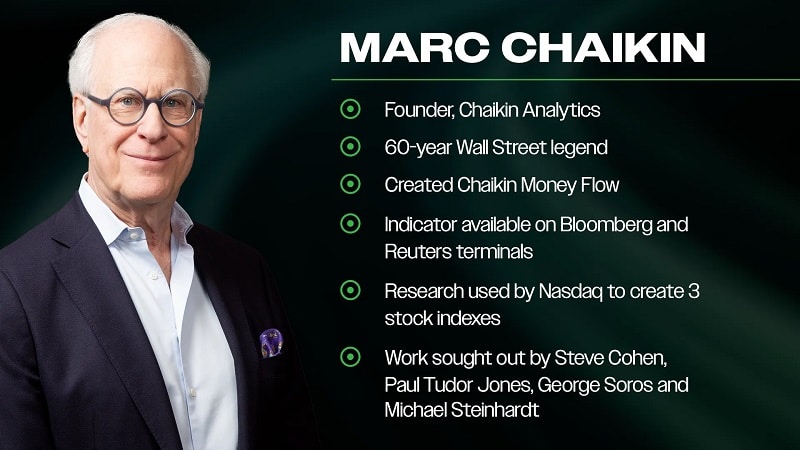
Marc Chaikin has spent nearly six decades on Wall Street. He began in 1966. Over the years, professional investors including Steve Cohen, Paul Tudor Jones, George Soros, and Michael Steinhardt sought out his analytical work. He developed the Chaikin Money Flow indicator, which became available on Bloomberg and Reuters terminals worldwide. Nasdaq later used his research to create three stock indexes.
For most of his career the tools he built served investors who already controlled large amounts of capital. The personal experience that redirected his focus occurred in 2008. His wife Sandy’s retirement savings, managed by a professional and held in a diversified portfolio, lost roughly half their value in the market crash. Recovering from a 50 percent decline requires a 100 percent gain simply to return to the starting point. That episode left a lasting impression. Chaikin has said he did not want his household to be the last to know again when danger was developing.
He returned to building systematic tools. The result was the Power Gauge, which draws on decades of work with money flow and related factors. Chaikin has stated that the same system later helped recover the losses and more. The Power Gauge is the engine behind the 401(ai) research.
Chaikin no longer manages money for clients. He does not open accounts, take custody of assets, or provide individualized advice. His role is research and communication of the signals his system produces. The Power Gauge Report is the vehicle through which he shares that research with individual investors.
Power Gauge Report: What It Is and How It Works
The Power Gauge is a quantitative rating system that evaluates thousands of stocks every day. It examines 20 separate factors. Some relate to a company’s financial statements. Others track earnings estimate revisions, analyst behavior, price and volume patterns, and money flow. Chaikin describes the factors as witnesses. One witness can be wrong. A single strong quarter can prove temporary. Hype can move a stock for a time. An analyst can miss important information. When several independent pieces of evidence begin pointing in the same direction, the system assigns a clear rating: Bullish, Neutral, or Bearish.
Users do not need to master all 20 factors. The system collapses the information into the three simple categories. Members receive ongoing research that applies these ratings, along with Chaikin’s commentary on what the evidence is showing.
The 401(ai) model portfolio is one application of that system. Chaikin asks a focused question: which companies would he most want to own right now if the goal is to keep a portion of capital on the upper arm of the K-shaped economy? The answer is a short list of five names. For each, the research explains why the stock earned its place, what the Power Gauge is currently seeing, and what would have to change for the position to be reconsidered.

Because the economy is moving quickly, the portfolio is not static. Ratings and underlying data are monitored continuously. If financials weaken, estimates are cut, money begins to leave, or a stronger candidate emerges, updates are provided. The small size of the portfolio is deliberate. A list of dozens of names across multiple AI sub-sectors can overwhelm someone who is already uncertain. Five names keep the focus manageable.
Two additional reports complete the picture. “5 Stocks to Sell Now” applies the same system in the opposite direction. It identifies companies showing warning signs—pressure from the transition, deteriorating earnings trends, weakening financials, institutional selling, or expectations that appear ahead of current business results. For each name the research states the concern and what would need to improve before the view would change.

“The 401(ai) Waiting Room” lists eight stocks that interest Chaikin but have not yet produced enough evidence for inclusion in the model portfolio. The report explains what he likes about each company and exactly what additional signal he is waiting to see—further estimate revisions, another quarter of results, or clearer institutional accumulation. Members who stay connected receive notice if one of those names later crosses the threshold.

Daily email alerts provide broader market context. The combination of the focused portfolio, the sell list, the watch list, the rating system itself, and ongoing commentary is intended to give members a continuous view of where the evidence is pointing.
The service does not claim to predict which technology will dominate ten years from now. It does not attempt to forecast the next Nvidia. It looks at what businesses are actually doing in their numbers today and whether those numbers are improving or deteriorating.
What’s Included in Marc Chaikin’s 401(AI) Offer
Membership in the Power Gauge Report at the current introductory terms delivers the following:
- Immediate access to The Chaikin 401(ai), the focused 5-stock model portfolio built around companies Chaikin believes currently sit on the upper arm of the K-shaped economy (listed value $299).
- The special report 5 Stocks to Sell Now, covering five companies where the Power Gauge is flashing warning signs (listed value $299).
- The special report The 401(ai) Waiting Room, covering eight stocks being watched for stronger evidence (listed value $299).
- One full year of the Power Gauge Report, including Marc Chaikin’s stock recommendations and monthly market analysis (listed value $499).
- One full year of access to the Power Gauge Rating system so members can check current Bullish, Neutral, or Bearish ratings on thousands of stocks (listed value $1,000).
- Ongoing research and updates as the evidence changes, including notice when a stock no longer belongs in the model portfolio or when a new name earns a place.
- Daily email alerts on market outlook, patterns, and trends.
The combined listed value of these elements is $2,396. The current introductory price is $149 for the full year—less than $3 per week.
Pricing and Guarantee
The standard annual value is presented as more than $2,000. The special offer reduces the cost to $149. Payment is for one year of membership.
A 30-day, 100 percent money-back guarantee applies. Members can review The Chaikin 401(ai), the two supporting reports, and the Power Gauge materials. If at any point in the first 30 days the service is not what they hoped for—any reason or no reason—they contact customer service and receive a full refund of the subscription price.
Who This Is For
The research is directed at people who feel time is limited. Typical descriptions in the presentation include individuals in their fifties or sixties who believe they are behind on retirement savings, who see the scale of economic change underway, and who do not want to throw capital at every AI stock highlighted in the media. It is also relevant for anyone who prefers a selective, evidence-based approach over broad index ownership that holds both the rising and the declining arms of the current economy.
It is not presented as suitable for someone seeking individualized portfolio management, customized advice, or a set-it-and-forget-it collection of stocks held for decades without review.
Pros & Cons
Pros
- Focuses attention on a small, understandable list of five stocks rather than dozens of AI themes.
- Uses a transparent rating system based on multiple factors rather than a single narrative.
- Includes both the upper-arm portfolio and a list of names showing warning signs.
- Provides a watch list of companies that have not yet earned a full recommendation.
- Delivers ongoing updates so the research can change as conditions change.
- Gives members direct access to the same Power Gauge ratings used in the research.
- Comes with a full 30-day money-back guarantee and a clear introductory price.
- Draws on nearly 60 years of the developer’s experience building tools for professional investors.
Cons
- The model portfolio is hypothetical in the illustrative examples shown; actual future results will differ.
- All investing involves risk of loss, including the possibility of losing some or all of the capital invested.
- Past performance, including any historical signals or member testimonials, is not a guarantee of future results.
- The service provides research and ratings, not personalized advice or money management.
- Members must still decide for themselves how much capital, if any, to allocate and must execute their own trades.
- The portfolio can and is expected to change; it is not a permanent buy-and-hold list.
- Access requires an ongoing subscription after the initial period.
Conclusion
The Chaikin 401(ai) research package takes a complex shift in the economy—the compression of time and the divergence between companies that adapt and those that do not—and reduces it to a practical set of tools. A five-stock model portfolio selected with the Power Gauge, a companion list of names showing caution signals, a watch list of candidates still gathering evidence, daily market notes, and continuous updates form the core of the offering.
Marc Chaikin’s long career building analytical systems for professional investors provides the foundation. The personal experience of 2008 supplies the motivation to make the same style of early-warning information available to individuals who feel they cannot afford to be last to know.

For readers who recognize the tension between the desire to participate in the current transformation and the need to protect limited remaining time, the research offers a structured way to examine the evidence. The current membership terms place the complete package—portfolio report, sell report, waiting-room report, full year of the Power Gauge Report, rating-system access, and ongoing updates—at $149 with a 30-day full refund guarantee.