Regular Americans face a relentless cost-of-living squeeze. Personal debt keeps climbing. Savings sit near decade lows. A recent survey showed 67 percent of people worry more about running out of money than about dying. Grocery prices have roughly doubled over more than a decade. A prescription that once cost $40 now runs $100. Car insurance that used to cost $1,000 a year has jumped past $2,000. Over the last five years the average family spends an extra $17,000 just to keep the same lifestyle. Even households earning $300,000 report living paycheck to paycheck in high-cost cities.
CDs returned about 1.7 percent last year. High-yield savings accounts hovered near 4 percent. Out of roughly 5,500 publicly traded stocks, only a few dozen are set up to deliver monthly income, and many of those carry speculative risk. Buying an undervalued stock and waiting years for it to double no longer keeps pace with prices that rise every month.
Rob Spivey has spent 25 years inside the highest levels of finance—Wall Street hedge funds, Silicon Valley wealth-management firms, and investment banks such as Credit Suisse. In 2009 he co-founded a financial think tank whose research is followed by professionals at more than 300 major firms, including Goldman Sachs, JPMorgan, BlackRock, and Fidelity. Institutions once paid as much as $100,000 for a single report. The same research desk flagged Meta in 2013 before a 1,300 percent move, Moderna before a 2,200 percent rise, and AMD in 2015 before a 4,200 percent advance. In the past four years followers had the chance to more than double their money 43 separate times across the firm’s services. The team called the 2008 crisis and the 2020 COVID crash and recovery.
In 2019 the firm opened its work to everyday investors through Hidden Alpha, a monthly research service Spivey runs with partner Joel Litman. Litman has presented research at the FBI and the Pentagon and lectured at the U.S. Marine War College. Hidden Alpha focuses on income-generating names and uses a proprietary tool called the Altimeter that examines cash flows, debt maturities, interest expense, available cash, dividends, capital spending, and maintenance costs—metrics most investors never check. The system also attempts to flag large moves months ahead. Back-tests of its top 30 names over nearly three decades showed them crushing the broader market. One open position has reached as high as 440 percent. Average gains over the past two years sit near 50 percent, more than double the S&P 500, though past results are never a guarantee of future performance and all investing carries risk of loss.
Recently the firm launched what it calls an income rescue mission. After months of digging through filings, contracts, and structures most investors never see, the team identified what Spivey terms Elon’s Shadow Trust. It is not a traditional trust fund or endowment. It is not endorsed by or affiliated with Elon Musk, his family, or any government relief program. It consists of five publicly traded stocks spread across seven U.S. states. Each is tied to the same structural thesis: massive demand for AI compute, constrained supply of power and grid capacity, and the physical infrastructure required to keep Tesla, SpaceX, xAI, Neuralink, The Boring Company, and related operations running.
The Shadow Trust has already distributed $4 billion in the past 12 months and more than $100 million in recent weeks. Since the SpaceX IPO in June it has paid out an additional $1.1 billion. Long-term back-testing suggests the combination would have delivered an average of $12,000 a month—or more than $144,000 a year—to a regular American over the past two decades when dividends were reinvested. The next distributions are scheduled for early November. Since 2025 the value of the underlying holdings has surged an average of 97 percent. Compounded at that rate for three years, $10,000 grows to roughly $76,500. Over five years the same sum approaches $296,000—before counting the monthly income received along the way.
The opportunity sits at the intersection of two powerful forces: Elon Musk’s expanding empire and the national push to dominate artificial intelligence and data-center capacity.
The Compute Bottleneck and the Power Crisis
In a closed-door meeting at SpaceX headquarters, Elon reportedly identified the biggest bottleneck in the global AI and data-center race. It was no longer chips or large language models. It was compute—the raw processing power behind every chatbot answer, every generated image, and every trained model. Compute is the horsepower of the AI age. AI compute is now doubling roughly every six months. The International Energy Agency projects data centers will soon consume 945 terawatt hours of electricity—more than the combined annual usage of California, New York, and Texas.
The United States already hosts more than 5,000 data centers, outnumbering Walmart stores. Data centers are on track to account for nearly half the growth in American electricity demand by 2030. Elon’s Colossus Supercluster crossed the 1-gigawatt threshold and is moving toward 2 gigawatts—enough to power 660,000 homes. His planned $119 billion Terafab facility near College Station, Texas, is expected to draw more than one terawatt of energy, roughly twice the current grid capacity of the entire United States.
China has already built an electric grid larger than the U.S. and European Union combined and plans $574 billion in upgrades. American tech giants were slower to react. OpenAI’s CEO sent an urgent letter to the White House. Elon, an engineer by training, had been preparing for years. He is targeting $2.4 trillion to overcome the compute bottleneck—more than Tesla’s market capitalization and four times China’s planned spend. The first $192 billion is already moving. In a single month Tesla’s Gigafactory activated more than 100,000 GPUs and installed a new semiconductor fab. xAI’s Colossus is racing to double its power. Rivals including Anthropic and Google are now renting compute from Elon at a reported rate of $2.2 billion a month, or more than $25 billion a year for years to come. That cash is being reinvested into SpaceX rockets, xAI models, and Tesla’s Optimus robots. Analysts have called the Tesla robot opportunity alone a multi-trillion-dollar market.
The Shadow Trust holdings are positioned across the physical backbone of this build-out. One focuses on the semiconductor equipment that prints the chips themselves. Nvidia designs chips; this company helps manufacture nearly all of them. It has produced an estimated 99 percent of every chip in existence, holds more than 38,000 patents, and operates roughly 300 massive lithography machines—each the size of a school bus and weighing as much as a blue whale. Moving one requires disassembly into seven Boeing 747 loads. The machines produce billions of chips a year, yet demand keeps rising. Elon has set a goal of 100 billion chips annually for his own empire alone. That would require hundreds of millions of chips every day. The company paid out $2.9 billion in distributions last year. Hedge funds and asset managers have been accumulating the shares; one manager shifted hundreds of millions out of Nvidia and into this name. Year-to-date the stock has outperformed the S&P 500 by a wide margin.
Two other holdings sit in energy. American oil and gas powered the industrial age, World War II production, and the country’s rise. Every Tesla factory, xAI data center, and SpaceX facility runs around the clock and needs reliable power. Texas pumps 5.8 million barrels of oil a day—2.1 billion barrels a year worth roughly $210 billion. One Shadow Trust name does not drill or refine. It owns mineral rights under nearly one million acres, much of it in the Permian Basin where more than 70 percent of Texas oil is concentrated. The company functions as a perpetual toll booth, collecting revenue from every well drilled on its acreage. Last year it distributed $147 million. Institutions including State Street, Vanguard, Citadel, Sequoia, and BlackRock have taken large positions totaling billions. Texas is already home to more than 500 data centers and is set to become the world’s largest data-center market. Meta, Google, and the $500 billion Stargate project are pouring capital into the state. Rising demand for power should lift both the size of the royalty checks and the underlying stock price.
The second energy name operates more than 1,500 miles away in the Marcellus Shale of Western Pennsylvania and surrounding states. The formation covers more than 100,000 square miles and holds an estimated $2 trillion of natural-gas value. The company has become the largest natural-gas producer in the United States, extracting roughly 2.2 trillion cubic feet per year worth about $6.9 billion. It has spent nearly $8 billion acquiring rivals and set a world record for the largest shale well. Washington Post reporting has highlighted Western Pennsylvania as a key power source for the AI future. The company already supplies power-intensive sites and is positioned to serve more as data-center demand grows.
Two additional names supply critical infrastructure and services that Meta, Amazon, and now Elon’s operations have used. Together the five stocks have appreciated an average of nearly 40 percent since the start of the year. Spivey expects further gains as the $192 billion capital wave continues to flow and as the companies expand grid, power, and data-center capacity. Every incremental sale or new project increases the revenue that is distributed back to shareholders.
Policy Tailwinds and Historical Parallels
President Trump signed Executive Order 14318, declaring energy, infrastructure, and the race to scale data centers a national priority. He has described artificial intelligence leadership as a test unlike anything since the dawn of the Space Age and has singled out China as the primary competitor. ARK Invest has projected the broader industry could reach $200 trillion. The Department of Justice has labeled certain data-center assets critical to the economy. The Pentagon has signed a $6.5 billion deal with Starshield, the military arm of SpaceX.
History shows that when the federal government prioritizes a sector, capital and profits often follow. Franklin Roosevelt’s New Deal accelerated electrification, built the Hoover Dam, and helped create companies that later became household names. Kennedy’s space race expanded NASA’s budget tenfold and generated generational wealth for early shareholders of aerospace suppliers. Obama’s green-energy push directed $90 billion into renewables; certain solar and related stocks delivered multi-hundred-percent gains in short periods. Spivey argues the current policy stance is the modern equivalent and that the Shadow Trust names sit at the intersection of private innovation and public priority.
Large institutional investors are already positioned. Morgan Stanley has committed $1.7 billion. JPMorgan holds a $3.2 billion stake. Ken Griffin of Citadel has put in $100 million. Ray Dalio has $31 million. Steve Cohen holds a position. These are not casual observers; they are allocating serious capital to the same structural theme.
How the Income Engine Works
The five stocks pay distributions every month of the year. Because of their business models—royalty streams, high-margin equipment sales, and essential energy production—the more capacity they build and the more volume they handle, the larger the checks that flow back to shareholders. An investor does not need to buy Tesla, SpaceX, or any hyperscaler. Exposure comes through the companies that supply the physical inputs those platforms require.
A simple brokerage account is enough. Open Interactive Brokers, Fidelity, Robinhood, or any standard platform. Purchase the five names at or below the buy-up-to prices listed in the research. From that point the companies send monthly distributions. An optional extra step is dividend reinvestment: each payout automatically buys more shares, compounding ownership over time. Back-tests that include reinvestment show the $10,000 example growing to approximately $3.47 million over the multi-decade period that begins with the founding of SpaceX. Without reinvestment the figure is still measured in the millions. Actual future results will differ; markets fluctuate and no outcome is guaranteed.
The research also includes risk management. The Altimeter grades the financial health of each name so members can see whether cash flow and balance-sheet metrics support continued or growing payouts. Special updates arrive by email when positions need adjustment. A model portfolio tracks every recommendation in real time. Members who followed the full set of recommendations since inception would have seen a cumulative return of 137 percent, again with the standard caveat that past performance does not predict future results and that investors can lose money.
The Full Hidden Alpha Package and Current Offer
Access to the complete research begins with a no-risk trial of Hidden Alpha. The normal annual price is $499. For a limited time the full year is available for $129—roughly 35 cents a day and a 74 percent discount. The welcome package includes:
- Twelve months of Hidden Alpha issues, each containing a new recommendation plus updates on existing positions.
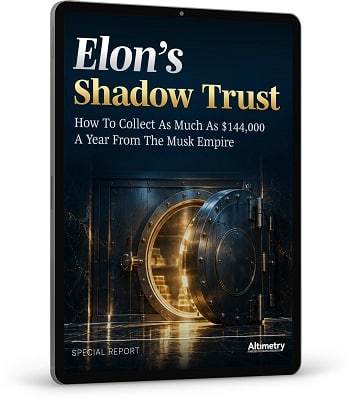
- The featured report “Elon’s Shadow Trust: How to Collect as Much as $144,000 a Year from the Musk Empire,” which names the five stocks, their tickers, the investment thesis for each, and the buy-up-to prices.
- The bonus report “The #1 Oil Income Play of 2026,” focused on a smaller energy-services company that has already shown peak gains above 100 percent, raised revenue targets toward $7 billion, and increased dividend payouts by nearly $200 million over three years to more than $910 million.
- The second bonus report “The Big Score: How to Profit as America Goes Nuclear,” covering the operator of America’s largest nuclear fleet—25 reactors producing more power than Finland and Austria combined. The company has secured a $1 billion Department of Energy agreement, a $1.6 billion Microsoft contract, and a multi-billion-dollar Meta partnership. The stock rose 200 percent after ChatGPT’s launch and recently pulled back about 5 percent on a delay, creating a potential entry window.
- A surprise report listing ten widely held stocks the team believes should be sold immediately, based on the same forensic process that previously flagged names that later fell 90 percent or more.
- Continuous access to the model portfolio.
- Special intra-month updates.
- Full use of the Altimeter database for any S&P 500 ticker.
- The digital archive of prior Hidden Alpha issues.
- One free year of The Timetable Investor, a second Altimetry service that projects broader market direction and portfolio positioning.
- A complimentary one-year membership to TradeStops Basic, a portfolio-tracking tool that syncs with brokerage accounts, calculates position sizes by risk tolerance, and uses a Volatility Quotient to set data-driven exit levels.
The combined value of the package is listed at $1,694. The current price is $129. A 30-day 100 percent money-back guarantee applies from the moment of enrollment. If a member is not satisfied for any reason within the first 30 days, a full refund is issued with no questions or hurdles. Customer support operates from the firm’s Baltimore office, Monday through Friday, 9 a.m. to 5 p.m. Eastern, at 800-701-9346. There is no outsourcing and no scripted responses.
Risks and Realistic Expectations
Every investment carries the risk of loss. Stock prices can fall. Dividend policies can change. Energy prices fluctuate. Semiconductor demand can slow. Policy priorities can shift.
The back-tested average monthly income of $12,000 and the multi-million-dollar compounding examples assume historical conditions and continuous reinvestment; actual results for any future period will differ.
The research desk has recorded many winning recommendations and also names that did not perform. Members are repeatedly reminded never to risk more than they can afford to lose. The 30-day guarantee exists so that anyone who finds the service unsuitable can exit cleanly.
The window for the current discount is limited. Once the promotional pricing ends, the full $499 annual rate returns.
Distributions scheduled for early November mean that delay reduces the chance to participate in the next set of payouts. Institutional capital is already moving into the same themes. Mainstream coverage of the specific five-stock combination remains limited, which is why the research is packaged inside Hidden Alpha rather than broadcast widely.
Frequently Asked Questions
What exactly is Elon’s Shadow Trust?
It is a label for five publicly traded stocks whose businesses supply critical inputs—semiconductor manufacturing equipment, mineral rights and natural-gas production, and supporting infrastructure—to the AI, data-center, and energy needs of Tesla, SpaceX, xAI, and related projects. It is not a legal trust, not endorsed by Elon Musk, and not a government program. The companies pay monthly distributions and have collectively returned billions to shareholders in the past year.
Do I need a large account or special qualifications?
No. The stocks trade on regular exchanges and can be purchased through any standard brokerage account. There is no accredited-investor requirement. Position sizes can be scaled to whatever capital an individual is comfortable allocating.
How does the Altimeter help with income stocks?
The tool examines the underlying financial strength that supports dividends—cash generation, debt obligations, capital spending needs, and free cash flow. It also attempts to identify companies positioned for multi-month or multi-year advances. Members can run any S&P 500 ticker through the system for a rapid forensic snapshot.
What happens if I am not satisfied?
The 30-day money-back guarantee is unconditional. Contact the Baltimore support team within the first 30 days and a full refund is issued. No explanation is required.
Why the urgency around the $129 price?
The promotional rate is temporary. After the offer window closes the annual price returns to $499. In addition, the next scheduled distributions from the Shadow Trust holdings arrive in early November. Acting before that date allows participation in the upcoming payouts and locks in the discounted access to the full research package.
Conclusion
The combination of private capital already committed, federal policy support, and physical constraints on power and compute creates a multi-year runway. Elon’s $192 billion initial outlay is only the beginning of a larger planned spend. Data-center electricity demand is projected to keep rising through 2030. Texas and the Marcellus region sit at the center of the domestic energy response. Semiconductor equipment that can print chips at scale remains scarce relative to stated goals of 100 billion chips per year. The five stocks inside the Shadow Trust are designed to collect a share of that activity every month while the underlying equity values have room to appreciate.
Hidden Alpha delivers the specific names, the entry parameters, the ongoing monitoring, and the additional reports on oil-services and nuclear opportunities. The current trial price of $129 removes most of the financial barrier. The 30-day guarantee removes the residual risk of dissatisfaction. The research desk that previously identified Meta, Moderna, AMD, and multiple energy winners is now focused on the income engine tied to the AI power build-out.

The cost-of-living pressure is real. Traditional income sources have lagged. A small number of companies sitting at the intersection of Elon’s expansion and national energy priorities have already distributed billions and are positioned to continue. The practical steps are straightforward: review the research, open a standard brokerage account if one is not already in place, and size positions according to personal risk tolerance. The full details, including the five tickers and the precise buy-up-to levels, are inside the Shadow Trust report that arrives immediately upon enrollment.
Click through to the secure order form, enter the required information, and the complete package—Hidden Alpha issues, the three core reports, the Altimeter, the model portfolio, the archive, The Timetable Investor, and TradeStops Basic—becomes available at once. The 30-day clock starts then. If the service does not meet expectations, the refund process is simple and complete. For those who stay, the monthly research and the monthly distributions from the underlying holdings continue for the full year.
The window for both the discounted price and the next set of payouts is open now. The structural forces driving compute demand and power supply are already in motion. Rob Spivey’s Hidden Alpha research on Elon’s Shadow Trust is designed to give individual investors a clear, income-focused way to participate.