
Anthropic has become one of the most closely watched private companies in artificial intelligence. Its Claude models compete directly with OpenAI’s ChatGPT, and the firm has attracted heavyweight backers including Amazon, Google, Nvidia, Microsoft, and sovereign wealth funds. For ordinary investors, however, Anthropic remains off-limits. Shares trade only in private rounds at valuations that already price in substantial future growth. When (or if) an IPO arrives, the public will likely buy at a price that reflects years of private-market appreciation.
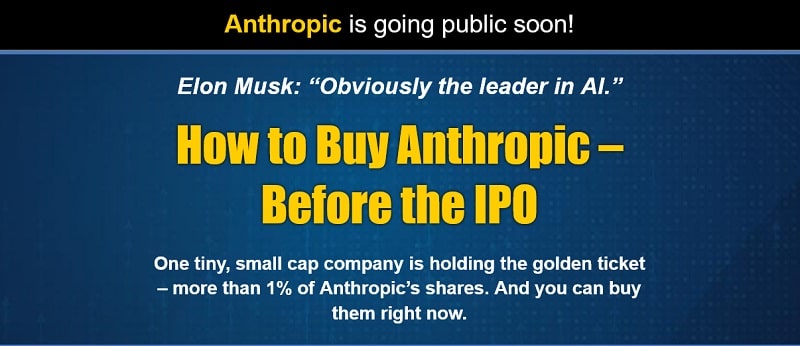
Michael A. Robinson, through his Weiss Ratings service Disruptors & Dominators, argues there is a better route. He points to a small publicly traded company that he says holds an estimated 1 percent stake in Anthropic. That existing ownership, combined with the company’s other AI-related businesses, forms the core of what he calls the “Anthropic IPO Loophole.” The pitch is simple: gain indirect exposure now rather than wait for the eventual public offering and risk buying after the biggest gains have already been captured by private investors.
This article examines the strategy in detail, reviews everything included with a Disruptors & Dominators subscription, weighs the reported track record and pricing, and assesses whether the package offers genuine value or merely clever marketing around a hot theme.
The Anthropic Opportunity and the Limits of Waiting for an IPO
Artificial intelligence has moved from research labs into the center of corporate capital expenditure. Training and running large language models requires enormous computing power, specialized chips, advanced cooling systems, data-center capacity, and supporting software. Anthropic sits near the center of that spending wave. Its models are used by enterprises seeking alternatives or complements to OpenAI, and its safety-focused branding has resonated with certain corporate and governmental customers.
Because Anthropic remains private, most retail investors cannot buy shares directly. Secondary markets for private stock exist but are typically restricted to accredited or institutional participants, involve high minimums, and carry significant liquidity and valuation risks. The conventional advice for ordinary investors has been to wait for an IPO. Robinson contends that advice may be suboptimal.
Historical examples illustrate the point. Uber, Facebook (now Meta), Robinhood, and Duolingo all generated intense retail interest at their public debuts. In each case, the stock later experienced meaningful drawdowns as early private shareholders sold into the public market and as valuations that had been set in private rounds adjusted to public-market realities. SpaceX has been cited in similar discussions: when private companies finally list, the first days or weeks can see heavy supply from long-locked-up shareholders. Anthropic’s eventual IPO could follow a comparable pattern, especially if the opening valuation already embeds aggressive growth assumptions about Claude’s market share versus ChatGPT and other rivals.

Robinson’s alternative is not to ignore Anthropic but to locate a publicly traded vehicle that already owns a meaningful stake. According to the research offered through Disruptors & Dominators, a relatively small listed company holds roughly 1 percent of Anthropic. Because the public company’s market capitalization is far smaller than those of Amazon, Google, Microsoft, or Nvidia, any material increase in the value of that stake could, in theory, have a larger percentage impact on the smaller firm’s share price. The research also highlights other businesses within the same company that stand to benefit from rising AI infrastructure spending by Anthropic, OpenAI, and their peers.
Whether that 1 percent stake is accurately described, whether the valuation impact will be as significant as claimed, and whether the other AI-related operations will deliver the expected results are questions only time and financial disclosures can answer. The research package aims to give subscribers the company name, ticker, ownership details, Weiss Ratings assessment, and supporting financial case so they can evaluate the thesis themselves.
What Disruptors & Dominators Actually Delivers
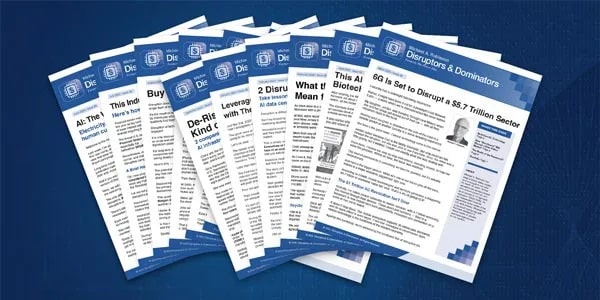
Disruptors & Dominators is a monthly technology research service. Each issue, released on the first Friday of the month, contains one new stock recommendation focused on companies that Robinson believes are positioned to benefit from major technology shifts. The emphasis is on durable long-term growth rather than pure short-term trading ideas, though the service acknowledges that some positions may produce faster gains when catalysts materialize.
Subscribers receive more than a ticker symbol. The monthly issue includes the research reasoning, the investment thesis, and relevant financial or competitive context written in accessible language. When material developments occur—company announcements, sharp price moves, or changes that affect an active recommendation—Flash Alerts are issued so members are not left waiting for the next scheduled report.
Membership also includes:
- Instant access to the full archive of past issues, special reports, and alerts.
- One year of Weiss Ratings coverage on more than 65,500 stocks, ETFs, and mutual funds. The independent ratings system assigns Buy, Hold, or Sell designations based on its own financial analysis.
- Lifetime access to the Weiss Ratings Daily e-letter (published three times per week), which provides broader market commentary on interest rates, sector moves, and macroeconomic developments.
- Occasional confidential online video briefings when the Weiss team determines that a major market story or theme requires more explanation than an email can provide. These sessions discuss research and general strategy; they do not offer personalized portfolio advice.
The service is explicitly designed for investors comfortable with a longer time horizon. Technology themes often take quarters or years to play out, and some recommendations may experience volatility or periods of underperformance while catalysts develop.
The Anthropic IPO Loophole Report and Supporting Bonus Material
The centerpiece of the current promotional package is the report titled “The Anthropic IPO Loophole Wall Street Doesn’t Want You to Know About.”

It identifies the small public company with the reported Anthropic stake, supplies the ownership percentage estimate, the ticker, the Weiss Rating, and the quantitative case for why the holding could matter. Robinson argues that the combination of the Anthropic equity interest and the company’s other AI-exposed businesses creates a dual catalyst: potential valuation uplift from the Anthropic stake itself plus operating leverage to broader AI capital expenditure.
Four additional special reports expand the thesis beyond a single name:
- The Best Way to Play the AI IPO Wars focuses on four companies that supply critical infrastructure or components needed by both Anthropic and OpenAI. Areas covered include advanced semiconductors, data-center cooling, semiconductor manufacturing equipment, and long-term AI infrastructure. The logic is that capital flowing into either AI leader (or both) should benefit these suppliers regardless of which model ultimately gains more market share.

- The $7 Dollar Stock Helping Build Nvidia’s Trillion-Dollar Robot examines a smaller company trading near that price level that Robinson describes as essential to Nvidia’s robotics ambitions. Nvidia CEO Jensen Huang has spoken publicly about robotics approaching a “ChatGPT moment.” The report outlines the smaller firm’s role in enabling that vision and why a major robotics announcement could draw attention to its shares.

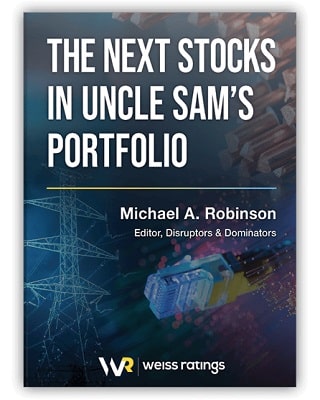
- The Next Stocks in Uncle Sam’s Portfolio looks at companies that may attract U.S. government support on national-security or strategic-technology grounds. The report highlights three names in particular, describing their roles and the potential for federal investment, contracts, or policy measures to influence their valuations.
- The User’s Guide to Disruptors & Dominators is a practical manual. It explains where new recommendations appear, how Flash Alerts work, how to navigate the research archive, how to use Weiss Ratings, and how to avoid common mistakes such as acting on an outdated recommendation without checking subsequent updates.

Together the five reports attempt to give subscribers multiple ways to approach the AI spending cycle rather than a single binary bet on Anthropic’s IPO timing or success.
Pricing, Guarantee, and Membership Structure
The standard digital membership is currently offered at $49 for the first year, a substantial discount from the regular $129 annual rate. That price includes the twelve monthly issues, the five Anthropic-related reports, Flash Alerts, the Weiss Ratings access, the lifetime Daily e-letter, and the archive. A premium option at $99 for the first year adds print delivery of the monthly issues while retaining all digital benefits. Both plans renew at $129 unless cancelled.
A 365-day money-back guarantee accompanies the offer. Subscribers may use the service for a full year and request a complete refund if unsatisfied. Cancellation can be handled by phone or email, and the Anthropic reports may be retained even after a refund is processed. This structure reduces the financial risk of trying the service, though it does not eliminate the opportunity cost of time spent reviewing the research or the market risk of any positions taken.
Reported Track Record and How to Interpret It
Promotional materials associated with Disruptors & Dominators cite several performance figures. Since the beginning of 2025 the service is said to have closed 16 triple-digit winners, with specific examples including 167 percent on TransDigm Group, 216 percent on Broadcom over three years, and 260 percent on Cadence Design Systems over five years. Across all portfolio recommendations since Robinson joined Weiss Ratings in 2024, an average gain of 50 percent is reported (including losing positions). Over a longer career span, 120 opportunities for triple-digit returns are mentioned, with standout examples such as 317 percent on Novavax and more than 560 percent on another name.
These numbers are drawn from the promotional materials themselves and should be treated accordingly. They represent selected outcomes under specific time frames and market conditions. Past performance is not indicative of future results. Technology stocks can experience extended periods of underperformance, and any average that includes both winners and losers will fluctuate with market cycles. Investors evaluating the service should request or review the full list of recommendations, entry and exit criteria, and the treatment of closed versus open positions rather than relying solely on highlighted winners.
Pros and Cons of the Package
Strengths
- Clear focus on a timely theme (AI infrastructure and pre-IPO exposure) with a concrete, named vehicle rather than vague promises.
- Multiple supporting reports that broaden the thesis beyond a single stock.
- Ongoing communication via Flash Alerts and access to a large independent ratings database.
- Lifetime Daily e-letter and a full research archive that remain useful even if the main subscription is not renewed.
- Unusually long 365-day refund window that allows real-world evaluation.
- Accessible writing style aimed at non-specialists.
Limitations
- Oriented toward growth-oriented investors comfortable with volatility and longer holding periods.
- No personalized advice; members must apply the research to their own circumstances, risk tolerance, and portfolio construction.
- Some recommendations may require patience while catalysts develop; there is no guarantee of near-term price appreciation.
- The core Anthropic thesis depends on the accuracy of the ownership stake, the eventual IPO timing and valuation, and the smaller company’s ability to capitalize on related AI spending. Any of those elements could diverge from expectations.
- As with any paid research service, the quality of analysis must be judged by the subscriber over time; marketing claims are not a substitute for independent verification.
Is the Anthropic IPO Loophole Strategy Worth Considering?
The answer depends on what an investor is actually seeking. If the goal is a low-cost way to obtain a packaged set of research ideas centered on AI infrastructure and one specific pre-IPO proxy, the current $49 first-year price plus the long money-back guarantee makes the package relatively low-risk to try. The combination of a monthly recommendation engine, timely alerts, a large ratings database, and several themed special reports provides more content than a typical single-idea teaser.
If the expectation is a near-certain path to outsized gains timed precisely to Anthropic’s IPO, the service cannot deliver that. IPO timing remains uncertain, private-company valuations can change, and the impact of a minority stake on a small public company’s share price is not mechanical. The broader AI infrastructure names may perform independently of Anthropic’s listing success or failure. In short, the package is research, not a guaranteed trade.
Investors who already follow AI capital expenditure trends closely may find limited incremental value. Those who prefer to wait for clear public-market catalysts or who allocate only to large-cap, highly liquid names may find the smaller-company focus outside their preferred style. Conversely, investors who want curated idea generation in emerging technology themes, who value the Weiss Ratings overlay, and who are comfortable conducting their own due diligence on the named companies may find the structure useful.
A prudent approach is to treat the Anthropic report as one data point among many. Verify the ownership claims through public filings if possible, examine the financials and competitive position of the recommended companies, assess position sizing relative to overall portfolio risk, and maintain realistic expectations about timing. The 365-day guarantee provides a practical window in which to do that work and decide whether the ongoing monthly research justifies the renewal price.
Broader Context: Pre-IPO Exposure Strategies and Their Trade-Offs
Indirect exposure to private companies through public vehicles is not new. Closed-end funds, listed holding companies, and certain SPACs or special-purpose vehicles have been used for years to give public-market investors partial access to private assets. The appeal is liquidity and accessibility; the drawbacks are dilution of the pure private-company exposure, potential management fees or corporate overhead, and the risk that the public vehicle’s other operations dominate or obscure the target stake.
In the current AI cycle the same logic applies. A small company with a 1 percent Anthropic position may see its valuation influenced by that stake, but it will also be judged on its own revenue growth, margins, balance sheet, and competitive dynamics. Market participants may assign a partial valuation to the Anthropic interest or may largely ignore it until an IPO crystallizes the value. Either outcome is possible.
Similarly, suppliers of chips, cooling systems, or robotics components can benefit from AI spending regardless of which model provider leads. That diversification is a potential strength of the supporting reports. At the same time, semiconductor and capital-equipment cycles are notoriously volatile, and government-related themes can shift with policy priorities and political cycles.
The Disruptors & Dominators package attempts to navigate these realities by combining a specific Anthropic proxy idea with a basket of related infrastructure and policy themes, then surrounding the ideas with ongoing research support and a long refund period. Whether that combination proves valuable is ultimately an empirical question that each subscriber must answer by examining the actual recommendations and results over time.
Practical Considerations for Potential Subscribers
Anyone considering the service should clarify several points before or shortly after joining:
- Confirm the exact ownership percentage and the source of that information (SEC filings, company disclosures, or estimates).
- Review the full list of past recommendations and the methodology for calculating average returns.
- Understand the difference between a research idea and a personal investment decision; position size, entry timing, and exit rules remain the investor’s responsibility.
- Note that Flash Alerts and video briefings are discretionary; the service does not promise continuous real-time coverage.
- Evaluate the Weiss Ratings methodology independently; ratings systems differ in their weighting of financial strength, valuation, and momentum factors.
- Plan an exit strategy for the subscription itself. The lifetime Daily e-letter and the retained Anthropic reports provide residual value even if the monthly service is cancelled after the first year.
Technology investing rewards informed risk-taking more than perfect foresight. The Anthropic IPO Loophole is one attempt to structure that risk-taking around a high-profile private company and the surrounding capital-expenditure wave. At the current promotional price and with the extended guarantee, the cost of examining the research is modest. The cost of acting on it without independent analysis is not.
Final Assessment
Michael Robinson’s Anthropic IPO Loophole thesis rests on a straightforward observation: private-market gains often accrue before the public ever has a chance to buy, and a small public company with an existing stake may offer a practical, if imperfect, form of early exposure. The Disruptors & Dominators package packages that idea together with several related AI infrastructure and policy themes, monthly research, alerts, ratings access, and a generous refund policy.

The offering is strongest as a curated idea-generation and education product for investors who already accept the volatility of technology stocks and who are willing to perform their own due diligence. It is weaker if treated as a shortcut that removes the need for independent analysis or as a timed bet on the precise date and valuation of Anthropic’s eventual listing.
At $49 for a full year of research plus the surrounding tools, the financial barrier to entry is low and the refund window is long. That structure allows interested investors to test the quality of the work rather than rely solely on marketing claims. Whether the specific Anthropic proxy and the supporting recommendations ultimately deliver attractive risk-adjusted returns will depend on company execution, broader AI spending trends, market conditions, and the investor’s own discipline in applying the research. Those factors lie outside any newsletter’s control.
For readers following the AI capital cycle and seeking structured research on both a potential Anthropic proxy and adjacent infrastructure names, the package merits a careful look. For everyone else, the same themes can be monitored through public filings, earnings transcripts, and independent analysis without a paid subscription. The decision ultimately turns on whether the convenience, curation, and ongoing communication justify the cost and the time required to evaluate the ideas properly.