
Quick Verdict
Weiss Ratings Plus is a subscription research platform from Weiss Ratings that gives letter-grade Buy/Sell ratings on more than 22,000 stocks plus thousands of ETFs, mutual funds and cryptocurrencies. The service positions itself as a practical way for ordinary investors to try to grow dollars faster than the long-term decline in the dollar’s purchasing power that the company calls “Project Pyramid.” Independent performance data outside Weiss’s own calculations is limited, past results do not guarantee future returns, and the $97 annual introductory price is locked in for continuous members. It is a tool for research and screening, not a managed account or guaranteed profit system.
Key Takeaways
- Project Pyramid is Weiss Ratings’ name for the multi-decade expansion of the U.S. money supply after the 1971 end of the gold standard and the resulting long-term loss of the dollar’s real-world buying power.
- Weiss Ratings has issued Buy, Sell and Hold ratings on U.S.-traded stocks since 2003 and states that its Buy-rated stocks, including all winners and losers, produced cumulative returns above 4,300 percent and an average 310 percent gain over an average 4.7-year hold period.
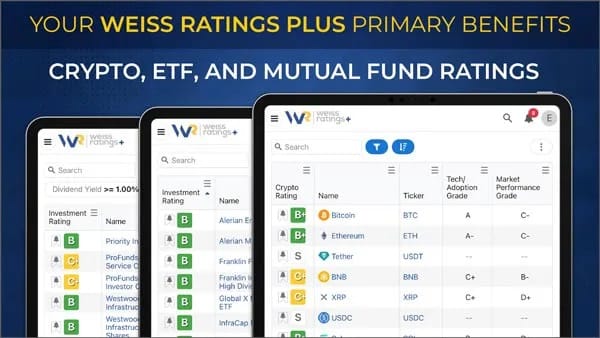
- Weiss Ratings Plus bundles real-time letter-grade ratings, custom alerts, special screeners, an interactive income predictor, tutorial videos, daily research letters and a special-report archive.
- Current special offer is $97 per year (stated 57 percent off the regular price) with the rate locked for as long as membership continues; cancellation is allowed at any time with access continuing until the paid period ends.
- The service is aimed at individual investors who want simple letter grades instead of complex technical charts and who are concerned about inflation, middle-class cost pressures and retirement funding.
- No performance guarantee is offered; the only firm promise is access to the tools at the locked price and the ability to cancel freely.
- Strengths include breadth of coverage, simplicity of the A–E grading system and real-time upgrade/downgrade alerts. Limitations include reliance on the company’s own historical calculations and the fact that markets can move against any rating system.
What Is Project Pyramid?

According to the material presented by Weiss Ratings senior research analyst Gavin Magor, Project Pyramid is the long-running monetary policy that began when the United States ended the dollar’s convertibility into gold in 1971. From that point forward the supply of dollars expanded dramatically. Weiss states that the money supply has multiplied by a factor of roughly 35 since the late 1950s, with most of the growth occurring after the gold link was broken.
The company argues that this expansion creates an illusion of rising asset prices and economic activity while steadily reducing the real purchasing power of wages and savings. Charts cited in the presentation compare the growth of the money supply with the much slower growth of average personal income and with the theoretical income that would exist if dollars had remained indexed to gold. The result, according to Weiss, is that everyday costs—housing, college tuition, healthcare—have risen far faster relative to family income than official inflation statistics suggest.
Weiss further links Project Pyramid to a set of broader trends: rising household debt, higher delinquency rates on credit cards, auto loans and mortgages, a shrinking middle-class share of national income and wealth, and a debt-to-GDP ratio that exceeds the level reached at the peak of World War II. Foreign holders of U.S. debt, including Japan and China, have reduced their relative holdings, and several countries have increased gold reserves while reducing the share of reserves held in dollars.
The presentation concludes that Washington cannot easily reverse the process. Returning to a gold standard would trigger immediate calls on outstanding dollar claims; interest costs on the national debt already exceed long-term real GDP growth expectations; and the U.S. share of global manufacturing has fallen sharply from the levels of the mid-20th century. Therefore, the only practical response available to individual investors, in Weiss’s view, is to accumulate dollars faster than the currency loses value—primarily through investment returns that outpace the rate of monetary expansion.
What Is Weiss Ratings?
Weiss Ratings is an independent financial research firm founded in 1971, the same year the gold standard ended. It rates more than 65,000 stocks, ETFs, mutual funds, cryptocurrencies, banks, insurance companies and other financial institutions. The firm emphasizes that its ratings are not influenced by investment-banking relationships and that it has a long record of issuing early warnings on financial crises.
Gavin Magor, the voice of the Project Pyramid presentation, has worked as an economic analyst for 38 years and has served as a senior research analyst at Weiss for 18 years. The firm presents its ratings as a practical alternative to traditional Wall Street research, which it says often lagged in issuing Sell recommendations during major downturns such as 2008–2009 and the early COVID market decline.
What Is Weiss Ratings Plus and How Does It Work?
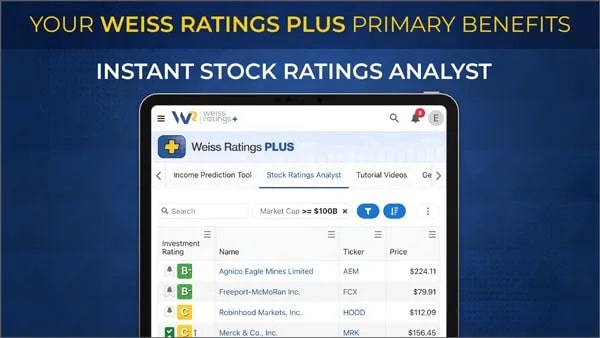
Weiss Ratings Plus is the consumer-facing membership platform that packages the firm’s ratings and research tools for individual investors. The core idea is simple: every covered security receives a letter grade from A to E. Grades in the A or B range are treated as Buy signals; grades below C are treated as Sell signals. The system is designed so that a user can evaluate a stock, ETF, fund or crypto in a few clicks without reading technical charts, moving averages or complex overlays.
The ratings draw on multiple proprietary factors that Weiss labels Risk, Reward, Growth, Solvency, Volatility and others. The platform continuously processes large volumes of market data—Weiss states more than 10 terabytes and over 1.2 billion calculations per day—to update grades in real time. Members can look up any individual security, sort and filter the entire universe by dozens of criteria, or rely on pre-built “Special Screeners” that surface newly upgraded Buys, newly downgraded Sells, undervalued names and high-yield stocks that still carry a Buy rating.
In addition to the letter grades, the service supplies historical rating changes for every covered security, total-return and dividend data, and the ability to compare individual names or whole sectors against the S&P 500. An Interactive Income Predictor lets a member enter a ticker, position size and time horizon and receive model-based estimates of possible share-price appreciation and dividend income. Real-time IRVING alerts (named after the firm’s founder’s father) notify members by email or other preferred channels whenever a followed security changes grade.
Supporting materials include a Quick-Start Guide, a series of short tutorial videos, daily market and crypto commentary, and an archive of special reports that highlight timely opportunities or risks. Member Care is available by phone and email during standard business hours.
The platform is browser-based with a companion app so ratings and alerts remain accessible on mobile devices. Everything is presented in plain language aimed at non-professional investors.
Historical Performance Claims
Weiss states that from the launch of its equity ratings in 2003 through the period covered in the presentation, the group of all stocks that received a Buy rating produced cumulative returns exceeding 4,300 percent when both winners and losers are included. Over the same span the S&P 500’s total return was substantially lower, resulting in a multiple of more than three times the benchmark according to the firm’s calculations.
On a shorter horizon the average Buy-rated stock is said to have delivered a 310 percent gain over an average holding period of 4.7 years, compared with roughly 67 percent for the S&P 500 over comparable windows. The firm also cites a series of individual high-return examples that reached four-digit percentage gains in weeks or months, as well as longer-term compounders such as Apple, NVIDIA, Monster Beverage, O’Reilly Automotive, Tractor Supply and others that posted multi-thousand-percent advances after receiving Buy ratings.
Weiss notes that these figures include every Buy rating issued, not a cherry-picked subset, and that the record spans two recessions and multiple market regimes. At the same time the firm repeatedly states that past performance is not a guarantee of future results and that no investor should expect identical returns going forward.
What’s Included in Weiss Ratings Plus

Membership provides immediate access to:
- Letter-grade ratings and multi-factor scores on more than 22,000 stocks.
- Ratings coverage of more than 15,000 cryptocurrencies, 21,000 mutual funds and 2,700 ETFs.
- Real-time Special Screeners: Hidden Buys (recent upgrades), Danger Zone (recent downgrades), Untapped Gems (undervalued Buys) and Ultimate Yield (high-dividend Buys).
- Instant IRVING alerts for any number of followed securities whenever a rating changes.
- Advanced Stock Ratings Analyst with full ratings history, custom filters and sector/industry comparisons.
- Interactive Income Predictor for share-price and dividend projections.
- Weiss Ratings Plus MasterClass video tutorials (more than two dozen short modules).
- Quick-Start Guide.
- Lifetime access (while a member) to Weiss Ratings Daily and Weiss Crypto Daily commentary.
- Complete archive of members-only special reports.
- Web portal, mobile app and Member Care support.
All of the above is available under the single annual membership.
Pricing
The special offer presented is $97 for a full year of Weiss Ratings Plus. Weiss states this represents a 57 percent discount from the regular price. The $97 rate is locked in for as long as the member remains continuously subscribed; no future price increases apply to that membership. Payment is made at the time of enrollment. After the order is processed the member receives confirmation emails containing access links and contact information for support.
Guarantee and Cancellation
There is no performance or money-back guarantee of investment results. The firm’s promise is limited to providing the full suite of tools and research for the paid period and never raising the subscription price for continuous members. Cancellation is available at any time with no additional fees or penalties; access continues until the end of the already-paid term. Member Care can be reached by phone (1-877-934-7778 or +1-561-627-3300 from overseas, Monday–Friday 9:00–5:30 Eastern) or by email at contactus@weissinc.com.
Who Is Weiss Ratings Plus For?
The service is designed for individual investors and savers who:
- Are concerned about long-term erosion of the dollar’s purchasing power and its effect on retirement planning.
- Prefer a simple letter-grade system over technical chart analysis.
- Want real-time notification when ratings change so they can act promptly.
- Seek coverage across stocks, ETFs, funds and cryptocurrencies in one place.
- Are comfortable making their own buy and sell decisions rather than handing money to a managed account.
- Value independent research that does not rely on investment-banking relationships.
It is less suitable for investors who want a fully managed portfolio, guaranteed returns, or advice that replaces personal responsibility for risk management and tax considerations.
Pros
- Simple A–E grading system that reduces decision complexity.
- Very broad coverage of stocks, ETFs, funds and cryptos.
- Real-time upgrade and downgrade alerts.
- Pre-built screeners that surface new opportunities and risks quickly.
- Locked-in low annual price for continuous members.
- Extensive educational materials and daily commentary included.
- Independent orientation with a stated history of early crisis warnings.
- Ability to cancel at any time without penalty.
Cons
- Performance figures are calculated by Weiss itself; independent third-party audits of the exact long-term track record are not referenced in the material.
- No guarantee that future Buy-rated stocks will match historical averages.
- Investors still must execute trades, manage position sizes and handle taxes themselves.
- The letter-grade system, while simple, necessarily compresses a large amount of information into a single symbol and may overlook company-specific nuances.
- Heavy emphasis on the Project Pyramid narrative may not resonate with investors who view monetary policy differently.
- Crypto and newer asset classes carry additional volatility and regulatory uncertainty that letter grades alone cannot eliminate.
Conclusion
Weiss Ratings Plus packages a long-running independent ratings system into a consumer membership that emphasizes simplicity, breadth and real-time alerts. The firm’s central argument is that decades of monetary expansion—labeled Project Pyramid—have steadily reduced the dollar’s real value and that the practical response for most individuals is to seek investment returns that outpace that decline. Historical calculations published by Weiss show that its Buy-rated equities substantially outperformed the S&P 500 from 2003 onward, both on a cumulative basis and on an average-hold-period basis.
The current offer makes the full platform available for $97 per year with the rate locked for continuous members and free cancellation. Whether the service is “legit” depends on an investor’s needs: it is a legitimate research and screening tool with a clear track record of published ratings and a transparent pricing structure. It is not a managed account, a guarantee of profit, or a substitute for personal due diligence. Investors who value independent letter-grade research, real-time change alerts and multi-asset coverage will find the features directly address those preferences. Investors seeking absolute certainty or hands-off management will need to look elsewhere.
As with any financial research product, the final decision rests on whether the tools and philosophy match the user’s goals, risk tolerance and willingness to act on the information provided.