
Larry Benedict has spent decades navigating markets that move on headlines, policy shifts, and sudden geopolitical pressure. His latest focus, branded the American Energy Endgame, centers on how Washington’s push for energy dominance could create repeated, tradable swings in crude oil. Rather than scatter attention across dozens of energy stocks, refiners, and drillers, Benedict’s One Ticker Trader service zeroes in on a single vehicle—the United States Oil Fund (USO)—and layers options strategies designed to benefit whether prices rise or fall.
This article unpacks the full playbook: the investment thesis, the one-ticker framework, the membership components, educational resources, performance claims, pricing structure, risks, and practical steps for evaluating the approach. Everything is drawn from the public description of the service so readers can assess whether the combination of research, alerts, and beginner-friendly options guidance fits their style and risk tolerance.

Understanding One Ticker Trader and Its Distinct Approach
One Ticker Trader is Larry Benedict’s monthly research and trade-alert service delivered through The Opportunistic Trader. The core idea is deliberately narrow. Instead of producing a fixed quota of recommendations each month regardless of opportunity quality, Benedict identifies the single ticker he believes sits closest to a major market catalyst. He then monitors that ticker for multiple potential setups as the catalyst develops.
Members receive a combination of deeper monthly analysis and timely alerts that specify the ticker, a target entry area, and exit guidance. Alerts appear only when Benedict judges the setup strong enough. Quiet periods may yield a single recommendation; faster-moving environments can produce several. This selective cadence stands in contrast to services that commit to a set number of ideas every month even when conviction is low.
The current dominant theme is the American Energy Endgame. Benedict frames President Trump’s energy agenda as a multi-year effort that goes beyond domestic production targets. The stated goal is to make American energy easier for allies to access, more reliable as a supply source, and more central to the global economy. In the near term, policy actions, sanctions pressure, production growth, and diplomatic developments can create sharp two-way moves in crude oil prices. Those swings form the backdrop for the USO-focused options work that currently anchors the service.
The Investment Thesis: American Energy Dominance and Two-Way Oil Volatility
The American Energy Endgame thesis rests on the observation that U.S. policy can simultaneously constrain certain foreign supplies while expanding domestic output and export capacity. On one side sits pressure on Iranian oil and related risks around key transit points such as the Strait of Hormuz. On the other side sits encouragement of higher American drilling, increased exports, and new supply arrangements with partners.
The net effect is potential volatility rather than a one-directional price path. Tighter sanctions or heightened tension near Hormuz can raise supply-risk premiums and push prices higher. Accelerated U.S. production and successful export deals can ease those fears and exert downward pressure. History offers illustrations of how quickly oil can reprice when geopolitics intervenes—most famously the roughly doubling of prices in a matter of months after Iraq’s 1990 invasion of Kuwait. Benedict’s approach treats such uncertainty as the opportunity rather than a problem to be avoided.
Because the direction of the next major move is inherently uncertain, the strategy does not rely on a permanent bullish or bearish stance. Options on USO allow positioning for upside with calls or downside with puts as conditions evolve. The same ticker can therefore be revisited multiple times as successive headlines or policy steps create fresh setups.
Why USO Serves as the Primary Vehicle
USO tracks movements linked to oil futures and trades through ordinary brokerage accounts. For Benedict, this combination makes it a clean, liquid way to express views on crude without having to analyze individual producers, refiners, pipeline operators, or shipping companies after every development.
Importantly, the service does not treat USO as a long-term buy-and-hold holding. Holding the fund for extended periods can produce results that diverge from spot oil because of the way futures-based products are structured. Instead, the emphasis is on shorter-duration options trades timed around catalysts. Calls are used when the outlook is constructive; puts when the balance of risks points lower. This flexibility is central to the American Energy Endgame framing: the strategy seeks to participate in price swings in either direction as sanctions, supply changes, or negotiations shift expectations.
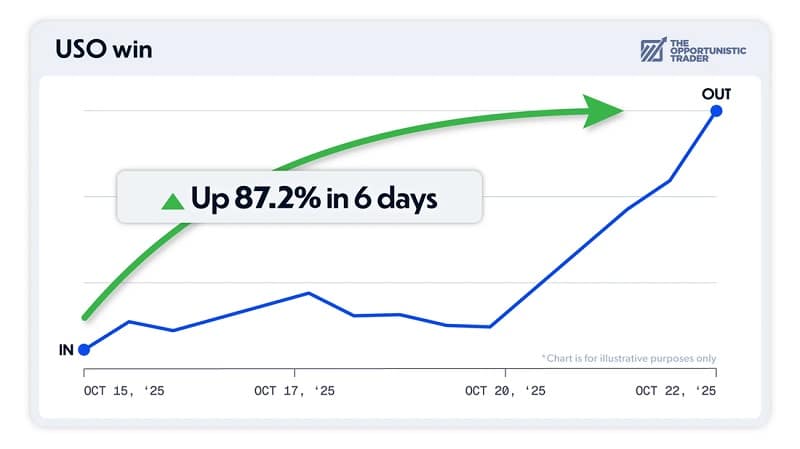
Past USO recommendations cited by the service include multi-day or multi-week percentage gains in the tens and higher, illustrating the type of move the approach aims to capture when timing aligns. Readers should note that these are selected examples; the service acknowledges that losses also occur.
How One Catalyst Can Produce Multiple Trade Opportunities
A defining feature of the one-ticker method is the willingness to return to the same instrument repeatedly while a broader theme unfolds. After a major policy announcement, for instance, Benedict previously issued a series of options recommendations on QQQ within a short window, with cited gains of nearly 60 percent, 18 percent, and 29 percent on successive trades.
The same logic applies to the energy theme. A new sanction, a supply agreement, a shift in Hormuz risk, or a White House statement can each create a distinct setup. Benedict performs the monitoring of Iran developments, U.S. production data, futures markets, and official statements. Members receive the distilled output: the ticker (currently USO), the suggested entry zone, and later the exit signal. The research burden on the individual is thereby reduced, though the responsibility for deciding whether to act and for managing position size remains with the subscriber.
Membership Components: What Subscribers Receive
A full-year subscription to One Ticker Trader includes continuous access to Benedict’s research and alerts for twelve months. This covers the current American Energy Endgame focus as well as any subsequent themes that emerge if the oil narrative quietens or another sector presents stronger catalysts.
Monthly deep-dive research forms the analytical backbone. Each issue examines what is changing in the market, how policy actions are evolving, and where capital may flow next. The goal is context: an alert alone does not explain why a particular development matters or how it connects to the chosen ticker. The monthly piece supplies that linkage, helping members evaluate risk before deciding whether to follow a recommendation.
Timely trade alerts supply the actionable layer. They specify the ticker, the approximate entry price Benedict favors, and later the instruction to close. Because there is no fixed monthly quota, the volume of alerts varies with market conditions. Subscribers can review and place orders through standard brokerage platforms, always cross-checking live prices and performing their own due diligence.
Two special reports accompany the American Energy Endgame package. The first, “USO: The Opening Move of The American Energy Endgame,” explains why the fund is positioned to respond to major crude-oil developments in either direction. It outlines the signals Benedict watches for potential new moves and the timing considerations that may confirm an opportunity. Practical guidance on using options rather than simply buying the fund is included.

The second report, “Larry’s Guide to Options,” is written for readers who want a clear foundation before placing trades. It covers calls and puts in plain language, when each is appropriate, step-by-step placement of a first position, position sizing, profit-taking, and loss-cutting. The guide is intended to reduce hesitation for newer options users and to serve as a reference when questions arise later.

Together these elements aim to provide both the strategic overview and the tactical execution details needed to follow the recommendations.
Pros and Cons of the Approach
Advantages highlighted by the service include a full year of access, a focused USO and crude-oil strategy capable of addressing rising or falling prices, clear entry and exit instructions, monthly research that links politics to market response, catalyst-driven alerts, beginner-oriented options education, and a 30-day money-back guarantee. The introductory pricing further lowers the barrier to evaluating the method.
Trade-offs are equally straightforward. Options can require relatively prompt action once an alert arrives. There is no guaranteed number of alerts each month. The concentrated one-ticker style suits participants who are comfortable following active recommendations rather than those seeking broad diversification or purely passive income. The service is therefore better matched to active market followers than to investors whose primary goal is set-and-forget portfolio construction.
Track Record Claims and Context
The service cites a 13-for-13 record in the first quarter of 2025 and a 279 percent return on cash for the full year, compared with roughly 15 percent for the S&P 500 over the same period. Since inception the approach is credited with a return on cash approaching 500 percent. Specific examples include QQQ options trades generating nearly 60 percent in one day, 18 percent overnight, and 29 percent within the same week, as well as USO trades producing 87 percent in six days, 25 percent in one week, and 77 percent in eight days. Additional Trump-related positions in TLT, Tesla, and META are listed with gains of 41 percent, 38 percent, and 135 percent respectively.
These figures are selected results shared by the service. Benedict notes that losses occur as well. Past performance is never a guarantee of future results, and any evaluation should weigh both the highlighted wins and the inherent risks of options trading, including the potential for rapid loss of premium if timing or direction is incorrect.
Pricing, Guarantee, and Renewal Terms
New members can currently join for $19 for the first twelve months, a substantial discount from the listed regular price of $499. That introductory rate equates to less than two dollars per month and includes the monthly research, all alerts issued during the year, the two special reports, and the 30-day money-back guarantee.
After the first year the subscription renews automatically at $199 annually (plus applicable taxes). Members receive a reminder before renewal and can cancel at least one day prior to avoid the charge. Under the guarantee, subscribers may review the materials, follow alerts, or paper-trade for a full month. If the service does not meet expectations, a prompt full refund is available upon contact with the team; the reports may still be retained.
The low entry cost is designed to let interested readers test the research quality, alert timing, and overall fit with minimal financial commitment.

Practical Steps for Evaluating the American Energy Endgame Strategy
Anyone considering the service is advised to begin with education rather than immediate capital deployment. Reading Larry’s Guide to Options first builds familiarity with calls, puts, strike prices, premiums, expiration, and basic risk management. Understanding these mechanics reduces the chance of misinterpreting an alert.
Next, review the USO-specific report to grasp why the fund is chosen and how its futures-linked structure differs from simply holding physical oil or longer-term energy equities. Paper-trading the first alert—recording the recommended entry, the live market price at the time, the exit instruction, and the eventual outcome—provides a low-stakes test of whether alerts arrive in a usable timeframe and whether the pace feels manageable.
When moving to real capital, keep position sizes modest. Defined-risk options still require that the absolute dollars at risk remain appropriate to the individual’s overall portfolio and risk tolerance. The American Energy Endgame may generate multiple opportunities as the policy and geopolitical landscape evolves, yet no one can know in advance which headline will prove most consequential. Benedict’s role is to monitor those developments and translate them into concrete setups; the subscriber’s role is to decide which ones to act on and at what size.
Broader Context: Event-Driven Trading and Concentration Risk
Event-driven approaches like the one employed here succeed or fail largely on the quality of the catalyst identification and the discipline of execution. Concentrating on a single ticker amplifies both the potential impact of a correct call and the consequences of an incorrect one. Diversification is intentionally sacrificed in favor of focus and reduced research load.
Options introduce additional layers of complexity: time decay, implied volatility changes, and the need for timely exits. The educational materials attempt to mitigate these challenges for less experienced traders, yet they cannot eliminate them. Readers who prefer buy-and-hold equity portfolios, broad index exposure, or income-oriented strategies may find the style mismatched to their objectives.
Conversely, participants who already follow markets closely, are comfortable with options mechanics, and value concise, catalyst-tied guidance may appreciate the reduction in information overload that the one-ticker framework provides.
Putting the Pieces Together: Is the Playbook Coherent?
The American Energy Endgame playbook is internally consistent. It identifies a multi-year policy theme capable of generating repeated oil-price volatility. It selects a liquid, futures-linked vehicle that can be traded efficiently in either direction via options. It supplies monthly context so members understand the “why” behind each setup. It delivers selective alerts only when conviction is present. It includes foundational education so newer traders are not left guessing about calls, puts, or risk management. And it pairs the package with a low introductory price and a short-term guarantee that lowers the cost of evaluation.
Whether that package is worth pursuing depends on individual circumstances: time available to monitor alerts, comfort with options, tolerance for concentrated positions, and belief that the energy-policy landscape will continue to produce tradable swings. The materials make no claim of guaranteed profits; they present a structured method for attempting to capitalize on the volatility that policy and geopolitics can create.
For those who decide the approach aligns with their goals, the current introductory offer provides a low-cost window to examine the research quality and alert process firsthand. Securing access before the next significant oil-related development is the practical implication of the service’s own timing argument.
In summary, Larry Benedict’s American Energy Endgame centers on focused, catalyst-driven options trading of USO rather than broad energy-stock selection or directional oil bets. The One Ticker Trader membership packages the research, the alerts, the educational support, and the performance claims into a single annual subscription currently available at a steep first-year discount. Readers who take the time to study the options guide, understand the two-way nature of the thesis, and test the process carefully will be best positioned to judge whether the playbook belongs in their own toolkit.