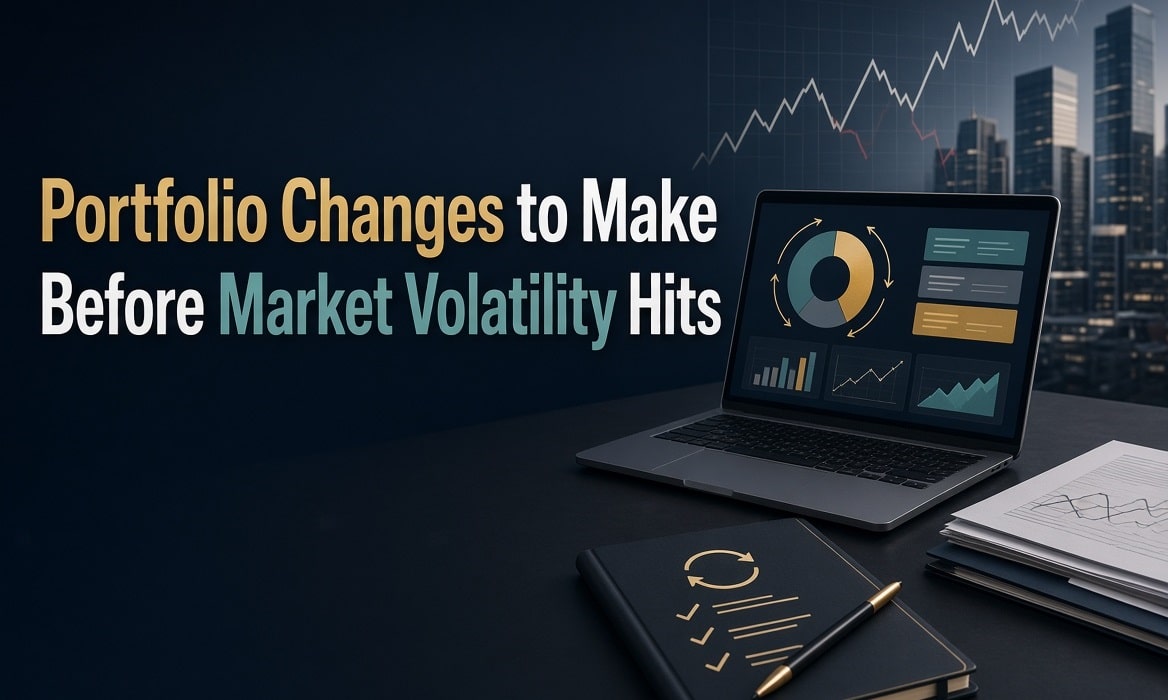
The best portfolio changes to make before market volatility hits are rarely dramatic. Start by checking whether your asset allocation still matches your goals, time horizon, and tolerance for losses, not last year’s returns.
Next, separate money you may need soon from investments meant to ride out market swings. A clear cash reserve and a balanced mix of assets can help you make decisions from a position of confidence when headlines turn unsettled.
Key takeaways
- Review asset allocation as life, income needs, time horizon and risk tolerance change.
- Identify hidden concentration across companies, sectors, property, currencies, fund managers and correlated holdings.
- Keep near-term spending and emergency reserves in accessible cash or high-quality short-duration holdings.
- Ensure bonds and defensive assets provide intended liquidity, diversification and downside resilience.
- Set annual reviews and allocation bands to rebalance systematically, not in response to headlines.
- Limit leverage, speculative positions and illiquid assets that could force selling during downturns.
Portfolio changes to make before market volatility hits
As an investor, I have learned that the most useful portfolio changes are made before headlines turn anxious and prices start moving sharply. Market volatility is inevitable; the question is whether your portfolio has been built to withstand it without forcing difficult decisions at the worst possible moment. That starts with planning around your real needs: income, time horizon, liquidity and comfort with temporary declines.
Review how much of your investments is concentrated in one company, sector or asset type. A portfolio that has quietly become dependent on a narrow part of the market may deserve rebalancing while conditions are calm. It is also sensible to keep near-term spending needs in readily available cash or high-quality, short-duration holdings, rather than relying on shares you may need to sell during a downturn.
These are not dramatic moves or attempts to predict the next bout of volatility. They are practical ways to ensure your investments still reflect your objectives. A diversified portfolio, a clear income plan and an agreed rebalancing discipline can make market uncertainty far easier to live with when it arrives.

Revisit your financial plan and asset allocation
A financial plan should evolve with your life, markets and retirement goals. Revisit your financial plan regularly to confirm your asset allocation still suits your time horizon, income needs and appetite for equity risk. The right asset allocation supports portfolio diversification, a balanced portfolio and the long-term return your investment portfolio requires.
Risk tolerance is not a score to set once and forget. It can change after retirement, a business sale, a change in health, or simply when market volatility reveals how much uncertainty you are genuinely comfortable carrying. I encourage clients to reassess risk in the context of the income their portfolios must produce, rather than focusing solely on headline performance.
Hidden concentration risk deserves particular attention. A portfolio may appear diversified while being heavily exposed to one employer’s shares, a local property market, a single fund manager, or companies responding to the same economic forces. Even global holdings can become concentrated if they favour similar sectors or styles. Sound wealth management looks beneath the labels: at underlying holdings, currency exposure, liquidity and correlations. The aim is not to eliminate risk, investment return requires accepting some, but to make sure each risk is intentional, proportionate and consistent with the life your wealth is meant to support.

Portfolio Risk Review: Areas to Check
| Risk area | What to review | Why it matters |
|---|---|---|
| Underlying holdings | Look beneath fund and portfolio labels to identify the investments actually held. | A portfolio can appear diversified while underlying holdings create concentrated exposure. |
| Employer-share exposure | Check how much of the portfolio is invested in one employer’s shares. | Heavy exposure to a single employer can create a significant concentration risk. |
| Property exposure | Consider reliance on a local property market. | Local market conditions can create concentrated exposure within an otherwise varied portfolio. |
| Fund manager exposure | Review whether investments rely heavily on a single fund manager. | Apparent diversification may be reduced when a large share of assets is managed through one source. |
| Sector and style overlap | Check whether global holdings favour similar sectors, investment styles or companies affected by the same economic forces. | Different holdings can still move together, creating hidden concentration. |
| Currency exposure | Assess the currencies to which the portfolio is exposed. | Currency is one of the underlying risks that should be intentional and proportionate. |
| Liquidity | Review how readily investments can be accessed or sold. | Liquidity should be considered alongside the income the portfolio must produce. |
| Correlations | Consider how investments may behave in relation to one another. | Correlated investments can increase risk even where a portfolio contains many holdings. |
Separate cash needs from investment risk
One of the most practical ways to invest with confidence is to stop asking your portfolio to do two different jobs at once. Money you may need soon, for bills, planned purchases, a change in work, or an unexpected repair, belongs in cash or cash equivalents, where liquidity matters more than return. That readily available buffer means you are less likely to sell long-term investments at the wrong time simply because life needs funding.
I encourage investors to decide how much cash they need based on their own circumstances, rather than a headline or a market forecast. A household with irregular income, upcoming school fees or a near-term property expense may sensibly hold more. The appropriate place for this money is one where it can be accessed without relying on favourable market conditions.
Once that reserve is set aside, the remainder can be invested according to its genuine time horizon and risk tolerance. A market decline is uncomfortable, but it need not disrupt a well-funded plan. Keeping a clear distinction between your liquidity needs and your investment capital is central to overcoming market volatility: your short-term money stays secure and available, while your longer-term money has time to work through the cycle.
Check whether bonds and defensive holdings still fit their role
In a well-built portfolio, bonds are not there simply to generate income. Their job is usually broader: to temper equity risk, provide a source of liquidity and give you something comparatively dependable to rebalance from when the market falls. That role deserves a fresh review after periods of changing interest rates, inflation or sharp share-price movements.
I would start by looking at what your fixed-income allocation actually owns. Government bonds may offer a different kind of protection from corporate bonds, while longer-dated holdings can move more sharply when rate expectations change. A fund labelled defensive may also carry meaningful credit, duration or currency risk, so its behaviour in volatile markets may not match the reassurance its label implies.
The right mix depends on when you expect to need the money and how much fluctuation you can live with. A portfolio that includes bonds, cash and other defensive assets should have a clear purpose for each component. If a holding no longer contributes reliable income, diversification or downside resilience, it may be time to adjust it rather than assume yesterday’s allocation still suits today’s market.

Set regular rebalancing rules before you need them
Regular rebalancing is a discipline, not a reaction to headlines. A clear asset allocation review schedule helps with maintaining the risk you chose, while reducing the urge to tinker when markets move sharply or fund managers fall in and out of favour.
Calendar reviews or allocation bands?
Most investors can use either a calendar-based review or allocation bands; the right choice is the one they can follow without turning their portfolio into an active trading exercise. A calendar review, perhaps once or twice a year, offers welcome simplicity. You assess holdings, contributions and withdrawals, then restore the intended mix if it has materially shifted.
Allocation bands are more responsive. You set a permitted range around each asset class, such as allowing equities to move five percentage points above or below their target. Rebalancing occurs only when a holding crosses that boundary. This can keep the portfolio closer to its agreed risk tolerance during extended market runs, but it requires reliable monitoring and a little more administration.
Volatility is not, by itself, a reason to act. The purpose is to preserve the investment plan, not to predict the next turn in markets. In practice, I favour a scheduled annual review with sensible bands as a backstop, particularly for investors who want discipline without constant attention.
Choosing a rebalancing approach
- Use a calendar review once or twice yearly for a simple, repeatable routine.
- Check holdings, contributions, withdrawals and overall asset allocation during each scheduled review.
- Set allocation bands around targets to identify when market movements materially change portfolio risk.
- Rebalance only after a band is crossed, rather than reacting to everyday volatility.
- Choose bands that are wide enough to avoid unnecessary trading but narrow enough to protect your intended mix.
- Consider an annual review with allocation bands as a practical balance between discipline and low administration.
- Focus on maintaining your agreed investment plan, not predicting short-term market direction.
Contain active, leveraged and speculative portfolio risk
In unsettled conditions, the job is not to predict every turn in the market. It is to know where a portfolio can be hurt most quickly, and to reduce exposures that depend on favourable timing, cheap funding or uninterrupted confidence. That is especially important when market volatility rises and prices begin moving faster than the underlying business case.
Start with the active positions that require frequent decisions. If an investment only works when you can trade in and out at the right moment, it deserves a smaller allocation than a durable holding supported by cash flow and a clear valuation. Be equally direct about leverage. Borrowing can magnify returns, but it also narrows your room to wait through a decline. Margin calls and refinancing pressures can turn a manageable fall into forced selling.
Speculative assets need their own limits, rather than being allowed to drift into the core portfolio after a strong run. Decide in advance what proportion can be exposed to higher-risk ideas, illiquid holdings or businesses without proven earnings. In my experience, a portfolio is more resilient when its essential income and long-term capital are not reliant on one active bet. Sensible position sizes, liquidity and a clear rebalancing discipline give you choices when others are selling.
Consider tax and account type before selling
Before selling investments, I look at where they are held as closely as I look at what they are. A sale in a taxable brokerage account can create capital gains tax, while selling within a traditional IRA generally does not trigger an immediate tax bill, but withdrawals from that account are ordinarily taxed as income. Roth retirement accounts work differently again: qualified withdrawals can be tax-free, making those assets especially valuable later in retirement.
That distinction matters when you need money for spending, want to rebalance, or are deciding which holdings to reduce first. Selling a long-held investment in a taxable account may mean realizing a sizable gain. On the other hand, harvesting losses or using lower-income years strategically may soften the tax impact. Required minimum distributions can also shape the timing of sales from certain retirement accounts.
The right choice is rarely just “sell the winner” or “sell the account with the largest balance.” It should fit your broader financial plan, including your expected income this year, future tax brackets, charitable goals, and estate considerations. An experienced tax professional or financial advisor can help coordinate those decisions so a necessary sale does not create an avoidable tax surprise.
Avoid reactive moves, then use a pre-volatility checklist
When the market turns sharply, the most expensive decision is often the one made to relieve discomfort. A sudden hit to account values can create an urge to sell, retreat to cash, or make a sweeping change before the facts are clear. That response may satiate the need to act, but it can also lock in losses and leave a portfolio poorly positioned for the recovery that follows. Before volatility arrives, decide what would actually justify a change: a material shift in income needs, a change in time horizon, or an allocation that no longer reflects your objectives. Then keep a short checklist: review how much near-term spending is covered by cash and high-quality bonds; confirm that stock and bond holdings still fit the role assigned to them; and consider whether a sale would create an unnecessary tax bill. For households with several portfolios, review the full picture rather than judging each account in isolation. A disciplined process does not eliminate volatility. It gives you a practical way to distinguish a temporary market setback from a genuine reason to adjust your plan.
Pre-Volatility Decision Checklist
- Define in advance which life changes, not market headlines, would justify adjusting your investment plan.
- Confirm cash and high-quality bonds can cover near-term spending needs without selling long-term holdings.
- Review whether stock and bond allocations still match your objectives, timeline, and comfort with risk.
- Assess all household accounts together rather than reacting to losses in one portfolio alone.
- Estimate potential taxes before selling investments, especially positions with meaningful unrealized gains.
- Pause before acting during sharp declines; distinguish temporary setbacks from lasting changes to your circumstances.
When wealth management or tax guidance is worth seeking
In my experience, professional guidance becomes most valuable when your financial life gains moving parts: a growing portfolio, stock compensation, a business sale, real estate, an inheritance, retirement withdrawals, or charitable giving. These are moments when a good decision in one area can create an unintended tax bill or alter the level of risk you are taking elsewhere.
Wealth management is not reserved for a particular net-worth threshold. It can be worthwhile when you want a coordinated financial plan rather than a collection of accounts and isolated recommendations. An experienced advisor can help connect cash flow, investments, insurance, estate documents, and long-term goals, while keeping your portfolio aligned with your actual risk tolerance, not the appetite for risk you had during a strong market.
Tax guidance deserves similar attention before a major transaction, not after it appears on a return. A CPA or tax attorney can clarify the consequences of exercising options, selling appreciated assets, taking required distributions, or establishing a trust. The right team brings discipline to management decisions and helps protect the wealth you have worked hard to build.
Frequently asked questions
What portfolio changes should I make before market volatility?
Review whether your asset allocation still reflects your goals, time horizon and capacity for loss. Reduce unintended concentration in a single share, sector, employer or asset type; set aside money needed soon in accessible cash or high-quality short-duration holdings; and confirm that defensive assets still have a clear role.
How much cash should I hold before a market downturn?
Hold enough readily accessible cash or cash equivalents to cover near-term spending, planned purchases and likely emergencies without needing to sell investments in poor market conditions. The appropriate amount depends on income reliability, upcoming commitments and personal circumstances rather than a universal rule.
How often should I rebalance my investment portfolio?
Many investors review and rebalance once or twice a year, with allocation bands as an additional trigger. For example, you might rebalance if equities move materially above or below their target weighting. The aim is to maintain your intended level of risk, not to react to market headlines.
Why can a diversified portfolio still have concentration risk?
Different funds or holdings may own similar companies, sectors, regions or investment styles. Concentration can also come from employer shares, property, a single fund manager, currency exposure or holdings that respond similarly to economic changes. Review underlying investments, not only fund labels.
What role should bonds play during volatile markets?
Bonds can provide income, liquidity and a counterbalance to equity risk, but their behaviour varies. Government, corporate, short-duration and long-duration bonds have different interest-rate and credit risks. Check that your fixed-income holdings match when you expect to use the money and the protection you expect them to provide.
Should leveraged or speculative investments be part of a core portfolio?
Higher-risk, leveraged and illiquid positions should normally be limited to an amount you can afford to lose or leave untouched for an extended period. Borrowing can create margin calls and forced sales during declines, so core income needs and long-term capital should not depend on favourable timing or one speculative outcome.