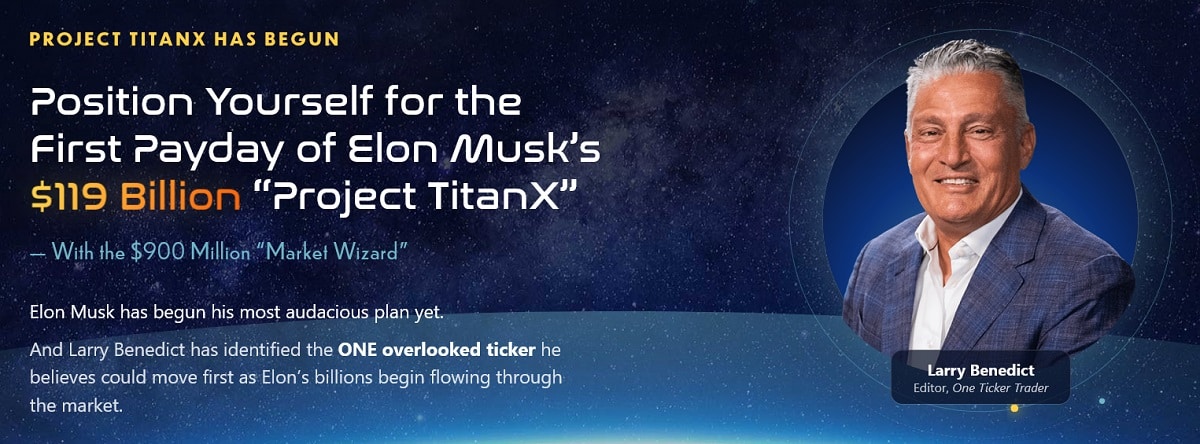
Former $900 million fund manager and Wall Street legend Larry Benedict has identified what he believes is the first major ticker positioned to benefit from Elon Musk’s newest and most ambitious plan. Benedict calls the plan Project TitanX. According to documents he has reviewed, Elon could spend as much as $119 billion to take control of the single technology that every major piece of his empire depends on.
That technology is advanced AI chips. Without enough of them, Tesla’s self-driving systems, Optimus robots, xAI and Grok, and even parts of SpaceX cannot grow at the speed Elon wants. Project TitanX is Elon’s answer: build the capacity to make those chips himself inside a factory large enough to cover Central Park nearly three times over. The first phase alone is projected to cost more than $16 billion. The full effort could reach $119 billion.
Benedict’s core message is straightforward. Whether Elon fully succeeds or faces setbacks, the sheer scale of spending will move money across multiple markets. Companies that supply technology, equipment, or expertise stand to benefit. One of those companies, Benedict argues, has been written off by Wall Street for years. Its ticker is INTC — Intel.
Elon’s Proven Ability to Move Markets
Elon Musk does not just run companies. His actions and even his social media posts regularly shift billions of dollars in a matter of hours or days. Benedict uses several recent examples to make the point.
When SpaceX went public, it became the largest IPO in history. Shares jumped 28% on the first day of trading. At the same time, other space stocks fell. Rocket Lab dropped 8%. Intuitive Machines fell 11%. Virgin Galactic declined 28%. One company’s success created a group of losers in the same sector within hours.
In November 2021, Elon asked his followers on Twitter whether he should sell 10% of his Tesla stake. More than 3.5 million people voted, and most told him to sell. The next trading day, roughly $30 billion was wiped from Tesla’s market value. Broader indexes moved lower as well.
In January 2021, Elon changed his Twitter bio to one word: Bitcoin. Within hours Bitcoin rose nearly 20%, adding about $111 billion to its market capitalization. Days later Tesla announced it had bought $1.5 billion of Bitcoin. The price climbed another 15% to a new high.
These are not isolated events. Benedict’s view is that Elon can send markets higher or lower with unusual speed. When he commits capital on the scale of Project TitanX, the logical result is multiple waves of money moving through suppliers, partners, and related stocks. The opportunity lies in positioning before those waves become obvious to the broader market.
Getting Ahead of the Money Flow
Benedict’s track record includes multiple instances of identifying secondary effects after a major Elon-related event. After the SpaceX IPO, while most attention stayed on the newly public company, he recommended a trade that members who took it had the chance to close for a 175% gain in a little over a week.
In March 2025, during the period of uncertainty around Elon’s work with government efficiency efforts, markets grew nervous. Benedict recommended three quick trades across his services. The Nasdaq fell about 4% in a single day. Members who followed the recommendations had the chance to close those trades for gains of 47%, 28%, and 50% — all in one day.
In July 2024, anticipation built around Tesla’s Robotaxi reveal. Benedict recommended a trade on Tesla itself. When reports later indicated a design-related delay, Tesla shares dropped about 8%. Members who took the trade had the chance to pocket a 135% gain.
These examples illustrate the pattern Benedict follows. He watches where money is likely to move next rather than chasing the headline stock. He then focuses on a single ticker he believes sits at the center of that movement.
One member reported more than $50,000 in pure profits following Benedict’s recommendations during 2025. Results of that size are not typical. Investing in securities carries a high degree of risk, and investors can lose some or all of their capital. Still, the reported outcome shows what is possible when multiple successful trades stack over time.
Over his career, Benedict managed close to $1 billion. He has banked more than $1 million in profit on a single trade more than 500 times. His hedge fund ranked in the top 1% worldwide and generated more than $274 million in pure profits for clients. He maintained a 20-year winning streak that spanned the dot-com boom and bust, the 2008 financial crisis, and the COVID period. In 2008, when the S&P 500 fell 37%, his fund posted gains and made clients $95 million that year. In early 2020 he warned publicly that more downside was coming and made $2 million in a single month while the market dropped 34%.
What Project TitanX Actually Is
AI may appear as software on a screen, but it runs on physical computer chips that perform enormous numbers of calculations. Tesla’s Full Self-Driving systems, Optimus humanoid robots, xAI’s Grok models, and related SpaceX applications all require these chips in large quantities. Elon has stated publicly that even if Nvidia supplied every chip it could produce, the volume would still fall short of his needs.
Project TitanX is Elon’s plan to solve that bottleneck by making advanced AI chips in-house. The centerpiece is a factory complex large enough to cover Central Park nearly three times over. The initial phase is expected to cost more than $16 billion. Documents Benedict has reviewed point to a potential total outlay of up to $119 billion.
Benedict’s position is that success or failure is secondary to the money that will move either way. Every supplier chosen, every technological breakthrough, every delay, and every new partnership can create winners and losers on a scale larger than previous Elon-driven moves. Benedict has never seen one individual undertake a project with this much potential to shift capital across so many markets.
The plan is already underway. Most public attention remains fixed on Elon himself, the giant factory, and the headline dollar figure. Benedict and his team have spent months following the quieter details. They believe one long-overlooked company sits near the center of the early stages.
Why Intel Is the First Ticker Benedict Highlights
For years Intel was the largest computer company in the world. Competitors eventually caught up and passed it. Its stock declined sharply. Wall Street largely wrote it off as a company whose best days were behind it.
Benedict looks at Intel the way he believes Elon sees it today. Building the world’s largest chip factory is useless without the technology, process knowledge, and decades of manufacturing experience required to produce advanced chips at scale. Intel still possesses that expertise. Elon can spend tens of billions on buildings and equipment, but he cannot instantly recreate institutional knowledge that took decades to accumulate.
In Benedict’s view, Intel is the missing piece that can help turn the factory into a functioning production facility faster than starting from zero. Wall Street continues to judge the company by its past struggles. Elon appears to be evaluating it by what it can still deliver. That gap in perception is the opportunity Benedict sees.
He is not recommending that readers simply buy and hold Intel shares. A 5% or 10% rise in the stock alone may not produce life-changing gains for most individual investors. Instead he focuses on what he calls accelerated trading — using options to pursue larger percentage returns from relatively small moves in the underlying ticker.
How Accelerated Trading Works in Practice
Traditional stock investing links your percentage return directly to the stock’s percentage move. If a stock rises 5%, you make roughly 5% (before costs). Benedict’s approach uses options contracts that can multiply the effect of a modest move.
Several concrete examples from his past recommendations illustrate the difference:
- A trade on SPY (the S&P 500 tracker) closed for a 189% gain in one day while the index itself fell about 2%.
- A trade on DIA (the Dow tracker) closed for a 100% gain over six days while the Dow rose only about 1.4%.
- A trade on Apple closed for a 154% gain while the stock finished a two-day period down about 1%.
- Another SPY trade closed for a 212% gain in two days while the index fell about 1.3%.
- An earlier SpaceX-related trade produced a 175% gain from an 8% move in the underlying ticker.
These results are not typical, and every options trade carries the risk of losing the full amount invested. The defining feature is that the maximum loss is known and limited to the premium paid before the trade is placed. An investor can choose to risk $300, $500, or whatever amount fits their situation rather than committing the full capital required to buy hundreds of shares outright.
In 2025 more than 15 billion options contracts traded in the United States. Technology has made the market accessible from a phone. Benedict’s role is not to turn everyday investors into options experts. He identifies the setup, sends the exact instructions, and later sends the exit alert. Members who choose to participate can place the trade in roughly 30 seconds once they understand the basics.
One Ticker Trading
Benedict’s broader method is called One Ticker Trading. When a major event begins moving capital through the market, he isolates the single ticker he believes sits at the center of that flow and concentrates there. He does not scatter attention across dozens of names.
A March 2025 sequence shows how the approach can produce multiple opportunities in a short window. Focusing on the ticker IBIT, Benedict recommended two trades on March 4. Readers had the chance to close one for a 40% gain and the other for 41% before the day ended. When the market turned the next day, he recommended two more trades that offered chances for 39% and 61% gains. Four separate opportunities from the same ticker in roughly six days added up to 181% in combined pure profit potential for those who took every trade.
The same focused process is what Benedict intends to apply to Project TitanX over the coming year. The first recommended ticker is Intel. Subsequent recommendations will depend on where the money actually moves as the project advances — new suppliers, new partnerships, technological milestones, or setbacks.
The Practical Package Benedict Offers
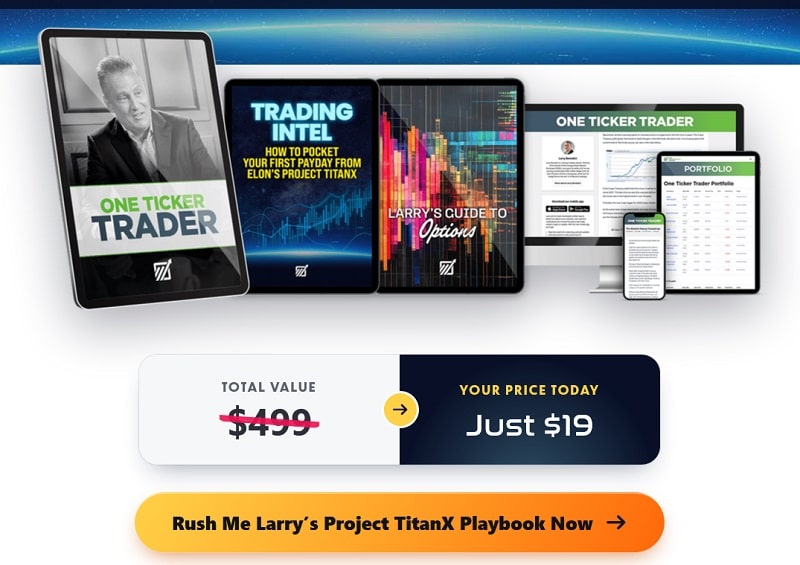
Benedict has prepared two special reports and a full year of ongoing coverage through his service One Ticker Trader.
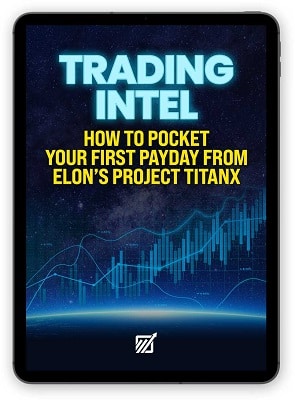
The first report is titled Trading Intel: How to Pocket Your First Payday From Elon’s Project TitanX. It lays out the specific setup he sees forming around INTC, the type of trade he prefers, the signals he is watching, and the complete picture of how he would approach the opening move. It is written so that someone with no prior options experience can follow the logic and the instructions.
The second report is Larry’s Guide to Options (also referred to as the guide to accelerated trading). It explains in plain language what an option is, the two basic types (calls and puts) and when each is typically used, how to place a trade inside a standard brokerage app, and how to keep risk defined and limited. The goal is to take a complete beginner from zero knowledge to the ability to act on a clear recommendation in a short time.
One Ticker Trader itself provides twelve months of research and trade alerts focused on Project TitanX and related opportunities. When Benedict identifies a setup he believes in, members receive an email with the ticker, the recommended structure, entry details, and later an exit alert. Some months may bring two or three recommendations. Other months may bring one. He only sends trades he rates highly.
The standard one-year membership price is listed at $499. For those who watched the original presentation, the publisher has offered the complete package — both reports plus a full year of One Ticker Trader — for a single payment of $19. That works out to less than 40 cents per week. A 30-day money-back guarantee applies. Anyone who is not satisfied can request a full refund within 30 days and keep both reports.
Results such as the $50,000 reported by one member in 2025 or the multi-trade sequences described earlier are not typical. Past performance does not guarantee future results. No one should invest money they cannot afford to lose. Options can expire worthless, resulting in a 100% loss of the premium paid.
Why the Window Matters
Benedict emphasizes timing. Elon’s next major Project TitanX milestone could arrive within days. When it does, mainstream coverage is likely to intensify. The ticker that has been largely ignored may suddenly appear in far more research notes and news stories. The advantage of positioning early would diminish.
The same dynamic applies to the special $19 rate. The publisher can return the price to the regular $499 level at any time. Once visible winners begin appearing and demand for the research rises, the current offer is unlikely to remain available indefinitely.
Putting the Pieces Together
Project TitanX is not a single announcement. It is a multi-year effort that will require suppliers, equipment, process knowledge, and capital on a scale rarely seen. The money will flow somewhere. Benedict’s research points to Intel as the first public company that could sit near the center of that flow because of the manufacturing expertise it still holds.
His method does not require investors to become chip engineers or to monitor Elon’s every statement. It requires identifying the one ticker most tightly linked to the next wave of spending, then using defined-risk options structures to pursue amplified returns from ordinary percentage moves in that ticker.
Readers who want the detailed trade plan for Intel, the beginner’s options guide, and twelve months of follow-on recommendations can obtain them through the One Ticker Trader membership currently offered at $19. Those who prefer to act independently now know the ticker Benedict has highlighted and the broader logic behind the opportunity.
Either path carries risk. Markets can move against any position. The information presented here is educational and promotional in nature and should not be treated as personalized investment advice. Anyone considering options or individual stocks should carefully assess their own financial situation, risk tolerance, and time horizon before committing capital.
The core claim remains simple. Elon Musk is preparing to spend up to $119 billion to control the AI chips his companies require. One long-overlooked American technology company still possesses the experience that could help make that plan real. Larry Benedict believes that company is Intel, and he has laid out a specific, time-sensitive way to approach the opening move and the opportunities that may follow.