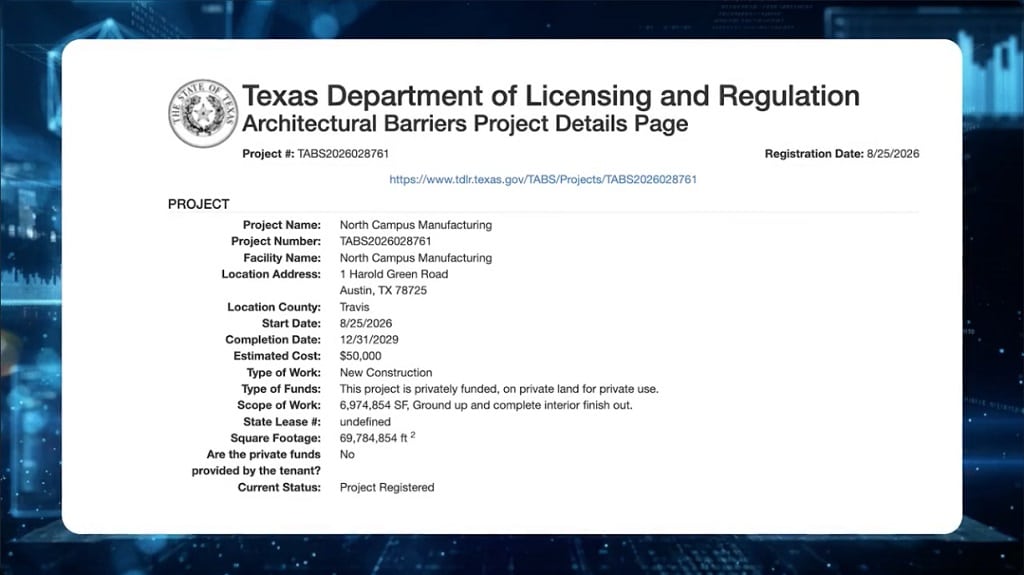
Elon Musk just filed a document with the Texas Department of Licensing and Regulation. Most people missed it. Jeff Brown did not.
The Silicon Valley insider and founder of Brownstone Research calls the filing the start of what he terms M.A.G.I. Phase II. He believes it opens a once-in-a-lifetime wealth window that could prove far larger than the gains his readers already saw in Phase I.
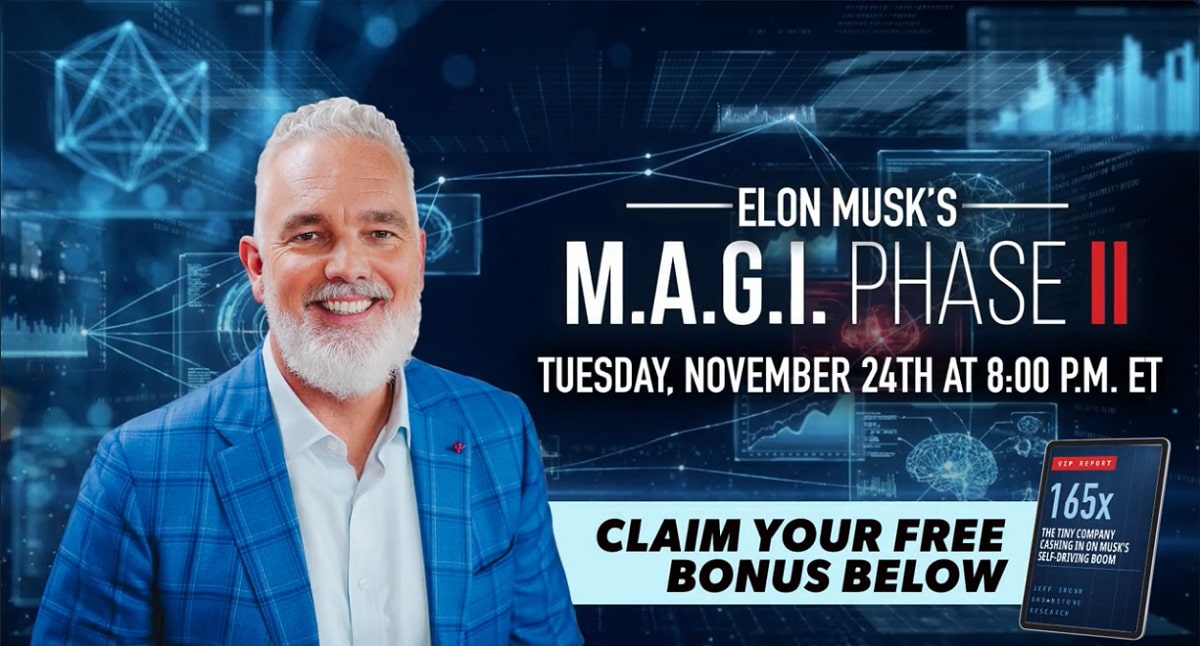
This coming Tuesday, November 24, at 8 p.m. ET, Brown is hosting a free strategy session titled Elon Musk’s “M.A.G.I. Phase II.” In that session he plans to explain exactly what Phase II is, how investors can prepare, and the free name and ticker of a company making a strange device the size of a shirt button. Musk, according to Brown, is about to need 200 billion of those devices every single year.
Brown has also uncovered evidence that the biggest gains tied to this window could disappear as early as December 13. That is why the timing of the free session matters.
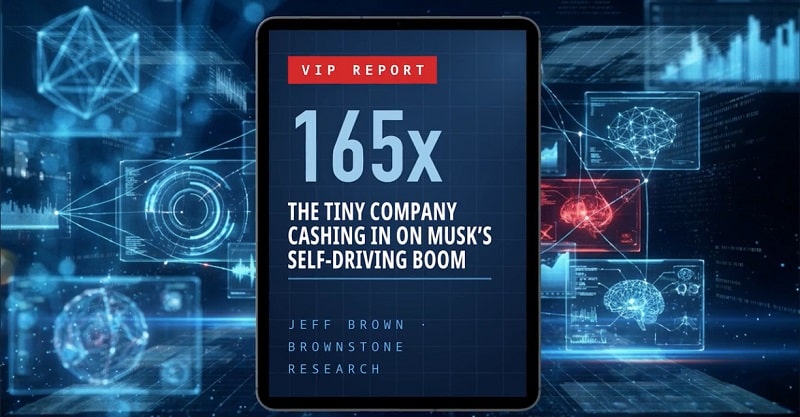
Readers who register can also join a free VIP list and receive a report valued at $199. That report reveals a tiny company that has found a way to profit from Tesla’s projected explosion in full self-driving miles. Musk himself shared news of the company’s breakthrough with his more than 240 million followers on X.
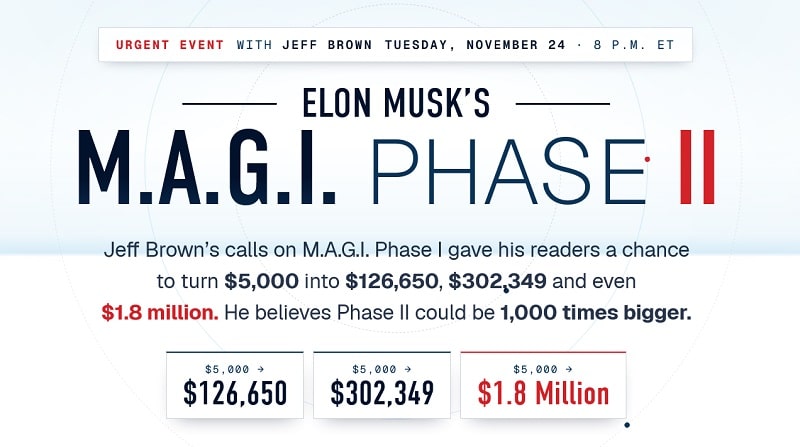
The numbers Brown lays out are striking. He says his M.A.G.I. Phase I calls already gave readers the chance to multiply money by 12 times, 13 times, 25 times, 60 times, and even 360 times. Just $5,000 placed in each of those positions could be worth more than $2.36 million today.
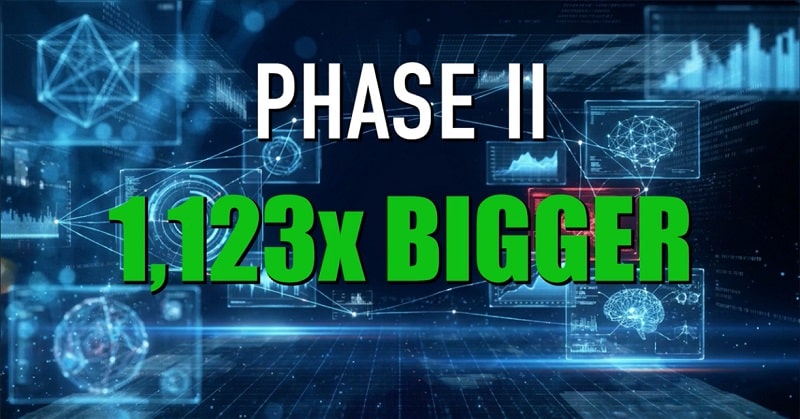
Using Musk’s own figures, Brown calculates that Phase II is set to be 1,123 times bigger. Musk has described the opportunity as “an infinite money glitch.” Brown’s math on the projections points to 66,566 percent growth in the next year alone. That is the kind of move that could turn a $2,000 investment into more than $1.3 million, a $5,000 investment into $3.3 million, or a $10,000 investment into $6.6 million—in a single year.
A little-known company that is 1,573 times smaller than Tesla has already received an official letter that Brown believes marks it as a key supplier for Phase II. On Tuesday he also plans to name another supplier that Goldman Sachs once called a generational buying opportunity.
Who Is Jeff Brown and Why Investors Listen
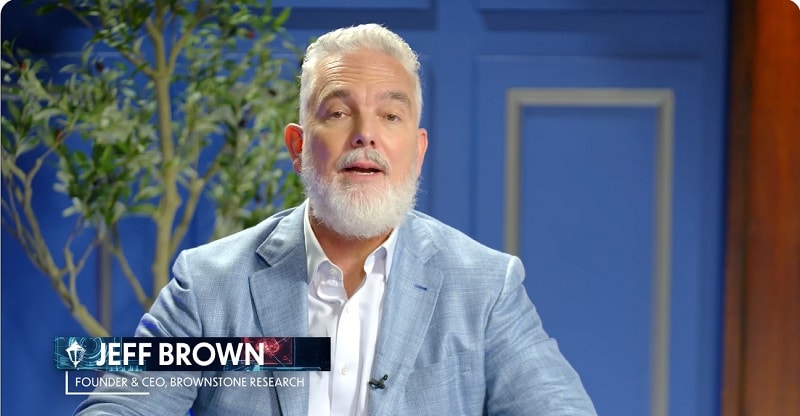
Jeff Brown is the founder and CEO of Brownstone Research. Before launching the firm he spent roughly 25 years as a high-technology executive. He worked at companies including Qualcomm, NXP Semiconductors, and Juniper Networks. That experience inside the industry, combined with active angel investing in early-stage technology companies, gives him a view of trends months or years before they become obvious to most investors.
He holds formal degrees and professional certificates from institutions that include MIT, Stanford, UC Berkeley’s School of Law, and the National University of Singapore. He is an active board member and adviser to several companies.
Brown’s research focuses on technologies he believes are on the verge of exponential growth. His services give self-directed investors access to ideas that range from established large-cap leaders to smaller companies still flying under Wall Street’s radar.
Exponential Tech Investor is Brownstone’s premier advisory for small- and micro-cap technology companies developing cutting-edge technologies on the verge of exponential growth. Led by Jeff Brown and senior analyst Joe Withrow, it targets companies in artificial intelligence, robotics, semiconductors, advanced computing, biotechnology, cybersecurity, blockchain, automotive technology, aerospace, wireless, and financial technology. The service aims to identify names before they become well-known, with a typical holding period of one to two years and a focus on high-conviction ideas that still have their largest potential gains ahead of them.
The Near Future Report is the firm’s flagship service for high-growth large-cap technology companies that possess durable competitive advantages and clear near-term catalysts. Led by Jeff Brown with senior analyst Nick Rokke, it covers leaders in AI, semiconductors, cybersecurity, biotech, cloud computing, and related areas. Brown has used the service to publish research on names such as Tesla, Taiwan Semiconductor, NVIDIA, and Bitcoin at earlier stages of their growth.
Critical Assets is a premium research service focused on the small, little-known companies pulling oil, gas, and critical metals out of the ground that will support the next industrial revolution. Co-led with senior analyst Dave Forest, a trained geologist with nearly three decades of experience in mining and petroleum, the service delivers monthly reports on high-upside opportunities in the resource space, often with boots-on-the-ground perspective. It has been positioned around the intersection of technology infrastructure needs and the materials required to build them, including themes tied to space, AI data centers, and advanced manufacturing.
Together these services give Brown a platform that spans large-cap stability, small-cap exponential potential, and the resource foundation underneath major technology buildouts. The M.A.G.I. Phase II session sits at the intersection of several of these themes.
What Phase I Delivered and Why Phase II Matters
Brown frames M.A.G.I. as a multi-stage opportunity tied to Elon Musk’s technology ambitions. Phase I, according to the materials, produced the series of large multiples already noted: 12 times, 13 times, 25 times, 60 times, and 360 times on certain calls. Those gains turned modest allocations into life-changing sums for early participants.
Phase II is presented as dramatically larger. The 1,123 times bigger claim is Brown’s calculation based on Musk’s own projections. The “infinite money glitch” language comes directly from Musk. The 66,566 percent growth figure for the next year is Brown’s math applied to those same projections.
Whether those exact percentages materialize is unknowable in advance. What is clear from the promotional materials is the scale of the opportunity Brown is describing and the urgency he attaches to positioning before December 13.
The catalyst is the quiet filing with the Texas Department of Licensing and Regulation. Brown believes that document sets Phase II in motion. Most observers overlooked it. Brown and his team did not.
The Shirt-Button Device and the 200-Billion Annual Demand
One of the central reveals planned for the free Tuesday session is the name and ticker of a company producing a device roughly the size of a shirt button. Brown states that Musk is about to need 200 billion of these devices every year.
At that volume the supplier becomes strategically important. A company that can deliver at that scale, at acceptable quality and cost, sits in a privileged position in the supply chain. Brown intends to give the free name and ticker so attendees can evaluate the opportunity for themselves.
He also plans to name a second supplier linked to Phase II—one that Goldman Sachs previously described as a generational buying opportunity. Together these two names form the practical core of the session for investors looking for actionable ideas.
A separate company, 1,573 times smaller than Tesla by market size, has received an official letter that Brown interprets as marking it a key supplier for Phase II. That letter is presented as independent confirmation of the company’s relevance.
The Free VIP Report: Cashing In on the 165x Self-Driving Boom
Readers who register for the free session can also join the VIP list at no cost. The immediate gift is a report valued at $199 titled The Tiny Company Cashing in on Musk’s 165x Self-Driving Boom.
By Elon Musk’s own forecast, full self-driving is set to explode by 165 times. The report identifies a small, under-the-radar company that has found a way to profit from the billions of full self-driving miles Tesla is expected to generate. Importantly, it is not a chip company and not a conventional Musk supplier. Yet Musk personally shared news of the company’s breakthrough with his more than 240 million followers on X.
Outside recognition has followed. The Motley Fool has called the stock a “glorious growth stock that could 10X” and a potential “millionaire maker.” Smart money has taken notice. Citadel, often described as the most profitable hedge fund in history, holds 2.2 million shares. Baillie Gifford, the firm that made roughly $29 billion for its investors from Tesla, holds 2.8 million shares. Morgan Stanley has upgraded the company to overweight and stated it is on the path to 10 times its business.
The report is available only to those who claim the free VIP upgrade, and the materials note that it disappears once the M.A.G.I. Phase II strategy session airs. VIP members also receive text updates and reminders so they do not miss the November 24 event.
Why December 13 Matters
Brown has uncovered evidence that the biggest gains associated with Phase II could disappear on December 13. The promotional materials treat that date as a hard deadline for positioning.
The free strategy session on November 24 is therefore timed to give participants roughly three weeks to absorb the information, evaluate the named companies, and take any action they choose before the window narrows.
Missing the session does not eliminate the opportunity, but it does remove the free delivery of the name, ticker, and supporting analysis that Brown intends to provide.
How the Free Strategy Session Works
The event is scheduled for Tuesday, November 24, at 8 p.m. Eastern Time. It is free of charge. Registration simply adds a name to the guest list and, for those who choose, the VIP list.
Before the main session, Brown plans to release a few bonus videos to help participants prepare. These appear on the registration page as they become available.
The session itself is designed to answer three core questions:
- What exactly is M.A.G.I. Phase II and how does the Texas filing set it in motion?
- Which specific companies stand to benefit, starting with the shirt-button device maker and the Goldman Sachs–highlighted supplier?
- How can investors prepare before the December 13 date Brown has identified?
Attendees leave with the free name and ticker of the button-sized device company and the supporting context needed to research it further.
Putting the Opportunity in Context
Technology investing rewards those who correctly identify infrastructure bottlenecks early. When a new platform—whether smartphones, cloud computing, electric vehicles, or generative AI—moves from demonstration to mass deployment, the suppliers of critical components often experience rapid revenue growth.
Humanoid robotics, advanced autonomy, and the supporting semiconductor and sensing stack represent one of the largest potential platforms now forming. Musk’s companies sit at the center of several of these efforts: Tesla for vehicles and Optimus robots, xAI for advanced models, SpaceX and Starlink for space-based infrastructure. A filing in Texas that accelerates one part of that ecosystem can ripple through an entire supplier network.
Brown’s approach has consistently been to look past the most obvious large-cap names and identify the smaller companies that solve specific, high-volume problems. The shirt-button device fits that pattern. So does the self-driving data play and the second supplier Goldman Sachs flagged.
At the same time, every high-growth technology story carries risk. Timelines slip. Contracts change. Competition intensifies. Valuations can run ahead of fundamentals. Smaller companies in particular can be volatile. Position sizing, diversification, and independent due diligence remain essential. Brown’s materials present the opportunity in strong terms; responsible investors treat the claims as a starting point for their own research rather than a guarantee of results.
Practical Steps for Interested Investors
- Register for the free November 24 session at 8 p.m. ET.
- Claim the free VIP upgrade to receive the $199 self-driving report and text reminders.
- Watch any preparatory bonus videos released on the registration page.
- Attend the live session and note the free name and ticker of the shirt-button device company and the second supplier.
- Conduct independent research on those companies, including financials, competitive position, and risks, before making any investment decision.
- Keep the December 13 date in mind as a potential inflection point identified by Brown.
None of these steps requires a paid subscription. The session and the VIP report are offered free of charge.
Expanding on the Self-Driving Angle
Full self-driving remains one of the most ambitious technology projects under way. Musk has repeatedly pointed to the data advantage Tesla accumulates with every mile driven under its system. A 165 times increase in that data volume, if realized, creates secondary opportunities for companies that can process, store, analyze, or monetize aspects of that data stream.
The tiny company highlighted in the VIP report is presented as one such beneficiary. It is not competing head-to-head with Tesla on autonomy software or hardware. Instead it has developed a specialized approach that benefits from the sheer volume of miles. The fact that Musk amplified the breakthrough on X, combined with the positions taken by Citadel and Baillie Gifford and the Motley Fool’s language, gives the story external validation that is relatively rare for micro-cap names.
Investors who receive the report will be able to evaluate the business model, competitive moat, and valuation for themselves.
The Broader Supply-Chain Opportunity
Large technology platforms rarely manufacture every component in-house. They rely on specialized suppliers for sensors, actuators, power management, packaging, materials, and a host of other parts. When volumes reach the hundreds of billions of units, even a modest-priced component becomes a multi-billion-dollar market.
A device the size of a shirt button that is required at a rate of 200 billion units per year sits in that category. The company that can reliably produce it at scale stands to capture significant revenue. Brown’s decision to name that company for free in the November 24 session is the practical centerpiece of the presentation.
The second supplier, previously called a generational buying opportunity by Goldman Sachs, adds another layer. Institutional recognition of that type often precedes broader market attention.
Risk Considerations
High-multiple technology stories attract attention precisely because the upside can be large. The same dynamics that create outsized gains also create outsized volatility and the possibility of permanent capital loss.
Key risks include:
- Execution risk at the platform companies (Tesla, SpaceX, xAI, and others).
- Supply-chain competition or vertical integration that reduces demand for external suppliers.
- Regulatory or licensing delays that slow the Texas filing’s impact.
- Broader market conditions that compress valuations across growth stocks.
- Company-specific risks such as dilution, customer concentration, or technological obsolescence.
Brown’s track record with Phase I calls is presented as evidence that the research process can identify winners. Past performance is never a guarantee of future results. Investors should size any position according to their own risk tolerance and overall portfolio construction.
FAQ
What is M.A.G.I. Phase II?
Brown’s term for the next stage of opportunity he sees following Elon Musk’s recent filing with the Texas Department of Licensing and Regulation. He calculates it is 1,123 times larger than the Phase I gains his readers already experienced.
When is the free strategy session?
Tuesday, November 24, 2026, at 8 p.m. Eastern Time.
Is the session really free?
Yes. Registration adds a name to the guest list at no charge. The VIP upgrade that delivers the $199 report is also free.
What will Brown reveal on Tuesday?
The free name and ticker of the company making the shirt-button-sized device that Musk is projected to need 200 billion of each year, plus details on a second supplier previously highlighted by Goldman Sachs, and the overall framework for Phase II.
What is the December 13 deadline?
Brown has uncovered evidence that the biggest gains tied to this window could disappear on that date. The free session is timed to give participants roughly three weeks to prepare.
What is the free VIP report about?
The Tiny Company Cashing in on Musk’s 165x Self-Driving Boom. It names a small company positioned to benefit from the projected explosion in Tesla full self-driving miles. Musk shared the company’s breakthrough on X. Citadel and Baillie Gifford hold millions of shares.
Do I need to subscribe to a paid newsletter to attend?
No. The November 24 session and the VIP report are offered without a paid subscription.
Final Thoughts
Jeff Brown is treating the quiet Texas filing as the opening of M.A.G.I. Phase II—an opportunity he calculates is more than a thousand times larger than the already substantial gains of Phase I. The free strategy session on November 24 is the vehicle he has chosen to share the details, including the name and ticker of a company producing a device the size of a shirt button that could see demand of 200 billion units a year.
The additional free report on the self-driving data play, the Goldman Sachs–noted second supplier, and the December 13 date together create a clear timeline for investors who want to evaluate the thesis.
Technology infrastructure buildouts of this scale do not happen every year. When they do, the suppliers that solve high-volume problems often experience the sharpest growth. Brown’s research is designed to identify those suppliers early. The free session is the practical next step for anyone who wants to see the specific names and the supporting analysis.
Register here, claim the VIP report if desired, attend on November 24, and then apply independent judgment to the information provided. The window Brown has identified is measured in weeks, not months.