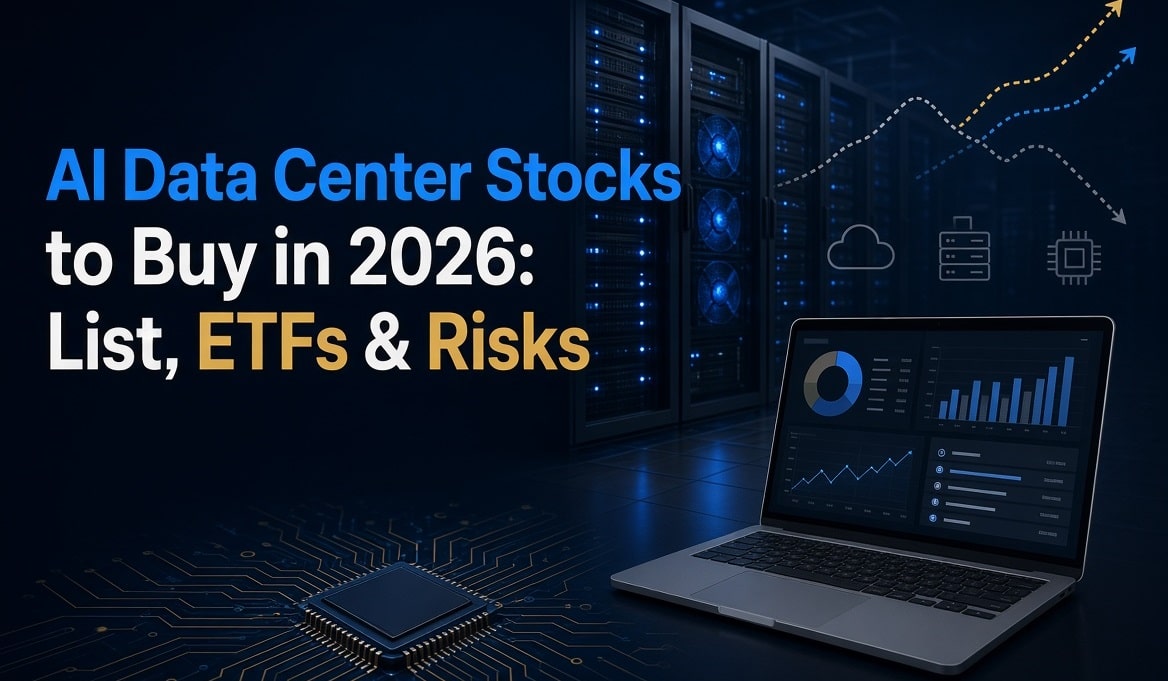
AI data center stocks just had a wild week. Democrat Gina Hinojosa won the Texas governor’s race on November 3 after campaigning for an immediate pause on new data center approvals, and AI names slid overnight. By Friday, tech stocks had bounced back. That whiplash tells you what you’re buying: a huge growth story with real policy risk attached.
So what are AI data center stocks? They’re public companies that build, equip, power or rent out the buildings that run artificial intelligence. Nvidia sells the chips. Equinix leases the space. Vertiv sells the cooling. In this guide, you’ll find a list sorted by role, a shortlist of ten names, ETF options, and the risks that matter most right now.
This article is educational, not financial advice. I’m not a licensed advisor, so check your own goals and risk tolerance before you buy anything.
What Are AI Data Center Stocks?
AI data center stocks cover every company that earns money from the buildout. Because each layer makes money differently, the group acts more like a supply chain than one sector. You’ll run into six layers most often:
- Chips and networking: processors and the gear that links them
- Memory and storage: the parts that feed data to those chips
- Data center REITs: landlords that lease space and power
- Neoclouds: AI-focused cloud companies that rent out computing power
- Hyperscalers: the giant cloud firms that spend the most
- Power and cooling: electrical and thermal equipment
Why Demand for AI Data Centers Keeps Climbing
Start with the spending. Amazon, Alphabet, Meta, Microsoft and SpaceX all raised capital spending last quarter, and together they’re on track to spend between $803 billion and $828 billion in 2026. Also, Alphabet’s CFO said capex will rise significantly in 2027, and Amazon’s CEO promised more spending next year too.
The real estate data points the same way. CBRE’s first-half 2026 report found that North American supply grew 33.7% to 10,903 megawatts while vacancy fell to 1.4%, and customers had already committed to 80.4% of capacity under construction. Meanwhile, JLL projects roughly 100 gigawatts of new capacity between 2026 and 2030. Power is the other half of the story, since the IEA expects global data center electricity use to roughly double from 485 TWh in 2025 to 950 TWh in 2030. For more picks tied to this buildout, see our list of five tech stocks to watch for 2027.
Not every number points up, though. Microsoft trimmed its calendar-year 2026 capex outlook to about $170 billion because third-party data center capacity arrived late. Delays like that can push revenue out for the companies that supply the hardware.
The Texas Election Shock: A New Risk for AI Data Center Stocks
Texas matters because so much capacity sits there. Wells Fargo estimates Texas holds 27% of planned US data center gigawatts. After the result, CoreWeave fell 7% overnight, while Oracle and Nebius each lost 4%. The Nasdaq-100 had already entered correction territory at the end of October on worries about slowing spending, so the news landed on nervous ground. Our guide to stock market corrections explains what that label means, and our breakdown of why AI stocks are pulling back covers the wider weakness.
However, nothing changes overnight. Hinojosa takes office in January, and national rules would still need bipartisan support. She also says she doesn’t oppose data centers outright. She wants communities to have a seat at the table. Meanwhile, Trump defended the data center boom after the midterm results.
For investors, the lesson is simple. Policy risk now sits next to demand risk. Texas projects still waiting on permits face the biggest timing question.
AI Data Center Stocks List by Category
| Category | Example stocks | Main driver | Main risk |
| Chips and networking | Nvidia, Broadcom | AI training and inference demand | Customer construction delays |
| Memory and storage | Micron, Sandisk, Western Digital | Data and memory needs of AI servers | Pricing cycles |
| Data center REITs | Equinix, Digital Realty | Leasing and pricing power | Heavy capex and debt |
| Neoclouds | CoreWeave, Nebius | Long contracts with AI labs | Debt and thin margins |
| Hyperscalers | Amazon, Alphabet, Microsoft, Oracle | Cloud and AI revenue | Cash flow squeezed by capex |
| Power and cooling | Vertiv, GE Vernova, Eaton | Grid and thermal bottlenecks | Permitting and labor limits |
Chips and networking
Nvidia sits at the center. Its latest fiscal quarter brought $96.2 billion in revenue, with Data Center sales up 117% to $89.0 billion, about 93% of the total. That concentration cuts both ways. Strong AI spending lifts the stock, but a slowdown hits it hardest. Broadcom offers a different angle. It co-developed Alphabet’s TPUs, so it benefits directly when Alphabet spends more. You can compare more chipmakers in our AI semiconductor stocks guide.
Memory and storage
Micron supplies the high-bandwidth memory that keeps AI systems running. Its latest quarter showed revenue of $54.23 billion, against $11.32 billion a year earlier. Sandisk grew even faster in percentage terms, with quarterly revenue of $11.03 billion versus $2.31 billion, and data center sales of $4.80 billion. It also announced an eight-for-one stock split, with split-adjusted trading starting November 20. Western Digital rounds out the group, since cloud customers made up 88% of its sales. Still, all three face the same risk: memory and storage prices swing hard.
Data center REITs
Equinix reported record annualized bookings of $533 million, up 35% from last year, and raised its outlook for the third time. Its CEO said there isn’t enough capacity to meet demand. Digital Realty and American Tower also appear among the top holdings in data center ETFs. In return for that pricing power, REITs spend heavily. Equinix expects $5 billion to $6 billion in capital spending this year.
Neoclouds and AI hosts
CoreWeave carries a $104.2 billion backlog and guides 2026 revenue to $12.4–13.2 billion, but it posted a $626 million GAAP loss last quarter. Nebius reported about $40 billion in committed backlog and guided capex at $20–25 billion. These stocks move the most on the news. CNBC describes CoreWeave as a high-risk neocloud that borrows money to build data centers.
Hyperscalers
Amazon spent $75.9 billion in cash capex last quarter, mostly on AWS and AI. Alphabet raised its 2026 capex guidance to $180–190 billion. These companies pay for the buildout, so they’re a bet on AI revenue catching up with the bills. For another big spender, our Microsoft stock price prediction breaks down its outlook.
What if you bought $1,000 of Amazon in 1997? The IPO price was $18, so $1,000 bought 55.56 shares, which stock splits turned into 13,334.4 shares. Multiply that by today’s share price to see the result. For forecasts, read our Amazon stock prediction guide.
Power and cooling
Vertiv’s third-quarter sales jumped 61% to $4.31 billion, and orders more than doubled. Management also named power availability, permitting and skilled labor as limits on construction timelines. Eaton, Trane Technologies and GE Vernova also show up on analyst lists of data center plays. Eaton also appears in our guide to the top industrial automation stocks.
Top 10 Data Center Stocks Shortlist
This list isn’t a ranking. Each name has a verified data center link in this article.
| Stock | Layer | Latest data point |
| Nvidia (NVDA) | Chips | Data Center sales of $89.0B in one quarter |
| Broadcom (AVGO) | Chips | Co-developer of Alphabet’s TPUs |
| Micron (MU) | Memory | Quarterly revenue of $54.23B |
| Sandisk (SNDK) | Storage | Data center sales of $4.80B, split starts Nov 20 |
| Western Digital (WDC) | Storage | Cloud is 88% of sales |
| Equinix (EQIX) | REIT | Record $533M annualized bookings |
| Vertiv (VRT) | Power/cooling | Sales up 61%, orders more than doubled |
| CoreWeave (CRWV) | Neocloud | $104.2B backlog, $626M GAAP loss |
| Alphabet (GOOGL) | Hyperscaler | 2026 capex guidance of $180–190B |
| Amazon (AMZN) | Hyperscaler | $75.9B cash capex in one quarter |
AI Data Center Stocks to Buy: How to Pick
No single pick fits everyone. Instead, run five checks:
- Growth versus backlog. Revenue should grow, and signed contracts should back it up.
- Valuation. A low forward P/E depends on earnings forecasts that can change. Ask what drives the growth: customers, component prices or one-time gains.
- Customer concentration. A few big buyers can swing results.
- Power access. No power means no revenue, whatever the order book says.
- Debt and capex. Compare spending with sales. For example, CoreWeave raised its capex guidance by 12.1% but its revenue guidance by only 2.4%.
Data Center Stocks Under $10
Many investors search for cheap data center stocks, but a low share price doesn’t mean a low valuation. Sandisk proves the point. Its split changes the share price on November 20, yet the company’s value stays the same.
Insider Monkey defines “cheap” differently. Its screen looked for a positive forward P/E below 20 and quarterly revenue growth of at least 15%. If you want sub-$10 names, run your own screener the day you buy. Then check market cap, debt, cash burn and contract backlog. Small, cheap stocks often carry the most dilution and financing risk.
AI Data Center Stocks ETF Options
ETFs spread the risk across many companies. For a broader take on the idea, see our AI-powered ETF article. Here are three funds that focus on this theme:
| ETF | Focus | Expense ratio | Note |
| Global X DTCR | REITs, digital infrastructure, chips | 0.50% | About $1.92B in assets (Nov 4) |
| Pacer SRVR | Data center REITs and infrastructure | 0.55% | Over 62% in real estate |
| VanEck RACK | Chips, cooling, power, electrical | Check fund page | Launched June 2026, still small |
DTCR holds more chip and tech names, while SRVR leans toward real estate. RACK covers the supply chain but has little trading history. Check each fund’s live data before you buy.
Risks Before You Invest in AI Data Center Stocks
- Regulation. Texas showed how one election can shift timelines.
- Power limits. Grid queues and slow permits delay projects.
- Financing. Neoclouds borrow heavily to build.
- Spending fatigue. Meta shares dropped 9.25% after it raised spending plans. Investors want proof of returns.
- Cash flow. Amazon’s trailing free cash flow fell 95% to $1.2 billion as capex climbed.
- Pricing cycles. Memory and storage profits can reverse fast.
How to Start Investing in AI Data Center Stocks
First, open a brokerage account. Our guide to the best brokerage for beginners compares your options. Next, pick your route: single stocks, REITs or ETFs. Then decide how much risk you’ll take, and keep any one position small. After that, buy in stages rather than all at once. Finally, track earnings dates, since those moves can be sharp. If you’re new, our walkthrough on how to invest in stocks covers the basics.
Conclusion
AI data center stocks offer growth across the whole buildout, from chips to cooling. However, the November sell-off proved the sector carries policy, power and financing risk too. So build your list by layer, check the numbers, and size positions you can hold through a drop. The strongest AI data center stocks combine real contracts with manageable debt. Review this list again after each earnings season.
FAQs
Can you buy stock in AI data centers?
Yes. You can buy shares of public companies in the chain, such as Nvidia, Equinix or Vertiv, through any brokerage. You can also buy REITs or ETFs like DTCR, SRVR and RACK. Few stocks are pure plays, so most investments give indirect exposure.
Which company is leading in AI data centers?
It depends on the layer. Nvidia leads in chips, with $89.0 billion in Data Center revenue last quarter. Amazon leads in spending, with $75.9 billion in quarterly capex. Equinix leads in leased space, with record bookings.
Which AI stocks are a good buy right now?
No one answer fits every investor, and I can’t make that call for you. Compare growth, valuation, debt and power access, and remember the sector just had a sharp drop. Match any pick to your timeline and risk tolerance first.
What AI stock is Warren Buffett buying?
Berkshire Hathaway, now led by CEO Greg Abel, keeps buying Alphabet. In the second quarter, it raised its stake by 83% to about 106 million shares. Alphabet is now Berkshire’s third-biggest holding. Alphabet isn’t a pure data center play, though. Berkshire’s next 13F filing arrives by mid-November.
Which AI stocks are billionaires buying?
Insider Monkey’s second-quarter 2026 count shows 52 billionaire investors in Nvidia, 41 each in Broadcom and Micron, 34 in Sandisk and 31 in Western Digital. Those counts reflect past filings. They don’t predict future returns.