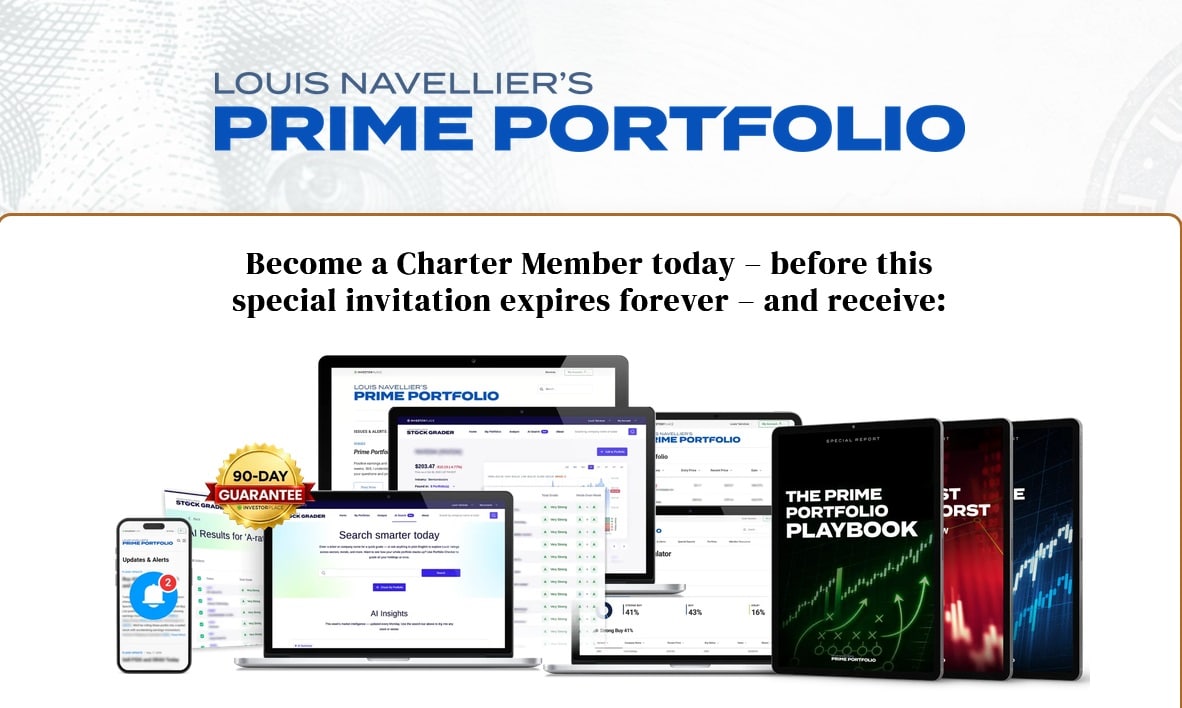
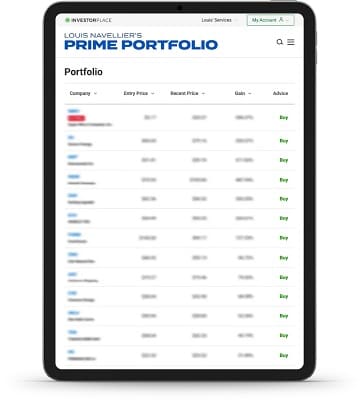
Louis Navellier’s Prime Portfolio is a brand-new, actively managed model portfolio of 25 of his highest-rated “A+ stocks.” It was launched during his Fed Warning 2027 presentation in November 2026. The service pulls the strongest ideas from across his research lineup, applies his long-running quantitative Stock Grader system, adds a monthly rotation model, and includes a Portfolio Allocation Tool so members know not just what to buy but how much of each position to hold.
Charter members can currently join for $2,500 for the first year (normally $5,000), plus a package of bonuses that InvestorPlace values at several thousand dollars. The offer comes with a 90-day, 100% satisfaction guarantee.
For investors who already follow Navellier’s work or want a concentrated, rules-based growth portfolio that adapts as market leadership shifts, the service is legitimate and well-aligned with his established methodology. It is not a “set it and forget it” product, and the price puts it in the premium tier of advisory services. Results will depend on how well the rotation works in 2027 and beyond.
Key Takeaways
- Prime Portfolio holds 25 of Navellier’s top-rated stocks selected by his Stock Grader system and personal review.
- The first portfolio already shows a tilt toward energy and healthcare names, reflecting the market rotation Navellier has been highlighting.
- Members receive the 25 stocks, ongoing updates, a monthly rotation model, and a Portfolio Allocation Tool that tells them exact position sizes based on their total capital.
- Charter pricing is $2,500 for one year (50% off the regular $5,000 rate) and includes free access to Stock Grader AI, the allocation tool, and several special reports.
- A 90-day money-back guarantee from InvestorPlace applies.
- The service is designed for investors who want a focused, high-conviction growth portfolio rather than a broad list of dozens of recommendations.
- Navellier has more than 40 years of experience running quantitative growth strategies and managing money through Navellier & Associates.
The Fed Warning 2027 Event and the Idea Behind Prime Portfolio
In early November 2026 Louis Navellier held a special online event called Fed Warning 2027 (also referred to as Roadmap to 2027). The presentation focused on a market environment he believes is already taking shape: a narrowing list of winners, a clear rotation away from some of the recent technology and AI leaders, and the continuing influence of Federal Reserve policy and political gridlock heading into 2027.

Navellier pointed to sector performance over the prior six months. Healthcare and financial stocks had led, while technology and communication services lagged. Energy had also outperformed the former market leaders. He used examples such as IREN Ltd., an AI-related company whose Stock Grader rating had fallen sharply from A to F after mixed results and rising costs, to show how quickly fundamentals and institutional interest can change.
Against that backdrop he introduced Prime Portfolio. He described it as the “crème de la crème” of the stocks he follows across his various services. Instead of asking subscribers to track multiple newsletters and dozens of recommendations, the new service concentrates on the 25 highest-conviction names that his quantitative system currently favors. He selected the first 25 stocks himself the weekend before the presentation. A meaningful portion of those names were energy companies, along with three healthcare stocks.
The core idea is straightforward. Markets rotate. Yesterday’s leaders are not guaranteed to lead tomorrow. A portfolio that stays locked into the previous cycle’s winners can lag or lose money even if the overall market rises. Prime Portfolio is built to identify the companies with the strongest current combination of earnings growth, other fundamental strength, and institutional buying pressure, then adjust the list as those conditions change.
Navellier also emphasized that the service goes beyond a static list of tickers. It includes tools and ongoing guidance so members can size positions properly and know when to make changes. In his view, 2027 is shaping up as a year in which selectivity and adaptability will matter more than simply owning the biggest or most popular names.
The presentation itself walked through the risks facing broad index investors and bond investors under a higher-rate or more uncertain Fed regime, then showed how superior growth stocks have historically been less damaged by rate pressure. It positioned the new portfolio as a practical way to stay on the side of the stocks that are still delivering strong fundamentals while avoiding the “hidden bear market” he sees in many other names.
Louis Navellier is a well-known growth investor and quantitative analyst with more than four decades of experience. He was born in 1957 in Berkeley, California. He earned a bachelor’s degree in finance from Cal State Hayward (now Cal State East Bay) at age 20 and completed his MBA the following year.
While still in college he worked on a project intended to build a model that would match the performance of the S&P 500. Using early computer resources, the model he developed actually outperformed the index. That experience led him to focus on quantitative screens that identify stocks with superior reward-to-risk characteristics.
He launched his first newsletter, MPT Review, in 1980. In 1987 he founded Navellier & Associates, an independent investment advisory firm based in Reno, Nevada. The firm has managed assets for high-net-worth individuals and institutions; figures cited over the years have ranged from roughly $1 billion to higher levels depending on the period. Navellier serves as chairman and chief investment officer.
He is best known to individual investors through his work with InvestorPlace. His flagship service, Growth Investor, launched in 1998 and has a long published record of outperformance versus the S&P 500 on a cumulative basis. He also edits or contributes to other services including Breakthrough Stocks, Accelerated Profits, and Platinum Growth Club.
Navellier’s core tool is Stock Grader (previously known as Portfolio Grader). The system screens thousands of stocks (more than 6,000 in recent descriptions) and assigns each a letter grade from A to F. The grade combines a fundamental score (looking at sales growth, operating margins, earnings growth and momentum, earnings surprises, analyst revisions, cash flow, and return on equity) with a quantitative score that incorporates institutional buying pressure and other market-flow measures.
He has been profiled or quoted by The New York Times (which called him “an icon among growth stock investors”), Forbes (which has referred to him as the “King of Quants”), Barron’s, and major business television networks including CNBC, Fox Business, and Bloomberg. He continues to write regularly for InvestorPlace’s Market 360 and other platforms.
His approach has always emphasized that great companies can still be poor investments if institutional money is not flowing into the shares. That dual focus—strong fundamentals plus measurable buying pressure—remains the foundation of the stock selection process used in Prime Portfolio.
What Prime Portfolio Is and How It Works
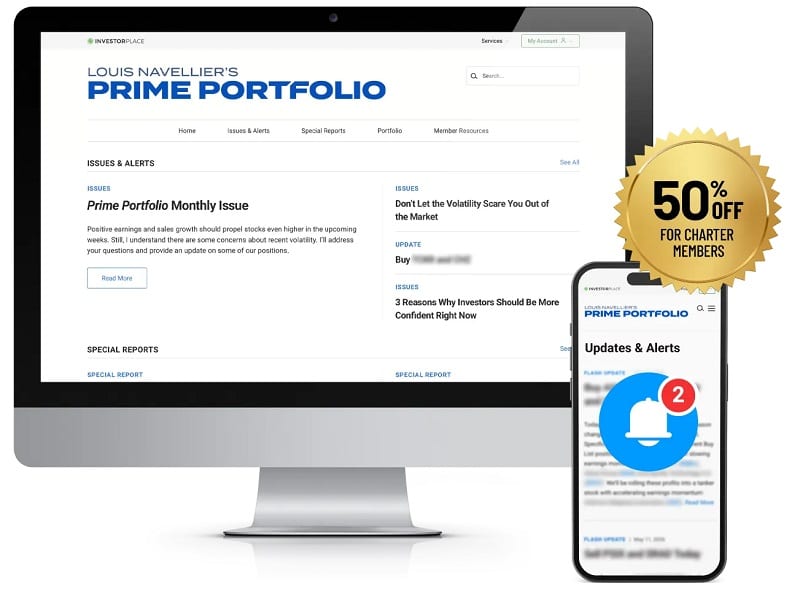
Prime Portfolio is a concentrated model portfolio of 25 stocks. According to Navellier and InvestorPlace materials, these are the highest-rated names drawn from across his research services and ranked by his quantitative system. The goal is to hold the “best of the best” rather than a long list of ideas.
Selection starts with Stock Grader. Stocks that earn top fundamental and quantitative grades move to the top of the candidate list. Navellier then reviews the names personally and chooses the final 25. The initial portfolio already reflects the sector rotation he has been discussing: a significant weighting in energy companies and a smaller allocation to healthcare, with fewer pure AI or high-flying technology names than many investors might expect.
One explicit point made around the launch was that Nvidia was not included in the first 25 stocks, even though Navellier still views the company as having strong earnings power and is watching its upcoming results closely. He has also noted that certain other high-profile names such as GE Vernova and Bloom Energy were not part of the initial list. The emphasis is on the companies currently showing the strongest combination of metrics rather than the most popular stories.
A key feature is the monthly rotation model. Navellier tracks shifts in market leadership and institutional flows. When the data show money moving out of certain names or sectors and into others, the portfolio is adjusted. The aim is to stay focused on what is working rather than holding yesterday’s winners too long.
Members also receive the Portfolio Allocation Tool. Users enter the total amount of capital they plan to dedicate to the strategy. The tool then calculates the recommended percentage (and therefore dollar amount or share count) for each of the 25 positions. Navellier has stressed that position sizing matters as much as stock selection: “It’s not just which stocks you own… it’s how much.”
Ongoing portfolio updates form another part of the service. Navellier monitors the holdings and provides alerts when he believes a change is warranted. These updates are intended to cut through daily market noise and focus on the numbers that actually affect the A-rated stocks in the model.
In short, the service combines three elements:
- A concentrated list of 25 high-conviction stocks chosen by quantitative screens and human review.
- A process for rotating the portfolio as leadership changes.
- Practical tools for sizing positions and staying informed of recommended changes.
It is designed as a managed model that members can follow in their own brokerage accounts rather than a fully discretionary managed account.
What’s Included in the Current Charter Offer
The charter membership package is priced at $2,500 for one full year of Prime Portfolio (regularly $5,000). InvestorPlace presents the total value of the bundle at $8,997. Here is everything listed in the offer materials:
- One year of Prime Portfolio at 50% off ($5,000 value). Access to the 25-stock model portfolio, the monthly rotation process, and related research.
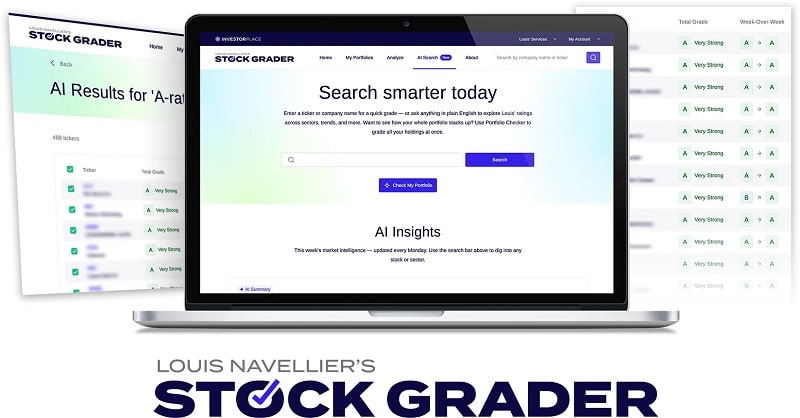
- One free year of Stock Grader AI ($2,500 value). An upgraded version of Navellier’s grading system that allows users to run custom screens (for example, A-rated energy stocks with recent earnings beats or positive analyst revisions) and to check the grade of any individual stock.
- Louis’ Portfolio Allocation Tool ($500 value). The position-sizing calculator described above.
- Bonus Report: The Worst of the Worst – 25 Stocks to Sell Now ($599 value). A list of 25 stocks that have earned consecutive F ratings and that Navellier views as particularly risky heading into 2027.

- Bonus Report: The Prime Portfolio Playbook ($99 value). Guidance on how to use the portfolio, when to rotate from a good stock into a stronger one, and how the rotational strategy is intended to work even if a broader market decline occurs.

- Free Mystery Bonus: Explosive Alpha – Hunting for the Next 1000% Winners ($299 value). A special report on higher-upside opportunities.

- One free year of Louis’ Prime Portfolio Updates. Regular commentary that explains which headlines and data points actually matter for the holdings.
- 100% 90-day Satisfaction Guarantee from InvestorPlace.
Additional language in the promotional materials mentions that the package is meant to give members the same stocks Navellier is using for his own family’s capital and that the rotational strategy is designed to keep the portfolio focused on the market’s strongest names.
Pricing and Guarantee
The regular annual price for Prime Portfolio is listed at $5,000. Charter members pay $2,500 for the first year. After the charter period the renewal rate would be expected to move toward the full price, though exact future terms are set by InvestorPlace.
The 90-day, 100% satisfaction guarantee means a member can request a full refund within the first three months if the service does not meet expectations. This is a standard InvestorPlace policy for many of its premium products and removes much of the short-term financial risk of trying the service.
Who the Service Is For
Prime Portfolio is aimed at investors who:
- Want a focused list of high-conviction growth stocks rather than a long menu of recommendations.
- Are comfortable owning a concentrated 25-stock portfolio and following position-size guidance.
- Believe that market leadership rotates and that staying with the strongest current fundamentals and institutional flows is more important than buying and holding the previous cycle’s winners.
- Prefer quantitative, rules-based selection over pure storytelling or macroeconomic narratives.
- Are willing to pay a premium price for ongoing research, tools, and updates from an experienced growth investor.
It is less suitable for pure index investors, very conservative income-focused investors, or those who prefer to build highly diversified portfolios of 50–100 names themselves. It is also not a day-trading or short-term speculative service; the emphasis is on multi-month to multi-year holding periods with periodic adjustments.
Pros & Cons
Pros
- Concentrated 25-stock portfolio drawn from Navellier’s highest-rated ideas across his research.
- Clear quantitative framework (Stock Grader) that has been used for decades.
- Explicit focus on market rotation and the willingness to move out of former leaders.
- Portfolio Allocation Tool that addresses the important question of position sizing.
- Ongoing updates and alerts rather than a one-time list.
- Charter pricing at half the regular rate plus a substantial package of bonuses.
- 90-day money-back guarantee reduces the risk of trying the service.
- Backed by an analyst with a long public track record in growth investing and quantitative screening.
Cons
- Premium price even at the charter discount; $2,500 is a significant commitment for many individual investors.
- New service with no multi-year public performance history of its own (although it draws on Navellier’s existing methodology).
- Concentrated portfolio means higher volatility than a broad index or a 50–100 stock diversified portfolio.
- Success depends on the continued effectiveness of the Stock Grader system and the rotation decisions in the specific market environment of 2027 and later.
- Requires members to implement the recommendations themselves in their own brokerage accounts.
Conclusion
Louis Navellier’s Prime Portfolio is a legitimate new research service built on the same quantitative foundation he has used for more than 40 years. It addresses a real problem many investors face: how to keep a growth portfolio focused on the companies that are currently showing the strongest earnings, margins, and institutional support while leadership in the market shifts.
The Fed Warning 2027 presentation framed 2027 as a year in which selectivity and adaptability will matter more than broad market exposure. Prime Portfolio is Navellier’s practical answer to that environment—a 25-stock model that he updates, a rotation process, and tools that help members size positions correctly.
At the current charter price of $2,500 for the first year, with the listed bonuses and a 90-day guarantee, the service offers a relatively low-risk way for interested investors to put the approach to work. Whether it ultimately delivers strong results will depend on how accurately the Stock Grader system and the rotation model identify the next group of leaders. For investors who already respect Navellier’s process and want a concentrated, actively monitored growth portfolio, it is a coherent and well-documented offering.
As with any investment research product, past performance of similar strategies is not a guarantee of future results, and every investor should consider their own risk tolerance, time horizon, and overall portfolio before allocating capital.