

In the fast-paced world of investing, achieving a high return on investment (ROI) is every investor’s dream. Unearthing opportunities that promise 10% ROI or more can significantly enhance your portfolio, driving substantial financial growth. On this page, we explore seven lucrative investments that have consistently delivered impressive returns. To optimize your strategy, our interactive ROI Calculator is at your fingertips, offering personalized insights to help maximize your gains. Whether you’re a seasoned investor or just starting your investment journey, unlocking the secrets to high ROI can pave the way for financial success.
Brief Overview
Achieving a high return on investment (ROI) is crucial for growing your wealth, with the promise of a 10% ROI opening doors to significant financial growth. The article explores seven investment opportunities delivering such returns, supported by an ROI calculator to fine-tune strategies. Real estate, stocks, index funds, and private equity are highlighted as effective avenues, each with unique benefits and risks. Understanding these options, employing strategic planning, and utilizing financial advisors can empower both novice and seasoned investors to make informed decisions and optimize their portfolios for long-term success.
Key Highlights
- High-return investments of 10% ROI signal significant growth potential, outpacing inflation and generating substantial gains.
- Real estate offers steady cash flows and tax advantages, but requires careful market trend analysis for optimal ROI.
- Index funds provide low-cost diversification, capturing market trends with stable returns and minimal management.
- Private equity presents high-return opportunities but involves illiquidity and requires thorough due diligence.
- Using an ROI calculator aids in understanding investment strategies, enabling data-driven decisions for maximized returns.
Understanding High Return Investments
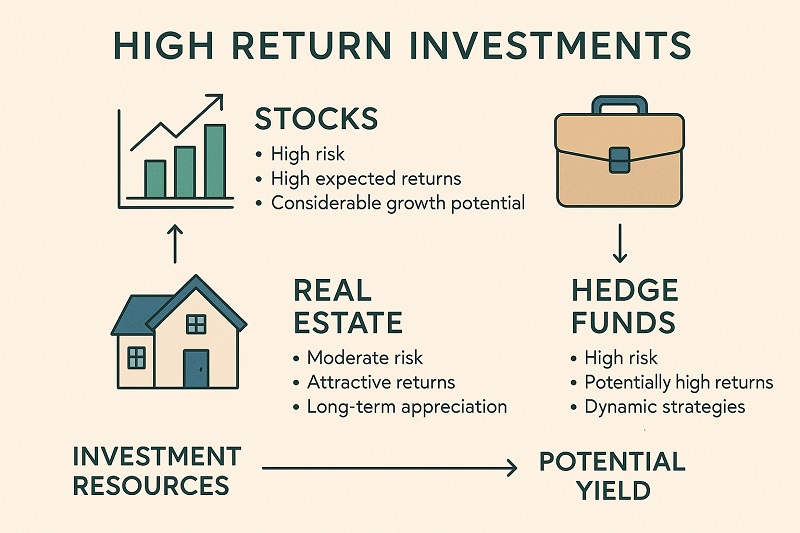
For investors seeking sustainable wealth accumulation, high-return investments are a crucial component of the strategy. Achieving a return on investment (ROI) of 10% or higher signals significant potential for growth, allowing portfolios to outpace inflation and generate substantial gains. High ROI investments are not just about the numbers, they’re about understanding how these opportunities fit within your portfolio strategy, ensuring that both risk and reward are balanced effectively. In this context, it’s essential to know what a 10% ROI entails and why it’s so important to aim for such returns in your investment journey.
What Constitutes a 10% ROI?
A 10% ROI, put simply, signifies that for every dollar you invest, you gain ten cents in profit. It’s a measure that many investors aim for due to its ability to indicate a good ROI, surpassing typical savings account returns and even some stocks and bonds. Achieving this level of return isn’t arbitrary; it requires strategic planning, a keen eye for emerging trends, and sometimes a bit of luck. Investors often explore varied avenues such as technology stocks, real estate, or even private equity to reach or exceed this benchmark.
To calculate ROI effectively, investors consider both the initial investment cost and the net gains realized from it. For example, if you invested $1,000 in a tech startup and sold your stake for $1,100, your ROI would be calculated by dividing the profit ($1,100 – $1,000 = $100) by the original investment ($1,000), giving you a 10% ROI. Yet, this level of return isn’t just about getting lucky with one-off investments. It’s about consistently finding investment opportunities that promise higher returns while balancing potential risks.
Understanding market dynamics is crucial, as stock market volatility can influence ROI outcomes significantly. While tech stocks might boast high potential returns, they come with inherent risks. As such, consulting a financial advisor can offer insights into achieving a consistent 10% ROI, ensuring your investment aligns with broader financial goals. By evaluating not just the potential profits but also the underlying risks, investors can tailor their portfolios to maintain a higher average ROI over time. Given the unpredictability of financial markets, diversifying across sectors and regions can also help stabilize returns, ensuring your portfolio is robust against economic downturns.
Achieving a 10% return on investment requires a thoughtful approach and strategic planning. Consider the following practical investment strategies:
- Diversify your portfolio across various asset classes to reduce risk and increase potential returns.
- Invest in high-growth industries such as technology and renewable energy where demand and innovation drive valuations.
- Consider dividend-paying stocks for steady income alongside capital appreciation.
- Utilize dollar-cost averaging to reduce the impact of market volatility by spreading out investment purchases over time.
- Research and invest in emerging markets that offer higher growth potential due to expanding economies.
- Take advantage of tax-efficient investment accounts to maximize after-tax returns.
- Engage with a knowledgeable financial advisor to tailor strategies to your specific financial goals.
Implementing these strategies can play a crucial role in consistently achieving a 10% return on investment while managing risk.
The Importance of High ROI in Your Portfolio
Having a high ROI investment as a core component of your portfolio is pivotal for several reasons. Firstly, it acts as a catalyst for wealth accumulation, allowing your portfolio to grow at a rate that exceeds inflation and elevates your financial position over time. Secondly, higher ROIs can cushion your portfolio against less-performing investments, creating a balance that can enhance overall returns despite market fluctuations. As such, achieving consistent high ROIs becomes more than just chasing numbers, it becomes about securing financial independence and stability.
Investors should recognize that a high ROI isn’t just a number; it’s indicative of the strategic choices made in fund allocation, asset selection, and timing of entry and exit from the market. Positioning yourself in investment opportunities with a high potential ROI involves understanding not just the short-term gains but also how these investments will interact with and influence your portfolio over the long term. This entails careful scrutiny of market trends, emerging sectors, and a willingness to adapt as new opportunities arise.
Recognizing emerging markets and sectors can provide lucrative opportunities for achieving a higher ROI. The tech industry, for example, has consistently offered high ROI prospects due to continuous innovation and growth. Similarly, real estate can offer significant returns if strategically invested in locations poised for appreciation. It’s important to remember that these higher rois come with their share of risks, and investors must be prepared to manage these risks proactively. Engaging with a financial advisor can offer tailored guidance to navigate these complex waters efficiently.
Moreover, calculating potential returns accurately with an investment (ROI) calculator can add significant value. Not only does it help in visualizing potential gains, but it also aids in making informed decisions that align with long-term financial goals. Considering your portfolio as an ecosystem, where each component influences the other, can foster resilience against economic fluctuations. By consistently seeking high ROI investments while balancing risk, you can ensure that your portfolio remains dynamic and capable of achieving long-term success.
Diverse Means to Achieve Good ROI
Maximizing returns requires diversifying your investment strategy beyond traditional savings accounts, aiming for ventures that promise 10% ROI or more. Real estate and stocks stand out as viable options, each with its own set of advantages and risks. Real estate offers tangible asset appreciation, while the stock market provides higher liquidity and potentially quicker returns. Understanding these investment avenues and employing strategies that align with your financial goals can significantly elevate your portfolio’s performance. Financial advisors often advocate for blending these investments to harmonize potential gains with manageable risks.
Evaluating Real Estate Opportunities
Investing in real estate is a time-honored strategy that has created wealth for many investors. It offers potential for steady cash flows, tax advantages, and property appreciation that can provide solid returns. The real estate market, however, like any other, requires careful analysis and comprehension of market trends. One of the major benefits of investing in real estate is the ability to leverage other people’s money, such as mortgage financing, to increase ROI. This strategy, when properly managed, allows investors to amplify returns without tying up large amounts of personal capital.
Investors need to evaluate locations where property values are expected to rise. Understanding the dynamics of local markets, such as job growth and population influx, can provide clues to real estate appreciation potential. Cities undergoing significant infrastructural development often signal burgeoning opportunities. Additionally, considering the type of property, whether commercial, residential, or retail, can also influence return prospects. For instance, rental properties can offer continuous income streams while waiting for property values to appreciate.
Investment returns in real estate aren’t solely about passive income. They also encompass significant tax benefits. Deductions for mortgage interest, property depreciation, and operation costs can enhance net income and make real estate a compelling component of an investment portfolio. Moreover, savvy investors can employ strategies such as flipping houses, a method where investors buy properties with potential, renovate them, and then sell for a profit, to achieve substantial, short-term investment returns.
A practical approach involves partnering with financial advisors to navigate this complex landscape. Advisors can provide insights into optimal market entry timing and financing strategies to maximize your investment return. Real estate, while traditionally stable, evolves with economic changes, requiring continuous market monitoring. Yet, when managed wisely, adding real estate to your investment portfolio can help achieve a higher ROI, bolstering financial independence and security.
Exploiting Stock Market Investments
The stock market offers a dynamic platform for investors aiming to achieve a higher ROI. Stocks provide diverse opportunities, from blue-chip companies offering stability and dividends to growth stocks with significant appreciation potential. The key to success in stocks lies in strategic selection based on solid research and an understanding of market trends. Investors often seek to create a balanced portfolio with a mix of high-risk, high-return investments and stable, dividend-paying stocks to secure consistent returns.
Financial advisors recommend employing trading strategies such as dollar-cost averaging, which mitigates risk while building wealth over time. By investing a fixed amount regularly, investors purchase more shares when prices are low and fewer when they are high, effectively averaging the cost of investments. This strategy can be particularly advantageous during volatile market conditions, balancing investment returns while minimizing exposure to market downturns.
For those with a higher risk appetite, venture capital investments in promising startups can deliver tremendous returns, albeit with increased volatility. Investing in new technologies or disruptive industries can offer high ROI opportunities as these fledgling businesses transition into successful enterprises. However, this path requires thorough due diligence, assessing company fundamentals, competitive positioning, and market potential to safeguard against eventualities.
Index funds also present an attractive option for investors looking to capture broad market performance with lower management fees compared to actively managed funds. These funds encapsulate a slice of the market, diversifying holdings and generally aligning with market averages. While they might not always offer the highest returns, their stability makes them a reliable component for any portfolio, especially when combined with other high-return investments.
Staying informed about financial markets and macroeconomic indicators is crucial for stock market investing. Economic trends, interest rate forecasts, and geopolitical events can substantially impact stock performance, dictating when to buy, hold, or sell. Employing digital tools like trading platforms and investment calculators can aid decision-making, optimizing potential gains while managing risks. Used thoughtfully, stock market investments can significantly boost your ROI, reflecting a well-rounded investment strategy that drives long-term success in your portfolio.
Incorporating Index Funds for Steady Growth
Index funds have become a cornerstone for investors looking to achieve steady growth in their portfolios. These funds offer a balanced approach by mirroring the performance of a broad market index, thus providing diversification and stability. As financial markets fluctuate, index funds present a viable option for those aiming to capture consistent returns without constantly monitoring their investments. By incorporating index funds into your investment strategy, you can benefit from their potential for high returns while mitigating risks typically associated with individual stock selection.
Benefits of Investing in Index Funds
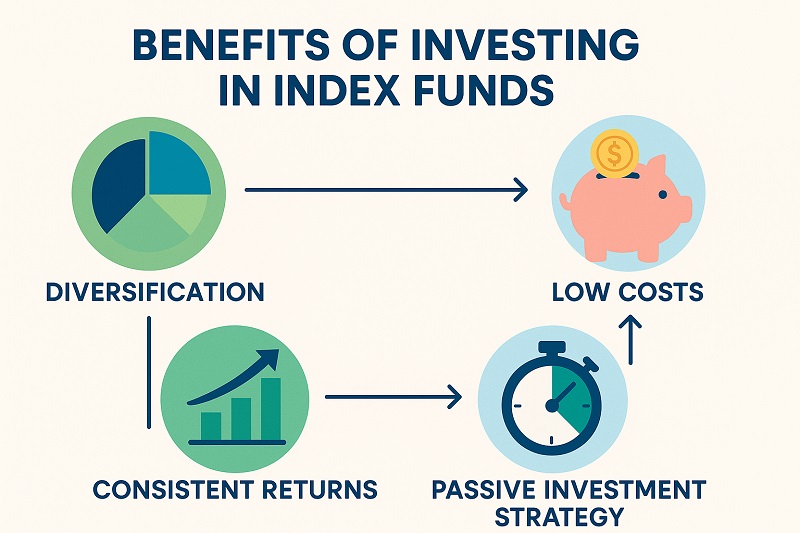
Investing in index funds is an appealing strategy for both novice and seasoned investors due to its simplicity and cost-effectiveness. One of the primary benefits is their low management fees. Since index funds are passively managed, they don’t incur the high fees associated with active management, allowing more of your investment returns to remain in your pocket. This makes them an ideal choice if you’re looking to maximize returns without substantial overhead costs. Additionally, index funds offer broad market exposure, reducing the risk posed by individual company volatility. By holding a piece of several companies within a market index, your portfolio gains the stability that comes with diversification, a vital aspect of any sound investment strategy.
Another significant advantage of index funds is their historical track record of consistent returns. Over the long run, these funds have often outperformed actively managed funds, thanks largely to their low fees and broad market exposure. For investors looking for high returns, index funds represent a balanced approach, providing exposure to economic growth without the need for constant oversight. Moreover, they align well with a buy-and-hold strategy, which is ideal for long-term wealth building. This hands-off investment style frees up time while ensuring your portfolio is actively participating in the growth of the global economy.
In addition to financial benefits, investing in index funds can also simplify the management of your investment accounts. With fewer transactions required than with individual stock investments, account management becomes streamlined, making it easier to maintain an overview of your portfolio’s performance. Furthermore, index funds offer the flexibility to seamlessly incorporate other asset classes, such as bonds or commodities, into your investment strategy, providing a wider scope for asset allocation. By affording the dual benefits of ease of management and broad exposure to market trends, index funds effectively bolster the resilience and long-term growth potential of your portfolio. Given their ability to offer stable returns and decreased volatility, they are a staple component in the quest for financial independence.
How Do Index Funds Maximize Returns?
Index funds are a tool that can help maximize returns while minimizing the inherent risks in investing. The methodology behind these funds is relatively straightforward: by miritating a specific index like the S&P 500, index funds allow investors to enjoy the overall returns of that index, effectively capturing the widespread economic growth. This approach ensures that your funds are steadily compounding, mirroring the long-term upward trend of the stock market. In the process, this lessens the impact of poor performances from any single entity within the index, thus reducing investment risks.
The key to maximizing returns through index funds lies in their diversification and consistency. Unlike actively managed funds, which rely heavily on market timing and stock picking skill, index funds leverage the power of diversification across many industry sectors. This grants them a natural hedge against market volatility. Furthermore, the minimized turnover of assets in index funds translates to lower transaction costs and reduced capital gains taxes, both of which can erode the profitability of an investment.
To further enhance returns, some investors choose to reinvest dividends from index funds, leading to a compounding effect over time. This strategy allows your investment to grow exponentially, as both your initial capital and accumulated dividends work together to enhance total returns. Implementing strategies like dollar-cost averaging can shield investors from market timing risks, allowing investments to gradually increase during market dips and rises.
Financial advisors often recommend index funds due to their strategic advantages, underscoring their role in achieving a balanced portfolio. By comparing various index funds and their past performances, investors can select those most aligned with their financial goals and tolerance for risk. Evaluating fund reviews and seeking advice from financial advisors can provide insights into which fund components can maximize returns effectively. For sustainable, high-return investments, index funds stand out as a reliable choice, empowering investors to grow their portfolios methodically and strategically. In a world of unpredictable financial markets, they represent a steady vehicle toward achieving desired financial milestones.
Discovering the Potential of Private Equity
Private equity stands out as a dynamic investment avenue, attracting investors with its potential for higher returns and diverse portfolio benefits. As part of a balanced investment strategy, private equity can complement traditional assets like stocks and real estate. It’s important for investors to understand its unique advantages and inherent risks. By examining private equity’s role in a balanced portfolio and the potential risks and rewards, investors can make informed decisions about its place in their financial strategy.
The Role of Private Equity in a Balanced Portfolio
Private equity investments are increasingly becoming a staple in diversified portfolios due to their potential for high returns and their distinctive role in wealth management strategies. As investors search for alternatives that offer higher returns beyond the conventional stock market, private equity emerges as a powerful contender. These investments generally involve acquiring private companies or buying out public companies to delist them from stock exchanges, ultimately enhancing value through strategic financial and operational improvements. For many investors, engaging with private equity is an opportunity to access innovative companies at various developmental stages, ranging from startups to established enterprises, offering growth prospects not readily available in public markets.
The appeal of private equity in a balanced portfolio lies in its unique ability to deliver uncorrelated returns. Unlike traditional equity investments tied to market whims, private equity benefits from hands-on management and intrinsic value creation in businesses. By integrating private equity, investors can achieve diversification, potentially reducing the overall risk of their investment portfolio while gaining exposure to assets that may yield higher returns over time. This becomes particularly advantageous for retirement planning, where long-term growth is paramount.
Financial advisors play a crucial role in guiding investors through the intricate process of selecting private equity opportunities. Firms like Fidelity offer specialized advisory services, helping investors assess which funds align with their financial ambitions and tolerance for risk. Advisors often recommend private equity as a means of hedging against stock market volatility and inflation, creating a safety net that enhances portfolio resilience. Moreover, private equity’s illiquid nature, although perceived as a drawback by some, can enforce discipline in investors, reducing the temptation to react impulsively to market fluctuations.
In addition to potential high returns, private equity investments offer significant profit opportunities through innovative structures, such as leveraged buyouts, venture capital investments, and growth capital. These strategies can facilitate higher gains by capitalizing on industry shifts and technological advancements. By actively participating in management and strategic development, investors can drive substantial value creation, leading to enhanced investment returns. Consequently, private equity not only diversifies an investor’s portfolio but also provides a pathway to achieving financial independence and stability.
Risks and Rewards Associated with Private Equity
While private equity presents enticing prospects for high returns, it also accompanies a distinct set of risks and considerations that investors must navigate. One of the foremost risks is the illiquid nature of private equity. Unlike stocks, which can be bought and sold quickly, private equity investments lock in capital for extended periods, sometimes ranging from five to ten years. This illiquidity requires a long-term commitment and is best suited for investors with a longer investment horizon, particularly those planning for retirement.
The risk of business failure is another critical factor. As private equity often involves investing in companies not listed on the stock exchange, the lack of transparency can pose challenges. Investors may encounter difficulties in obtaining accurate information about a company’s financial health and operational effectiveness, increasing the likelihood of encountering unfavorable surprises. Consequently, due diligence is crucial. Investors should meticulously analyze potential investments, assessing factors such as market positioning, management expertise, and competitive dynamics. Financial advisors can provide valuable insights into mitigating this risk by leveraging their expertise in evaluating investment opportunities thoroughly.
Despite the inherent risks, the rewards of private equity can be substantial. Successful private equity investments can yield significantly higher returns than traditional public market investments, driven by strategic enhancements to a company’s operations and market positioning. These improvements often result in better profitability, higher market share, and, ultimately, a substantial increase in company valuation upon exit. Furthermore, private equity enables investors to partake in niche markets and emerging sectors that may offer tremendous growth potential, further amplifying investment returns.
Investors considering private equity should also account for the potential for significant profit upon divestment. Exit strategies, such as initial public offerings (IPOs) or company sales, provide lucrative opportunities for realizing gains on private equity investments. Strategic timing and market conditions play a crucial role in optimizing exit outcomes, and professional guidance from financial advisors can be invaluable during this phase.
In conclusion, while private equity offers enticing prospects of higher returns, it necessitates careful consideration of associated risks and a clear understanding of one’s investment goals. As part of a diversified investment strategy, private equity provides an effective tool for achieving enhanced returns and securing financial growth. By weighing its benefits against potential drawbacks, investors can harness private equity’s powerful capacity to contribute meaningfully to long-term financial success and stability.
Using an Investment (ROI) Calculator
Leveraging an investment (ROI) calculator can transform the way you approach investment decisions. By accurately calculating your return on investment, you can make more informed decisions that align with your financial goals. This tool not only aids in visualizing potential gains but also helps in understanding how different investment strategies can impact your overall portfolio. With the ability to perform precise calculations, including projections of expected profits and tax considerations, an ROI calculator is fundamental for evaluating investment opportunities effectively.
How to Calculate ROI for Accurate Projections
Understanding how to calculate ROI is crucial for making well-informed investment decisions. ROI, or return on investment, is essentially a measure of the profitability of an investment. This is calculated by taking the current value of the investment, subtracting the initial investment cost, and then dividing the result by the initial investment cost. Expressed as a percentage, ROI offers a clear picture of the potential gains or losses you might encounter. When using an investment (ROI) calculator, you’ll gain immediate insights into how adjustments in your investments could change overall performance, guiding towards more profitable avenues.
It’s important to account for all variables when you calculate ROI. Often, this involves considering tax implications, reinvestment opportunities, and market conditions that might affect your investments over time. Many investors rely on automated tools to perform these calculations, ensuring that results are quick and precise. Bankrate’s return calculations and automated systems are popular options, providing a seamless way to measure potential profitability across multiple assets within your portfolio. These calculators allow you to test scenarios to see how different rates of return or investment vehicles perform under varied conditions, a feature highly valuable in an unpredictable market.
For instance, in situations where you’re comparing stocks or mutual funds, understanding how fees and dividends might impact your returns is crucial. Using an ROI calculator helps address these nuances by allowing you to add up factors like management fees or return reinvestment options that can enhance your profitability. This feature is especially beneficial when evaluating funds, as you can effortlessly compare agents and advisors while finding the best strategy tailored for your investment goals. Accurate ROI calculations aren’t just about tracking current values, but also about forecasting future returns, ensuring all investment decisions push towards the ultimate goal of financial growth.
Practical application of ROI calculations is further enhanced by looking at consistent reviews of past performance within your portfolio. Regular reviews allow for adjustments based on changing market conditions. Whether it’s the rise in interest rates or a sudden market dip affecting stocks, revisiting ROI projections gives investors the flexibility to pivot strategies quickly and efficiently. By embracing these tools and insights, investors can better manage their accounts, turning potential gains into realized profits. The consistent use of an ROI calculator transforms investment assessments into a science, allowing for strategic, data-driven decision-making that optimizes returns.
Making Informed Decisions with ROI Calculations
Informed decision-making in investments relies significantly on the ability to project potential outcomes with accuracy. Using an ROI calculator enriches this process by supplying vital information on how various investments will impact your portfolio over time. It’s not merely about crude calculations but understanding how each decision aligns with your broader financial strategy. The importance of ROI calculations is paramount when considering high-stake investments or exploring new avenues that promise significant returns. When used effectively, these calculators become a decisive element in crafting a successful investment portfolio.
To start, you’ll want to ensure you’re inputting comprehensive data into your ROI calculations. This means including details on initial investment costs, anticipated gains, and any associated fees or taxes. This approach ensures your return projections are reflective of real-world conditions, accounting for varying factors that might impact your ROI. Strategic use of an ROI calculator empowers you to review how changes in rates or different account types may influence overall performance. By simulating different scenarios, the calculator offers a chance to see potential outcomes, effectively enabling a test run of investment strategies without the immediate risk.
The utility of these calculations extends to planning long-term financial goals. Whether it’s retirement planning or building a robust diversified portfolio, understanding your expected ROI helps manage expectations and align strategies with anticipated life changes. ROI calculations offer a straightforward method to gauge the effectiveness of decisions, particularly when enhancing your portfolio with new investments like real estate, stocks, or mutual funds. Calculating ROI before making changes ensures that each decision contributes positively to your financial growth, framing the decision-making process around objective data rather than conjecture.
Moreover, reviewing ROI outcomes should be a routine part of investment management. Detailed insights provided by calculators help refine approaches, ensuring you’re not overly reliant on underperforming assets that could drag down overall returns. By partnering with financial advisors or leveraging automated investment tools, you can maintain a proactive approach, identifying when to adjust holdings or when to capitalize on emerging market trends. In essence, mastering ROI calculations means you’re not just hoping for return success but actively engineering it through thoughtful, strategic maneuvers. Making informed decisions through ROI analysis solidifies the path toward reaching and exceeding your financial ambitions in an organized and effective manner.
Investments with a high ROI are essential for any savvy investor looking to grow their wealth effectively. By exploring diverse options such as stocks, real estate, or peer-to-peer lending, and leveraging tools like the ROI calculator, you can strategically maximize returns. Always remember, while high returns are enticing, they often come with increased risk. Conduct thorough research, stay updated on market trends, and consider consulting with a financial advisor to tailor a portfolio that aligns with your risk tolerance and financial goals. Start investing wisely today and pave the way towards a prosperous future.
FAQ: 7 Investments That Earn A High Return
What is ROI and why is it important for investors?
ROI, or Return on Investment, measures the efficiency of an investment by calculating the percentage of profit relative to the initial investment cost. It’s crucial for investors as it helps gauge the profitability and guides investment decisions.
ROI = (Net Gain / Cost of Investment) 100%
What are some investment avenues that promise a high ROI?
Some popular investment avenues offering high ROI include:
- Real Estate
- Stocks
- Index Funds
- Private Equity
Why should investors use an ROI calculator?
An ROI calculator assists investors in visualizing potential gains, making data-driven decisions, and optimizing portfolio strategy. It allows precise investment projections and scenario comparisons.
What are the risks associated with achieving a high ROI?
High ROI investments typically come with increased risk, including market volatility, investment illiquidity, and potential business failures. Thorough research and consultation with financial advisors help mitigate these risks.
How can diversifying investments help in attaining a higher ROI?
Diversifying investments across sectors, assets, and geographies reduces risk and capitalizes on various market opportunities, helping maintain high ROI even during economic fluctuations. Combining different investment types balances potential losses against gains.