Wall Street is abuzz with speculation about SpaceX’s potential IPO, with reports suggesting a June 2026 listing that could value Elon Musk’s aerospace giant between $1.5 trillion and $2 trillion. If those numbers hold, it would mark the largest public offering in history and validate what several prominent analysts are calling the dawn of a multi-trillion-dollar space economy.
But here’s what most investors are missing: You don’t need to wait for the SpaceX ticker to start trading to capture this opportunity. In fact, some of the biggest fortunes may be made by those who position themselves now in the publicly traded companies already embedded in SpaceX’s ecosystem—the suppliers, partners, and infrastructure providers that will scale alongside Musk’s vision.
The “Pre-IPO Positioning” Strategy Gaining Momentum
According to investment research from Mark Skousen, Jeff Brown, and Michael Robinson—three veteran analysts who’ve been tracking the SpaceX story closely—the smartest play may not be chasing the IPO itself, but rather building positions in what Skousen calls “backdoor SpaceX exposure”.
Brown, a former tech executive at Qualcomm and NXP Semiconductors with a track record that includes early calls on Bitcoin at $240 and Nvidia before its AI breakout, frames the opportunity around SpaceX’s Starlink satellite network. He points out that Starlink is already generating over $6.5 billion in recurring revenue and has doubled its customer base to more than 5 million users across 118 countries. With 80% of SpaceX’s income now coming from predictable subscription revenue, the conditions Musk once set for an IPO have been met.
Robinson, meanwhile, emphasizes what he calls “Project Unlimited”—Musk’s audacious plan to deploy up to one million orbital AI data centers to solve the artificial intelligence industry’s escalating power crisis. SpaceX has already filed with the FCC for this massive satellite constellation, which would effectively double global AI compute capacity each year without drawing a single watt from Earth’s strained electrical grid.
The common thread across all three analysts: The real wealth-creation opportunity lies not in owning SpaceX directly, but in the ecosystem around it.
Why “Picks and Shovels” Often Outperform the Headline Name
History offers a clear lesson. During the smartphone revolution, a chip supplier that made connectivity components for the iPhone delivered returns around 15,000% over a decade—dramatically outpacing Apple’s own gains. In the recent AI boom, Vertiv (which builds cooling systems for data centers) surged roughly 1,700%, and Super Micro Computer climbed about 2,850% at its peak—both outperforming even Nvidia over comparable periods.
The pattern repeats: The companies providing critical infrastructure and components frequently deliver more explosive upside than the brand everyone recognizes.
Applied to SpaceX, that logic points toward three types of plays: companies in SpaceX’s direct supply chain, firms enabling the broader satellite economy, and operators positioned to benefit from the space-driven data and defense spending surge.
Momentus: In-Space Infrastructure for the Orbital Economy
Momentus (NASDAQ:MNTS), specializes in orbital transportation and satellite servicing—essentially, logistics in space. The company’s Vigoride missions, launched via SpaceX rideshare programs, demonstrate how smaller players are already leveraging SpaceX’s infrastructure to build their own businesses.
The investment case rests heavily on government contracts tied to the U.S. Space Force and Missile Defense Agency. With the FY2027 Space Force budget request exceeding $71 billion—more than double last year’s allocation—Momentus is positioned to capture a share of what analysts describe as a historic inflection in government space spending.
Robinson’s research highlights a similar dynamic: As SpaceX scales its launch operations and orbital infrastructure, demand for in-space services like payload delivery, satellite deployment, and autonomous rendezvous operations is expected to accelerate. Momentus sits at the center of that trend.
Revenue projections for 2026 stand at around $10 million, representing a nine-fold increase over 2025, driven by milestone-based NASA and Department of Defense contracts. The stock remains speculative, but for investors willing to accept volatility, it offers direct exposure to the emerging orbital services economy.
Redwire: Building the Hardware That Powers Space Operations
While rockets grab headlines, the long-term space economy will be built on infrastructure—satellites, power systems, communications networks, and in-space manufacturing platforms.
Redwire (NYSE:RDW), develops exactly those systems. The company’s portfolio includes solar arrays for satellites, deployable structures, robotic assembly systems, and 3D printing technologies designed to function in the vacuum of space.
This is what Brown calls the “picks and shovels” strategy: investing in the underlying technologies that power the space boom rather than waiting for headline IPOs. As more satellites launch and orbital infrastructure expands, demand for Redwire’s products should scale in tandem.
Recent financials show sales growth of nearly 58% year-over-year and an expanding gross profit margin of 26.6%. New contract wins are arriving at roughly twice the pace seen in 2025, and Wall Street analysts at H.C. Wainwright have set a $22 price target, implying substantial upside from current levels.
If SpaceX follows through on plans to launch up to a million satellites for its orbital AI data centers, each will require power generation, structural integrity, and mechanical systems—exactly what Redwire builds.
Planet Labs: The Data Play Behind the Space Economy
Beyond launches and hardware, the most scalable asset in the space economy may be data.
Planet Labs (NYSE:PL), operates one of the world’s largest Earth-imaging satellite fleets, with roughly 200 satellites collecting high-frequency data used across defense, agriculture, climate monitoring, logistics, and AI-driven analytics. The business model is built on recurring subscriptions, with approximately 90% of customers using subscription-based services.
This aligns closely with Robinson’s “Project Unlimited” thesis, which emphasizes the convergence of space infrastructure, artificial intelligence, and real-time data networks as a defining investment megatrend. As AI systems become more sophisticated, demand for satellite-generated Earth observation data is expected to surge.
The stock has delivered explosive gains—up 115% year-to-date and over 1,000% in the past year—though analysts caution that short-term pullbacks are possible. Longer-term, the fundamentals remain compelling: Roughly 60% of Planet Labs’ 2025 revenue came from the defense sector, and governments worldwide are increasing budgets for satellite intelligence and space-based monitoring.
For investors seeking exposure to the data layer of the space economy rather than just launch services, Planet Labs offers a differentiated angle.
The Broader Thesis: A Multi-Front Space Economy
The three analysts—Skousen, Brown, and Robinson—each emphasize different facets of the same underlying shift.
Skousen highlights indirect exposure through funds like ARK Venture Fund (ARKVX), which holds SpaceX as its largest position, giving ordinary investors a way to participate without accredited investor status. He also points to a second, more concentrated fund run by a billionaire manager who has reportedly allocated around 32% of assets to SpaceX.
Brown focuses on Starlink’s explosive growth trajectory and the potential for the satellite internet business to capture a meaningful share of 5.5 billion global internet users, which could translate into 1,000% to 10,000% business expansion. He also notes that SpaceX’s reusable rocket technology has slashed launch costs by roughly 65%, enabling the kind of satellite deployment that was previously impossible.
Robinson takes the longest view, arguing that SpaceX’s merger with xAI and the push toward orbital AI data centers represent a fundamental reimagining of where computing happens. He identifies critical suppliers—including a semiconductor company that has shipped over 5 billion chips to SpaceX and is projected to double that figure by 2027—as potential “hidden winners” that could outperform even SpaceX itself.
Together, these perspectives suggest that the space economy is moving from niche to mainstream, with multiple entry points for investors depending on risk tolerance and investment horizon.
What the IPO Could Unlock
If and when the SpaceX IPO arrives, it’s expected to do more than just create a new ticker symbol.
Historical precedent suggests that landmark IPOs often trigger sector-wide revaluations. Amazon’s 1997 listing helped spark a broader internet boom, with companies like Qualcomm, Cisco, and AOL delivering multi-thousand-percent returns in subsequent years. Coinbase’s 2021 debut legitimized crypto in the eyes of institutional investors, coinciding with explosive runs in ecosystem players like MicroStrategy and Marathon Digital.
Robinson calls the potential SpaceX listing a “supersonic tsunami” of capital that could reprice the entire space and space-AI sector. Yahoo Finance has noted that the offering could redefine valuations across space-related firms, while Bloomberg reports that the combined SpaceX-xAI entity is preparing for an IPO that could value it at around $1.75 trillion.
For investors positioned early in the right suppliers and infrastructure providers, that re-rating wave could deliver substantial gains.
Investment Takeaway
SpaceX remains the headline story, but the market opportunity extends far beyond one private company.
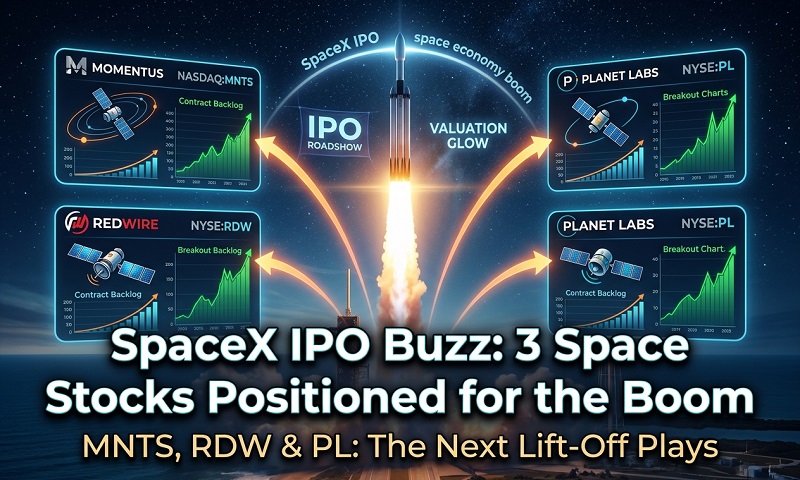
Momentus, Redwire, and Planet Labs each offer a distinct way to participate in the space economy—whether through orbital logistics, infrastructure hardware, or satellite data. The common thread is simple: The space sector is scaling rapidly, government and commercial spending is accelerating, and public investors don’t need to wait for a SpaceX ticker to take part.
For those looking to position ahead of the next wave, the better opportunities may already be trading on the open market.
FAQ: SpaceX IPO Buzz: 3 Space Stocks Positioned for the Boom
What is the expected timeline for the SpaceX IPO?
Reports suggest SpaceX could go public as early as June 2026, with an estimated valuation between $1.5 trillion and $2 trillion. However, Elon Musk has not officially confirmed a specific date, and the timeline remains speculative. Analysts note that SpaceX has met many of the conditions Musk previously outlined for going public, including achieving predictable revenue through Starlink subscriptions.
Can I invest in SpaceX before the IPO?
Direct investment in SpaceX shares is typically limited to accredited investors through private markets. However, retail investors can gain indirect exposure through certain venture capital funds like ARK Venture Fund (ARKVX), which holds SpaceX as its largest position. Alternatively, investors can buy publicly traded companies in SpaceX’s supply chain and ecosystem, such as satellite operators, space infrastructure providers, and component manufacturers.
Why are analysts recommending space stocks instead of waiting for the SpaceX IPO?
Historical patterns show that suppliers and infrastructure providers often outperform the headline company during major technological shifts. During the smartphone revolution, key component suppliers delivered returns exceeding 15,000%, while AI boom beneficiaries like Vertiv surged roughly 1,700%. Analysts like Mark Skousen, Jeff Brown, and Michael Robinson argue that publicly traded space companies offer earlier entry points and potentially higher returns than waiting for the SpaceX listing.
What is Project Unlimited and how does it relate to SpaceX?
Project Unlimited refers to Elon Musk’s plan to deploy up to one million orbital AI data centers through SpaceX’s satellite network. This massive constellation would effectively double global AI compute capacity annually without drawing power from Earth’s electrical grid. The initiative represents a convergence of SpaceX’s launch capabilities with xAI’s artificial intelligence ambitions, creating new investment opportunities in space-based computing infrastructure and supporting technologies.
Which sectors benefit most from SpaceX’s growth and the broader space economy?
The expanding space economy creates opportunities across multiple sectors including orbital logistics and in-space servicing, satellite manufacturing and infrastructure hardware, Earth observation and data analytics platforms, defense and national security applications, and AI-driven space computing systems. Government spending is accelerating rapidly, with the U.S. Space Force budget request exceeding $71 billion for FY2027, more than double the previous year’s allocation.