While America fights the war you can see on the evening news—with missiles, carrier groups, and maps highlighting Tehran—Iran has already won the war you can’t see. This invisible conflict is reshaping the global financial order in real time. It is the death of the petrodollar, a system that underpinned American financial privilege for more than 50 years. The consequences are already rippling through bond markets, energy prices, and central bank reserves worldwide.
In this comprehensive guide, I break down exactly what happened in the Strait of Hormuz, why Saudi Arabia’s earlier moves sealed the petrodollar’s fate, and the cascading effects now forcing Washington into an impossible corner. Most importantly, I explain why gold—and specifically a select group of undervalued gold miners—stands as the premier asset class positioned to deliver life-changing returns as the dollar faces historic devaluation.
This is not speculation. It is the logical outcome of decades of policy choices colliding with geopolitical reality. Readers of Garrett Goggin’s Golden Portfolio IV (GPIV) have already benefited from timely insights into this shift. Subscribing positions you to capture the upside with actionable, high-conviction ideas.
The Hidden War: Iran’s Hormuz Toll Booth
In March 2026, amid headline-grabbing military exchanges, Tehran implemented a transit fee for vessels passing through the Strait of Hormuz—the narrow 21-mile chokepoint that handles roughly one-fifth of global oil supply. Critically, this toll is payable only in Chinese yuan, not U.S. dollars.
Reports from Fortune, Al Jazeera, and the Atlantic Council confirmed the shift: millions of barrels have since moved through the strait settled in yuan. China, already purchasing over 80% of Iran’s seaborne oil exports, benefits directly. This was no improvisation. It operationalizes a strategic partnership with Beijing formalized in 2021.
Consider a tanker loading crude in Basra, Iraq, destined for Shanghai. To transit Iranian waters, the operator buys yuan for the toll and settles the oil purchase in yuan. The result? Zero dollars touch the transaction. Scaled across daily tanker traffic, this bypasses the U.S. dollar-clearing system entirely.
This move accelerates de-dollarization. If Iran can enforce yuan settlement at a critical chokepoint, other producers gain leverage to follow. Central banks worldwide now question the necessity of holding vast dollar reserves. The petrodollar’s foundational logic erodes.
The Saudi Surprise: Ending the 1974 Agreement
The Hormuz development did not occur in isolation. Two years earlier, in June 2024, Saudi Arabia quietly let the 1974 petrodollar agreement expire. No fanfare, no press conference—just expiration. For half a century, Saudi oil sales in dollars secured U.S. military protection and cemented dollar dominance. Every nation needing oil required dollars, forcing central banks to accumulate Treasuries.
The Kingdom went further. A $7 billion currency swap with China in 2023 enabled direct yuan-riyal trade. The first digital yuan oil purchase followed. Saudi Arabia joined China’s mBridge platform—a multi-currency settlement system bypassing SWIFT and dollar rails. Infrastructure built to endure signals permanence.
Together, Iran’s toll booth and Saudi Arabia’s pivot mean no structural requirement remains for global oil to price in dollars. This rewrites macro rules. Demand for dollars softens. Treasury demand weakens. The exorbitant privilege of issuing the world’s reserve currency—the ability to run massive deficits financed by global buyers—faces terminal decline.
Visible and Invisible Consequences
The military conflict caused immediate disruptions. Tanker traffic plummeted. Qatar’s Ras Laffan LNG facility suffered damage, taking 17% of export capacity offline. Taiwan’s 11-day LNG stockpile, Australia’s fuel shortages, Slovenia’s rationing, and the UK’s impending jet fuel crisis illustrate energy shock waves. Polyethylene prices doubled at Dow Chemical, affecting everything from packaging to medical supplies.
Yet the invisible financial war poses greater long-term risk. Foreign central banks, facing higher oil costs and reduced dollar needs, sell U.S. Treasuries. Japan holds $1.2 trillion; the UK holds $866 billion. Holdings at the New York Fed hit lows not seen since 2012, dropping sharply post-conflict.
Three weak Treasury auctions in late March 2026 highlighted fragility. Yields approaching 4.4% prompted rhetorical softening from Washington. At 5%, debt service on $39 trillion spirals. Economists call this a debt death spiral: borrowing to pay interest accelerates the problem.
The Trap Washington Cannot Escape
Pull any thread and the crises intertwine. High oil from Hormuz disruptions spikes prices and forces Treasury sales. Withdrawal reopens the strait on Iran’s yuan terms, cementing petroyuan momentum. Full control requires an invasion on a scale America cannot sustain. Either path cracks the bond market, demanding Fed intervention—printing to buy Treasuries and devalue the dollar.
Former Treasury Secretary Hank Paulson called for contingency plans. A record $15 billion Treasury buyback occurred the same day—quiet monetization masked as liquidity management. The UAE’s public request for a wartime dollar swap line carried an implicit threat: accommodate us or face sales and yuan settlement.
This is not conspiracy. It is arithmetic. The petrodollar recycled deficits for 50 years. Its end removes the automatic bid for Treasuries as $9 trillion rolls in 2026 alone, plus $21 trillion by 2031.
Who Is Garrett Goggin and Why Listen?
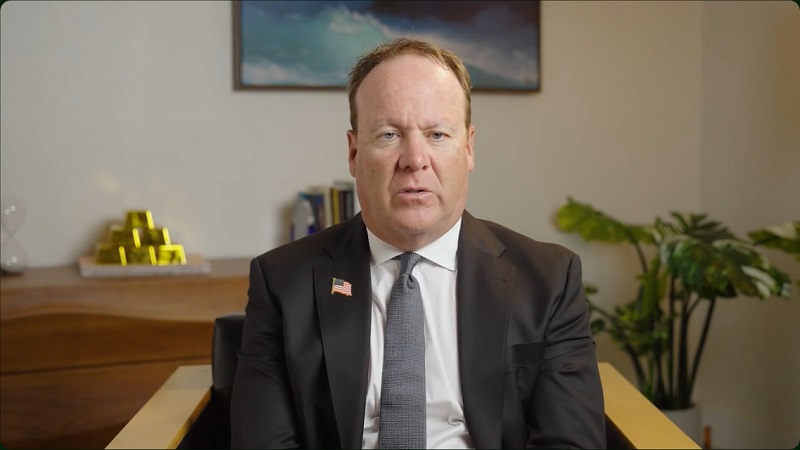
Garrett Goggin is a Chartered Financial Analyst (CFA) and Chartered Market Technician (CMT), credentials held by a limited number of professionals worldwide. His background includes direct apprenticeship under John Doody, a respected figure in gold sector analysis. Goggin distinguishes himself through extensive on-the-ground due diligence, visiting mining operations in challenging jurisdictions to evaluate management, assets, and execution risks firsthand rather than relying solely on desk research.
His approach emphasizes long-term historical cycles in monetary systems, ore grades, free cash flow generation, and net asset value (NAV) discounts. This fundamentals-driven methodology has earned recognition from figures like Porter Stansberry, who described Goggin as among the most knowledgeable gold investors globally. Rather than catering exclusively to institutional clients—who have reportedly offered substantial sums for his research—Goggin focuses on delivering actionable insights to individual investors concerned about currency debasement and wealth preservation.
Goggin operates multiple complementary services designed for different investor profiles. These include the aggressive Golden Portfolio 10X (GP10X), the income-oriented Gold Royalty Retirement Portfolio, and the accessible Golden Portfolio IV (GPIV). Each applies rigorous screening for high-grade assets, de-risked projects, and significant undervaluation relative to underlying gold exposure. His track record features notable calls on companies that delivered multiples for subscribers during prior gold strength, with audited or model performance showing substantial outperformance versus benchmarks in favorable cycles.
The Math the Fed Cannot Escape
Foreign demand for dollars funded U.S. deficits. Oil in yuan reduces that demand. Treasury demand falls. Washington must refinance enormous maturing debt at market rates or rely on the Fed. The Fed prints—trillions—amid oil shocks and lost reserve status. This is textbook currency debasement.
Gold shines brightest here. Rising gold prices signal falling dollar purchasing power. Central banks bought over 1,000 tonnes of gold annually for years. Ray Dalio recommends 15% portfolio allocation. Jeffrey Gundlach suggests 25% is not excessive. Jamie Dimon warns of bond market cracks and sees gold at $10,000. Even Secretary Rubio acknowledged eroding sanction power via non-dollar trade.
America’s Counter-Move: Revaluing Gold
Washington holds 8,133 metric tons of gold booked at $42.22/ounce since 1973. At ~$4,800/ounce market prices, revaluation adds over $1 trillion to the balance sheet, improving debt metrics. Treasury Secretary Scott Bessent, a gold proponent, signals monetizing assets. Proposals for gold-backed Treasuries or instruments gain traction. Judy Shelton advocates gold-collateralized bonds.
The U.S. now has structural incentive for higher gold prices. Tether buys tonnes weekly. Morgan Stanley models 20% gold allocation. The next Fed chair inherits no choice but accommodation.
Why Gold Miners Over Physical Gold?
Physical gold protects, but miners amplify upside. Retail investors pulled $13 billion from gold ETFs near highs, leaving sentiment depressed while fundamentals roar. Miners have not fully priced $4,800 gold, let alone petrodollar collapse or Fed printing.
Historical precedent is compelling. In the 1930s, dollar devaluation lifted miners during Depression. The 1970s saw gold rise 24X; top miners delivered 20X to 76X. The 2000s delivered 8X in gold with far higher multiples in quality juniors. Debt crises plus fiat decline drove each. Today’s scale—larger debt, greater debasement, petrodollar collapse—promises to dwarf priors.
The Golden Anomaly: Your Path to Asymmetric Gains
A “Golden Anomaly” exists: miners trading at deep discounts to net asset value (NAV) based on proven reserves and free cash flow (FCF) at current gold prices. The 90% of miners that never profit aside, the top 10% with high-grade ore, de-risked projects, and strong management coin profits yet trade as if gold were $1,800.
Garrett Goggin’s earlier GPIV picks delivered 115% to 2,050% gains yet still average a 64% discount to in-ground value. The anomaly gap—market cap versus lifetime FCF/NAV—closes as sentiment shifts, often overshooting.
Criteria for Selection:
- Superior Ore Grades: Pick #1 reaches 74 g/t; others 13+ g/t—far above averages. High grades ensure profitability even in cost inflation.
- Production Stage: Sweet spot—permitting done, ramping production.
- Anomaly Profit Variable: Market cap vs. NAV gaps of 1.5X to 16.6X. One trades like gold at $288/ounce (94% discount).
Detailed profiles (available in GPIV):
- Pick #1: ~3X anomaly, trophy assets, up 69% in 2026.
- Pick #2: 16.6X anomaly, extreme undervaluation.
- Pick #3: Massive low-cost heap-leach deposit, proven CEO track record (prior 66X).
- Pick #4: Derisked, fast-track jurisdiction, family ownership, 2,050% prior gains.
A small stake across these—$1,000–$10,000—could compound dramatically as the gap closes and gold fever returns. M&A waves already deliver 40-80% premiums; one prior pick jumped 79% on acquisition.
Bonus Royalty Pick #5: Low-risk, high-margin royalty/streaming model partnering with Tether. Proven 85X anomaly on one asset; NYSE listing incoming. Royalties like Franco-Nevada created legendary wealth with minimal operational risk.
Why Subscribe to Golden Portfolio IV Today?

Golden Portfolio IV delivers quarterly reports, live model portfolio, real-time fundamentals, and the starter guide for new gold investors. For $189/year—far below institutional rates or comparable services—you access hedge-fund quality research focused on the anomaly miners best positioned for 10X, 20X, or higher.
Past readers turned modest stakes into multiples while the NASDAQ lagged. The petrodollar’s death accelerates this cycle. Gold re-stabilizes trust; quality miners deliver the leverage.
The window narrows. Anomaly gaps close. M&A accelerates. Sentiment shifts daily. Do not watch from the sidelines as the dollar’s privilege ends.
Action Step: Visit the subscription link for Golden Portfolio IV and secure your copy of the Top Four plus Bonus Pick. A $189 investment today could secure financial independence tomorrow. Protect and grow your wealth as history turns. The math favors the prepared.
This moment—the death of the petrodollar in 2026—marks a generational wealth transfer from fiat holders to hard asset owners. Garrett Goggin’s Golden Portfolio IV equips you to participate on the winning side.