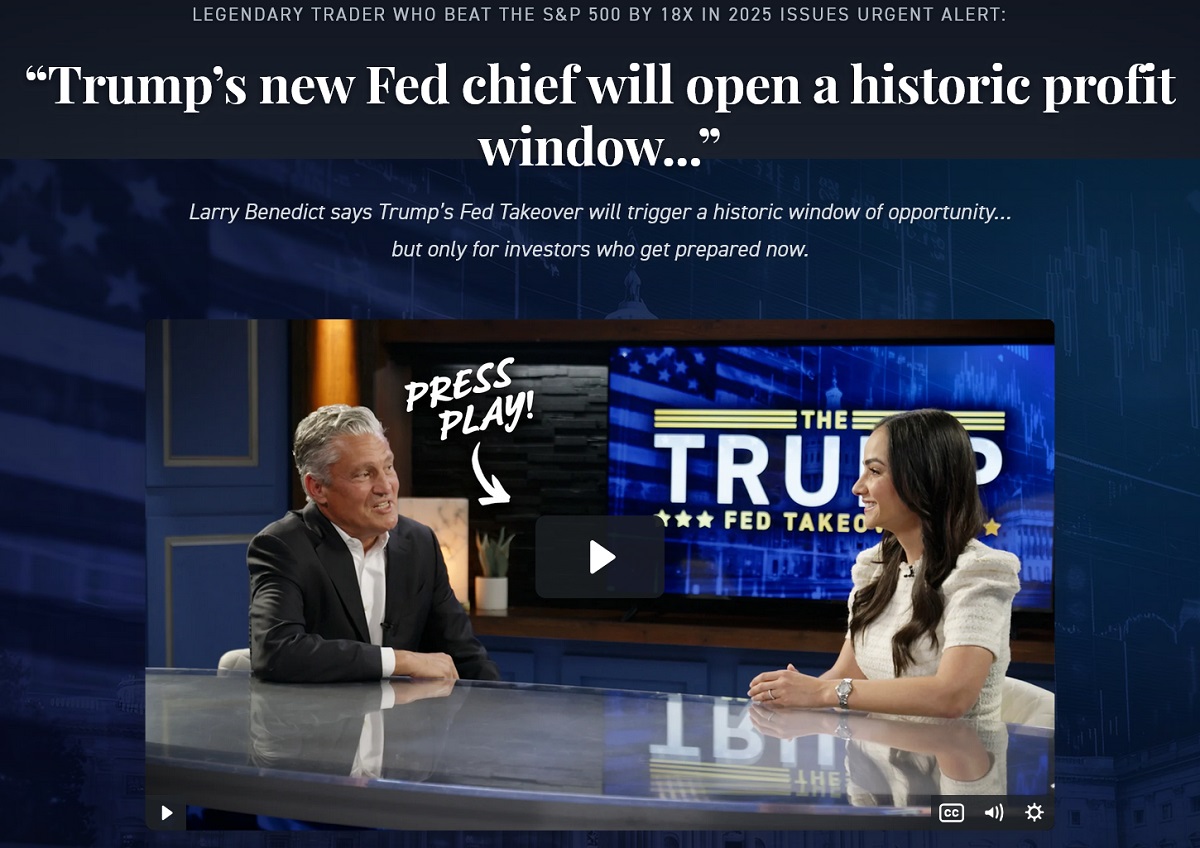
When most investors hear “Fed shakeup” or “market volatility,” their first instinct is to retreat to the sidelines. Yet veteran trader Larry Benedict argues that the coming “Trump Fed Takeover” is not a threat, but a rare, generational opening. In his view, the combination of President Trump’s market‑moving style and a new, aggressive Federal Reserve regime could create one of the clearest, most tradable environments in decades—if you know exactly where the money is going and how to position ahead of it.
At the center of his thesis is a single ticker and a simple idea: instead of scattering capital across dozens of positions, you focus on one highly sensitive fund and trade it repeatedly as the Fed moves. That approach, which Benedict calls One Ticker Trading, is the backbone of his One Ticker Trader research service and his “Trump Fed Takeover Play.”
In this article, we’ll unpack the full story behind this setup, why Benedict believes TLT sits at the heart of the opportunity, and how his One Ticker Trader strategy is designed to help everyday investors turn Fed‑driven chaos into targeted options trades.
A generational shift: Why Benedict says this setup is different
Benedict’s argument starts with a bold claim: Trump’s influence over the Federal Reserve represents a “complete regime shift,” something he says only happens once or twice in a generation. For him, this isn’t just another rate‑cut cycle or a routine policy pivot. It’s a fundamental change in how monetary policy is set, how markets react, and how long these conditions could last.
He points back to 2022 as the closest recent analogy. Coming out of the pandemic, the Fed had pumped nearly nine trillion dollars into the financial system, kept rates near zero, and helped support soaring asset prices. When inflation surged to a 40‑year high, the Fed was forced to slam on the brakes.
Over just twelve months, the Fed pushed through seven rate hikes, including four consecutive three‑quarter‑point increases—something that had never happened in Fed history. The result was brutal for traditional, buy‑and‑hold investors:
-
The S&P 500 dropped nearly 20%.
-
The Nasdaq lost about a third of its value.
-
Bonds, traditionally seen as the “safe” side of a portfolio, fell at the same time.
It felt like there was nowhere to hide. But Benedict argues that this is exactly the wrong way to interpret a Fed shock. In his words, money “doesn’t disappear; it moves into specific parts of the market.”
He highlights how, during 2022, Fed announcements repeatedly triggered sharp rallies and rotations:
-
A March announcement coincided with an 11% S&P rally.
-
A May announcement saw the index jump 7%.
-
Later announcements in July and October were associated with 17% and 14% moves, respectively.
Where most saw chaos, Benedict saw patterns. He claims he went 11 for 11 on trades across his services in that environment, including a 117% gain on a single position in under a month. That experience informs his view today: a major shift at the Fed doesn’t just create volatility—it creates repeatable opportunities if you can anticipate where the money will flow.
Now, he says, what’s unfolding with Trump and the Fed is even bigger than 2022. With President Trump’s second term stretching to 2028 and Kevin Warsh’s term at the Fed extending to at least 2030 in this narrative, Benedict sees years—not months—of fertile trading conditions.
Trump’s market power: From tariffs to “Stargate”
To understand why Benedict views this as a “Trump Fed Takeover,” you have to look at how he frames Trump’s impact on markets so far.
He argues that no modern president has moved markets as aggressively or as frequently as Trump. Rather than slow, telegraphed policy, Trump has relied on big announcements , sweeping executive orders, and sudden shifts that ripple through sectors and asset classes within hours.
Benedict points to several key episodes in 2025:
-
Stargate and AI infrastructure: On January 21, Trump announced a $500 billion initiative—“Stargate”—aimed at building AI infrastructure in America. Benedict notes that billions of dollars flowed into AI stocks within hours, as capital piled into companies positioned to benefit from this wave of spending.
-
Bank deregulation: Trump then moved to deregulate the banking sector. As a result, six of the largest U.S. banks added more than $600 billion in combined market value by year‑end, all off a single policy shift.
-
“Liberation Day” tariffs: On April 2, Trump unveiled his full tariff plan—“Liberation Day.” The broad market dropped on the announcement, but Benedict says he already had his readers positioned in QQQ, the Nasdaq‑tracking ETF, via options. According to his track record, that setup offered nearly 60% gains in a single day. When Trump later paused those tariffs, the S&P 500 enjoyed its third‑biggest single‑day gain since World War II, and Benedict’s QQQ trade allegedly captured another 29%.
For Benedict, these episodes illustrate a pattern: Trump acts, money flows, and traders who know where to stand can benefit. His One Ticker Trading method, as applied to QQQ in 2025, involved repeatedly returning to the same ticker—three winning trades in a single week tied to Liberation Day and its aftermath, with returns of about 60%, 29%, and 18% on that one instrument.
The Trump Fed Takeover, in his telling, is the next logical escalation. Tariffs and executive orders move sectors. A Fed under Trump’s influence has the potential to move the value of money itself.
The Warsh “Shock”: Why a new Fed regime matters
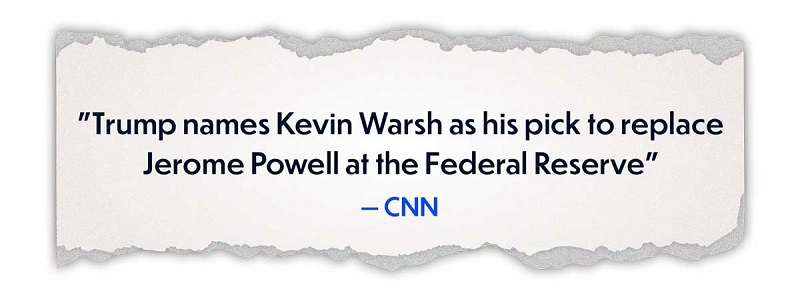
In Benedict’s narrative, the turning point is Trump’s frustration with former Fed chair Jerome Powell. Trump wanted lower rates and cheaper money, but Powell continued to run policy his own way, creating tension between the White House and the most powerful financial institution in the world.
The solution, according to this pitch, was for Trump to install “his own man” at the top of the Fed: Kevin Warsh. This isn’t presented as a routine leadership handover. Instead, Benedict emphasizes how critical Warsh has been of the prior regime and how different his proposed playbook looks:
-
Warsh has publicly called for a “regime change” at the Fed.
-
He believes interest rates should be lower.
-
He has pledged to shrink the Fed’s $6.5 trillion balance sheet.
-
He has talked about eliminating “mission creep” at the central bank.
Wall Street, Benedict notes, has already dubbed this the “Warsh Shock,” a reflection of how uncertain large institutions feel about what’s coming. Markets dislike ambiguity, and an activist Fed chair—especially one aligned with a president as market‑moving as Trump—creates plenty of it.
But Benedict’s key point is that the specific direction of policy—rate cuts versus hikes, faster versus slower balance‑sheet reduction—is less important than the fact that major moves will keep happening. He expects regular announcements, frequent shifts, and persistent volatility for years.
Every one of those moves, he argues, will kick off huge flows of capital. And each of those flows is an opportunity, provided you know where to look.
TLT: The “one ticker” at the heart of the Trump Fed Takeover
So where does Benedict believe that money will show up most predictably? His answer is TLT, the long‑duration U.S. Treasury bond ETF.
TLT is designed to track the performance of long‑term U.S. government bonds. That means it lives and dies by expectations around interest rates and Fed policy. When investors anticipate cuts and lower yields, demand for long‑term Treasuries tends to rise, lifting TLT. When they expect aggressive hikes and higher yields, long‑duration bonds often sell off and TLT falls.
For Benedict, that sensitivity is exactly the point. He calls TLT the “one ticker at the center of Fed policy” and argues that it has been reacting to major Fed shifts for decades. In his own track record, he cites several examples:
-
January 2022: The Fed signaled it would begin hiking rates aggressively. TLT dropped about 4%. Benedict says he had already positioned in TLT options, and that move gave some readers the chance to capture a 117% gain in under a month.
-
August 2022 (Jackson Hole): Fed Chair Powell told markets that rates would go higher and stay there. TLT fell around 5%. Benedict claims his options trade on that move produced an 89% profit in just 17 days.
-
September 2024: The Fed cut rates for the first time in four years. TLT jumped around 2%, and Benedict’s recommended trade captured a 35% gain in two days.
The numbers are presented as evidence of leverage: a mid‑single‑digit move in TLT can translate into double‑digit or even triple‑digit returns in a well‑structured options trade. Crucially, Benedict emphasizes that it doesn’t matter whether TLT moves up or down. As long as it moves in response to Fed decisions, he believes there’s an options angle to exploit.
This is why his lead special report is titled How to Play TLT: The Trump Fed Takeover’s First Move. It’s pitched as a step‑by‑step playbook that explains:
-
Why the current TLT setup is unusually compelling.
-
What specific signs to watch for that a major move is starting.
-
How to structure trades to potentially profit from that move.
-
How to be in position before the market fully reacts.
In his view, TLT is not a “buy it and forget it” holding. It’s a responsive instrument that can be traded repeatedly around Fed events—exactly the kind of asset he wants at the core of his One Ticker Trader strategy.
One Ticker Trading: Why Benedict rejects traditional diversification
Most mainstream financial advice revolves around diversification: spreading capital across many positions and holding for the long term. Benedict takes the opposite stance. He’s blunt: “Diversification is for dummies.”
That’s intentionally provocative, but it underlines a real philosophical divide. In a calm, slow‑moving market with low volatility, broad diversification can help smooth returns and reduce idiosyncratic risk. In a regime of sharp Fed shifts, geopolitical surprises, and violent one‑day moves, Benedict argues that it becomes a liability.
His reasoning:
-
When you own 30–50 different positions, you can’t truly know any of them deeply.
-
You end up “watching everything,” which means you are effectively watching nothing with focus.
-
When a big event hits—like a surprise Fed decision or a major Trump announcement—you have dozens of decisions to make at once, and by the time you choose, the opportunity has often passed.
One Ticker Trading is his answer. Instead of trying to juggle multiple names, he chooses a single instrument that sits at the center of a key macro story—in this case, TLT at the center of the Trump Fed Takeover—and trades it again and again as the narrative unfolds.
The Liberation Day example with QQQ illustrates this in practice. When tariffs hit and markets scrambled, many investors wondered which banks, exporters, or manufacturers to buy or sell. Benedict ignored the noise and zeroed in on one ETF, QQQ, and ran three distinct options trades on it in a single week, all winners, as events evolved.
Applied to TLT and the Trump Fed Takeover, his plan is similar:
-
Focus on TLT as the primary vehicle for Fed‑driven moves.
-
Use options to amplify relatively small price changes.
-
Look for multiple, repeatable setups over time, rather than just one “big bet.”
For investors, the appeal is simplicity: one ticker to monitor, one set of patterns to learn, one core options framework to apply.
Why options sit at the center of the strategy
Options can intimidate many retail investors, and Benedict is aware of that. Early in his career on the CBOE floor in the 1980s, they were the domain of professionals and institutions. Today, the landscape is very different.
By 2025, U.S. markets saw roughly 4.6 billion options contracts traded, and that activity has only continued to expand into 2026. App‑based brokers and streamlined platforms now allow traders to execute options orders from their phones in seconds.
Benedict leans heavily into this shift. In his view, options are no longer an obscure tool for hedge funds—they’re accessible instruments that can give regular investors defined risk and leveraged upside when used correctly.
He frames the advantages this way:
-
In an environment where gold can drop 10% in a single day, sitting with $18,000 in a stock position exposes you to an immediate $1,800 loss on a routine shock.
-
An options position might require $500 of premium to control a similar amount of exposure. If the trade fails, your maximum loss is set at $500; if it works, upside can be multiples of that amount.
His argument is that options, when paired with a clear process and strict risk controls, can actually be less risky than buy‑and‑hold stock positions in a hyper‑volatile Fed regime.
To bridge the knowledge gap, Benedict includes Larry’s Guide to Options as a core part of the One Ticker Trader package.
It’s described as a “beginner’s masterclass” designed for readers who have never placed a single options trade. The guide covers:
-
What an option is in real‑world terms, not just textbook definitions.
-
The two main types of options trades Benedict uses.
-
How to size positions and decide how much to put in each trade.
-
When to take profits and when to cut losses.
Testimonials in the pitch reinforce this educational angle, featuring readers who report making 23% in two days on their first ever options trade, 100% on a single alert, or even larger gains during periods of extreme Fed‑driven volatility—always with the caveat that past performance is not typical and losses are possible.
The core message is that, with guided instructions and a focused ticker, options can become a practical tool rather than a source of confusion.
Real‑world volatility: Gold, silver, Bitcoin, and the Warsh announcement
Benedict doesn’t present the Trump Fed Takeover as a hypothetical future scenario; he insists that it has already begun. The moment Trump announced Warsh as his Fed chair, markets reacted violently across multiple asset classes.
He highlights three examples from early 2026:
-
Gold: After a 29% run‑up in the opening weeks of the year, gold suffered its worst single‑day drop since 1983, crashing nearly 10% in a single session.
-
Silver: Even more dramatic, silver fell about 27% in one day.
-
Bitcoin: The flagship cryptocurrency surged, then snapped back toward the $73,000 area, with big swings up and down within days.
All of this, Benedict notes, was sparked by a single development: Trump’s choice of Warsh for the Fed. By his estimate, roughly $7 trillion in global market value evaporated in just 48 hours following that announcement.
However, while many investors saw these moves as chaotic and frightening, Benedict points out that he and his readers were already positioned in gold, silver, and Bitcoin trades across his services:
-
A silver recommendation that delivered 59% in 16 days.
-
A Bitcoin setup that produced nearly 14% in a single day.
-
A gold trade that doubled, with gains of about 107% in three days.
Again, these are presented as “best” examples and not representative of typical returns, but they reinforce his main thesis: volatility is not something to avoid; it is where serious money can be made if you can get in front of the move.
Institutional investors are noticing the same pattern. Benedict references a Goldman Sachs survey of major global allocators in which nearly half said they were shifting more capital into strategies designed to work around Fed activity—the highest such percentage in recent history. In other words, big money sees the same regime change and is already adapting.
For Benedict, this is an inflection point for individual investors: either you stay in a traditional 60/40, buy‑and‑hold playbook that was built for calmer times, or you pivot to a more agile, event‑driven strategy that treats Fed moves as recurring catalysts.
What One Ticker Trader subscribers are actually getting

At this point, Benedict’s pitch shifts from macro narrative to concrete offer. The One Ticker Trader service is presented as a full‑year “Trump Fed Takeover Trading Blueprint,” designed to help subscribers navigate every major move Warsh and Trump are likely to trigger.
The package has several layers:
-
Monthly research issues
Each month, Benedict publishes a new issue where he breaks down what is happening in the markets and how the latest developments fit into the broader Trump Fed Takeover narrative. This includes his read on Fed announcements, Trump’s policy moves, rate expectations, and where he sees the next setup forming. -
Real‑time trade alerts
Rather than promise a fixed number of trades each month, Benedict emphasizes that he sends alerts “when I see the setup.” Some months may feature multiple trades; others might have fewer. Each alert includes:-
The exact ticker (often TLT in this context).
-
The specific options contract (strike, expiry).
-
Clear instructions on when to buy and, importantly, when to sell.
The goal is to remove guesswork so subscribers can execute quickly from their phone or brokerage platform.
-
-
Special report: How to Play TLT – The Trump Fed Takeover’s First Move
This report is the heart of the “one ticker” thesis. It explains in detail why TLT is so sensitive to Fed moves, why Benedict believes the current environment is unusually favorable, what signals to look for, and how he intends to trade around them. -
Special report: Larry’s Guide to Options
A foundational guide aimed at complete beginners, covering the mechanics, terminology, position sizing, and risk management for options trading in plain English. -
Member‑only bonus: The 95% Playbook
Benedict hints at another market where Trump has “more direct influence than almost anything else in the global economy” and claims he can move this market with a phone call. He doesn’t name the instrument on camera, but says he has traded it many times, producing gains of 41%, 87%, and 95% in past recommendations. The 95% Playbook lays out how he approaches this trade and why he believes a similar pattern is setting up again.
From a pricing standpoint, the retail cost of One Ticker Trader is listed at $499 per year. For this Trump Fed Takeover campaign, it’s offered at $19 for the first year—a 96% discount—backed by a 30‑day money‑back guarantee. If a new subscriber isn’t satisfied within the first month, they can request a full refund and keep all the reports.
Why Benedict is targeting everyday investors now
A recurring theme in the presentation is Benedict’s shift from managing money for ultra‑wealthy clients to focusing on individual investors.
During his hedge‑fund years at Banyan Capital, he reportedly required a million‑dollar minimum, delivered $274 million in profits to clients, and maintained a 20‑year streak without a single losing year. His client list included institutions like the Bank of New York, sovereign wealth funds, and large family offices, and Barron’s ranked his fund in the top 1% of hedge funds globally. He was also profiled by Jack Schwager in Hedge Fund Market Wizards alongside names like Ray Dalio.
Those investors, he argues, already have teams of analysts and robust infrastructure to weather the Trump Fed Takeover. The group he’s most concerned about now are everyday savers: people who’ve done “everything right,” built 401(k)s, trusted balanced portfolios, and are looking to protect and grow their retirement.
He points to stories from past crises to make the risk concrete:
-
A couple who saw 40% of their 401(k) disappear during 2008, derailing their retirement plans and delaying their dream of a quiet life in a log cabin in northern Michigan.
-
A retired pilot and his wife who lost $500,000 from their retirement accounts in 2022, forcing them to reconsider travel and lifestyle plans.
-
The broader statistic that $3 trillion was wiped from American retirement accounts during the 2022 volatility, and that years after 2008, 65% of those who lived through the crash said they still hadn’t fully recovered.
In both 2008 and 2022, Benedict emphasizes, he was not only avoiding those losses but actively making money: $95 million in profits for clients during the financial crisis and a 100% trading record in 2022.
For him, the Trump Fed Takeover is another such line in the sand. Investors can either continue with a “calm‑market” playbook and risk being caught flat‑footed, or they can adopt a more tactical approach built around Fed‑driven flows, options, and one ticker at a time. His goal, as he frames it, is to “level the playing field” by making the same playbook he used for institutions available to regular subscribers at a retail price.
Is the One Ticker Trader Trump Fed Takeover Play right for you?
By design, this entire campaign is persuasive. It uses strong performance numbers, dramatic market episodes, and emotionally resonant retirement stories to motivate action. At the same time, it consistently acknowledges that past performance is not a guarantee of future results and that options carry real risk.
The real question for a potential subscriber is not whether this is risk‑free—it isn’t—but whether the strategy aligns with your goals, temperament, and time horizon.
You might be a good fit for this style of research if:
-
You accept that we’re in a structurally more volatile, Fed‑driven environment and want a way to potentially benefit from that volatility rather than hiding from it.
-
You prefer having a single, clearly defined vehicle (like TLT) to focus on, instead of trying to trade dozens of stocks or themes at once.
-
You’re willing to learn the basics of options and follow specific entry and exit instructions.
-
You understand that even with a strong track record and clear process, some trades will lose money, and you only risk capital you can afford to lose.
On the other hand, this may not be the right approach if you:
-
Can’t tolerate short‑term drawdowns or losing trades.
-
Prefer purely passive, long‑term investing and never want to execute tactical trades.
-
Are uncomfortable with derivatives, even with guidance and defined‑risk structures.
What Benedict is offering with One Ticker Trader is not a magic bullet. It’s a structured way to think about Fed regime change, combined with a specific options toolkit and a focus on a single, Fed‑sensitive ticker. For the right type of investor—someone who wants a more active stance in a choppy macro environment—that combination may be compelling, particularly at a low introductory price point.
How Benedict has handled past Fed shocks
To understand why Benedict is so confident about the Trump Fed Takeover, it helps to look at how he has navigated previous crises and policy shocks.
He points back to 2008 as a textbook case study. At the time, mainstream headlines focused on the collapse of the financial system. Major banks were on the brink, credit markets froze, and the S&P 500 ultimately fell about 37% for the year. Many investors panicked, went to cash, or sold near the lows.
Behind the scenes, however, the Fed was more active than ever:
-
It cut interest rates seven times in a single year.
-
It launched emergency facilities and backstops.
-
It helped orchestrate rescues for collapsing institutions like Bear Stearns.
Every one of those moves, Benedict notes, was an inflection point—not just for the broad indices, but for specific corners of the market.
He offers concrete examples:
-
On March 17, with Bear Stearns hours from collapse, the Fed intervened and cut rates. The S&P 500 jumped nearly 4% in a single session on that announcement.
-
On October 13, Congress passed the $700 billion Troubled Asset Relief Program (TARP), the largest government intervention in markets since the Great Depression. The S&P surged 11.58% in one day—the biggest single‑session gain in its history, a record that still stands.
While bank stocks and housing‑related names were collapsing, money was quietly rotating into other areas:
-
Discount retailers like Dollar Tree rallied, rising about 60% as consumers traded down.
-
Walmart reported record sales.
-
The U.S. Government Bond Index returned more than 14%, and gold rose over 5% during 2008.
From Benedict’s perspective, what looked like a system‑wide collapse was actually a massive reallocation of capital—from weak sectors to perceived havens. Every Fed announcement and rescue package acted like a trigger, moving money from one bucket to another.
In that same year when the S&P 500 lost 37%, Benedict says he posted a 23% gain for his clients. Same Fed, same news flow, same markets—but a very different result, because he focused on where the money was going, not on what was breaking.
He applies the same logic to 2020. In February of that year, with the Dow down 3.5% in a single session, he told CNBC “there’s much more to come,” anticipating further downside. When the pandemic panic deepened, the Fed cut rates to zero in an emergency move and launched massive liquidity programs.
Once again, Benedict highlights one specific “corner of the market” that tends to benefit when the Fed slashes rates. His readers positioned in that area, he says, saw a 62% gain in a matter of weeks, even as broad indices went into free‑fall. In that same period, he personally made $2 million in a single month, underscoring his belief that “when the Fed moves money, you can make a killing” if you know where to be.
These examples are not guarantees of what will happen next, but they form the backbone of his Trump Fed Takeover thesis: Fed shocks create volatility, volatility moves capital, and a disciplined trader can work with that movement instead of being run over by it.
The psychology shift: From fear of volatility to using it
A major barrier for many investors is psychological, not technical. Most are taught that “volatility” is a synonym for “danger” and that unpredictable markets should be avoided at all costs.
Benedict pushes back on that mindset. He argues that the instinct to “run for the hills” when markets become choppy is exactly what causes many long‑term investors to lock in losses and miss recoveries. Instead of seeing volatility as a destroyer of wealth, he frames it as a redistributor of wealth—from those who panic and sell, to those who understand where the money is going next.
This perspective requires a fundamental shift:
-
From: “I need the market to go up to make money.”
-
To: “I need movement—up or down—and a clear plan to trade around it.”
Benedict insists that what most investors have been taught—static diversification, rigid 60/40 portfolios, strict buy‑and‑hold—was built for an era of relatively stable monetary policy and modest swings. In a world where the Fed can wipe out 10% in gold in a day or trigger multi‑hundred‑billion‑dollar sector rotations with a press conference, he believes that old playbook has become dangerously out of date.
One Ticker Trader is his attempt to offer a practical alternative: you don’t need to become a full‑time trader, but you do need a system that embraces volatility, has clearly defined risk, and lets you act quickly when the Fed and the White House send shockwaves through the market.
A closer look at the numbers behind his pitch
Promotions like this stand or fall on credibility. Benedict and his publishers know that, so they lean heavily on track record and specific performance figures—always with the legal reminder that past results do not guarantee future performance.
Some of the headline numbers cited in the Trump Fed Takeover Play include:
-
11 for 11 winning trades in 2022 across his services during a year when the S&P 500 lost nearly 20% and the Nasdaq fell by about a third.
-
117% on a single TLT‑related trade in under a month in early 2022.
-
62% on a Fed‑driven trade following the emergency cut to zero in 2020.
-
23% gains in 2008 for clients while the broader market fell 37%.
-
279% return on cash in 2025 across his One Ticker Trader‑style trades, 18 times the return of the S&P 500 that year.
-
A 20‑year streak without a losing year during his hedge fund career, with $274 million in profits delivered to clients.
Testimonials, though anecdotal, add color:
-
A reader named Christopher reporting a 23% profit in two days on his first ever One Ticker Trader options trade.
-
Emilio describing a 100% return on a single alert while at work.
-
Rodd R. claiming an 800% gain in 24 hours tied to a Fed announcement.
-
Chris N. stating he made $12,000 in three hours, and Daniel recounting a trade from $4.50 to $46.40 in a day.
These stories are framed as exceptional rather than typical, and the presentation repeatedly warns that options carry a high degree of risk and that investors can lose some or all of their capital. Still, they serve a purpose: to show that the strategy is not purely theoretical, and that real readers have experienced outsized moves when Benedict’s Fed‑focused setups align.
From an analytical perspective, these figures suggest a high‑conviction, high‑volatility style. The strategy seeks out environments where large percentage gains are possible in short windows, preferably with defined‑risk structures. It is not attempting to smooth out volatility; it is trying to harness it.
How a One Ticker Trader trade might look in practice
While the promotion doesn’t share live trade details (those are reserved for paying subscribers), it does give enough clues to outline the mechanics of a typical One Ticker Trader setup.
A simplified example might look like this:
-
Macro trigger
The Fed is scheduled to announce a rate decision, or Warsh is set to speak at a major conference. Benedict has already formed an expectation—not of the exact language, but of the likely direction and magnitude of the market’s reaction in TLT. -
Pre‑positioning
Before the event, he identifies an options contract on TLT that aligns with his thesis: for instance, a call option if he anticipates a rally, or a put option if he expects a sell‑off. The trade alert to subscribers includes:-
TLT ticker
-
Specific option (strike and expiry)
-
Recommended entry window or price zone
-
Position sizing guidelines
-
-
Event and reaction
The Fed announcement hits. TLT moves sharply up or down in response to the market’s interpretation of the decision and forward guidance. If Benedict’s thesis is correct, the option’s price moves significantly more than the underlying ETF. -
Exit and risk management
Benedict sends a follow‑up alert telling subscribers when to sell and realize gains—or, if the move fails to materialize, when to cut the trade and limit losses. Because options have built‑in maximum loss (the premium paid), the risk is defined from the moment of entry. -
Rinse and repeat
As new Fed communications, economic data releases, and Trump policy interventions emerge, he looks for the next TLT setup. Over time, the same ticker is traded multiple times, each around a distinct catalyst, rather than being bought once and held indefinitely.
From a user’s point of view, the operational steps are straightforward:
-
Open a brokerage app.
-
Enter the ticker from the alert (e.g., TLT).
-
Select the specified option contract.
-
Place the order and wait for the next instruction.
The sophistication lies in Benedict’s read of the macro landscape, choice of contract, and timing—not in the mechanical act of placing the trade.
Balancing upside and risk: What subscribers should keep in mind
Even with an experienced guide, options‑based trading around macro events is inherently risky. The Trump Fed Takeover Play does not pretend otherwise.
Prospective subscribers should approach One Ticker Trader with a clear, realistic mindset:
-
Use risk capital only. Money needed for near‑term expenses, core retirement needs, or emergency funds should not be deployed into speculative trades, no matter how compelling the thesis appears.
-
Expect losing trades. Even the best traders have drawdowns and misreads. A strategy based on Fed volatility will naturally produce both wins and losses; the goal is that the winners, on average, more than offset the losers.
-
Follow sizing rules. One of the quiet lynchpins of Benedict’s approach is position sizing. By limiting each trade to a small portion of overall capital, a string of losses remains survivable, while a powerful run of wins can materially grow the account.
-
Stay engaged, not obsessive. The process requires you to open and act on alerts, but not to watch the tape all day. The key is to read each alert carefully, execute promptly when you agree with the thesis, and respect exit instructions.
Seen this way, One Ticker Trader is less about “day trading” and more about episodic macro trading. You don’t need to stare at screens, but you do need to be willing to act decisively when the Fed or the White House makes its next move.
Turning a confusing macro world into a single, actionable plan
For many investors, the sheer complexity of today’s macro environment is overwhelming. You have to juggle:
-
Interest rate expectations.
-
Inflation trends.
-
Fiscal policy.
-
Geopolitics and trade wars.
-
Currency moves and commodity shocks.
Benedict’s value proposition with the Trump Fed Takeover Play is to compress that complexity into a single action plan:
-
Let him parse the Fed statements, Trump tweets and announcements, global risk shifts, and institutional positioning.
-
Let him translate those inputs into tradeable setups on one primary ticker (TLT) and select secondary opportunities.
-
You focus on execution and discipline, not on decoding every dot plot or speech.
The promise is not that this will eliminate risk—only that it can transform overwhelming macro noise into a series of specific, time‑bound opportunities.
For investors who feel stuck between two unsatisfying extremes—either ignoring macro entirely or trying and failing to keep up with every data point—this “one ticker” bridge can be appealing.
If you decide to subscribe, how to use the service effectively
If you choose to act on this promotion and join One Ticker Trader, a bit of structure on your side can make a significant difference in outcomes and stress levels.

Here are practical ways to integrate the service into your routine:
-
Define your allocation upfront. Before placing a single trade, decide what percentage of your overall portfolio you are comfortable allocating to this strategy—whether that’s 5%, 10%, or another number that fits your risk tolerance.
-
Start small, then scale. For your first few trades, consider using smaller position sizes than the maximum you’re willing to risk. This lets you get comfortable with the flow of alerts and mechanics of options without emotional overload.
-
Read the reports in order. Begin with Larry’s Guide to Options to ensure you understand the terms and mechanics, then move to How to Play TLT so you grasp why this ticker is central. This context will make each alert more meaningful.
-
Treat alerts as recommendations, not orders. The service provides guidance, not mandates. It’s smart to sanity‑check each trade against your own risk appetite and financial situation.
-
Track results honestly. Keep a simple log of entries, exits, and outcomes. This gives you a clear picture of how the strategy is performing for you, not just in aggregate marketing terms.
Used thoughtfully, One Ticker Trader can become one part of a broader financial toolkit: a way to potentially add high‑octane, event‑driven returns on top of your more traditional core holdings, rather than replacing them entirely.
The strategic appeal of Larry Benedict’s Trump Fed Takeover Play
The Trump Fed Takeover Play, as presented through One Ticker Trader, is not simply a newsletter—it is a specific, tightly focused trading framework built for a particular kind of market.
Its strategic appeal rests on several pillars:
-
We are in a long‑lasting Fed regime shift, not a short‑term blip.
-
President Trump’s policymaking style will continue to generate large, sudden market moves.
-
The new Fed chair, Kevin Warsh, has signaled an activist agenda that will keep rates and the balance sheet in the spotlight.
-
TLT is uniquely positioned as a highly sensitive barometer and trading vehicle for these moves.
-
Options offer a way to express these views with defined risk and amplified upside.
-
A one‑ticker focus makes this complex environment manageable for non‑professionals.
For investors who believe this macro diagnosis is broadly correct, subscribing to One Ticker Trader can be seen as a way to outsource part of the heavy lifting: idea generation, macro interpretation, and trade construction.
At the same time, it demands a candid acceptance of volatility and risk. There will be losing trades. Markets will sometimes react irrationally. Even the best‑constructed thesis can be blindsided by an unexpected headline.
Benedict’s pitch is that his four decades of trading Fed moves, his record through past crises, and his concentrated One Ticker methodology give subscribers a real edge in navigating what he views as one of the most important monetary shifts in a generation.
If you share his view that “nobody gets ahead of Trump and the Fed better than Larry,” and you’re ready to engage actively with a structured options strategy, One Ticker Trader is positioned as a low‑cost, high‑leverage way to align with his Trump Fed Takeover Play.
FAQ: Larry Benedict’s TLT Strategy for the Trump Fed Shift
What is Larry Benedict’s One Ticker Trader?
It is a market research service built around Benedict’s idea of focusing on one key ticker at a time, rather than spreading attention across many stocks. In this pitch, the central ticker is TLT, which he views as highly sensitive to Federal Reserve policy shifts and Trump-driven market moves.
Why is TLT the focus of the Trump Fed Takeover Play?
Benedict argues that TLT reacts quickly when the Fed changes course, so it can be used to trade around rate expectations and policy shocks. He says that even relatively small moves in TLT have historically created much larger gains when he used options to trade it.
What does Benedict mean by a “Trump Fed Takeover”?
He is describing a scenario in which President Trump’s influence over Fed leadership and policy creates a new regime of persistent market volatility. In the pitch, this is framed as a years-long opportunity, not a one-time event.
How does the strategy make money?
The basic idea is to identify a ticker that is likely to move when the Fed or Trump makes a major announcement, then use options to try to capture that move with defined risk. Benedict says he looks for multiple trades in the same ticker as the market reacts and re-prices the news.
Do subscribers need to know how to trade options already?
No. The package includes a beginner-friendly guide that explains how options work in practical terms, along with the specific style of trades Benedict uses. The pitch presents the service as accessible to new traders who are willing to learn the basics.
Is this a buy-and-hold strategy?
No. Benedict argues that buy-and-hold alone is not enough for a market dominated by rapid Fed shifts and Trump-driven policy shocks. His approach is more tactical, with entry and exit points tied to specific catalysts.
What kind of results does Benedict cite?
The pitch highlights past examples like 62% gains in 2020, 117% gains in 2022, and 279% return on cash in 2025 across his services. It also includes testimonials from readers reporting large short-term gains, while clearly noting that such results are not typical and losses are possible.
How much does it cost?
The pitch says the retail price is $499 per year, but the promotional offer brings it down to $19 for the first year, along with a 30-day money-back guarantee.
Is this suitable for conservative investors?
Probably not if you want a completely passive, low-volatility approach. The service is built around active, event-driven trading and options, which means the opportunity may be high, but so is the risk.
What is the main takeaway for readers?
Benedict’s core message is that major Fed moves do not just create uncertainty—they create tradable flows. His pitch is that if you can focus on one sensitive ticker like TLT and follow a disciplined options strategy, you may be able to turn that volatility into opportunity.