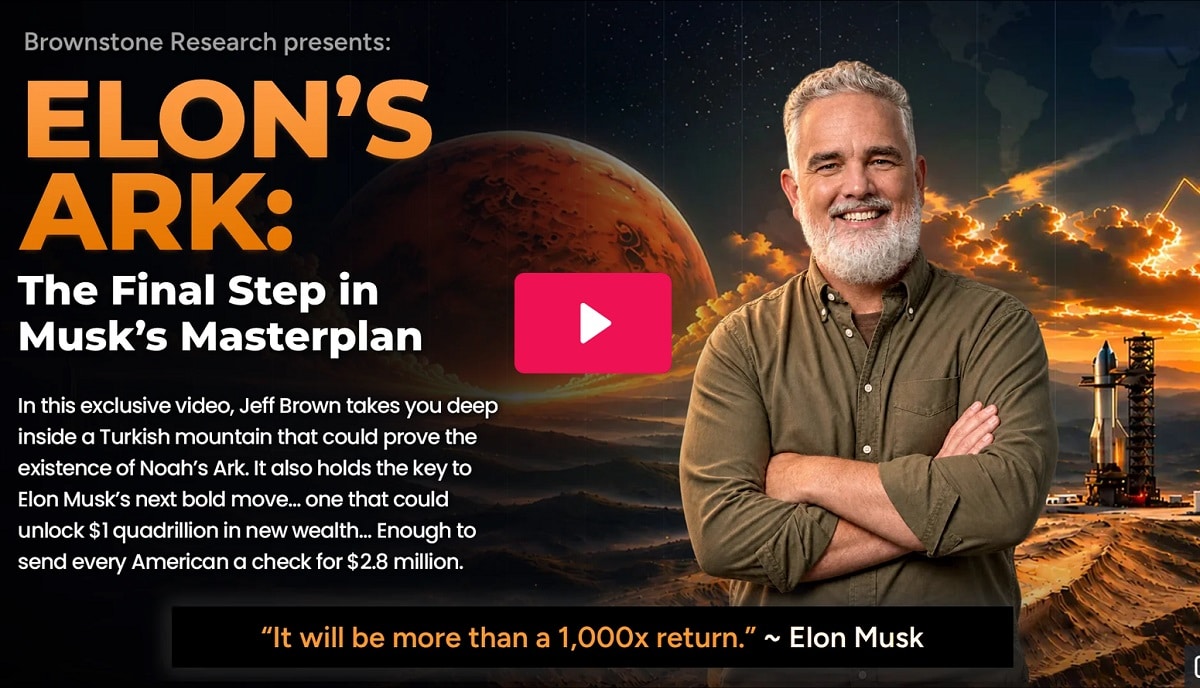
Elon Musk is building an ark. Not a wooden ship from an ancient story, but a modern system of rockets, robots, self-driving cars, and orbiting data centers that could reshape the global economy. The scale is enormous. Musk has spoken of more than a 1,000x return for early participants and of new wealth that could exceed $1 quadrillion—enough, by one calculation, to send every American a check for $2.8 million. At the center of this plan sits a chip factory unlike any other: the Terafab. And inside that factory is a critical partner most investors have never heard of.
This is the story of how that partner fits into Musk’s masterplan, why the pieces are already moving, and how one free stock name sits at the entry point for anyone watching. It begins in an unexpected place—a remote mountain in eastern Turkey—and ends in the largest building on Earth outside Houston.
A Mountain, an Ancient Story, and Modern Machines
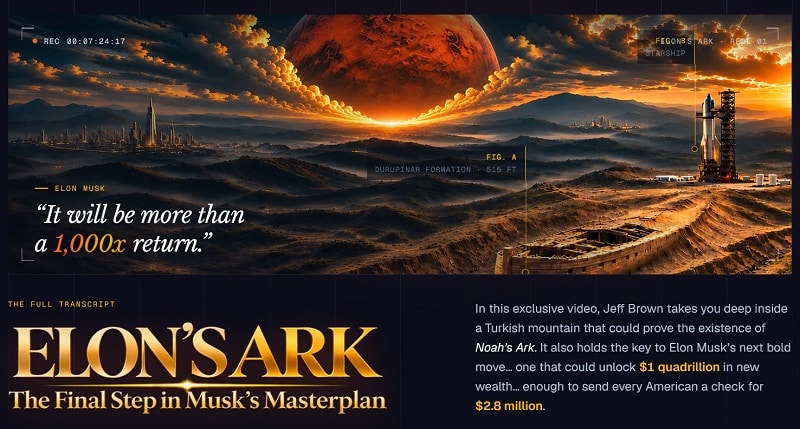
Eighteen miles from Mount Ararat, near the Iranian border, sits a long mound shaped like the hull of a ship. It measures roughly 515 feet from end to end, close to the dimensions given for Noah’s Ark in the Book of Genesis. Local names and traditions connect the slopes above it to the landing place described in both the Bible and the Quran. For decades people have visited the site. A Kurdish farmer reported finding the prow of a ship after a warm summer melted the snow in 1948. A Turkish army captain later spotted the outline in aerial photographs. The Turkish government turned the area into a national park. Expedition after expedition has studied the mound. Geologists have argued. No one could settle the question one way or the other.
The reason was simple. The ground is considered sacred. Heavy machinery that would destroy the site was never an option. A human being cannot fit down a hole only a few inches wide. For seventy years the interior stayed sealed.
That changed with technology that did not exist in earlier decades. A team led by Andrew Jones brought in advanced ground-penetrating radar and 3D mapping systems. The radar had been used to find buried structures and tunnels along the U.S.-Mexico border. Scans showed the mound is not solid rock. Straight lines, right-angle corners, and empty spaces appeared—corridors and rooms stacked in three layers, matching the three decks described in Genesis. Drill holes inside the outline did not hit bedrock. One broke into a cavity filled with mud and water. In another, about fifteen feet down, the bit struck a layer hard enough to snap. Samples went to the lab. The team believes the dark bands visible on camera could be organic material from the upper deck of a ship.
A tiny camera the size of a thumb traveled down a four-inch hole on a cable and sent pictures back. A small robot named Gopher, adapted from equipment used to study wildlife in burrows and named after the gopher wood of the biblical story, is prepared to enter wider holes. Drones fly the surface with lasers and heat cameras. Every image, every radar scan, and every map is fed into artificial intelligence—specifically the system known as Grok—for rapid analysis that would take human crews weeks or months.
None of this requires a final laboratory verdict on the mound itself. The point is the toolkit. The same classes of technology—vision sensors, advanced processors, autonomous machines, and AI that turns raw data into usable insight—are the tools Elon Musk is scaling for a completely different purpose.
Manifested AI: Intelligence That Leaves the Screen
Jeff Brown, a technology investor who has spent decades in Silicon Valley and Asia and has visited Musk’s facilities in person, calls the shift “Manifested AI.” It is artificial intelligence that has climbed out of the screen and into the physical world. It has eyes that see, hands or grippers that work, and wheels or feet that move. It is no longer limited to chatbots. It drives cars, controls robots, launches rockets, and analyzes the interior of a mountain in real time.
Musk sits at the front of this transition. His companies are building the hardware that gives AI a body. Tesla vehicles already drive themselves in many conditions. Cybercabs without steering wheels have begun limited operation. Optimus humanoid robots are in production. Starship rockets have reached orbit and deployed satellites. The same vision chips that let a Tesla “see” the road are the kind of sensors that let a camera peer inside a sealed cavity. The same AI that powers Grok processes the mountain scans in minutes. The same class of robots that will explore space or perform factory work can, in principle, go where humans cannot.
Brown has tracked these developments closely. He has toured the Texas Gigafactory, stood near the Colossus AI supercomputer outside Memphis, visited SpaceX launch facilities, and ridden in a Cybercab. He has written about Tesla as an artificial intelligence company since 2018, when many still saw it only as an electric-vehicle maker and some predicted bankruptcy. Shares later rose as high as 2,433 percent from levels around that time. He highlighted Nvidia in early 2016; the stock later reached gains as high as 38,530 percent. He recommended Bitcoin near $240. These are the kinds of calls that shape how he views the next phase.
The next phase is large. Musk has spoken of a billion Optimus robots over the coming decade. At roughly $25,000 each, that is a $25 trillion market. He has called Optimus “the biggest product ever.” Tesla has already shifted its Fremont Model S and Model X line entirely to Optimus production, targeting a million robots a year, with a much larger Texas line planned for ten million a year. Cybercab production has started with a goal of two million vehicles a year. Starship is designed to carry 100 tons of cargo and more than 100 people. The stated ambition is to scale toward thirty launches a day by 2030. One million solar-powered AI satellites have been discussed as orbiting data centers. The robots alone, Musk has said, could make the world ten times richer—more than $1 quadrillion in new wealth, or about $2.8 million for every American if distributed evenly. He has also said he sees a path for SpaceX to be worth orders of magnitude more than the current global economy of roughly $126 trillion.
These numbers sound extreme until they are placed against the pattern of earlier Musk projects that were widely dismissed and later delivered. Catching a skyscraper-sized rocket with mechanical arms, full self-driving progress, Starlink coverage in more than 160 countries and territories, and a Roadster demonstration of inverted driving all followed the same sequence: skepticism, then results. The people who treated the claims as plausible early had the chance to benefit.
The Bottleneck That Creates the Opportunity
One constraint stands in the way of the full plan. AI becomes more capable as it receives more computing power. That power lives in data centers filled with advanced chips. Musk’s own Grok system runs in such facilities. Colossus was designed around a full gigawatt of power. The longer-term target is a terawatt—a thousand gigawatts, or a thousand Colossus-scale systems.
Building that capacity on the ground is difficult. Roughly seven in ten Americans oppose a data center near their homes. New York has restricted new construction. Political races in other states have turned on electricity costs and data-center opposition. Even Texas has seen pushback. Musk’s response is to put the compute in space. Starship can loft large payloads. Solar power in orbit has no clouds, no night, no land-use fights, no local water demands for cooling, and no electric bill from a utility. Permission has been sought for up to a million satellites, each functioning as a flying AI data center.
Building a million satellites, a billion robots, millions of vehicles, and thousands of Starships requires chips on a scale the existing industry cannot supply. Musk has noted that the entire current output of the world’s chip industry covers only about 2 percent of what his companies alone will need. Memory chips are already sold out through 2027. Advanced processors are constrained. Dinner conversations with Nvidia leadership have included direct requests for more supply. Other major AI developers face the same shortage.
Musk’s answer is to build the chips himself. The facility is called the Terafab. Renderings show a plant outside Houston described as the largest and most valuable building on Earth. The target output is one million wafers a month of both logic processors and memory. That scale would make it the biggest chip factory on the planet, yet even that may not be enough. To accelerate further, the design appears to incorporate a free-electron laser—a ring that accelerates particles and converts their energy into intense light usable for semiconductor manufacturing. Such a light source could roughly double output and cut wafer costs by around 20 percent. A thin circle visible in the public rendering is the visual clue that led observers familiar with chip plants to this conclusion. Musk has made comments consistent with exploring the technology.
A free-electron laser and the overall plant still require specialized tools and equipment that Tesla and SpaceX do not manufacture themselves. In 2024 and into the following period, Musk’s team quietly solicited prices and delivery schedules from potential suppliers for nearly every major category of equipment a chip factory needs. One supplier received a request on a Friday holiday and was asked for a quote by Monday. No contracts have been publicly announced. The process is being kept quiet. The companies that win the largest pieces of this business stand to benefit from a project whose estimated cost has been placed as high as $225 billion by some Wall Street analyses.
The Free Name: Eyes and Power for Every Machine
Not every chip has to come from the most advanced line inside the Terafab. Simpler, high-volume components can be sourced from existing specialists. One such company already supplies Tesla. It is ON Semiconductor, ticker ON.
The camera lowered into the Turkish mountain uses a tiny image sensor—the same broad category of chip that gives Tesla vehicles their vision. Optimus robots are expected to carry multiple cameras. A single Optimus is said to contain about 10,000 unique parts, including eight cameras and 78 motors. Scaled to a billion robots, that becomes billions of cameras and tens of billions of motors. Each motor needs power-management chips that deliver electricity efficiently without wasting energy as heat. ON Semiconductor makes both the sensing chips that turn light into usable data and the power chips that help electric vehicles charge faster and run more efficiently. Musk has stated that technology developed for Tesla vehicles applies directly to humanoid robots.
Morgan Stanley has already identified ON Semiconductor as one way to participate in the robot opportunity. The stock trades at a small fraction of Tesla’s valuation—roughly 2 percent in some comparisons—and many forecasts still do not fully incorporate large-scale robot production. Production of Optimus has begun in Fremont. A second, larger plant is planned in Texas. The same parts that support autonomous driving support the vision and power systems of the robots. ON Semiconductor is available to any investor today. No membership or special report is required to act on the name.
The Critical Partner Inside the Terafab
The more specialized equipment for the Terafab itself is a different story. Elon can design chips, erect the building, and even pursue a free-electron laser. Certain machines and process tools, however, must be purchased. The company that supplies the most essential of those tools becomes a critical partner. Brown’s research concludes that one name stands out after examining the public rendering, the known solicitation of quotes, the technical requirements of high-volume advanced manufacturing, and the limited number of firms capable of delivering at the required speed and scale. That company is the subject of the report titled “Elon’s Ark: The Critical Partner to Elon’s 1000x Masterplan.”
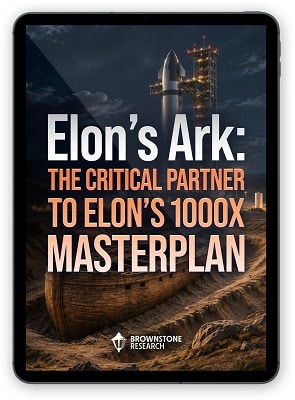
The report contains the name, the ticker symbol, the reasoning that begins with the circle in the rendering, evidence that the company has already been asked for pricing, and a suggested maximum purchase price so that readers can position themselves before any public announcement. When the partnership becomes widely known, the stock is expected to re-rate as the market prices in the volume of business tied to the largest chip factory ever built and to the broader Manifested AI build-out.
Two additional reports complete the picture.
One focuses on the memory specialist required to produce the high-performance memory chips that are currently sold out through 2027. Making memory at the volumes Musk needs is extremely difficult without the specific expertise and tools of one leading firm—the same firm that received outreach from the Terafab team.
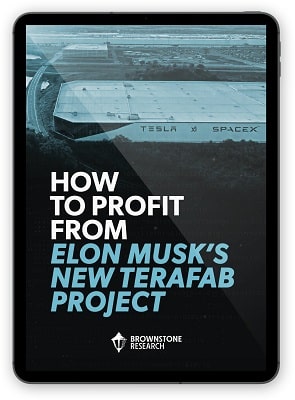
The third report covers the 130-year-old company whose turbine technology already handles roughly a quarter of the world’s electricity generation. Power is the ultimate limiting factor. Musk has said that the industry may soon produce more chips than it can power. The Terafab is planned to run on its own natural-gas generation and large battery banks. Turbines are in short supply, with order books extending years into the future. The company that supplies a large share of those turbines stands to benefit from every new data center, every new factory, and every expansion of AI compute.
Together the three reports form the core of the Elon’s Ark investment package. They are offered free of charge to new members of The Near Future Report.
What Membership Delivers
The Near Future Report is a monthly research service focused on technologies close enough to matter for portfolios today—AI, robotics, space, energy, and related fields. On the first Monday of each month, members receive one new recommendation: the single best idea the editor can identify at that time. Between issues, portfolio updates and urgent alerts are issued when positions need to be adjusted. Full access to the model portfolio shows every open recommendation and its status. A daily briefing called The Bleeding Edge arrives on weekday afternoons and covers developments in the same themes for an audience that has grown past 300,000 readers. It is the same channel that earlier flagged the SpaceX public-listing path years in advance and first called attention to the unusual circle in the Terafab rendering.
A one-year membership normally carries a $499 price. For those acting on the current presentation, the price is $179—64 percent off, or less than $15 per month. That fee unlocks the twelve monthly issues, the three Terafab-related stock reports, the full interview with the Noah’s Ark site team (including additional footage, analysis of the underground video, and a demonstration of the Gopher robot), continuous access to the members-only site, and the daily briefing. A 30-day money-back guarantee applies. If the research does not meet expectations for any reason, a full refund is available and the reports remain with the member.
Past performance figures cited in connection with the service include the Tesla, Nvidia, and Bitcoin examples already noted, as well as gains on other recommendations such as Taiwan Semiconductor, Palo Alto Networks, and Arista Networks during the period following the March 2020 market low. The average gain since inception for the service has been reported at 39.4 percent. These numbers are historical. Every investment carries risk. Capital can be lost. Position sizes should reflect personal risk tolerance. Past results do not guarantee future outcomes.
Why the Timing Matters
Several clocks are running. No Terafab supplier contracts have been announced, yet outreach for pricing has already occurred. An Optimus production or capability update is expected in the near term; any such announcement tends to move related stocks. Starship has already completed an orbital flight and satellite deployment. The long-term launch-rate target remains ambitious. The discounted membership rate is a limited offer that can revert to the standard price without extended notice.
The people who treated earlier Musk projects as serious when consensus was skeptical had the chance to capture large gains. The same pattern may or may not repeat. The difference this time is the breadth of the build-out—robots, vehicles, satellites, rockets, and the chip factory required to supply them all—and the explicit statement of a potential 1,000x return for those positioned early. A thousandfold return turns $1,000 into $1 million and $500 into half a million. Those figures are illustrative of the scale Musk has described, not a forecast of any particular stock.
Risks and Realistic Expectations
Semiconductor demand can soften. Construction of large facilities can face delays, cost overruns, or regulatory hurdles. Robot production targets can slip. Space-based compute remains early. Power infrastructure takes years to expand. Equity markets can decline for reasons unrelated to any single technology theme. Individual stocks, including ON Semiconductor and any names in the special reports, can fall sharply even if the broader thesis remains intact. Concentration in a small number of high-conviction ideas increases both upside potential and downside risk. Readers should treat the information as a starting point for their own due diligence, not as personalized advice.
Outlook: Abundance Built on Physical AI
If the robots, vehicles, and orbiting compute systems reach even a fraction of the described scale, the economic effects would be substantial. Tasks that currently require expensive human labor could be performed at far lower cost. Goods and services that are scarce today could become abundant. Medical research, materials science, and logistics could accelerate. Poverty reduction through lower production costs is one of the outcomes Musk has explicitly linked to Optimus. Longer human healthspans and faster scientific discovery are themes raised by leaders at other frontier AI organizations.
None of this is guaranteed. Execution risk is real. Competition is intense. Policy and public acceptance will influence the pace. Yet the direction of travel is visible in the factories already shifting production lines, the rockets already flying, the vehicles already operating with increasing autonomy, and the chip plant already being designed at unprecedented size.
The free stock, ON Semiconductor, provides immediate exposure to the vision and power components required by both cars and robots. The three special reports provide deeper exposure to the specialized tools, memory production, and power-generation equipment that the Terafab and the broader AI build-out will consume in large quantities. Membership in The Near Future Report supplies the ongoing research, alerts, and portfolio framework intended to keep participants informed as the story develops.
The mountain in Turkey showed that machines can now see and work in places humans cannot easily reach. The same principle, applied at industrial scale, is what Musk is pursuing. The critical partner inside the Terafab is one of the companies that will help make that scale possible. The research that names it, along with the supporting names in memory and power, is available to those who choose to examine it.
Frequently Asked Questions
What is the free stock name and why does it matter?
ON Semiconductor (ticker ON). It supplies image sensors and power-management chips already used in Tesla vehicles. The same categories of components are required in large numbers for Optimus robots. The company trades at a fraction of Tesla’s valuation and is not yet fully valued by the market for large-scale robot production.
Is the critical Terafab partner named in the free materials?
No. The name, ticker, detailed reasoning, and suggested maximum purchase price appear in the members-only report “Elon’s Ark: The Critical Partner to Elon’s 1000x Masterplan.” The free presentation establishes the existence of the opportunity and the technical clues that point to a specific supplier.
What else is included with membership?
Twelve monthly recommendation issues, portfolio updates and alerts, the model portfolio, the daily Bleeding Edge briefing, the three Terafab-related stock reports, the full on-site interview with the Noah’s Ark research team, and access to the members website. A 30-day full refund guarantee applies.
How should the 1,000x and $1 quadrillion figures be understood?
They are statements Musk has made about the potential scale of the robot economy and the returns available to early participants in the overall transformation. They are not forecasts for any single stock. They illustrate the size of the opportunity he is pursuing.
What are the main risks?
Execution delays, cost overruns, weaker-than-expected demand, regulatory obstacles, power shortages, and normal equity-market volatility. Individual stocks can decline even if the long-term technology direction remains positive. Position sizing and personal risk tolerance should guide any decisions.
Final Word
The tools that peered inside a sealed mountain cavity are the same class of tools now being prepared to build and operate a new layer of the physical economy. The companies that supply the most constrained pieces of that system sit at the center of the investment case. ON Semiconductor is available immediately. The deeper research on the critical Terafab partner and the supporting names in memory and power is available through The Near Future Report. The choice of whether to examine that research is open to anyone who wants to see the details for themselves.