Explore how President Trump’s public endorsements and policies could propel Oracle, Broadcom, Motorola Solutions, and more. Insights from his portfolio, prediction markets, and AI agenda reveal potential winners in semiconductors, data centers, and public safety.
Recommended:
 REVEALED: A Pentagon-Funded Technology 10x Better Than Starlink
He recommended Nvidia in 2016 for the chance at a 1,466% gain… Rocket Lab at $5.37 a share – before it soared past $69… and just weeks ago, he closed a 357% gain on Globalstar after Amazon stepped in to buy the company. This Thursday, our in-house space expert will name a tiny, virtually unknown company that he believes will be his next 1,000% winner as the SpaceX IPO unfolds.
The Power of the Presidential Nod in Markets
In the fast-paced world of Wall Street, few catalysts carry the weight of a presidential endorsement. President Donald Trump has honed a distinctive approach to engaging with corporate America: publicly praising companies and sectors that align with his policy priorities, often with dramatic market consequences. His recent actions have not only spotlighted individual firms but also raised questions about timing, ethics, and the intersection of politics and personal finance.
Trump’s ethics filings reveal thousands of transactions, including well-timed buys in companies like Dell and NVIDIA before public boosts or favorable policy shifts. Government stakes, such as in Intel, have delivered outsized returns, while prediction markets like Kalshi bet heavily on future interventions.
Trump’s habit of boosting stocks isn’t new, but its scale in his second term is unprecedented. From calling out Micron as “great” to urging crowds to “buy a Dell,” these moments have triggered rallies. A government equity stake in Intel, acquired for $8.9 billion, ballooned past $50 billion by mid-2026, yielding roughly 190% gains for the stock. Traders now scour filings and Truth Social posts for signals, with prediction markets pricing probabilities for government stakes in various names.
Trump’s Track Record – From Praise to Profits
President Trump’s public endorsements have a proven market-moving power. Consider Intel Corporation (NASDAQ: INTC). In 2025, the Trump administration took a significant equity stake, reportedly around 10%, to bolster domestic semiconductor manufacturing. The $8.9 billion investment quickly appreciated as AI demand and policy support fueled a turnaround. By May 2026, the position had more than quintupled in value, sending shares up nearly 190% (with some reports citing even higher peaks near 400-460% in certain periods).
This wasn’t isolated. On May 22, 2026, Trump praised Micron Technology (NASDAQ: MU) as “great.” Within days, the stock surged, closing near $896 and briefly crossing $1 trillion in market capitalization. UBS raised its price target dramatically from $535 to $1,625, amplifying the momentum.
Dell Technologies (NYSE: DELL) followed a similar script. Trump’s ethics filing showed a position opened in February 2026, followed by his May rally cry: “Go out and buy a Dell.” Shares jumped substantially, aided by AI server demand and government contracts.
NVIDIA (NASDAQ: NVDA) fits the pattern too. Purchases in early January preceded Commerce Department approvals for certain chip sales to China, unlocking revenue streams in a high-stakes geopolitical arena.
These examples illustrate a feedback loop: policy support, public praise, analyst upgrades, and retail frenzy. Critics point to potential conflicts, as the White House maintains the portfolio is trust-managed with no direct input. However, the volume—over 3,700 transactions in Q1 2026 alone—fuels debate.
Trump’s second term emphasizes American manufacturing resurgence, AI dominance, border security, and deregulation. Tech and defense contractors stand to gain. Prediction markets on Kalshi reflect this, with over $740,000 wagered on potential government stakes. Micron hovered around 42% probability, while quantum computing plays like Rigetti and D-Wave exceeded 80%. NVIDIA sat lower at 13%, but sentiment can shift rapidly.
Trump’s May 26, 2026, Truth Social post defended prediction markets, attacking figures like Chris Christie, Tim Walz, and JB Pritzker while insisting the CFTC retain exclusive authority. This bolsters platforms like Kalshi and Polymarket, where his family has ties, further intertwining politics and markets.
The Filing That May Tip His Hand
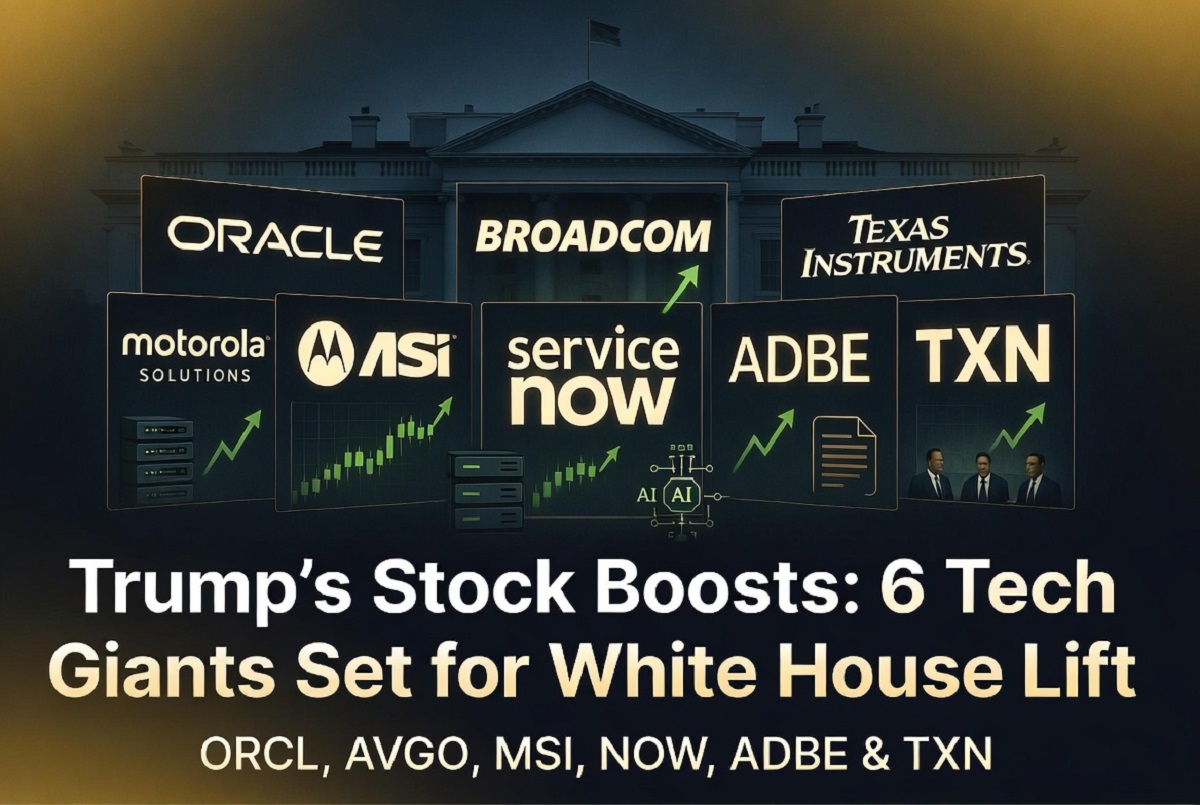
Trump’s Q1 2026 ethics disclosure, released mid-May, logged thousands of trades across tech heavyweights: ServiceNow (NOW), Adobe (ADBE), Texas Instruments (TXN), Oracle (ORCL), Broadcom (AVGO), Motorola Solutions (MSI), and others.
This shift from bonds to active stock trading marks a departure. Holdings span AI infrastructure, software, semiconductors, and public safety. While the trust claims independence, timing raises eyebrows—purchases preceding announcements or policy wins.
Investors interpret these as signals. Holdings in companies with administration ties suggest alignment. For instance, buys in Dell preceded the public endorsement; NVIDIA purchases aligned with export policy easing.
Deep Dive into Potential Boost Candidates
Oracle Corporation (NYSE: ORCL)
Oracle stands out due to deep personal and strategic ties. Co-founder Larry Ellison, a Trump ally, plays a lead role in the Stargate AI infrastructure project—a massive $500 billion initiative involving data centers, OpenAI, and SoftBank.
Oracle’s involvement in the TikTok U.S. operations deal further cements its position. As a key partner for data hosting, algorithm oversight, and security, Oracle benefits from national security-driven decoupling from ByteDance. Ellison’s influence extends to Hollywood mergers and AI surveillance visions.
Fundamentals: Oracle’s cloud business has grown rapidly, competing with AWS and Azure. AI integrations via its database strengths position it for explosive growth. Valuation metrics (as of mid-2026 context) show premium multiples justified by recurring revenue and government contracts.
Potential boost: A presidential mention or expanded Stargate funding could catalyze 20-50% upside. Risks include execution on massive projects and competition.
Broadcom (NASDAQ: AVGO)
Valued above $2 trillion recently, Broadcom supplies custom AI chips and networking for data center buildouts central to Trump’s tech agenda.
Partnerships with Meta and others for custom silicon highlight its role in scaling AI infrastructure. Executive orders accelerating data center permitting on federal lands directly benefit suppliers like Broadcom.
Fundamentals: Strong in semiconductors, networking, and VMware integration. AI tailwinds drive revenue. Trump’s portfolio included Broadcom purchases.
Catalyst potential: Policy support for domestic production and AI leadership could drive further gains. Detailed competitive analysis vs. NVIDIA, AMD; margin trends; dividend appeal; long-term 5G/7nm roadmap projections.
Motorola Solutions (NYSE: MSI)
Motorola Solutions provides police radios, dispatch software, surveillance, and border security gear—perfectly aligned with law enforcement and immigration priorities.
Contracts with CBP, ICE, and local agencies generate steady revenue. Technologies like license plate readers and command centers enhance operational efficiency.
Analysis: Public safety market size, recurring revenue from services, international expansion, valuation relative to peers, risks from budget constraints or policy shifts.
ServiceNow (NYSE: NOW)
Company Overview and Policy Alignment
ServiceNow operates as a leading enterprise workflow platform, often described as the “AI operating system” for businesses. Its platform automates IT service management, HR, customer service, and security operations. In Trump’s second term, ServiceNow benefits from federal efficiency drives, AI adoption mandates, and government contracting reforms emphasizing performance-based fixed-price deals. Trump’s personal holdings (up to $5 million purchased February 10, 2026) and public filings amplified interest, contributing to a notable market cap gain of roughly $9.8 billion upon disclosure.
Financials (as of mid-2026)
ServiceNow reported strong subscription revenue growth, targeting over $30 billion by 2030 (doubling from ~$15-16 billion levels in 2026). Q1/Q2 2026 guidance showed 22-22.5% YoY subscription growth. The company maintains high margins, with Rule of 60+ (growth + profitability) as a key metric. Free cash flow remains robust, supporting a $5 billion buyback authorization. Valuation trades at premiums but with an “AI discount” relative to peers—forward PEG attractive, around 15x FCF in some analyses.
SWOT Analysis
- Strengths: Dominant platform with 85%+ Fortune 500 adoption; deep AI integrations (Now Assist generating significant bookings); Nvidia CEO endorsement as enterprise AI backbone; recurring revenue model with high switching costs.
- Weaknesses: High valuation leaves room for multiple compression on growth misses; dependency on large enterprise deals; execution risk on aggressive 2030 targets.
- Opportunities: Federal contracting tailwinds under efficiency EOs; AI agent proliferation increasing platform usage; international expansion and vertical solutions (e.g., healthcare, finance).
- Threats: Intensifying competition from Salesforce, Microsoft, and pure AI startups; potential macroeconomic slowdowns reducing IT budgets; regulatory scrutiny on data handling.
Historical Performance Post-Endorsements/Policy Shifts
Trump’s disclosed position in February preceded broader tech rallies. Shares surged ~16% post-filing disclosure in May 2026. Similar patterns emerged around Nvidia CEO praise and AI partnership announcements, with stocks jumping 5-9% on positive catalysts. Post-earnings beats and buyback news drove extended gains, though software sector volatility caused drawdowns (e.g., earlier 2026 dips). Overall, policy-aligned software names have shown 20-60% rebounds from lows on administration tailwinds.
Forward Projections
Analysts project sustained 20%+ subscription growth through 2027-2028, driven by AI monetization (targeting 30%+ of ACV from AI by 2030). Revenue could reach $15.7-15.8 billion in FY2026. Bull case: Accelerated federal adoption pushes toward upper guidance; bear case: Delayed AI ROI leads to 15-18% growth. Long-term, $30B+ subscription revenue by 2030 implies significant market share gains in workflow automation.
Sensitivity Analysis
A 5% change in subscription growth rate could swing EPS by 8-12%. Valuation multiple sensitivity: At 40x forward earnings (current premium), a 10% growth beat justifies 15-20% upside; a miss triggers 10-15% downside. Interest rate sensitivity remains moderate due to strong cash flows, but recession scenarios (IT budget cuts) could pressure 20-30% valuation compression. Government contract wins provide a buffer, potentially adding 3-5% to annual revenue.
Adobe Inc. (NASDAQ: ADBE)
Company Overview and Policy Alignment
Adobe leads in creative software (Photoshop, Illustrator) and digital experience platforms. AI integrations via Firefly and generative tools drive growth amid Trump-era emphasis on domestic tech innovation and IP protection. Holdings in Trump’s portfolio align with broader creative economy and marketing tech support.
Financials
FY2026 revenue guidance around $23.6-23.7 billion with ~10-12% growth. Strong FCF (~$9.3 billion LTM) and 89%+ gross margins. Stock traded at compressed multiples post-drawdowns (down ~46% from peaks earlier in 2026), with EV/EBITDA around 7-8x—below historical and peer averages.
SWOT Analysis
- Strengths: Near-monopoly in professional creative tools; diversified portfolio (Digital Media, Experience); AI leadership with Firefly influencing billions in ARR.
- Weaknesses: Growth deceleration to single-digits in some periods; AI disruption fears from open-source alternatives.
- Opportunities: Enterprise AI adoption; government digital transformation; emerging markets.
- Threats: Competition from Canva/freemium; valuation sensitivity; regulatory AI/IP issues.
Historical Performance
Post-policy or earnings catalysts, Adobe showed resilience with quick rebounds. 2026 drawdowns reflected sector rotation, but buyback support and cash flow provided floors. Endorsement-style momentum historically lifts creative/tech stocks 10-25%.
Forward Projections
Double-digit ARR growth expected into 2027. AI contributing significantly to new bookings. Bull: 12-15% revenue CAGR; bear: Mid-single digits on competition. Undervalued entry at current levels per DCF models (~$445 intrinsic vs. market ~$260).
Sensitivity Analysis
EPS highly sensitive to subscription renewals (1% change ~3-5% EPS impact). Multiple re-rating to historical 15-20x could drive 30-50% upside. Macro downturns pose 15-25% risk, offset by defensive cash flows.
Texas Instruments (NASDAQ: TXN)
Company Overview and Policy Alignment
TI specializes in analog and embedded chips for industrial, auto, and data center uses. Major CHIPS Act beneficiary with massive U.S. fab investments ($60B+ planned). Aligns with Trump’s domestic manufacturing and semiconductor reshoring push.
Financials
Q1 2026 revenue ~$4.83B; Q2 guidance $5.0-5.4B. Strong free cash flow generation, dividends (22+ years increases), and share reduction. CapEx $2-3B targeted for 2026.
SWOT
- Strengths: Analog market leadership; U.S. manufacturing edge; diversified end-markets.
- Weaknesses: Cyclical semiconductor exposure.
- Opportunities: Data center/AI recovery; government incentives.
- Threats: Global competition; inventory cycles.
Historical/Forward
Policy support drove recoveries; projections show gradual improvement in 2026-2027. Sensitivity to industrial demand and CHIPS funding milestones.
Market Dynamics, Prediction Markets, and Trader Sentiment
Kalshi and Polymarket volumes signal crowd wisdom on Trump boosts. Traders price probabilities based on policy fit. Volume surged amid regulatory battles, with Trump backing CFTC oversight.
Broader market: AI hype, CHIPS Act extensions, tariffs on foreign tech, energy policy for data centers.
Risks, Ethics, and Investor Considerations
Conflicts of interest debates persist despite White House assurances. Volatility from tweets, policy reversals, or geopolitical events. Diversification advised; long-term fundamentals over short-term pumps.
Ethical frameworks: Transparency vs. influence; impact on retail investors.
Future Outlook – AI, Security, and American Leadership
Trump’s agenda prioritizes U.S. tech supremacy. Stargate, border tech, domestic manufacturing could define winners for years. Investors should monitor filings, Truth Social, and policy announcements.
Trump’s boosts blend policy, personality, and profits. The six stocks offer opportunities but demand caution. This phenomenon underscores markets’ sensitivity to political signals in an era of big tech and national security convergence.